
Civil Marriage Solutions Abu Dhabi for Expats

Updated: Aug 31

TL;DR:
Non-Muslim expats and visitors can pursue a civil marriage in Abu Dhabi through the appropriate court, provided they meet eligibility requirements. The process involves submitting documents, choosing a service tier, and attending a brief ceremony, often managed by a third-party service provider. Post-ceremony attestation and legalization steps are necessary for recognition abroad, requiring additional time and effort.
Yes, you can get a civil marriage in Abu Dhabi as a non-Muslim expat or visitor. The Abu Dhabi Civil Family Court, operating under Abu Dhabi Law No. 14 of 2021, handles these marriages for non-UAE-national parties. UAE national Muslims are directed to Sharia courts instead. Three things to do right now:
Check eligibility: Both parties must be at least 18, unmarried, and not first- or second-degree relatives.
Gather core documents: Passports, proof of single status, and any required translations.
Choose your service tier: Standard processing costs AED 300; express service costs AED 2,500 and confirms your date within one working day.
Harrisandcharms handles the entire process end-to-end, from document verification and Abu Dhabi Judicial Department (ADJD) submissions to MOFAIC attestation, photography, and event add-ons like yacht weddings.
Pro Tip: If you are unsure whether your nationality or religion qualifies under the civil system, contact ADJD directly before booking the express service. A quick eligibility check saves AED 2,200 if you need to switch tracks.
Table of Contents for Civil Marriage Solutions Abu Dhabi
Who can get a civil marriage in Abu Dhabi?
Abu Dhabi’s civil marriage system has clear eligibility rules, and most expats and international visitors qualify without difficulty.
Eligibility checklist:
Neither party is a UAE national Muslim (UAE national Muslims must use Sharia processes).
Both parties give free, informed consent.
Both are at least 18 years old. Abu Dhabi sets the minimum at 18, while other emirates often apply age 21, which is one reason couples specifically choose Abu Dhabi.
Both are legally single. Divorced applicants need a divorce decree; widowed applicants need a death certificate.
The parties are not first- or second-degree relatives.
Foreign Muslims present a nuance worth knowing. A non-UAE-national Muslim can generally use the civil court, but the court may review the case individually. If one party is a UAE national Muslim, the civil court route is closed and the couple must proceed through Sharia channels.
Abu Dhabi also allows visitors and non-residents to apply, which sets it apart from Dubai, where at least one resident is typically required. That residency flexibility is a genuine advantage for international couples flying in specifically to marry. You can read more about the legal benefits for expats who choose this route.

Unlike religious marriage processes, civil marriage in Abu Dhabi requires no wali (guardian), no medical exams, and no religious witnesses. That removes several logistical hurdles that trip up couples in other jurisdictions.
Pro Tip: Before booking express service, run a quick eligibility check on the UAE official portal (u.ae) or call ADJD. Edge cases involving dual nationality or mixed-religion couples occasionally require additional documentation.
What is the legal basis, and where do you register?
Abu Dhabi Law No. 14 of 2021 (Civil Marriage and its Effects) is the foundation. It created the civil family court structure, set the minimum age at 18, established consent requirements, and defined who the law applies to. Federal Decree-Law No. 41 of 2022 added a broader UAE-wide context for non-Muslim personal status matters, reinforcing Abu Dhabi’s framework at the federal level.
Official registration points:
Abu Dhabi Civil Family Court, administered by the Abu Dhabi Judicial Department (ADJD).
Applications are filed online via the ADJD portal using a UAE Pass account, or in person through an authorized typing center.
The UAE official portal (u.ae) provides eligibility guidance and links to the official filing system.
Ceremonies take place at the ADJD main court building.
The court’s throughput reflects genuine demand. Abu Dhabi’s Civil Family Court processes a high volume of applications daily—roughly 80 applications per day—and has finalized about 43,000 applications to date. Legal practitioners consistently describe the framework as intentionally neutral and aligned with international standards, which makes it attractive to interfaith and international couples who want a legally clean, religion-neutral marriage certificate.
How does the step-by-step process work?
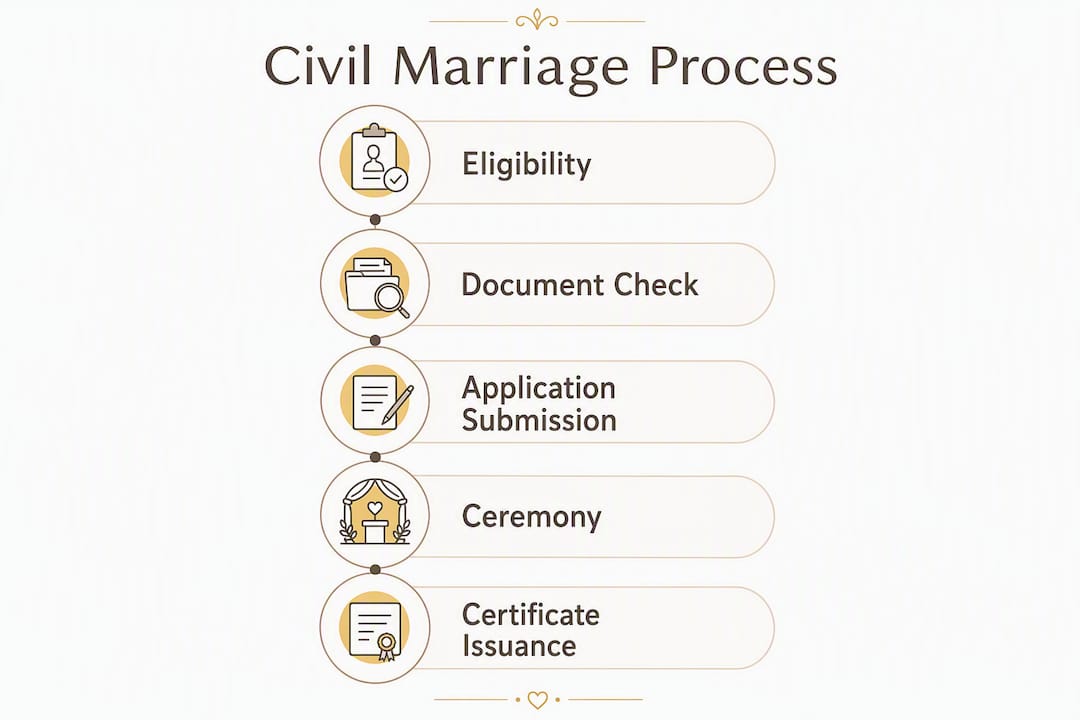
The process is more straightforward than most couples expect. Here is the sequence from application to certificate in hand.
Create or log in to your UAE Pass account. Residents use their Emirates ID-linked account; visitors can register with their passport.
Submit the application through the ADJD portal or a typing center. Upload scanned documents, pay the filing fee (AED 300 standard or AED 2,500 express), and select an available appointment date.
Receive approval and a court date. Standard service typically schedules an appointment within about five days of approval; express service confirms a date within one working day.
Attend the ceremony. Bring original passports. The presiding notary public officiates, verifies IDs, and acts as the official witness. No additional witnesses are required.
Sign the marriage contract. Both parties sign in the presence of the notary.
Receive the bilingual certificate. The court issues an Arabic-English marriage certificate at the end of the ceremony, usually the same day.
The ceremony itself runs about 15 minutes. ADJD offers pre-recorded vow audio tracks in several languages and on-site photography as a non-judicial add-on. Many couples use this as the legal moment and then build a fuller celebration around it with an external planner.
DIY vs. hiring a service: Self-submitting via UAE Pass is entirely doable if your documents are clean and your Arabic translation is certified. Where couples run into trouble is the attestation chain afterward. Harrisandcharms handles document preparation, ADJD submission, ceremony scheduling, MOFAIC attestation logistics, and event coordination, so you are not managing parallel bureaucratic queues while also planning a celebration. See the full civil marriage process guide for a detailed walkthrough.

What documents do you need? A complete checklist
Assemble these before you book an appointment. Missing even one item is the most common reason applications are delayed.
Core documents (both parties):
Passport copies (color scan, all pages)
Original passports (required at the ceremony)
Emirates ID copies (residents only)
UAE entry visa or entry stamp (visitors)
Marital history documents:
Divorce decree if previously married (must be attested)
Death certificate of former spouse if widowed (must be attested)
Single-status declaration or certificate of no impediment if originals are unavailable in your home country
Translation and legalization:
All non-Arabic documents need certified Arabic translation by a UAE-licensed translator.
Documents issued abroad typically require attestation from the issuing country’s foreign ministry and then from the UAE embassy in that country, before ADJD will accept them.
MOFAIC (UAE Ministry of Foreign Affairs and International Cooperation) attestation is required if the certificate will be used outside the UAE.
Document | Required? | Notes |
Passport (copy + original) | Yes, both parties | Original at ceremony |
Emirates ID | Residents only | Copy accepted for filing |
Divorce/death certificate | If applicable | Must be attested |
Single-status certificate | If no divorce/death cert | Country-specific format |
Certified Arabic translation | Yes, for foreign docs | UAE-licensed translator |
Entry visa/stamp | Visitors | Scan for filing |
Common rejection reasons: incorrect or uncertified translations, name mismatches between passport and supporting documents, and missing single-status proof. Order extra certified copies of your home-country documents before you travel.
How long does it take, and what does it cost?
Service | Processing Time | Official ADJD Fee |
Standard | ~10 working days; appointment ~5 days after approval | AED 300 |
Express | Date confirmed within 1 working day | AED 2,500 |
The express option is popular with tourists who want a specific symbolic date or have tight travel windows. It does not, however, speed up the attestation steps that follow.
Additional costs to budget for:
Certified Arabic translation: varies by document count and provider.
Prenup notarization (if used): approximately AED 950.
MOFAIC attestation: separate fee, paid at the ministry.
Embassy legalization for home-country use: fee varies by country.
Photography, styling, or event planning: depends on package.
Service provider fees (document prep, ADJD submission, attestation coordination): varies by package tier.
Couples who pay for express service often do so because the total cost of an extra hotel night or flight change exceeds the AED 2,200 premium. For a deeper look at express timelines, the express civil marriage guide covers the tradeoffs in detail.
How do you get your Abu Dhabi certificate recognized in the United States?
The UAE marriage certificate is legally issued and bilingual, but US state and federal agencies need additional authentication before they will accept it. Here is the sequence:
Obtain the bilingual certificate from ADJD at the ceremony. Order at least two certified copies on the spot.
Attest with MOFAIC. The UAE Ministry of Foreign Affairs and International Cooperation must authenticate the document before any foreign government will recognize it. Submit in person or through an authorized service.
US Embassy or Consulate authentication. The US Embassy in Abu Dhabi can further authenticate the MOFAIC-attested certificate if required by your home state. Check the embassy’s current requirements, as procedures can vary.
Certified English translation. If your certificate’s Arabic portion needs to accompany a US filing, a certified translation is required.
Register with your US county clerk. Most US states do not require registration of a foreign marriage, but some counties accept or record foreign marriage certificates for administrative purposes. Contact your county clerk’s office to confirm local practice.
Pro Tip: Order three or four certified copies at the ceremony. MOFAIC and the embassy each keep a copy, and you want at least one clean original for your own records. Going back to ADJD for additional copies costs time and another trip.
For the apostille or legalization steps once documents reach North America, same-day document legalization services can handle authentication paperwork without requiring you to queue in person.
Express ADJD service does not shorten MOFAIC or embassy timelines. Build at least two to three additional weeks into your planning for the full attestation chain.
Quick answers to common questions
How much does it cost? The official ADJD fee is AED 300 (standard) or AED 2,500 (express). Service provider fees, translation, and attestation are additional.
How long does it take? Standard service takes roughly 10 working days; express confirms your date within one working day. Attestation adds two to three weeks on top.
Can Muslims get a civil marriage in Abu Dhabi? Non-UAE-national Muslims can generally apply; UAE national Muslims cannot use the civil court and must use Sharia processes.
Do you need witnesses? No. The presiding notary public acts as the official witness.
Can tourists apply? Yes. Abu Dhabi accepts applications from non-residents and visitors, which is a key advantage over other emirates.
What if you need to amend or late-register your marriage?
If your marriage was not registered at the time of the ceremony, or if the certificate contains an error, ADJD handles amendment and late-registration requests through the Civil Family Court. The process typically requires submitting a formal application, the original or flawed certificate, supporting identity documents, and a written explanation of the discrepancy or delay.
Name corrections (common when passport spellings differ from other documents) and date corrections are the most frequent amendments. ADJD reviews each case individually, and processing times for amendments are generally similar to standard service timelines. If the error originated in a translated document, a corrected certified translation is required before ADJD will process the amendment.
Late registration, where a marriage took place but was never formally filed, follows a similar application path but may require additional evidence such as witness statements or supporting documentation from the relevant period. Contact ADJD directly or work with a document service to confirm the current requirements for your specific situation.
Key Takeaways
Civil marriage in Abu Dhabi is available to non-Muslim expats and visitors under Abu Dhabi Law No. 14 of 2021, with two service tiers and a clear document checklist that most international couples can meet.
Point | Details |
Eligibility is broad | Non-UAE-national Muslims and non-Muslims qualify; UAE national Muslims do not. |
Two official service tiers | Standard costs AED 300 (~10 working days); express costs AED 2,500 (date within 1 working day). |
Documents are the bottleneck | Certified Arabic translations and attested marital-status proof are the most common delay points. |
Attestation is a separate step | MOFAIC authentication and US Embassy legalization add two to three weeks after the ceremony. |
Harrisandcharms full service | Harrisandcharms manages ADJD filing, attestation, event add-ons, and Golden Visa marriage registration support end-to-end. |
What Abu Dhabi’s civil marriage system gets right that most couples overlook
Most articles about civil marriage in Abu Dhabi focus on the paperwork. That is understandable, but it misses the bigger picture. Abu Dhabi built a genuinely neutral legal framework, one that does not ask you to adopt a religion, produce a guardian, or submit to a medical exam. For interfaith couples especially, that neutrality is not a bureaucratic convenience. It is the whole point.
What surprises couples most is how short the ceremony actually is. Fifteen minutes. The court is efficient by design, not by accident. The volume of roughly 80 applications per day means ADJD has refined this process to a degree that most civil registries in the world have not. The bilingual certificate you walk out with is clean, internationally legible, and immediately ready for attestation.
Where people underestimate the process is the post-ceremony chain. MOFAIC attestation, embassy authentication, county clerk registration back home. None of that is difficult, but all of it takes time, and none of it is shortened by paying for express service at ADJD. Couples who plan only for the ceremony and not for what comes after end up scrambling. The smarter move is to treat attestation as part of the wedding timeline, not an afterthought.
How Harrisandcharms handles your civil marriage from start to finish
Harrisandcharms is the practical alternative to navigating ADJD, MOFAIC, and embassy queues on your own while also trying to plan a celebration worth remembering.

The service covers three package tiers. The Essentials package handles document verification, certified translation coordination, and ADJD submission. The Complete package adds MOFAIC attestation support, translated certified copies, and a photographer for the ceremony. The Premium package includes express booking, prenup notarization, embassy legalization coordination, and event add-ons including yacht wedding packages and Golden Visa marriage registration support.
Every package starts with a consultation to confirm eligibility and flag any document issues before you book a court date. From there, Harrisandcharms manages the timeline so you are not tracking three parallel processes at once.
To get started, visit the civil marriage packages page, fill out the inquiry form, and a consultant will confirm your eligibility and outline the right package within one business day.
Authoritative sources and next-step links
Abu Dhabi Judicial Department (ADJD) Civil Family Court: The official application portal for civil marriage filings, service type selection, and fee payment.
UAE Official Portal (u.ae): Government eligibility guidance for non-Muslim civil marriage, with links to the ADJD filing system.
Abu Dhabi Law No. 14 of 2021 (Civil Marriage and its Effects): The primary legal text governing civil marriage in Abu Dhabi, available as an English PDF through ADJD.
Federal Decree-Law No. 41 of 2022: The federal framework for non-Muslim personal status matters that reinforces Abu Dhabi’s civil marriage system.
Harrisandcharms civil marriage guide: The Abu Dhabi civil marriage guide covers recent legal developments and practical preparation steps for expats.
Harrisandcharms booking page: The civil wedding packages page for package details, pricing, and consultation requests.
Recommended
Comments