
Essential UAE Marriage Documents: Examples of Legal Marriage Documents Guide


TL;DR:
UAE marriage certificates must include full names, IDs, date, court number, signatures, seals, and bilingual format.
Getting married in the UAE sounds romantic until the paperwork starts. For expats and couples navigating civil or Islamic wedding requirements, the documentation process is detailed, strict, and surprisingly easy to get wrong. One missing stamp, a name spelled differently than your passport, or a translation that skips a required field can invalidate your certificate entirely. This guide walks you through what every legal UAE marriage document must contain, what civil and Islamic certificates actually look like, how they compare, and what steps protect your marriage from being rejected by embassies, employers, or courts both inside the UAE and abroad.
Table of Contents
Key Takeaways of Examples of Legal Marriage Documents
Point | Details |
Check mandatory fields | Every legal UAE marriage certificate must have names, IDs, seals, and signatures to be valid. |
Civil vs Islamic use | Choose the right document type—civil for expats and non-Muslims, Islamic for Sharia-compliant needs. |
Don’t skip attestation | Attestation and certified translation are essential for global recognition and legal use of your marriage documents. |
Request certified copies | Always obtain multiple certified copies to avoid future delays with embassies or employers. |
Key criteria for legal UAE marriage documents
Before you can understand what makes a civil or Islamic certificate valid, you need to know the baseline requirements that apply to all legal marriage documents in the UAE. These are non-negotiable, regardless of which court issues your certificate or which legal framework governs your marriage.
Every valid UAE marriage certificate must include the following fields:
Full legal names of both spouses exactly as they appear on official ID
Passport numbers or Emirates ID numbers for both parties
Date and location of the marriage
Official court registration number
Authorized signatures from the issuing official
Official court seal or stamp
Bilingual format (Arabic and English, depending on document type)
According to mandatory certificate fields, missing any of these elements can invalidate the entire document. That means a certificate without a registration number or an unsigned form is legally worthless, even if it looks official.
Important reminder: A document that looks complete is not the same as one that is legally complete. Always cross-check every field against your passport before leaving the court office.
Understanding UAE marriage documentation rules is especially critical for expats, since your home country’s embassy will scrutinize every detail. The UAE marriage documents checklist is a practical tool for making sure nothing slips through. The UAE government marriage requirements also outline what courts expect from non-Muslim couples specifically.
Now that we’ve set the stage for why legal details matter, let’s break down the main types of marriage documents you’ll encounter.
Civil marriage certificate: What it looks like and required details
A civil marriage certificate in the UAE is issued by a family or civil court, most commonly in Dubai or Abu Dhabi. It is the primary option for non-Muslim expats and couples who want a secular, legally recognized marriage under UAE or home country law.
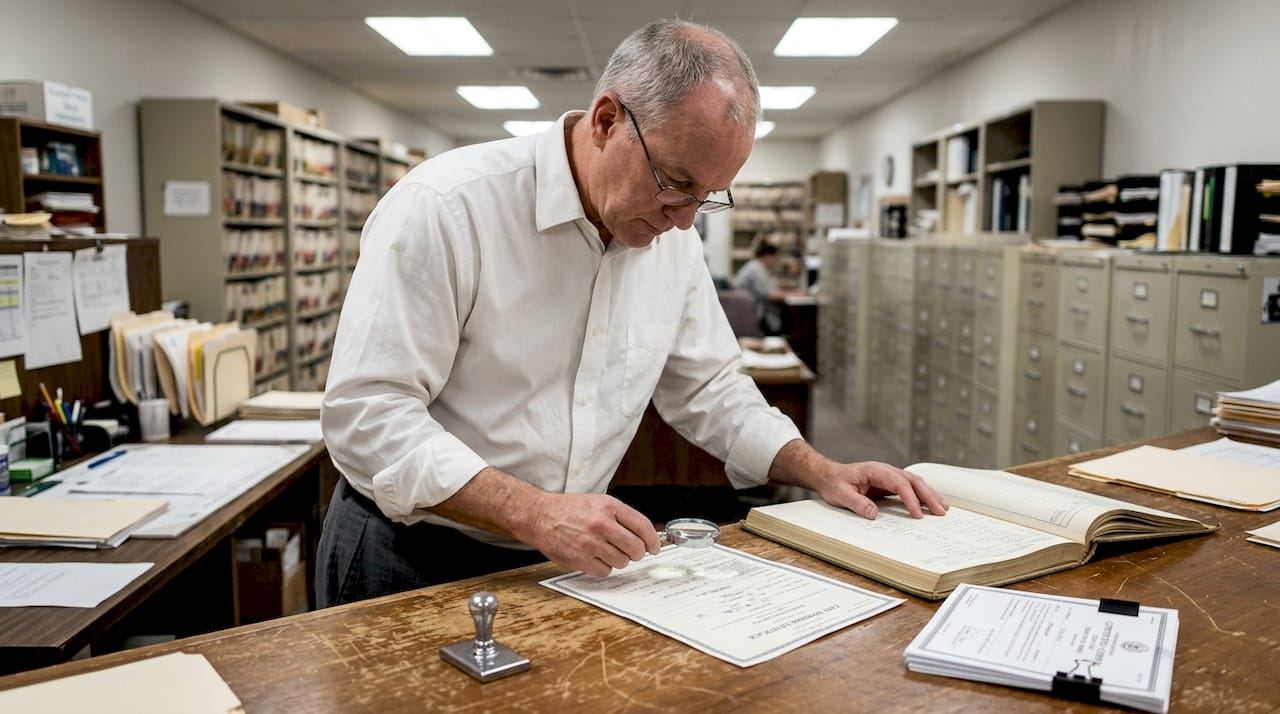
Under Federal Decree-Law No. 41/2022, non-Muslims can marry in the UAE without a religious ceremony, guardian, or witnesses. This was a landmark change that made civil marriage genuinely accessible to expats from almost any background.
Here is what a standard UAE civil marriage certificate contains:
Element | Details |
Language | Bilingual Arabic and English |
Names | Full legal names matching passport |
ID fields | Passport number or Emirates ID |
Date and location | Exact marriage date and court location |
Registration number | Unique court-issued reference |
Seals and signatures | Official court seal, judge or registrar signature |
Security features | Watermark, QR code for digital verification |
The QR code is especially useful. It lets embassies and employers verify the certificate’s authenticity instantly without contacting the court directly. Common features you will find on UAE civil marriage certificates also include watermarks and anti-forgery printing.
Certificates issued in Dubai often include a QR code linked to the Dubai Courts system
Abu Dhabi certificates follow a similar bilingual layout with ADJD court branding
Both include the judge’s or registrar’s signature alongside the court’s official stamp
Pro Tip: Always request at least three certified copies when you collect your civil certificate. Embassies, employers, and home country registries each typically require one original certified copy, and getting extras later takes time.
For a full walkthrough of the process, review the steps for a UAE civil marriage or explore what expat marriage in the UAE looks like from start to finish.
After explaining civil marriage certificates, it’s vital to recognize how Islamic documents differ, especially in legal and religious content.
Islamic (Sharia) marriage certificates: Structure and essentials
An Islamic marriage certificate in the UAE is issued by a Sharia court after the Nikah contract is registered. It is the required document for Muslim couples and carries distinct legal weight in matters governed by Islamic law, including inheritance, divorce, and child custody.
The structure of an Islamic certificate differs significantly from its civil counterpart. Here is what you will find:
Primary language is Arabic, with some courts providing an English translation
Nikah contract details including offer and acceptance
Mehr (mahr) clause specifying the agreed dowry amount
Names and signatures of two Muslim male witnesses
Qadi (Islamic judge) signature and court seal
Religious clauses affirming the marriage’s compliance with Sharia
Court registration number
Islamic marriage certificates from Sharia courts include the Mehr specifications and religious clauses that simply do not exist in civil documents. This is not just a formatting difference. These elements carry legal meaning in Sharia courts, affecting how disputes, divorces, and estates are handled.
Sample formats are sometimes circulated online, such as Nikah contract samples, but these are for reference only. The legally binding version must be obtained directly from the court after registration.
Pro Tip: When you collect your Islamic certificate, verify that both the Qadi’s signature and the court’s official seal are present. A certificate missing either one will not be accepted by other Sharia courts or government agencies.
For more detail, see the full guide on Islamic marriage steps and the breakdown of Muslim marriage rules in the UAE.
After understanding both certificate types, let’s compare their differences side-by-side and outline which is appropriate for varied situations.
Civil vs Islamic: Comparison and when each is needed
Choosing between a civil and Islamic marriage certificate is not just a matter of preference. It has real legal consequences for your future as a couple, especially when it comes to visas, inheritance, and divorce proceedings.
Criteria | Civil certificate | Islamic certificate |
Primary audience | Non-Muslims, expats | Muslim couples |
Language | Bilingual Arabic/English | Primarily Arabic |
Religious elements | None | Nikah contract, Mehr, religious clauses |
Witnesses required | Not required | Two Muslim male witnesses |
Legal recognition | UAE courts, international | Sharia courts, UAE and Muslim-majority countries |
Inheritance rules | UAE civil law | Sharia law |
Here is a simple guide for choosing the right type:
Non-Muslim expats: Civil certificate is the correct and only option
Muslim couples: Islamic certificate is required for Sharia compliance
Interfaith couples: Consult a legal advisor; specific rules apply depending on the nationalities and religions involved
Couples planning to relocate: Consider which type your destination country recognizes
The role of courts in UAE marriage matters here too. Civil courts and Sharia courts operate separately, and each only issues its own type of certificate.
Expert warning: Choosing the wrong certificate type can block future visa sponsorship or inheritance claims. A non-Muslim couple using an Islamic certificate, or a Muslim couple without a Sharia-registered contract, may face serious legal complications later.
As noted in the UAE marriage certificate examples guide, civil certificates suit expatriates seeking secular recognition, while Islamic certificates are essential for Sharia compliance affecting inheritance and divorce. Always base your choice on your future legal needs, not just your current situation.
Securing the correct marriage document is only the first step. Let’s cover how to ensure it’s legally recognized abroad.
Making your UAE marriage document valid everywhere: Verification and attestation
Having a valid UAE marriage certificate is not enough if you plan to use it outside the country. Attestation is the process that makes your document legally recognized internationally, and skipping or rushing it is one of the most common and costly mistakes expats make.
Here is the step-by-step process:
Obtain certified copies from the issuing court immediately after registration
Get a certified Arabic translation if your certificate is bilingual and your destination country requires a single-language version
Submit to UAE Ministry of Foreign Affairs (MOFA) for official attestation stamp
Authenticate at your home country’s embassy in the UAE
Get final legalization from your destination country’s authorities if required
A staggering 75% of expat errors come from improper attestation or translation. Getting multiple certified copies and using QR verification where available significantly reduces the risk of rejection. Dubai attestation is generally the fastest in the UAE, with civil certificate issuance taking 7 to 10 business days in Dubai before attestation even begins.
For attesting your marriage certificate, timing matters. Build in at least two to three weeks beyond the issuance date before any embassy appointments or visa applications. Also, review marriage certificate translation requirements early, since certified translators can have backlogs.
All foreign documents for UAE marriage must be translated into Arabic and attested by UAE MOFA before they are accepted by any UAE court. This applies both to documents you bring in and to documents you take out.
Pro Tip: Use your certificate’s QR code to verify its authenticity before submitting it anywhere. If the QR code fails to load or returns an error, contact the issuing court immediately. Do not assume the document is valid.
Now that you’ve seen the full legal pathway, here is an expert perspective on why accuracy at every step matters more than speed.
Our expert take: The real risks of missing one document detail
We have seen it happen more times than we can count. A couple completes their wedding, collects their certificate, and moves on with their lives, only to discover months later that a single field was entered incorrectly. One family we worked with had a residency renewal denied because the wife’s name on the marriage certificate did not exactly match her passport. One letter was different. That was enough.
Most problems do not come from major errors. They come from overlooked details: a middle name dropped, a seal that did not transfer clearly in photocopying, or a certified copy that was never actually certified. These are not dramatic mistakes. They are quiet ones that surface at the worst possible moments, like during a visa application or a property transfer.
Our contrarian advice: do not prioritize speed over accuracy. A fast-tracked certificate that has not been properly verified is a liability, not an asset. Demand that every field is checked against your passport before you leave the court. Ask for the QR code to be tested in front of you.
Getting married in the UAE is a legal process as much as a personal one. The couples who start preparing for UAE marriage with rigor and patience are the ones whose documents hold up years later, when the stakes are much higher than a wedding day.
Get trusted help with UAE marriage documents
Navigating UAE marriage paperwork on your own is possible, but the margin for error is narrow and the consequences of mistakes are significant. Professional support ensures every field is correct, every seal is in place, and every document meets the requirements of both UAE courts and international authorities.
At Harris & Charms, we handle civil and Islamic marriage documentation for couples and expats across the UAE. From initial paperwork to attestation, our team checks every detail so you do not have to. Explore our civil marriage packages in Dubai or browse the full range of UAE marriage services to find the support that fits your situation. Reach out today and let us make sure your marriage is legally protected from day one.
Frequently asked questions
What fields must appear on a UAE legal marriage certificate?
Full names, passport or Emirates ID numbers, marriage date, court registration number, official seal, and authorized signatures are all mandatory. As confirmed in the UAE marriage certificate guide, missing any single field can invalidate the entire document.
Are both civil and Islamic marriage certificates valid for visas and legal processes?
Yes, but the right choice depends on your situation. Civil certificates suit non-Muslims and secular legal matters, while Islamic certificates are required for Sharia-governed issues like inheritance or divorce, as outlined in the certificate examples guide.
Do I need to translate and attest my foreign documents for a UAE marriage?
Yes. All non-Arabic foreign documents must be translated by a certified translator and attested by the UAE Ministry of Foreign Affairs, as required under marriage documentation rules for expats.
How long does it take to get a UAE marriage certificate?
In Dubai, civil certificate issuance typically takes 7 to 10 business days, though timelines vary by emirate. Attestation for international use adds additional time beyond the issuance period.
Recommended
Comments