
Marriage Documentation Explained: UAE Rules in 2026


Choosing to marry in the United Arab Emirates can mean facing a maze of legal paperwork and cultural requirements that may feel unfamiliar to many expats. With marriage documentation explained in clear, practical terms, couples planning a civil or Islamic wedding can better understand the process and avoid unnecessary delays. This guide clarifies the differences, highlights what official registration looks like, and explains the key documents needed for a seamless journey toward certified marital status.
Table of Contents
Key Takeaways of Marriage Documentation Explained
Point | Details |
Marriage Documentation is Mandatory | Official registration through authorized government channels is essential for legal recognition in the UAE. |
Different Paths for Muslims and Non-Muslims | Islamic marriages follow Sharia law while civil marriages offer non-religious options for non-Muslim residents. |
Essential Documents Required | Couples must gather and authenticate key documents, including passports and residency permits, to proceed with marriage registration. |
Navigating Bureaucracy is Crucial | Understanding specific emirate requirements and avoiding common pitfalls can streamline the marriage documentation process. |
What Marriage Documentation Means in the UAE
Marriage documentation in the United Arab Emirates represents the comprehensive legal framework establishing the formal recognition of marital unions across different religious and cultural contexts. Unlike many global systems, the UAE offers nuanced approaches tailored to residents’ diverse backgrounds, ensuring legal validity through precise administrative processes.
The core of marriage documentation involves several critical elements that transform a personal commitment into a legally binding contract:
Official Registration: Mandatory process through authorized government channels
Identity Verification: Comprehensive checks of both parties’ legal status
Contract Validation: Formal documentation establishing marital rights and responsibilities
Legal Recognition: Ensuring the marriage meets UAE’s strict regulatory standards
For non-Muslim residents, the UAE provides a unique civil marriage option governed by Federal Decree-Law No. 41 of 2022. This framework allows couples to potentially adhere to laws from their home country or choose alternative personal status regulations. The legal marriage documentation process requires extensive paperwork demonstrating mutual consent, legal age, and compliance with national regulations.
Muslim and non-Muslim residents experience slightly different documentation pathways. Muslim couples typically undergo official religious ceremonies, while non-Muslim couples coordinate with notarial judges to register their marriage contracts. Regardless of religious background, the outcome remains consistent: an electronically issued marriage contract recognized as a legitimate legal document.
Pro tip: Begin gathering required documentation early, as processing times can vary significantly depending on your specific residency status and nationality.
Types of Marriage: Civil and Islamic Paths
The United Arab Emirates offers two distinct marriage pathways that reflect its commitment to legal flexibility and cultural diversity: Islamic marriages and civil marriages. These two approaches accommodate the complex social landscape of the UAE, providing legally recognized options for residents with different religious and cultural backgrounds.
Islamic marriages, deeply rooted in Sharia law, follow traditional religious protocols and are primarily designed for Muslim couples:
Conducted according to Islamic religious principles
Regulated by specific Sharia law guidelines
Permit Muslim men to have up to four wives under strict conditions
Require specific religious ceremonial procedures
In contrast, civil marriages provide a secular legal framework for non-Muslim residents. Introduced through Federal Decree-Law No. 41 of 2024, these marriages offer a non-religious alternative that allows couples to establish marital contracts without traditional religious requirements.
Civil marriages represent a progressive approach, giving non-Muslim residents greater legal flexibility in establishing marital relationships within the UAE.
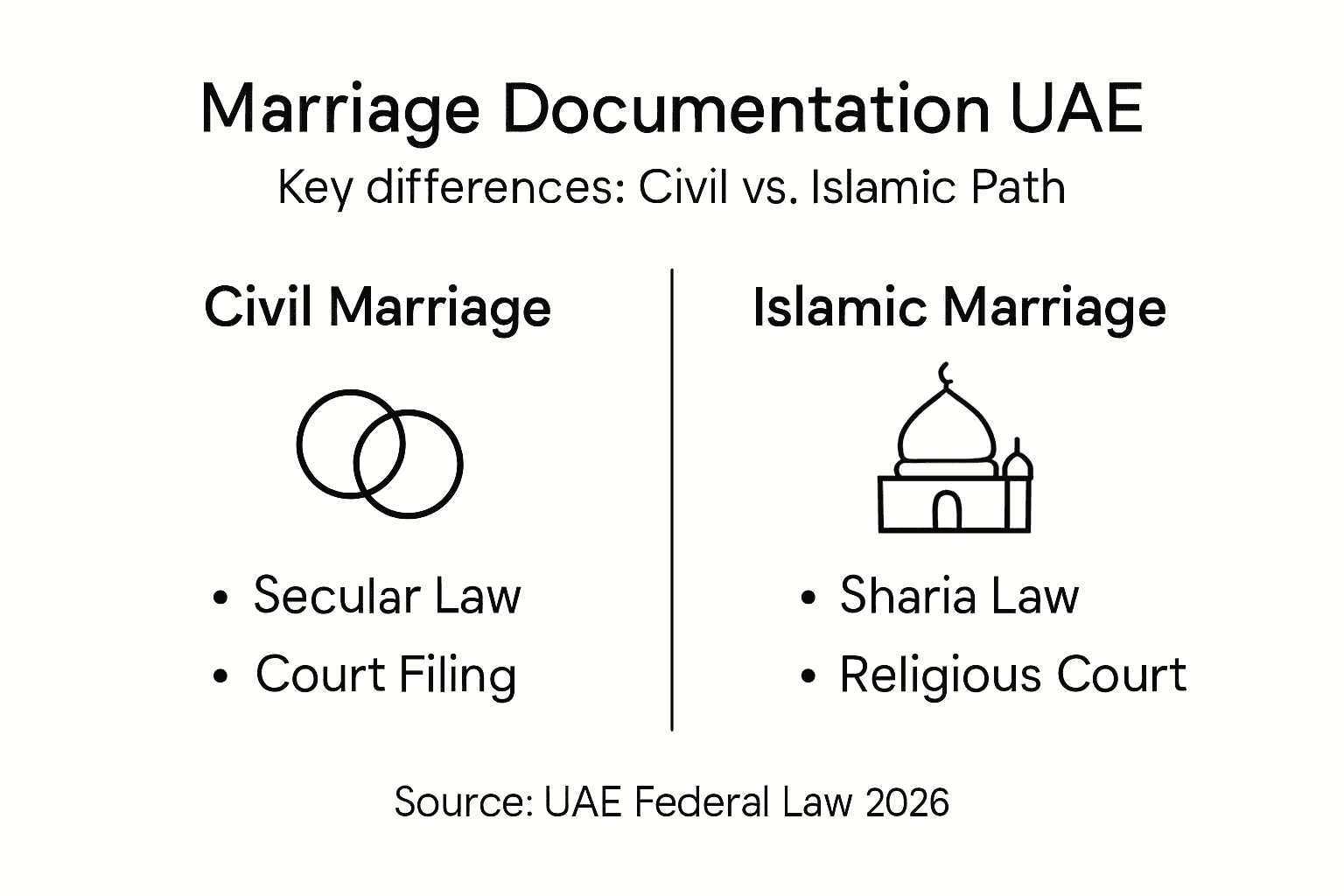
The key distinctions between Islamic and civil marriages extend beyond religious practices. Legal eligibility, documentation requirements, and marriage rights can vary significantly between these two pathways. Non-Muslim couples benefit from a more flexible legal structure that allows them to potentially apply laws from their home countries or choose alternative personal status regulations.
Here’s a quick comparison of key differences between civil and Islamic marriage pathways in the UAE:
Criteria | Civil Marriage | Islamic Marriage |
Governing Law | Federal Decree-Law No. 41 | Sharia law guidelines |
Religious Ceremony | Not required | Mandatory for Muslim couples |
Eligibility | Open to non-Muslims | Primarily for Muslims |
Flexibility | Home country laws can apply | Strict local regulations |
Number of spouses | One spouse only | Up to four wives under conditions |
Pro tip: Consult with legal professionals who specialize in UAE marriage laws to understand the specific requirements and implications of your chosen marriage path.
Essential Documents and Attestation Steps
Navigating marriage documentation in the United Arab Emirates requires careful preparation and understanding of the essential documents needed for legal recognition. The process involves collecting multiple papers that verify the identities, backgrounds, and eligibility of both partners for marriage under UAE regulations.
The core documents required for marriage documentation typically include:
Original passports for both partners
Valid residency permits
Birth certificates
Proof of marital status (divorce or death certificates if previously married)
Medical fitness certificates
Passport-sized photographs
No-objection certificates from respective embassies
Marriage certificate attestation represents a critical legal validation process that transforms your marriage documents into officially recognized instruments. This multi-step procedure involves authentication by various government entities to ensure the complete legal standing of your marriage documentation.
The attestation process serves as a crucial legal mechanism, transforming personal documents into officially recognized government instruments.
The attestation journey typically follows a structured path through different governmental departments. Couples must submit their documents to the Ministry of Foreign Affairs, potentially involving additional steps such as embassy verification and translation services. Each document undergoes rigorous scrutiny to confirm its authenticity, origin, and compliance with UAE legal standards.
Pro tip: Prepare multiple certified copies of all required documents and maintain a systematic folder to streamline the attestation process and prevent potential bureaucratic delays.
Legal Process and Requirements for Expats
Expats navigating marriage in the United Arab Emirates must understand the complex legal landscape that governs matrimonial processes. The UAE offers unique flexibility, allowing non-Muslim residents to choose between applying their home country’s personal status laws or adopting the local civil marriage framework established by recent federal legislation.
The core legal requirements for expat marriages include several critical components:
Minimum marriage age verification
Proof of legal eligibility to marry
Comprehensive medical fitness certificates
Identity document authentication
Consent documentation
Financial capability demonstrations
Embassy-issued no-objection certificates
Expat marriage checklists provide crucial guidance through the intricate legal maze of UAE marriage regulations. The process demands meticulous documentation and adherence to both federal and emirate-specific legal protocols that can vary significantly across different jurisdictions.
Foreign nationals must navigate a structured legal framework that prioritizes formal verification and protective legal mechanisms for all parties involved.
The legal journey involves multiple governmental touchpoints, including the Ministry of Justice, local courts, and potentially embassy representatives. Expats must be prepared for comprehensive background checks, consent verifications, and potential judicial reviews that ensure the marriage meets stringent legal standards established under the UAE’s evolving personal status laws.
Pro tip: Engage a local legal consultant specializing in expat marriages to help you interpret and navigate the complex documentation requirements with precision and confidence.
Common Pitfalls and How to Avoid Delays
Navigating marriage documentation in the UAE requires strategic planning and meticulous attention to detail. Bureaucratic complexities can quickly transform a straightforward process into a frustrating experience, making proactive preparation essential for couples seeking a smooth matrimonial journey.
The most frequent documentation challenges include:
Incomplete or improperly authenticated identity documents
Inconsistent information across different government records
Missing medical fitness certificates
Expired passport or residency permits
Lack of required embassy clearances
Misunderstandings about specific emirate-level requirements
Translation errors in international documents
Marriage documentation checklists provide crucial strategic guidance for avoiding procedural roadblocks. Understanding the nuanced requirements across different emirates can significantly reduce potential bureaucratic complications that might otherwise derail the marriage registration process.
Proactive documentation preparation is the single most effective strategy for preventing administrative delays in UAE marriage procedures.
Each emirate maintains unique procedural interpretations of federal marriage laws, creating potential variations in documentation requirements. Couples must remain adaptable and prepared to navigate these subtle legal distinctions, which can differ substantially between Dubai, Abu Dhabi, and other emirates.
Pro tip: Create a comprehensive digital and physical backup of all documents, ensuring each copy is certified and translated, to provide immediate resolution during any unexpected administrative challenges.
Costs, Recognition, and Post-Marriage Use
Marriage documentation in the United Arab Emirates represents a critical investment with far-reaching legal and administrative implications. Financial considerations extend beyond initial registration fees, encompassing a comprehensive framework of potential expenses and long-term benefits for couples navigating the UAE’s matrimonial landscape.
Typical costs associated with marriage documentation include:
Initial marriage contract registration fees
Document translation services
Embassy authentication charges
Medical fitness examination expenses
Potential expedited processing surcharges
Legal consultation fees
Certificate attestation costs
Marriage certificate documentation serves as a critical legal instrument enabling numerous post-marriage administrative processes. The official document becomes a gateway to essential services, allowing couples to access family visas, healthcare benefits, educational enrollments, and inheritance rights across all emirates.
The following table summarizes UAE marriage certificate uses and benefits for couples:
Purpose | Government Service Enabled | Legal Impact |
Family visa application | Visa processing for spouse | Proof of relationship status |
Healthcare access | Inclusion in medical benefits | Eligibility for insurance coverage |
Educational enrollment | Admission of dependents | Verification of family unit |
Inheritance rights | Official claim processing | Legal entitlement confirmation |
A properly executed marriage certificate transforms from a simple document into a powerful legal tool facilitating comprehensive social and administrative integration.
Recognition of marriage documentation transcends mere bureaucratic formality. Each emirate maintains sophisticated systems that validate and leverage marriage certificates for various governmental and personal purposes, ensuring couples can seamlessly establish their legal familial status throughout the United Arab Emirates.
Pro tip: Maintain multiple authenticated copies of your marriage certificate and store digital backups in secure cloud storage to ensure uninterrupted access during critical administrative processes.
Simplify Your UAE Marriage Documentation Journey with Trusted Support
Understanding the complex legal landscape around marriage documentation in the UAE can feel overwhelming especially when managing multiple documents like passports, medical certificates, and embassy no-objection clearances. The challenges of navigating different requirements for civil and Islamic marriages may cause delays or uncertainty. Harris & Charms is here to lighten your load by providing personalized assistance every step of the way—from managing essential paperwork and document attestation to coordinating your ceremony with cultural sensitivity and legal precision.
Whether you are an expat seeking clarity on Federal Decree-Law No. 41 rules or a couple aiming for smooth registration in any emirate, our experienced team understands the intricacies of the process. By choosing Harris & Charms, you gain access to trusted expertise that transforms complicated procedures into clear, stress-free actions.
Take the first step toward a hassle-free marriage experience now.

Discover how our comprehensive wedding and legal services can turn your documentation challenges into success stories. Visit Harris & Charms today and get personalized guidance tailored just for you. Explore our full range of support including civil and Islamic marriage assistance and legal attestations to secure your marriage rights in the UAE without delay.
Frequently Asked Questions
What is the process for marriage documentation in the UAE?
The marriage documentation process in the UAE involves official registration through government channels, identity verification, contract validation, and ensuring legal recognition according to UAE regulations. Couples must submit necessary documents, such as passports, residency permits, and medical fitness certificates.
What documents are required for marriage in the UAE?
Essential documents include original passports for both partners, valid residency permits, birth certificates, proof of marital status (like divorce or death certificates), medical fitness certificates, passport-sized photographs, and no-objection certificates from respective embassies.
How do civil and Islamic marriages differ in the UAE?
Civil marriages provide a secular framework for non-Muslim residents, while Islamic marriages follow Sharia law for Muslim couples. Key differences include the necessity of a religious ceremony for Islamic marriages and the ability for civil marriages to apply home country laws, offering more flexibility.
What common pitfalls should couples avoid during marriage documentation?
Common pitfalls include incomplete documents, inconsistent information across records, missing medical fitness certificates, and misunderstandings about specific emirate requirements. Couples should proactively gather all necessary documents and verify them for accuracy to avoid delays.
Recommended
Comments