
Legal Marriage Steps for Expats in the UAE: Complete Guide

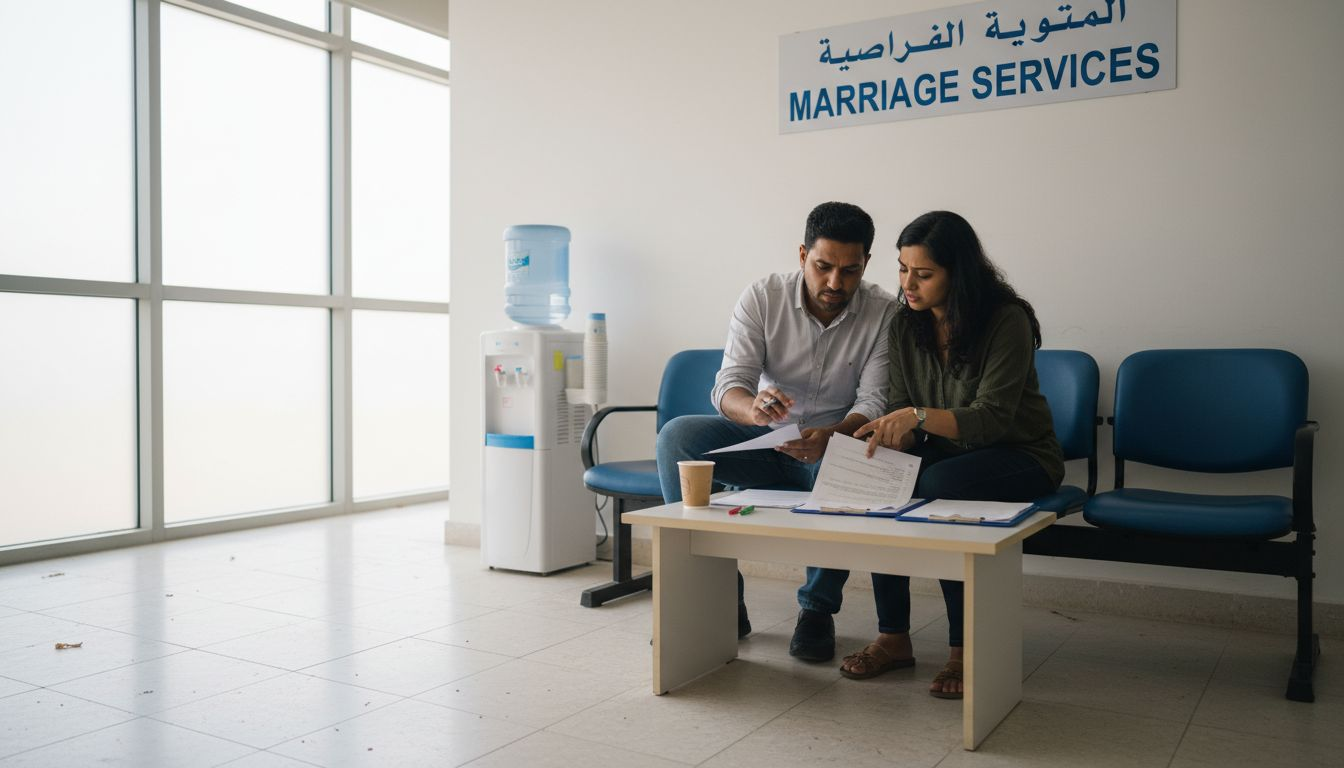
Sorting out paperwork can be the toughest part of planning a marriage in the UAE when you are an expat. Understanding the legal marriage steps for expats is essential, as the right documents are your gateway to a smooth application, whether your ceremony is held at Dubai Courts or an Islamic institution. This guide walks you through every step, from gathering your personal identity documents to securing official witnesses and verifying your marriage certificate for both UAE and international use.
Table of Contents
Quick Summary of Legal Marriage Steps for Expats
Main Point | Explanation |
1. Gather essential documents | Ensure you have a valid passport, birth certificate, and single status certificate for your application. |
2. Submit applications early | Submit your completed application 4-6 weeks before your planned wedding date to avoid delays. |
3. Witnesses are crucial | Arrange at least two official witnesses for civil marriages and a wali with two Muslim witnesses for Islamic marriages. |
4. Verify marriage registration | Confirm your marriage is officially recorded immediately after the ceremony for legal recognition. |
5. Attest your marriage certificate | For international validity, obtain Ministry of Foreign Affairs and embassy attestations of your marriage certificate. |
Step 1: Gather required documents and approvals
The foundation of your marriage application rests on having complete, accurate documentation. This step determines whether your application moves forward smoothly or gets delayed for missing paperwork. You’ll collect personal identity documents, civil status proof, health clearances, and residence approvals specific to your marriage type.
Start by gathering your personal identity documents. Your valid passport is non-negotiable—it must be current and valid for at least six months. Alongside your passport, you’ll need an original birth certificate or certified copy issued by your home country’s vital records office. These documents verify your legal identity and establish your eligibility to marry in the UAE.
Next, you’ll need proof of civil status. This is where many expats stumble. You must obtain a single status certificate from your home country, confirming you’re not currently married. This document varies by country—some call it a “Certificate of No Impediment” or “Declaration of No Impediment.” Contact your country’s embassy or consulate in the UAE for the exact process and any authentication requirements.
The documentation you’ll need depends on your marriage type:
Civil marriages: Single status certificate, birth certificate, valid passport, residence visa, medical fitness certificate
Islamic marriages: Similar documents plus any specific requirements from your chosen Islamic court or venue
Both types: Recent passport-sized photos (4x6 cm, usually 4-6 copies), residence visa or valid entry stamp
Medical clearance is required for both marriage types. You’ll undergo a health screening at an approved medical center in the UAE, confirming you’re free from communicable diseases. This certificate must be issued within a specific timeframe before your application—typically 30 days—so time this strategically.
Residence documentation matters too. If you’re on a valid visa, bring your residence card or passport pages showing your entry and residence status. Your visa must be current; expired residence permits complicate the process. Non-residents or those with short-term visas may face additional requirements, so check with the specific emirate’s marriage authority.
Complete documentation prevents rejections. Incomplete applications often mean costly delays and resubmission, which stretches your timeline unnecessarily.
Once you’ve compiled everything, verify each document against the checklist provided by your specific marriage authority—Dubai Courts, Abu Dhabi Judicial Department, or your emirate’s designated office. Different emirates have slight variations in requirements. When gathering documents from your home country, request certified English translations for any non-English documents. The UAE courts will only accept officially translated versions.
You’ll also need to confirm any additional approvals required. If you’re marrying someone from a specific nationality or your spouse is also an expat, certain countries may require additional attestations from their embassies. Check with both your embassy and your spouse’s embassy before submitting your main application. This prevents last-minute surprises that delay your wedding timeline.
Pro tip: Get ahead by requesting certified translations and embassy attestations simultaneously—these typically take 2-4 weeks in the UAE, so starting early prevents bottlenecks that could push your wedding date back.
To help clarify document requirements, here’s a comparison of civil and Islamic marriage essentials in the UAE:
Requirement | Civil Marriage | Islamic Marriage |
Personal ID Documents | Passport, birth certificate | Passport, birth certificate |
Single Status Certificate | Required | Required |
Residence Documentation | Residence visa, entry stamp | Residence visa, entry stamp |
Medical Fitness Certificate | Mandatory | Mandatory |
Witnesses | Court-appointed or personal | Muslim witnesses, bride’s guardian |
Additional Approvals | May need embassy attestation | May require court-specific documents |
Step 2: Submit applications and legal forms
With your documents ready, you’re now preparing to officially launch your marriage application through the proper channels. This step involves completing the required legal forms, submitting them to the correct government authority, and scheduling your marriage ceremony appointment. Getting this right prevents rejections and keeps your timeline on track.
Start by understanding which authority handles your application. In Dubai, you’ll submit to Dubai Courts or the Marriage Registration Center. Abu Dhabi uses the Abu Dhabi Judicial Department. Other emirates have their designated offices. The marriage application workflow varies slightly between emirates, so confirm the exact submission location for your specific emirate before proceeding.
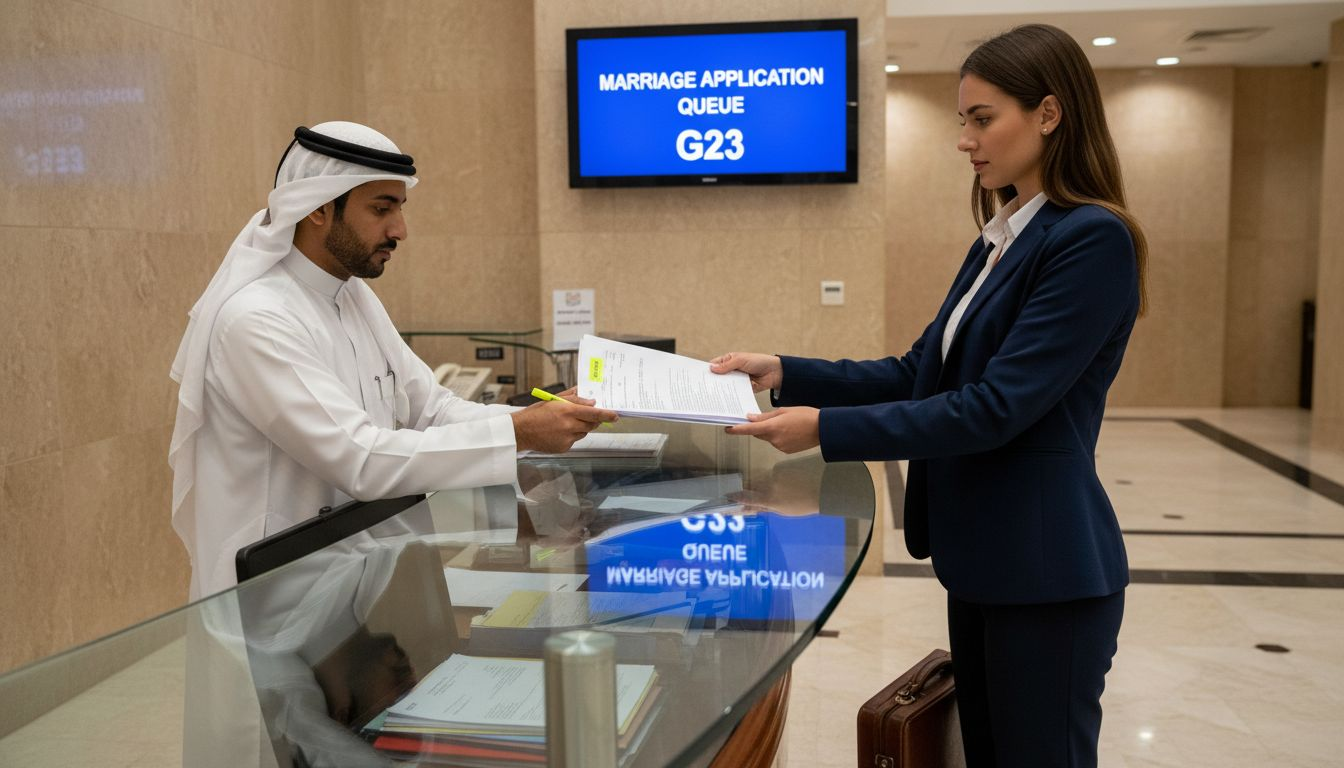
You’ll need to complete the official marriage application form for your marriage type. Civil marriages require different forms than Islamic marriages. These forms request your personal information, your spouse’s details, witness information (for Islamic marriages), and declaration of consent. Forms are available at the marriage registration center or downloadable from the emirate’s official website.
Here’s what the submission process typically involves:
Complete all required forms in English or Arabic (depending on the authority’s preference)
Attach all original documents and certified copies as specified
Pay the prescribed application fee (ranges from AED 200 to AED 500 depending on the emirate)
Submit your complete package at the marriage registration office
Receive your application reference number and appointment confirmation
Timing matters significantly. Submit your application at least 4 to 6 weeks before your intended wedding date. Processing times vary, but this buffer prevents last-minute rushes. Islamic marriages may require additional time for court review, while civil marriages sometimes move faster.
When you submit, bring original documents, photocopies for the file, and proof of payment. Some emirates require you to bring your spouse in person; others allow one party to submit on behalf of both. Verify this requirement before your submission appointment to avoid a wasted trip.
Timely submission with complete documentation is your strongest move. Missing forms or incomplete applications get sent back, costing you weeks.
After submission, you’ll receive an appointment confirmation for your marriage ceremony. This confirms the date, time, and location where your marriage will be officially solemnized. Mark this appointment in your calendar immediately—missing it forfeits your application and requires starting over.
Pay attention to any additional requirements the authority mentions. Some offices request updated medical certificates if processing takes longer than expected. Others may ask for updated single status certificates. Follow every instruction in your confirmation letter precisely.
Pro tip: Submit your application on a Tuesday or Wednesday morning—early in the week gives authorities time to flag any issues before the weekend, allowing you to address problems quickly rather than waiting until the following week.
Step 3: Arrange marriage ceremony and official witnesses
Your application approval opens the door to the actual marriage ceremony. This step requires coordinating the ceremony logistics, securing official witnesses, and understanding the specific requirements for your marriage type. Getting these details right ensures your marriage is legally recognized and officially registered immediately after the ceremony.
Understand what happens at your ceremony appointment. You’ll appear before a judge or authorized official at the designated venue, typically a court or religious institution. Your spouse must attend in person, along with the required witnesses and any additional parties specified by your marriage type. The official will guide the signing of your marriage contract, and witnesses will countersign to validate the union.
Witness requirements differ based on your marriage type. For civil marriages, you need at least two official witnesses who are present during the signing. These witnesses don’t need to be friends or family—the court can appoint official witnesses if you don’t bring your own. They must be of sound mind and able to understand the proceedings. For Islamic marriages, the requirements are stricter. You need a wali (bride’s guardian, typically the father or male relative) and two Muslim witnesses who meet specific religious and legal criteria.
Here’s what you need to coordinate before your ceremony:
Confirm the exact date, time, and location with the marriage authority
Brief your chosen witnesses about their role and legal responsibilities
Ensure witnesses bring valid identification documents
Arrange transportation and schedules so everyone arrives on time
For Islamic marriages, confirm your wali’s availability and legal documentation
Prepare any additional documentation required by your specific marriage authority
Bring all original documents to your ceremony, not just copies. The judge or official will verify them against what you submitted in your application. Bring your passport, birth certificate, and medical clearance certificate. Some authorities request your original single status certificate as well, so check your appointment confirmation letter.
The role of witnesses in UAE marriages ensures legal validity and protects both parties. Witnesses attest that the marriage contract was signed freely and without coercion, which is a legal protection under UAE law.
Your witnesses are more than formalities—they provide legal protection for both spouses by confirming the marriage was entered voluntarily.
On ceremony day, arrive 15 minutes early. The judge or official will review your documents one final time, guide you through the contract signing, and ensure all parties sign in the correct sequence. The entire process typically takes 20 to 45 minutes. Once complete, you’ll receive your official marriage certificate immediately, which legally confirms your union.
After receiving your certificate, don’t leave without verifying the details are correct. Check that both names, dates, and signatures are accurate. If something is wrong, address it immediately with the official rather than dealing with corrections later.
Pro tip: Ask for multiple certified copies of your marriage certificate on the same day—getting 3 to 4 originals now prevents future hassles when you need them for visa applications, banking, or other government services.
Step 4: Verify registration and receive marriage certificate
Your ceremony is complete, but the process doesn’t end there. This step involves confirming your marriage is officially recorded in the government system and obtaining your marriage certificate, the document that proves your legal union. You’ll also need to understand international attestation to ensure your certificate is recognized in your home country.
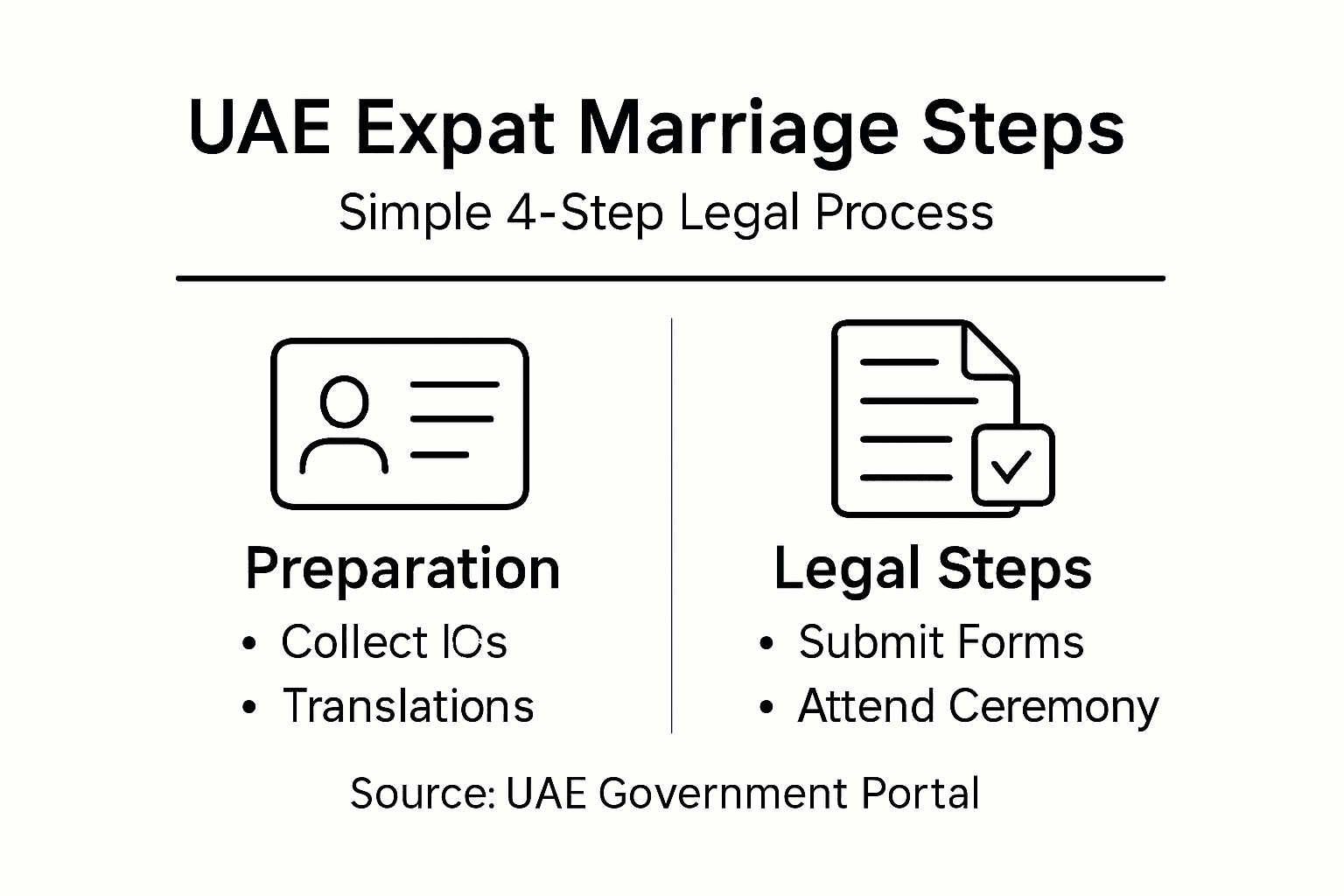
Immediately after your ceremony, ask the judge or official to confirm that your marriage registration is complete. In most cases, the authority will hand you your original marriage certificate on the same day. This certificate is an official government document signed by the judge or authorized official, stamped with the court seal, and listing both spouses’ names, marriage date, and registration number.
Verify the certificate details before leaving the office. Check that your name, your spouse’s name, date of birth, passport numbers, and marriage date are all correct and spelled accurately. Any errors now will require corrections later through an additional process, which costs time and money. If something is wrong, ask the official to correct it immediately while you’re there.
Understand what your certificate does and doesn’t cover initially. Within the UAE, your certificate is valid for all government purposes immediately. However, if you plan to use it abroad or in your home country, you’ll likely need additional attestation. This is where international recognition comes into play.
The attestation process typically follows this sequence:
Get your original marriage certificate from the marriage authority
Request Ministry of Foreign Affairs attestation at the UAE MFA office in your emirate
Submit the attested certificate to your country’s embassy or consulate for their attestation
Receive the fully attested certificate, which is now valid internationally
The process of obtaining your marriage certificate involves ensuring proper registration with your local marriage authority before pursuing international attestation.
Getting attestation early prevents delays when you need your certificate for visa sponsorship, banking, or legal matters in your home country.
Visit the UAE Ministry of Foreign Affairs office in your emirate with your original certificate. Bring identification and be prepared to pay a small attestation fee, typically between AED 50 and AED 100. The attestation process usually takes 2 to 5 business days. You’ll receive your certificate back with the MFA official seal and signature, confirming it’s genuine.
After MFA attestation, take your certificate to your country’s embassy or consulate in the UAE. They’ll verify the MFA attestation and add their own official stamp, making it valid in your home country. This step usually takes 3 to 10 business days. Some countries require specific forms or additional documentation, so contact your embassy before visiting.
Keep copies of your original and attested certificates in safe places. Store one in your home country with family, keep one with your important documents in the UAE, and maintain digital scans. You’ll need these for visa sponsorship, residency applications, and various legal and financial transactions.
Pro tip: Request additional certified copies of your original certificate from the marriage authority before starting attestation—getting 3 to 4 copies allows you to submit to your embassy and keep originals for your records without needing to request new copies later.
The following overview summarizes the marriage certificate attestation steps for local and international use:
Step | UAE Use | International Use |
Certificate Issuance | Marriage authority | Marriage authority |
Ministry of Foreign Affairs | Not required | Mandatory for recognition abroad |
Embassy Attestation | Not needed | Essential for home country |
Typical Processing Time | Same day | 2-10 business days |
Fees | AED 0-100 | Varies by embassy |
Simplify Your Legal Marriage Journey in the UAE with Expert Support
Navigating the detailed steps of legal marriage in the UAE can be overwhelming. From gathering personal identity documents and securing single status certificates to scheduling your ceremony and obtaining attested marriage certificates, each phase demands precision and timely action. Missing a single document or deadline could lead to costly delays and added stress. If you want to avoid endless paperwork, complex embassy attestations, and confusing ceremony requirements, expert assistance can make all the difference.

Experience peace of mind by partnering with Harris & Charms where we offer personalized help tailored to your marriage type—civil or Islamic. Our comprehensive services cover document collection and certification, marriage ceremony coordination including legal witness arrangements, and fast-track attestation services with embassy liaison so you can focus on your special day. Don’t let intricate UAE marriage regulations hold you back. Visit our main website, explore our full range of services, and take the first step toward your seamless wedding journey now.
Frequently Asked Questions
What documents do I need to collect before applying for marriage in the UAE as an expat?
To apply for marriage in the UAE, you will need personal identity documents like a valid passport, an original birth certificate, proof of civil status (a single status certificate), and medical fitness certificates. Gather these documents early to ensure your application is complete and avoid delays.
How can I ensure my marriage application is processed on time?
To ensure timely processing, submit your marriage application at least 4 to 6 weeks before your intended wedding date. Organize all required documents and forms beforehand to prevent any complications or rejections.
What should I do if my marriage certificate contains errors after the ceremony?
If there are errors on your marriage certificate after the ceremony, immediately bring them to the attention of the official officiating your marriage. Request corrections on the spot to avoid additional processing time and costs for later amendments.
How do I obtain international attestation for my marriage certificate?
To obtain international attestation for your marriage certificate, first get it stamped by the Ministry of Foreign Affairs in the UAE. Then, take the attested certificate to your country’s embassy or consulate for their additional validation.
What is the role of witnesses during the marriage ceremony, and how many do I need?
During the marriage ceremony, witnesses are required to validate the contract and ensure that the marriage is entered into willingly. You need at least two witnesses for civil marriages and specific requirements for Islamic marriages, including a wali (bride’s guardian) and two Muslim witnesses.
Can I submit my marriage application if I’m on a short-term visa in the UAE?
If you are on a short-term visa, you may face additional requirements to submit your marriage application. Confirm your residency status and check for any extra documentation needed as outlined by the marriage authority in your emirate.
Recommended
Comments