
Marital Status in the UAE Explained


Marital Status in the UAE Explained: Sorting through marriage requirements in the United Arab Emirates can feel overwhelming for expats who want clarity about their legal status. Understanding the difference between Islamic and civil marriage is crucial because rules vary based on your religion, nationality, and the type of ceremony you choose. With recent reforms like Federal Decree Law No. 41 of 2022, non-Muslim residents now have more options than ever before, but documentation and registration details remain a vital part of the process.
Table of Contents
Key Takeaways of Marital Status in the UAE Explained
Point | Details |
Understanding Marital Status | Marital status in the UAE is influenced by religious background, nationality, and personal circumstances, necessitating tailored legal pathways for different groups. |
Marriage Framework Options | The UAE recognizes Islamic, civil, and ceremonial marriages, offering flexibility to accommodate diverse religious and cultural needs. |
Registration Importance | Proper documentation and registration are essential for legal recognition of marriages and maintaining residency status in the UAE. |
Legal Rights and Obligations | Couples in the UAE should be aware of their legal rights and responsibilities, which differ significantly between Islamic and civil marriages. |
Defining Marital Status in the UAE
Navigating marital status in the United Arab Emirates requires understanding a complex legal landscape that balances traditional Islamic principles with modern civil frameworks. Marital status in the UAE is not a one-size-fits-all concept, but rather a nuanced legal definition that varies significantly depending on an individual’s religious background, nationality, and personal circumstances.
For expatriates, the UAE offers multiple pathways to establish legal marital status, reflecting the country’s diverse population and progressive legal approach. The legal implications of marriage are particularly important for non-Muslim residents who can now choose between different legal systems. Recent legislative changes, specifically Federal Decree Law No. 41 of 2022, have dramatically expanded these options by allowing non-Muslims to select either their home country’s legal framework or the UAE’s civil personal status law.
Key components that define marital status in the UAE include:
Age requirements: Minimum marriage age is strictly enforced
Consent: Both parties must provide voluntary, informed agreement
Legal documentation: Marriage certificates from recognized authorities
Religious or civil registration: Options for Islamic and non-Islamic marriages
Nationality considerations: Different rules apply based on citizenship
The UAE recognizes marriages through multiple mechanisms, accommodating the complex cultural and legal needs of its multinational population. For Muslim couples, marriages are traditionally solemnized through Islamic Sharia law, which involves specific religious procedures and documentation. Non-Muslim expatriates, however, can now choose civil marriage frameworks that align more closely with their cultural and legal backgrounds.
Here is a summary of how marital status frameworks differ across various groups in the UAE:
Group | Legal Pathways Available | Registration Authority | Unique Consideration |
Muslim UAE national | Sharia-based marriage | Islamic courts | Must follow religious process |
Non-Muslim expatriate | Civil and home country laws | Civil courts or embassy | Can select legal system |
Mixed-nationality couple | Sharia or civil option | Both Islamic and civil courts | Depends on chosen framework |
UAE-born expat | Variable (depends on religion) | Civil or Islamic courts | Status often tied to residency |
Pro tip: Always consult official UAE authorities or legal professionals to understand the specific marital status requirements applicable to your unique personal situation.
Types of Marriage Recognized by UAE Law
The United Arab Emirates offers a sophisticated and inclusive legal framework for marriage that reflects its multicultural population and progressive approach to personal status laws. Marriage types in the UAE are not uniform but carefully designed to accommodate diverse religious, cultural, and legal backgrounds of residents and citizens.
Under recent legal reforms, the UAE recognizes three primary marriage frameworks: Islamic marriages, civil marriages, and ceremonial marriages. Marriage under UAE law demonstrates remarkable flexibility in addressing the complex needs of its multinational population. These frameworks ensure that couples from different backgrounds can legally formalize their unions while respecting individual cultural and religious preferences.
Key characteristics of marriage types in the UAE include:
Islamic Marriages:
Governed by Sharia law
Follows traditional Muslim personal status regulations
Requires specific religious procedures
Civil Marriages:
Available for non-Muslims
Secular legal framework
Introduced by Federal Decree Law No. 41 of 2022
Ceremonial Marriages:
Conducted according to non-Muslim religious traditions
Legal recognition depends on specific nationality and religious criteria
Each marriage type carries distinct legal implications and documentation requirements. Islamic marriages are deeply rooted in religious traditions and personal status laws, while civil marriages provide a more secular approach for non-Muslim residents. The ceremonial marriage option further demonstrates the UAE’s commitment to supporting its diverse population’s cultural and legal marriage preferences.
The following table clarifies procedural differences between marriage types in the UAE:
Type of Marriage | Required Documentation | Governing Law | Certificate Issued By |
Islamic | Marriage contract, religious documents | Sharia law | Islamic court |
Civil | Passport, marital status proof, birth certificate | Federal civil law | Civil marriage authority |
Ceremonial | Religious documents from home country | Home country law (if applicable) | Embassy or church/temple |
Pro tip: Consult with official UAE marriage authorities or a legal professional to understand the specific requirements and implications of each marriage type for your unique personal circumstances.
Civil vs. Islamic Marriage: Key Differences
Navigating marriage in the United Arab Emirates requires understanding the nuanced legal distinctions between civil and Islamic marriage frameworks. While both provide legal recognition of marital unions, they fundamentally differ in their underlying principles, legal requirements, and cultural contexts.

Islamic marriage vs civil marriage reveals a complex landscape of legal options tailored to the UAE’s diverse population. The primary distinctions emerge from their distinct philosophical foundations: Islamic marriages are deeply rooted in religious traditions, while civil marriages offer a secular, legally neutral approach for non-Muslim residents and citizens.
Key comparative elements between civil and Islamic marriages include:
Legal Framework:
Islamic Marriage: Governed by Sharia law
Civil Marriage: Secular legal code
Religious Involvement:
Islamic Marriage: Requires religious ceremonial procedures
Civil Marriage: No religious rituals required
Spousal Rights:
Islamic Marriage: Follows religious personal status regulations
Civil Marriage: Secular legal protections
Marriage Eligibility:
Islamic Marriage: Specific religious and cultural criteria
Civil Marriage: Based on legal capacity and mutual consent
The Islamic marriage framework incorporates specific religious requirements, such as guardian approval for the bride and provisions allowing polygamy under certain conditions. Civil marriages, by contrast, focus on mutual consent, legal capacity, and equal rights for both partners, without religious constraints.
Civil and Islamic marriages in the UAE demonstrate the country’s commitment to providing flexible legal pathways that respect diverse cultural and religious backgrounds.
Pro tip: Before choosing a marriage framework, carefully consult legal professionals who specialize in UAE personal status laws to understand the full implications for your specific situation.
Legal Rights and Obligations for Spouses
Marriage in the United Arab Emirates establishes a complex web of legal rights and obligations that extend far beyond the ceremonial celebration. Spouses enter into a legally binding contract that defines their mutual responsibilities, financial arrangements, and personal protections under UAE law.
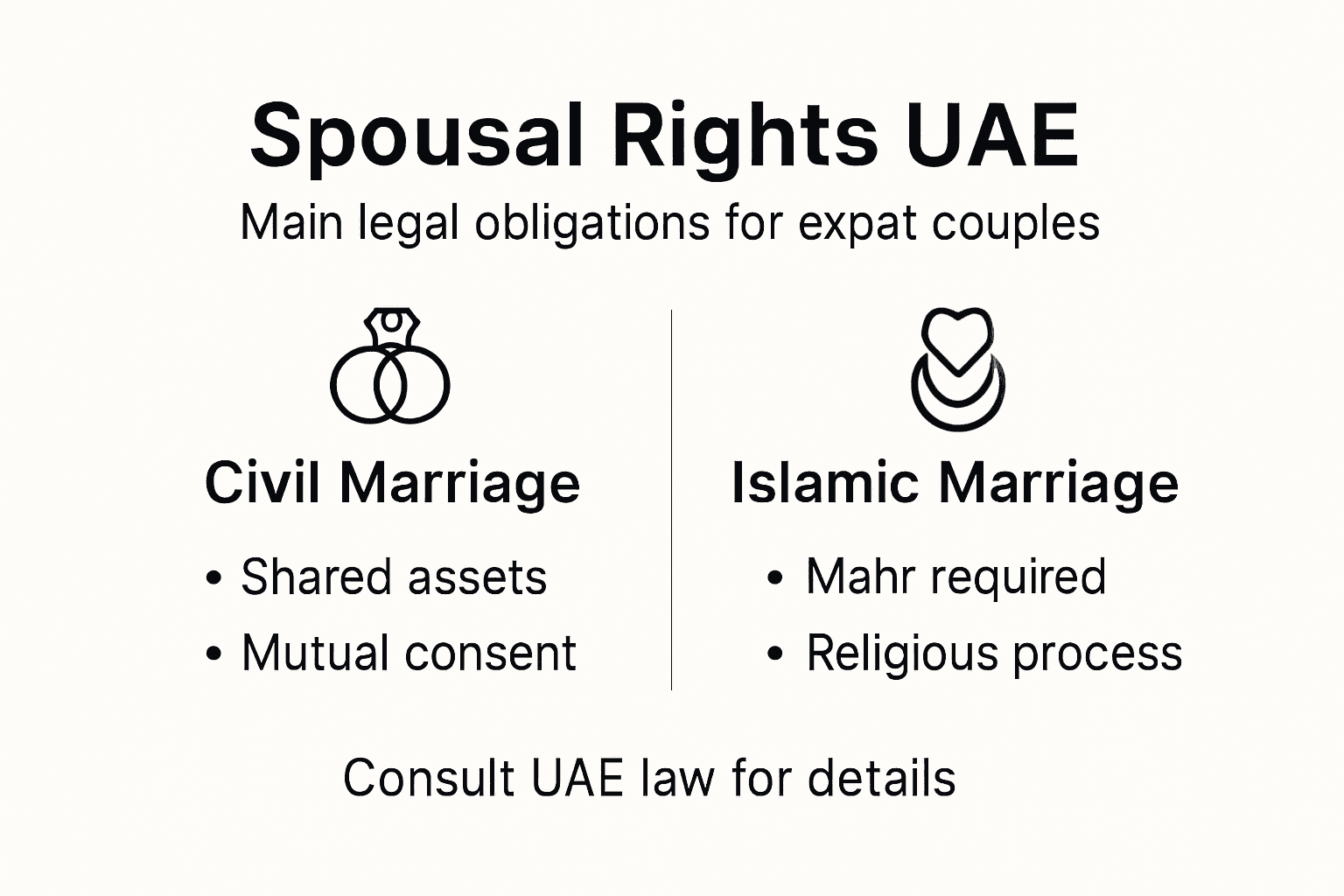
Legal benefits of marriage in the UAE are intricately designed to balance individual rights with collective family welfare. The legal framework varies significantly between Islamic and civil marriages, with each system providing distinct protections and expectations for married couples.
Key legal rights and obligations for spouses include:
Financial Responsibilities:
Mutual financial support
Shared economic obligations
Maintenance and living expenses
Personal Rights:
Mutual respect
Protection from domestic harm
Equal legal standing
Child-Related Obligations:
Shared custody responsibilities
Financial support for children
Education and welfare provisions
Property and Inheritance:
Asset management rights
Inheritance entitlements
Property ownership regulations
The legal landscape for spouses in the UAE is particularly nuanced, with different rules applying to Islamic and civil marriages. Islamic marriages follow Sharia law principles, while civil marriages provide secular legal protections that ensure equal rights for both partners.
Spouses in the UAE have comprehensive legal protections that safeguard their individual rights while maintaining the integrity of the marital relationship.
Pro tip: Consult a legal professional specializing in UAE personal status laws to fully understand the specific rights and obligations that apply to your unique marital situation.
Registration, Proof, and Marital Status Attestation
Navigating marital status documentation in the United Arab Emirates requires understanding a comprehensive process of registration, verification, and official attestation. Expats must meticulously follow specific procedures to ensure their marriage is legally recognized both within the UAE and internationally.
Why register marriage in UAE reveals the critical importance of formal documentation in establishing legal marital status. The UAE’s robust system ensures that marriages are not just ceremonial events, but legally binding contracts with significant administrative implications.
Key steps in marriage registration and attestation include:
Initial Registration:
Submit marriage contract
Provide required personal documents
Obtain initial marriage certificate
Document Verification:
Translation of foreign documents
Notarization by authorized entities
Verification of document authenticity
Ministry of Foreign Affairs Attestation:
Final official stamp
International legal recognition
Certification for cross-border use
Additional Requirements:
Passport copies
Residency permits
Proof of marital status
The UAE’s marriage registration process is designed to provide comprehensive legal protection for both UAE nationals and expatriates. Different procedures apply for Islamic and civil marriages, with each requiring specific documentation and follow-up steps.
Marriage registration is not just a bureaucratic requirement, but a crucial step in establishing legal rights and protections for couples in the UAE.
Pro tip: Always retain multiple certified copies of your marriage certificate and ensure all translations are done by authorized translators to prevent potential legal complications.
Common Mistakes and Residency Implications
Navigating marriage and residency in the United Arab Emirates requires careful attention to legal nuances that can significantly impact an expatriate’s status. Seemingly minor documentation errors or procedural missteps can create complex legal challenges that may jeopardize an individual’s ability to live and work in the country.
Marital contract requirements highlight the critical importance of understanding the intricate legal landscape surrounding marriage and residency. Expatriates must be particularly vigilant about meeting all legal requirements to maintain their residency status and avoid potential administrative complications.
Common mistakes that can negatively impact marital status and residency include:
Documentation Errors:
Incomplete marriage registration
Incorrect document translations
Missing required official stamps
Legal Compliance Issues:
Failing to register marriage within specified timeframes
Neglecting to update residency documents
Misunderstanding visa dependency rules
Procedural Oversights:
Not obtaining proper marriage attestations
Incomplete background documentation
Failing to meet specific nationality requirements
Residency Impact Risks:
Potential visa cancellation
Restrictions on work permits
Challenges with family sponsorship
The UAE’s legal system is particularly strict about marriage documentation and its relationship to residency status. Expatriates must navigate a complex web of requirements that vary based on nationality, marriage type, and individual circumstances.
Proactive legal compliance is the key to maintaining stable residency and avoiding potentially costly administrative complications.
Pro tip: Maintain a comprehensive file of all marriage and residency documents, and consult with a legal professional who specializes in UAE personal status laws to ensure full compliance.
Simplify Your Marital Status Journey in the UAE with Expert Support
Understanding the complexities of marital status, whether navigating Islamic or civil marriage frameworks, can quickly become overwhelming for expats in UAE. From ensuring proper registration and attestation to managing residency implications, the many legal requirements often pose major challenges. Whether you face strict documentation rules, need to select the right marriage type, or want to secure seamless legal rights and obligations, guidance is essential to avoid costly mistakes.
Harris & Charms specializes in helping couples overcome these hurdles by providing personalized, comprehensive assistance tailored to your unique situation. With expert knowledge of marriage laws, documentation processes, and event planning, we transform stressful legal procedures into a smooth and joyful experience. Learn more about how we support both Islamic and civil marriages on our main website. Discover detailed services for civil and Islamic weddings designed to meet all legal, cultural, and celebratory needs.
Take control of your marital status with confidence now.

Start your journey the right way by reaching out to Harris & Charms today. Let us handle your legal documentation, venue management, and the full wedding experience so you can focus on celebrating your new life together. Visit Harris & Charms and connect with professionals who care about making your UAE marriage dream hassle-free and legally secure.
Frequently Asked Questions
What is the legal definition of marital status in the UAE?
Marital status in the UAE refers to the legal recognition of an individual’s relationship, which varies based on religious background, nationality, and personal circumstances. Expats have multiple pathways to establish their marital status under UAE law.
What types of marriages are recognized in the UAE?
The UAE recognizes three primary types of marriages: Islamic marriages governed by Sharia law, civil marriages for non-Muslims, and ceremonial marriages according to non-Muslim religious traditions.
What are the key differences between civil and Islamic marriages in the UAE?
Islamic marriages are governed by Sharia law and require religious procedures, while civil marriages offer a secular framework with no religious rituals needed. Spousal rights and eligibility criteria also differ between the two.
What steps should be taken to register a marriage in the UAE?
To register a marriage in the UAE, couples need to submit their marriage contract and required documents, verify their documents for authenticity, and obtain official attestation from the Ministry of Foreign Affairs to ensure the marriage is legally recognized both locally and internationally.
Recommended
Comments