
Marriage Consent UAE: Legal Rules and Real Impact


More than half of American and European couples in the UAE face unexpected legal hurdles when securing marriage consent for civil or Islamic weddings. These requirements impact everything from personal autonomy to documentation, making clear guidance essential for expats and foreign nationals. Whether you are planning a multicultural celebration or a traditional ceremony, understanding how UAE laws define marriage consent can save you time, stress, and costly mistakes.
Table of Contents
Key Takeaways
Point | Details |
Marriage Consent Is Essential | In the UAE, valid marriage consent is a fundamental legal requirement that protects individual rights and fosters mutual understanding between spouses. |
Types of Marriage Consent | Civil and Islamic marriages have distinct consent frameworks, with civil marriages prioritizing individual autonomy and Islamic marriages including guardian involvement and religious ceremonies. |
Documentation and Legal Age | The legal marriage age is 18, and extensive documentation is required, including identification and medical fitness certificates. |
Risks of Invalid Consent | Coercion, incomplete documentation, and failure to meet legal requirements can lead to invalid consent, potentially nullifying the marriage contract. |
Defining Marriage Consent in the UAE
Marriage consent in the United Arab Emirates represents a critical legal framework designed to protect individual rights and ensure authentic marital commitments. Under UAE law, consent is not merely a formality but a profound legal requirement that safeguards personal autonomy and mutual understanding between potential spouses.
The legal landscape of marriage consent is primarily governed by the Federal Personal Status Law, which establishes clear parameters for what constitutes valid marital agreement. Key elements of this consent include:
Full voluntary agreement without external coercion
Mental capacity and sound understanding of marital obligations
Clear documentation of consent during marriage contract proceedings
Absence of religious or legal impediments to marriage
Specifically, the UAE legal system requires that both parties demonstrate unequivocal willingness to enter marriage. This means individuals must be mentally competent, of legal marriageable age, and providing consent without pressure from family, social structures, or external influences. Legal implications of marriage in the UAE provide additional context about these nuanced requirements.
Within Islamic legal traditions prevalent in the UAE, marriage consent transcends simple verbal agreement. It represents a comprehensive understanding of mutual rights, responsibilities, and shared life commitments. Guardians may play a role in traditional marriages, but the fundamental principle remains the autonomous decision of both individuals entering the marital contract.
Pro tip: Before finalizing any marriage arrangements, carefully document your consent and ensure you fully understand all legal implications of your marriage contract in the UAE.
Types of Marriage Consent: Civil vs. Islamic
In the United Arab Emirates, marriage consent is not a one-size-fits-all legal process, but rather a nuanced framework that varies significantly between civil and Islamic marriage arrangements. These two distinct pathways reflect the country’s commitment to accommodating diverse cultural and religious backgrounds while maintaining robust legal protections.
The civil marriage pathway, primarily designed for non-Muslims, offers a more flexible legal approach to marital consent. Civil marriage in Dubai presents a secular legal contract that does not require guardian approval or religious ceremony. Key characteristics include:
Direct consent between partners
Minimal religious intervention
Flexible personal status arrangements
Streamlined documentation process
In contrast, Islamic marriages follow a more traditional consent framework rooted in Sharia law. These marriages require additional layers of consent and formal procedures, including:
Mandatory guardian (wali) consent
Religious ceremony and certification
Strict adherence to Islamic legal principles
Comprehensive documentation of marital obligations
The consent mechanisms differ substantially between these two marriage types. Civil marriages prioritize individual autonomy, while Islamic marriages balance individual choice with family and religious traditions. Both systems aim to protect the rights and mutual understanding of potential spouses, albeit through different legal and cultural lenses.
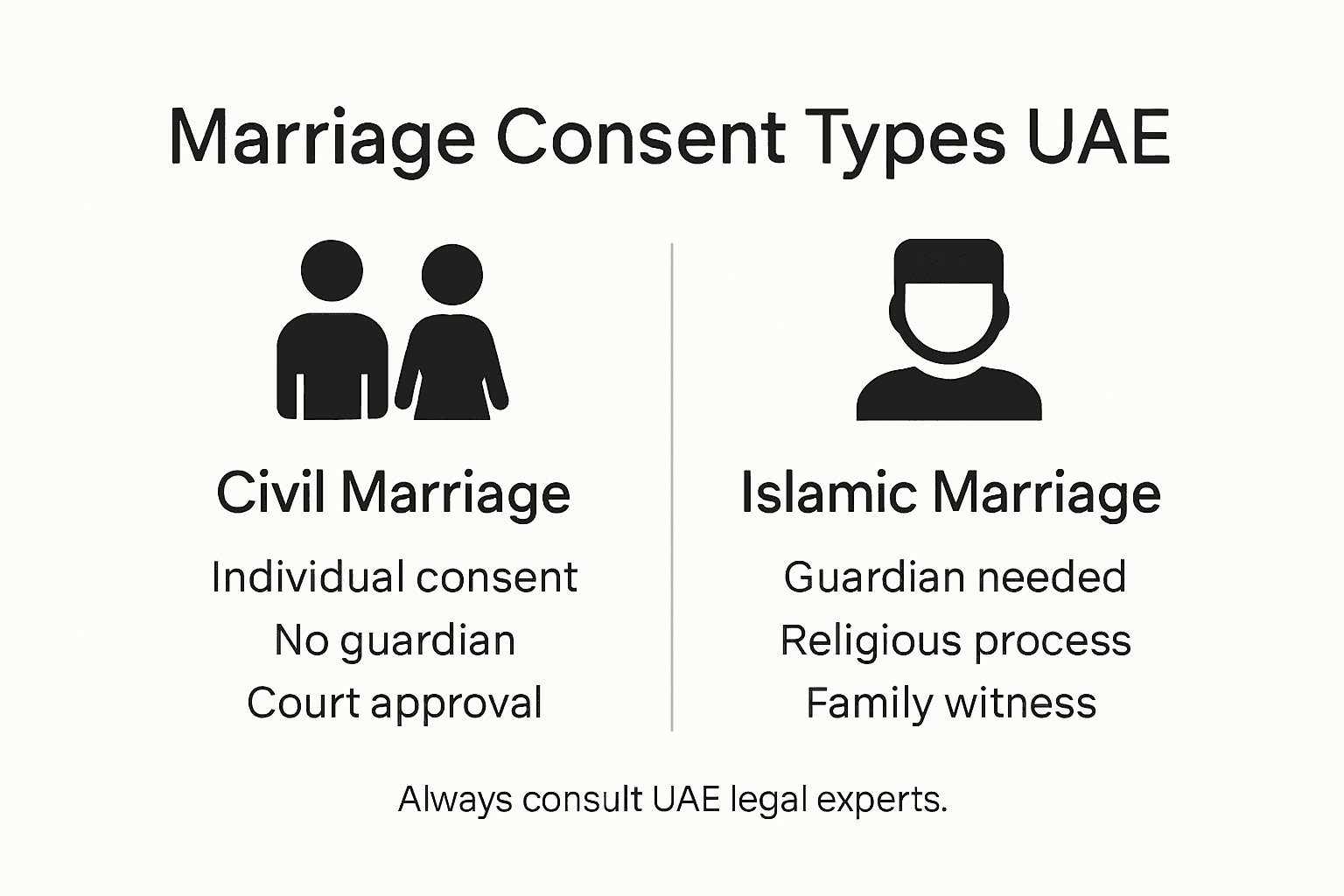
Here is a comparison of Civil and Islamic marriage consent requirements in the UAE:
Aspect | Civil Marriage (Non-Muslim) | Islamic Marriage (Sharia-based) |
Guardian Involvement | Not required | Mandatory in most cases |
Ceremony | Secular legal act | Religious ceremony required |
Documentation | Streamlined forms | Extensive religious documents |
Legal Oversight | Conducted by state officials | Sharia courts supervise |
Pro tip: Consult with a legal professional specializing in UAE marriage laws to understand the specific consent requirements that apply to your unique personal circumstances.
Legal Age, Documentation, and Guardian Roles
Marriage in the United Arab Emirates involves a comprehensive legal framework that carefully balances individual rights with traditional cultural practices. The legal age for marriage is firmly established at 18 years, with recent legal reforms significantly transforming the landscape of consent and guardian involvement.
The documentation requirements for marriage are rigorous and multifaceted. Islamic marriage legal steps typically involve several critical documents, including:
Valid government-issued identification
Passport copies for both parties
Medical fitness certificates
Proof of marital status (for previously married individuals)
Residency documentation
Notarized consent forms
Guardian roles have undergone substantial transformation in recent years. While traditionally guardians held significant power in marriage arrangements, contemporary UAE law has dramatically shifted towards individual autonomy. For adult women, the legal framework now allows independent marriage decisions without mandatory guardian approval. However, for individuals under 18, guardian consent remains a critical requirement.

The legal system also implements protective measures for marriages with significant age disparities. Court approval is mandatory for marriages where the age difference exceeds 30 years, ensuring that potential power imbalances or exploitative situations are carefully scrutinized. This approach demonstrates the UAE’s commitment to protecting individual rights while respecting cultural traditions.
Pro tip: Gather all required documentation well in advance and consult with a legal professional to ensure complete compliance with current UAE marriage regulations.
How Consent Works in Practice: Step-by-Step
Navigating marriage consent in the United Arab Emirates requires a systematic approach that balances legal requirements with personal autonomy. The consent process is a carefully choreographed series of steps designed to protect the rights and intentions of both parties entering a marital agreement.
The initial stage involves comprehensive personal verification and mutual understanding. Civil marriage in Dubai outlines the fundamental steps that couples must follow:
Individual Verification
Confirm legal eligibility (minimum age 18)
Obtain necessary identification documents
Complete mandatory medical fitness examinations
Mutual Declaration
Voluntary agreement without external pressure
Comprehensive discussion of marital expectations
Formal declaration of intent to marry
Legal Documentation
Prepare notarized consent forms
Submit required paperwork to authorized marriage registration centers
Obtain official marriage contract
For Islamic marriages, the consent mechanism incorporates additional cultural and religious considerations. The process typically involves a more intricate interplay between individual choice and traditional family consultation. Guardians may be consulted, particularly for younger participants, but the fundamental principle of individual consent remains paramount.
The legal system implements multiple safeguards to ensure genuine consent. This includes mandatory counseling sessions, waiting periods, and the right of either party to withdraw consent before final registration. These mechanisms protect against potential coercion and ensure that marriage remains a truly voluntary commitment.
Pro tip: Schedule preliminary legal consultations early to understand the specific consent requirements that apply to your unique marital circumstances.
Risks, Common Mistakes, and Invalid Consent
Marriage consent in the United Arab Emirates involves complex legal nuances that can potentially derail an entire marital agreement if not carefully navigated. Invalid consent represents a significant legal risk that can ultimately nullify the marriage contract and create substantial personal and legal complications for both parties.
Islamic marriage legal steps highlight several critical risks that can compromise marriage validity. The most significant consent-related issues include:
Coercion or Forced Marriage
External pressure invalidating voluntary agreement
Psychological or physical manipulation
Threats limiting personal choice
Procedural Consent Failures
Incomplete documentation
Lack of proper guardian approvals
Missing mandatory medical certifications
Unclear verbal or written consent
The UAE legal system provides robust mechanisms to protect individuals from inappropriate marriage arrangements. Courts meticulously examine consent circumstances, particularly in cases involving potential mental incapacity, age-related concerns, or allegations of forced marriage. This scrutiny ensures that marriage remains a voluntary, mutually agreed-upon commitment.
Legal invalidation can occur through multiple channels, including court-ordered annulment or separation proceedings. Factors like conditional agreements, incomplete understanding of marital obligations, or failure to meet specific legal formalities can trigger comprehensive legal reviews. The system prioritizes individual autonomy and ethical standards, allowing individuals to challenge marriages where genuine consent was absent.
The following table summarizes common causes and consequences of invalid marriage consent in the UAE:
Issue | Legal Consequence | Individual Risk |
Coercion or forced agreement | Marriage annulment possible | Emotional distress |
Incomplete documentation | Contract rejection | Delay or legal complications |
Age below legal minimum | Court invalidation | Loss of marriage rights |
Undisclosed marital status | Separation proceedings | Penalties or relationship loss |
Pro tip: Document every stage of your consent process and maintain clear, unambiguous communication to prevent potential legal complications in your marriage agreement.
Secure Your UAE Marriage Consent with Expert Support
Navigating the complex legal rules around marriage consent in the UAE can feel overwhelming. From understanding the voluntary agreement requirements to managing guardian roles and documentation for both civil and Islamic marriages, many couples face stressful hurdles. If you want to avoid risks like invalid consent or procedural mistakes that could affect your marital rights, professional guidance is essential.
At Harris & Charms, we specialize in simplifying these challenges. Our personalized services cover every step including legal document processing, ensuring your consent process is fully compliant and stress-free. Whether you are planning a civil marriage in Dubai or following the necessary Islamic marriage legal steps, our experienced team supports you with clarity and care.

Start your marriage journey with confidence today. Visit Harris & Charms to connect with experts who will safeguard your consent rights, handle your paperwork efficiently, and help create the wedding experience you truly deserve. Take the first step to a legally sound and emotionally fulfilling marriage now.
Frequently Asked Questions
What are the requirements for marriage consent in the UAE?
Both parties must provide full voluntary agreement without coercion, possess mental capacity, and be of legal marriageable age (18 years). Proper documentation must also be prepared during the marriage contract proceedings.
How does consent differ between civil and Islamic marriages in the UAE?
Civil marriages prioritize individual autonomy and do not require guardian approval, while Islamic marriages require mandatory guardian consent and adherence to religious ceremonies along with comprehensive documentation.
What legal documents are needed for marriage in the UAE?
Essential documents include valid identification, passport copies, medical fitness certificates, proof of marital status, residency documentation, and notarized consent forms.
What are the risks of invalid marriage consent in the UAE?
Invalid consent can result from coercion, incomplete documentation, or failure to meet mandatory legal requirements, potentially leading to marriage annulment or separation proceedings.
Recommended
Comments