
Role of Registrar in UAE Marriage – Smooth Legal Ties


Most couples are surprised to learn that over 60 percent of registration delays in the United Arab Emirates stem from missing or incorrectly prepared documents, affecting both American expats and UAE nationals. Whether you are planning a civil or Islamic wedding, the process involves much more than just exchanging vows. Understanding the registrar’s critical responsibilities and mastering the legal paperwork can help you avoid costly mistakes as you start your new chapter together.
Table of Contents
Key Takeaways in Role of Registrar in UAE Marriage
Point | Details |
Registrar’s Role | The Marriage Registrar in the UAE is essential for legalizing marriages, ensuring compliance with both Islamic principles and civil regulations. |
Types of Registrars | There are two main types: Sharia Registrars for Muslim marriages and Civil Registrars for non-Muslims, each with distinct responsibilities and protocols. |
Legal Authority | Registrars have substantial legal powers, including verifying identities, confirming eligibility, and issuing marriage certificates. |
Risk Mitigation | Couples should prepare all required documentation in advance and consult registrars to avoid common pitfalls in the registration process. |
Defining the Registrar in UAE Marriages
In the United Arab Emirates, the Marriage Registrar serves as the critical official responsible for documenting and legalizing marriage contracts across diverse cultural and religious contexts. This professional plays a pivotal role in ensuring marriages adhere to both Islamic principles and civil regulations, functioning as an authorized representative of the Ministry of Justice who oversees the entire marriage formalization process.
The Registrar’s responsibilities extend far beyond simply witnessing a marriage ceremony. They are legally mandated to verify the identities of both parties, confirm their eligibility to marry, validate submitted documentation, and ensure all legal prerequisites are meticulously satisfied. For expatriate couples and UAE nationals alike, marriage registration requirements can be complex, making the Registrar’s expertise absolutely essential.
Specifically, UAE Registrars handle critical tasks such as:
Reviewing and authenticating personal identification documents
Verifying marital status and legal capacity to marry
Conducting pre-marriage counseling and documentation checks
Witnessing the marriage contract signing
Issuing the official electronic marriage certificate
Ensuring compliance with both Sharia and civil legal frameworks
Pro Tip: Always schedule a preliminary consultation with the Marriage Registrar to understand specific documentation requirements for your unique situation and prevent potential administrative complications.
Types of Marriage Registrars and Jurisdictions
The United Arab Emirates features a complex and nuanced system of Marriage Registrars that reflects the country’s diverse cultural and legal landscape. These registrars operate across different jurisdictions, primarily categorized into two main types: Sharia court officials for Muslim marriages and civil court registrars for non-Muslim marriages. Each emirate maintains unique protocols while adhering to federal marriage registration guidelines.
Muslim marriage registrars are typically Islamic scholars or Sharia court officials authorized to conduct marriages according to Islamic legal principles. They verify religious compatibility, perform nikah ceremonies, and ensure all documentation complies with Islamic marriage requirements. In contrast, civil marriage registration systems for non-Muslims involve notarial judges and civil court representatives who handle documentation and legal formalization across different emirate jurisdictions.
The key jurisdictional variations include:
Abu Dhabi Civil Family Court handles civil marriages
Dubai Courts manage both Muslim and non-Muslim marriage registrations
Sharjah Islamic Affairs Department oversees religious marriage documentation
Federal judiciary system provides overarching legal framework
Each emirate maintains specific procedural nuances for marriage registration
Pro Tip: Always confirm the specific registration requirements with local authorities in your emirate, as marriage registration protocols can vary significantly between different jurisdictions.
Here’s a summary comparing Sharia and civil marriage registrars in the UAE:
Aspect | Sharia Registrar | Civil Registrar |
Jurisdiction | Muslim marriages only | Non-Muslim marriages |
Authority Source | Islamic courts and scholars | Civil courts and judges |
Main Responsibilities | Conduct nikah, verify faith | Validate documents, legalize union |
Certificate Issuance | Religious marriage certificate | Official electronic marriage certificate |
Ceremony Requirements | Islamic practices enforced | Secular legal framework |
Registrar’s Legal Authority and Responsibilities
In the United Arab Emirates, Marriage Registrars wield substantial legal authority granted by the Ministry of Justice, empowering them to oversee and validate the entire marriage registration process. Their mandate extends beyond mere administrative duties, encompassing critical legal responsibilities that ensure the integrity and legitimacy of marital contracts across diverse cultural and religious contexts.
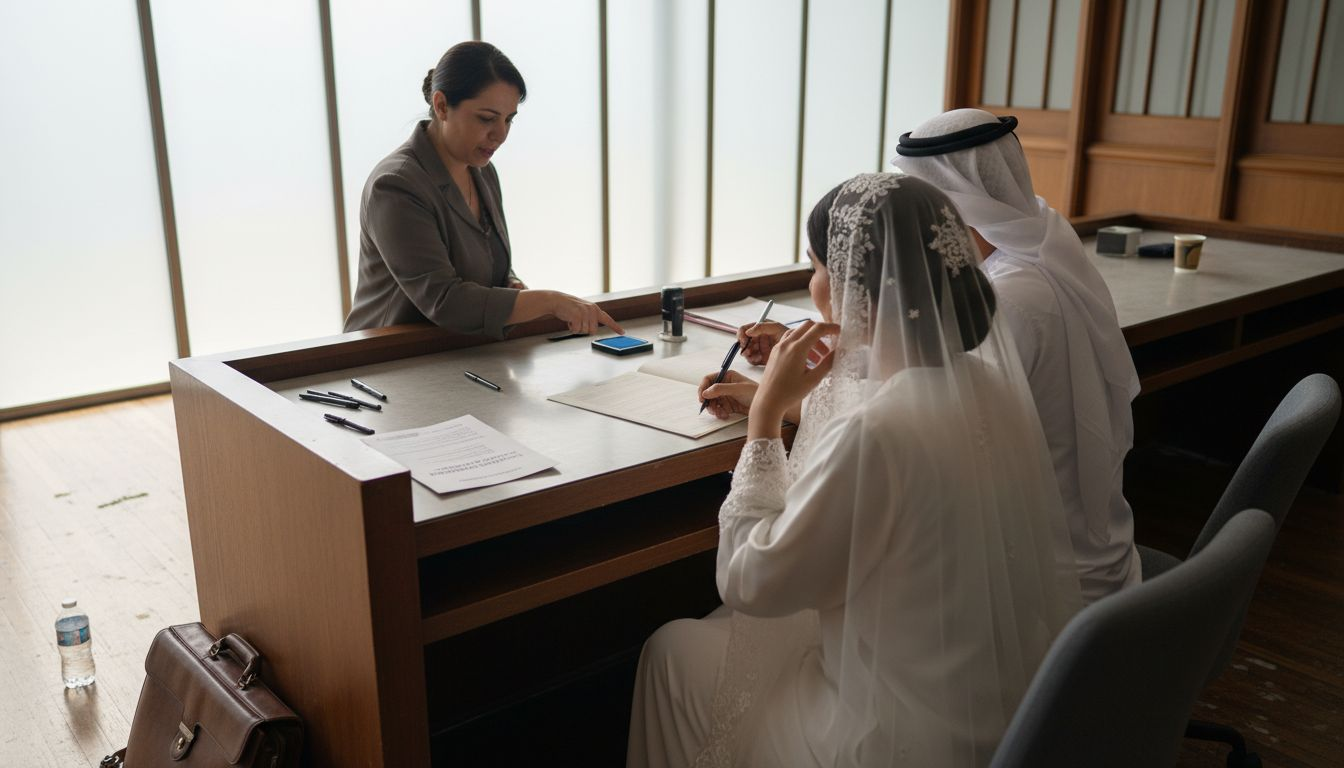
The registrar’s legal powers include comprehensive verification and validation processes. Marriage documentation requirements mandate that registrars must meticulously examine personal identification, verify legal eligibility, confirm mutual consent, and ensure all prerequisite legal conditions are satisfied before authorizing a marriage contract. This includes conducting mandatory medical screenings, validating age requirements, and confirming the absence of legal impediments to marriage.
Key legal responsibilities of UAE Marriage Registrars include:
Conducting official marriage ceremonies
Verifying identities of both marriage parties
Confirming legal eligibility and consent
Administering mandatory medical tests
Documenting and electronically recording marriage contracts
Ensuring compliance with federal and emirate-specific marriage laws
Issuing official marriage certificates
Maintaining confidential marriage records
Preventing fraudulent or unauthorized marriages
Pro Tip: Prepare all required documentation in advance and obtain certified translations for any non-Arabic documents to streamline the registration process with the marriage registrar.
Requirements for Registrar-Led Ceremonies
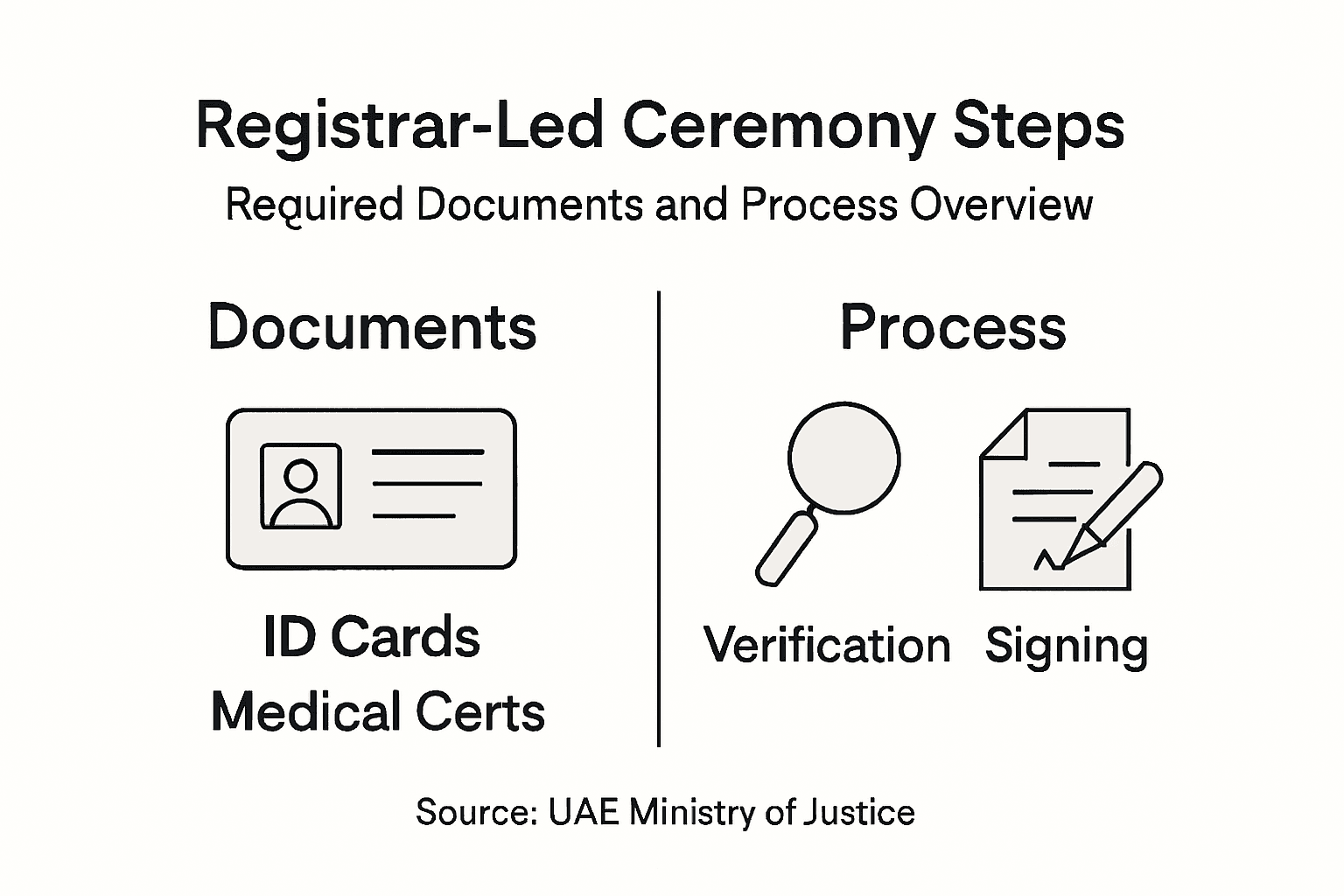
Registrar-led marriage ceremonies in the United Arab Emirates involve a meticulously structured process that ensures legal compliance and cultural sensitivity. Marriage ceremonies are not simply romantic events but complex legal transactions that require precise documentation, verification, and official authorization across different religious and civil frameworks.
The fundamental requirements vary significantly between Islamic and civil marriage ceremonies. Civil marriage registration processes demand specific documentation and procedural compliance that couples must carefully navigate. For Islamic marriages, the ceremony requires the presence of an authorized Islamic marriage officer (Mazoon), while civil ceremonies need official registrar validation and comprehensive legal documentation.
Key requirements for registrar-led ceremonies include:
Minimum age requirement of 18 years for both parties
Valid government-issued identification documents
Premarital medical fitness certificates
Consent from both marriage parties
Presence of legally recognized witnesses
Payment of required registration fees
Submission of no objection certificates (if applicable)
Translation of non-Arabic documents by certified translators
Proof of legal eligibility to marry
Completed electronic marriage application
Pro Tip: Schedule a preliminary consultation with the marriage registrar to confirm specific documentation requirements for your unique circumstances and prevent potential administrative delays.
Risks, Mistakes, and How to Avoid Issues
Navigating marriage registration in the United Arab Emirates involves understanding potential legal pitfalls that could compromise the validity and recognition of your marital union. The complex legal landscape demands meticulous attention to detail, with even minor documentation errors potentially resulting in significant complications for couples seeking to formalize their relationship.
The most critical risks stem from procedural non-compliance and documentation challenges. Legal implications of marriage registration reveal that couples must be extraordinarily precise in meeting all statutory requirements, as errors can lead to marriage contract invalidation, administrative rejections, or costly legal remedies.
Common risks and mitigation strategies include:
Incomplete personal documentation
Solution: Obtain comprehensive certified document sets in advance
Incorrect or expired identification papers
Solution: Verify all documents have current validity
Failure to meet age or consent requirements
Solution: Confirm individual legal eligibility thoroughly
Inadequate translation of non-Arabic documents
Solution: Use certified government-approved translators
Missing mandatory medical certificates
Solution: Complete premarital medical tests before application
Non-compliance with religious or civil ceremony protocols
Solution: Consult official registrar guidelines explicitly
Overlooking witness qualification standards
Solution: Verify witness legal status and documentation
Incomplete understanding of jurisdiction-specific requirements
Solution: Research emirate-specific marriage registration rules
Pro Tip: Engage a legal consultant specializing in UAE marriage registration to conduct a comprehensive document review and minimize potential registration complications.
Use this reference table as a quick guide to common risks in UAE marriage registration and how to avoid them:
Risk Type | Impact if Overlooked | Prevention Strategy |
Invalid ID documents | Registration rejection | Ensure all identification is current |
Missing medical tests | Marriage disqualification | Obtain fitness certificates early |
Poor translation | Legal contract delay | Use certified translator for all docs |
Incorrect ceremony protocol | Marriage not legally recognized | Consult registrar for procedures |
Simplify Your UAE Marriage Registration with Expert Support
Understanding the essential role of the Marriage Registrar in UAE marriages can feel overwhelming. From verifying documents to ensuring compliance with Sharia and civil laws, the process demands careful attention to detail and legal knowledge. If you want to avoid common pitfalls like missing medical certificates or incorrect paperwork, your best choice is trusted guidance that takes the stress out of legal formalities.
At Harris & Charms, we specialize in providing personalized, end-to-end assistance for both Islamic and civil marriages in the UAE. Our team helps you prepare and organize all necessary documentation, guides you through registrar-led ceremony requirements, and ensures that the legal process is smooth and compliant. By choosing our services, you not only ease the burden of navigating complex registration protocols but also experience a tailored approach inspired by the founders’ unique love story.
Take control of your wedding journey today with professional support designed for your peace of mind and legal certainty.

Start your hassle-free marriage registration now by visiting Harris & Charms and discover how our expert solutions can make your special day truly seamless. Reach out to us for a consultation and secure your smooth legal ties with confidence.
Frequently Asked Questions
What is the role of a Marriage Registrar in UAE marriages?
The Marriage Registrar is responsible for documenting and legalizing marriage contracts, verifying the identities of both parties, and ensuring compliance with legal requirements within both Islamic and civil frameworks.
What documentation do I need for a registrar-led marriage ceremony?
You will need valid government-issued identification, proof of legal eligibility to marry, premarital medical fitness certificates, consent from both parties, and legally recognized witnesses, among other required documents.
How can I avoid common mistakes during marriage registration?
To avoid mistakes, ensure all personal documentation is complete and current, obtain certified translations for non-Arabic documents, complete necessary medical tests, and understand specific guidelines from the local marriage registrar.
Are there different types of Marriage Registrars in the UAE?
Yes, there are two main types: Sharia court officials who handle Muslim marriages and civil court registrars who oversee non-Muslim marriages. Each type follows different protocols based on religious and legal requirements.
Recommended
Comments