
Marriage Validation in UAE: Legal Steps for Couples Explained


TL;DR:
Official marriage registration with UAE authorities is essential for legal recognition and rights.
Civil and Islamic marriage validation processes involve specific documentation, procedures, and timelines.
Recent reforms have simplified civil marriage options and improved the overall validation process for expats.
Marriage Validation Explained: Many couples assume that saying “I do” in a beautiful ceremony seals their marriage legally. In the UAE, that assumption can lead to serious problems. Marriage validation requires official registration with UAE authorities—not just a ceremony—for the union to be legally recognized. Without it, you could face blocked visa applications, inheritance disputes, or denied spousal rights. This guide walks you through everything you need to know, from civil and Islamic marriage validation to foreign certificate attestation, so you can approach your legal marriage process with confidence and clarity.
Table of Contents
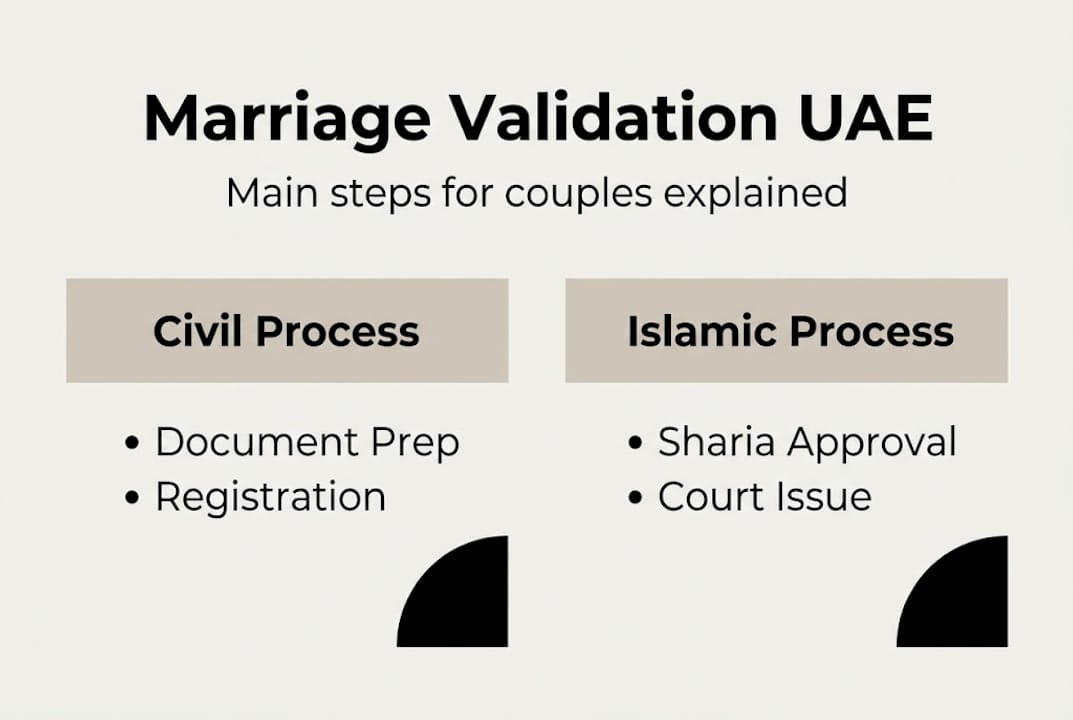
Civil marriage validation: Laws, steps, documents, and timelines
Islamic marriage validation: Sharia law requirements and process
Marriage attestation for international couples: The UAE chain of trust
Recent reforms and expert tips: Navigating modern UAE marriage validation
Our take: Practical realities of marriage validation in the UAE
Key Takeaways of Marriage Validation Explained
Point | Details |
Registration is mandatory | A wedding ceremony without legal registration isn’t recognized by UAE law or government processes. |
Civil and Islamic paths differ | Civil marriage suits non-Muslims while Islamic marriage follows Sharia law—both must meet official requirements. |
Attestation for foreign marriages | International marriage certificates require a multi-step attestation before they are valid in the UAE. |
Recent reforms help expats | New laws make civil marriage validation more accessible but official documentation remains crucial. |
Why marriage validation matters in the UAE
Marriage validation is the official process by which a government authority legally recognizes your union. In the UAE, a ceremony performed by a religious figure, a family elder, or even a licensed officiant does not automatically create a legally binding marriage. You must register the marriage with the appropriate UAE authority for it to count in the eyes of the law.
Why does this matter so much? Because nearly every major life event that follows marriage depends on that legal record. Consider what’s at stake:
Spousal visa sponsorship: Without a registered marriage, your partner cannot be added to your residency visa.
Inheritance rights: UAE courts rely on official marriage certificates when distributing assets. An unregistered marriage leaves your spouse legally unprotected.
Healthcare and insurance: Many providers require proof of legal marriage before extending spousal coverage.
Child registration: Registering a child’s birth in the UAE typically requires the parents’ official marriage certificate.
Travel and immigration: Several countries require a UAE-recognized marriage certificate for joint visa applications.
The consequences of skipping legal validation are real and painful. Couples have faced denied residency renewals, frozen joint accounts, and complicated custody situations, all because their ceremony was never officially registered. As the marriage requirements in the UAE make clear, ceremonial and legal marriage are two completely separate things under UAE law.
Important: A religious ceremony, no matter how elaborate or witnessed, does not substitute for official registration. Legal marriage validation is mandatory for spousal rights, visas, and inheritance in the UAE.
The good news is that the UAE has made significant strides in recent years to streamline the process for both Muslim and non-Muslim couples. Understanding which path applies to you is the first step.
Civil marriage validation: Laws, steps, documents, and timelines
Non-Muslim couples have a clear legal path to civil marriage validation in the UAE. The framework is governed by Federal Decree-Law No. 41/2022 and Abu Dhabi Law No. 14/2021, which together modernized civil marriage options and reduced the requirement for religious procedures among non-Muslims. Both parties must be at least 18 years old.
Here is the step-by-step process for civil marriage validation:
Gather your documents. You will need valid passports, Emirates ID or proof of residency, and official proof that you are single or legally divorced.
Submit your application. Apply at the Abu Dhabi Judicial Department or the relevant emirate’s civil court. Some emirates have dedicated non-Muslim personal status courts.
Pay the applicable fees. Fees range from AED 300 to AED 2,500 depending on whether you choose standard or express processing.
Attend the appointment. Both partners must appear in person for the formal registration.
Receive your certificate. Processing takes between 1 and 10 days depending on the service tier you select.
Service tier | Estimated fee | Processing time |
Standard | AED 300 | 7 to 10 days |
Express | AED 2,500 | 1 to 3 days |
For a detailed breakdown of each requirement, the civil marriage steps guide covers everything from document authentication to appointment booking. If you are weighing your options, reviewing the civil vs Islamic marriage differences can help you decide which path fits your situation.
Pro Tip: Always get your proof-of-single-status document officially translated into Arabic by a UAE-certified translator before your appointment. Untranslated documents are one of the most common reasons for delays.
Islamic marriage validation: Sharia law requirements and process
For Muslim couples, marriage validation follows Sharia law principles and is processed through UAE Sharia courts. The legal requirements are specific and non-negotiable, so understanding them before you begin saves time and stress.
Under Sharia law requirements, a valid Islamic marriage must include:
Ijab and Qabul: The formal offer and acceptance between the two parties.
Wali consent: The bride’s male guardian must give consent. If no guardian is available, the court can appoint one.
Two male witnesses: Both must be present at the time of the contract.
Mahr: A mandatory gift from the groom to the bride, agreed upon and documented.
Premarital medical certificate: Both parties must complete a government-mandated health screening before the marriage can be registered.
After meeting these prerequisites, couples register at the local Sharia court. The judge (qadi) oversees the contract, and the certificate is issued upon successful registration. For a complete walkthrough, the Islamic marriage steps resource covers each stage in detail.
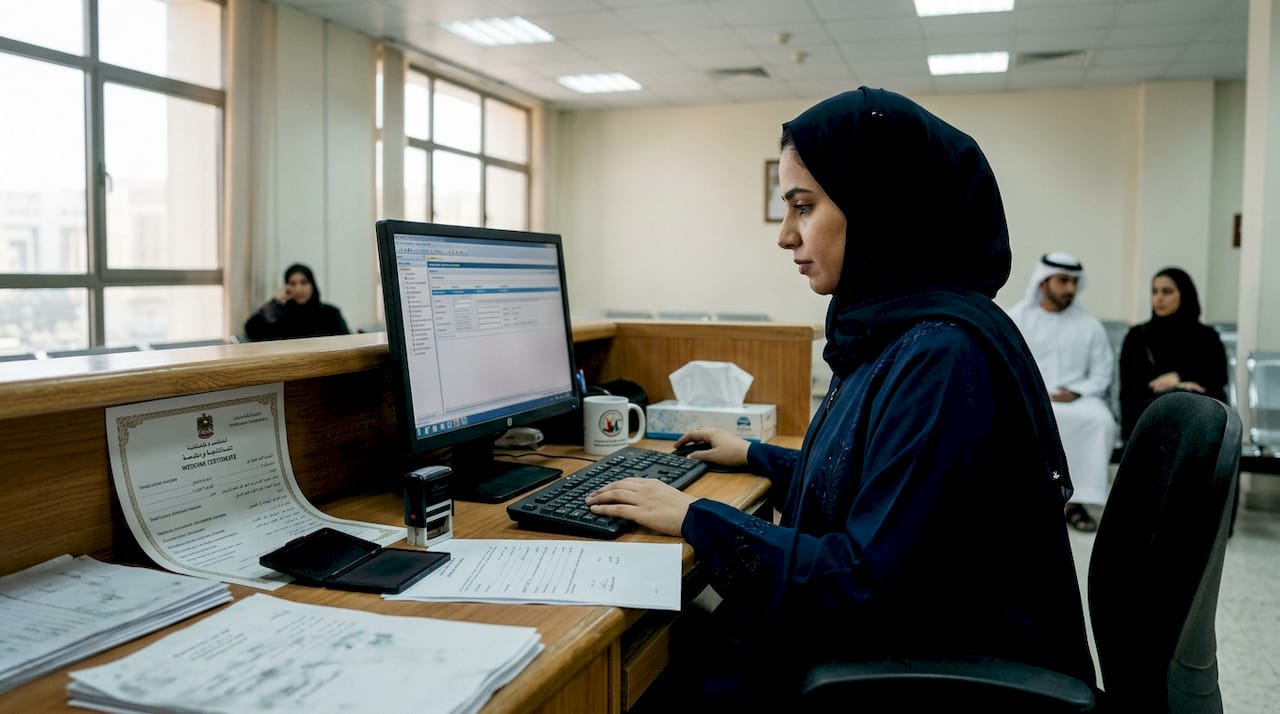
Requirement | Civil marriage | Islamic marriage |
Minimum age | 18 | 18 (court approval for younger) |
Religious prerequisite | None | Sharia contract required |
Medical screening | Not mandatory | Mandatory |
Guardian consent | Not required | Required (wali) |
Registration authority | Civil court | Sharia court |
For a broader look at what the law requires, the Muslim marriage rules UAE guide is a helpful reference before you begin gathering documents.
Pro Tip: Book your premarital medical screening as early as possible. Clinics can have waiting periods, and you cannot proceed with court registration without the completed certificate in hand.
Marriage attestation for international couples: The UAE chain of trust
If you were married outside the UAE and need your foreign marriage certificate recognized here, attestation is the process that makes it legally valid. Think of attestation as a chain of official stamps that each authority adds to confirm the document is genuine.
The full attestation chain works as follows:
Notarize in your country of origin. A certified notary public authenticates the original certificate.
State or federal authentication. Depending on your country, this may involve a state department or federal foreign ministry.
Ministry of Foreign Affairs (MOFA) in your home country. This step confirms the document’s authenticity at the national level.
UAE Embassy or Consulate. The UAE diplomatic mission in your country verifies and stamps the document.
UAE Ministry of Foreign Affairs (UAE MOFA). The final step in the UAE, with a standard fee of AED 150 per document. The total process typically takes 10 to 15 days.
Common issues that cause delays include:
Documents with expired notarization
Missing apostille for countries in the Hague Convention
Incorrect or inconsistent name spellings across documents
Untranslated certificates submitted to UAE MOFA
Remember: Every link in the attestation chain must be complete. Skipping even one step means UAE authorities will not accept the document, and you will need to restart from that point.
For a full breakdown of the process, the attestation process UAE guide is a reliable starting point. Couples based in Dubai can also consult the attestation in Dubai resource for emirate-specific details. If you need your UAE marriage recognized internationally, the UAE marriage recognition abroad guide explains the reverse process. Additional marriage recognition resources can also be useful for couples with ties to European countries.
Recent reforms and expert tips: Navigating modern UAE marriage validation
The UAE’s approach to marriage law has changed significantly. The 2021 to 2023 reforms modernized the process by introducing civil marriage options for non-Muslims and removing the requirement for religious procedures in civil cases. This was a major shift that opened the door for expat couples who previously had no straightforward legal path.
What these reforms mean for you:
Non-Muslims can now marry civilly without any religious component.
Divorce and inheritance laws for non-Muslims were also updated, creating a more secular framework.
The Abu Dhabi courts now handle non-Muslim personal status cases under a separate, dedicated system.
Express processing options have made timelines faster and more predictable.
Despite these improvements, couples still run into avoidable problems. Here are the most common pitfalls and how to sidestep them:
Starting too late: Document gathering, translation, and authentication take time. Begin at least 6 to 8 weeks before your intended registration date.
Assuming online ceremonies count: Virtual or overseas ceremonies performed without UAE registration have no legal standing here.
Ignoring document expiry: Passports, proof-of-status letters, and medical certificates all have validity windows. Check them carefully.
Skipping professional help for attestation: The chain of trust process is easy to get wrong. One missed step means starting over.
The impact on UAE expats from these reforms has been significant, particularly for couples from countries without a strong bilateral agreement with the UAE.
Pro Tip: Keep certified copies of every document at each stage of the process. If a step needs to be repeated, having copies saves you from requesting originals again.
Our take: Practical realities of marriage validation in the UAE
After helping hundreds of couples through this process, we have noticed something consistent: the couples who struggle most are not the ones who lack information. They are the ones who underestimate how strictly the UAE enforces its documentation requirements.
Conventional wisdom says, “Just follow the checklist and you’ll be fine.” The reality is that checklists don’t account for inconsistencies in your documents, bureaucratic timing, or the fact that one authority’s stamp can be rejected by the next if the format is slightly off. We have seen couples with every document in order face delays because a name was spelled differently on two separate certificates.
The DIY approach works for some, but it carries real risk when the stakes are your legal marital status. The most successful couples we work with treat the attestation process tips as a living checklist, not a one-time task. They verify, double-check, and build in buffer time. Our honest advice: prepare earlier than you think you need to, and never assume a document is acceptable until an authority confirms it.
Simplify your UAE marriage validation with expert help
Navigating UAE marriage validation is manageable when you have the right support from the start.
At Harris & Charms, we specialize in guiding couples through both civil and Islamic marriage validation, handling documentation, translations, and attestation so you don’t have to chase paperwork across multiple offices. Whether you are just starting to plan or already mid-process and feeling stuck, our UAE marriage services cover every step from document preparation to final registration. If you want to talk through your specific situation before committing, you can speak to a UAE wedding expert today. We make the legal side simple so you can focus on what actually matters.
Frequently asked questions
Is a wedding ceremony alone legally valid as marriage in the UAE?
No. Legal registration with UAE authorities is required for official recognition, and ceremonies alone are insufficient under UAE law.
How long does civil marriage validation take in the UAE?
The process takes 1 to 10 days from submission, depending on whether you choose standard or express processing fees.
What documents are needed to validate a marriage in the UAE?
You will need valid passports, Emirates ID or residency proof, and proof of single or divorced status. Islamic marriages also require a premarital medical certificate from an approved clinic.
How do I validate a foreign marriage certificate in the UAE?
You must complete the full attestation chain: notarize in the country of origin, authenticate through MOFA, stamp at the UAE Embassy, and finalize at UAE MOFA.
Are recent legal reforms making civil marriage validation easier for expats?
Yes. The 2021 to 2023 reforms introduced dedicated civil marriage options for non-Muslims and streamlined the entire process for expats living in the UAE.
Recommended
Comments