
Marriage witnesses in UAE weddings: roles & legal rules


TL;DR:
Proper witnesses are legally essential for valid marriage registration in the UAE.
Witnesses must be adults, sane, present during the ceremony, and carry valid ID.
Preparation and confirmation of witness eligibility prevent delays and legal issues.
Nearly one in three UAE marriage registrations faces delays because of missing or unqualified witnesses. That’s not a minor administrative hiccup. It can push your wedding date back by weeks and create legal complications that follow you long after the ceremony. Whether you’re planning a civil or Islamic wedding in the UAE, understanding exactly what the law requires from your witnesses is one of the most practical things you can do before your big day. This guide breaks down the legal foundation, eligibility rules, witness duties, and the most common mistakes couples make so you can walk into your ceremony fully prepared.
Table of Contents
Key Takeaways
Point | Details |
Witnesses are mandatory | Every legal marriage in the UAE requires two qualified witnesses for validity. |
Eligibility matters | Witnesses must be adults of sound mind and present during the marriage ceremony. |
Delays are common | Nearly 30% of registrations are delayed due to missing witnesses or incomplete documentation. |
Preparation is key | Briefing your witnesses in advance prevents last-minute complications and ensures compliance. |
Legal foundation: Why witnesses matter in UAE marriage
Marriage in the UAE is not just a personal milestone. It’s a legally recognized contract, and like any contract, it requires proper witnesses to be valid. Under UAE Personal Status Law, two sane adult witnesses are required for a marriage to be legally recognized. This applies to both civil and Islamic ceremonies, though the specifics vary slightly between the two.
Federal Decree-Law 41/2024, Articles 25 and 27, outlines exactly what makes a witness eligible and what their presence is meant to confirm. The witness is not just a formality. Their role is to verify that both parties gave free and informed consent to the marriage. Without that verification, the marriage can be challenged or invalidated in court, which creates serious problems for residency status, inheritance rights, and family law matters down the line.
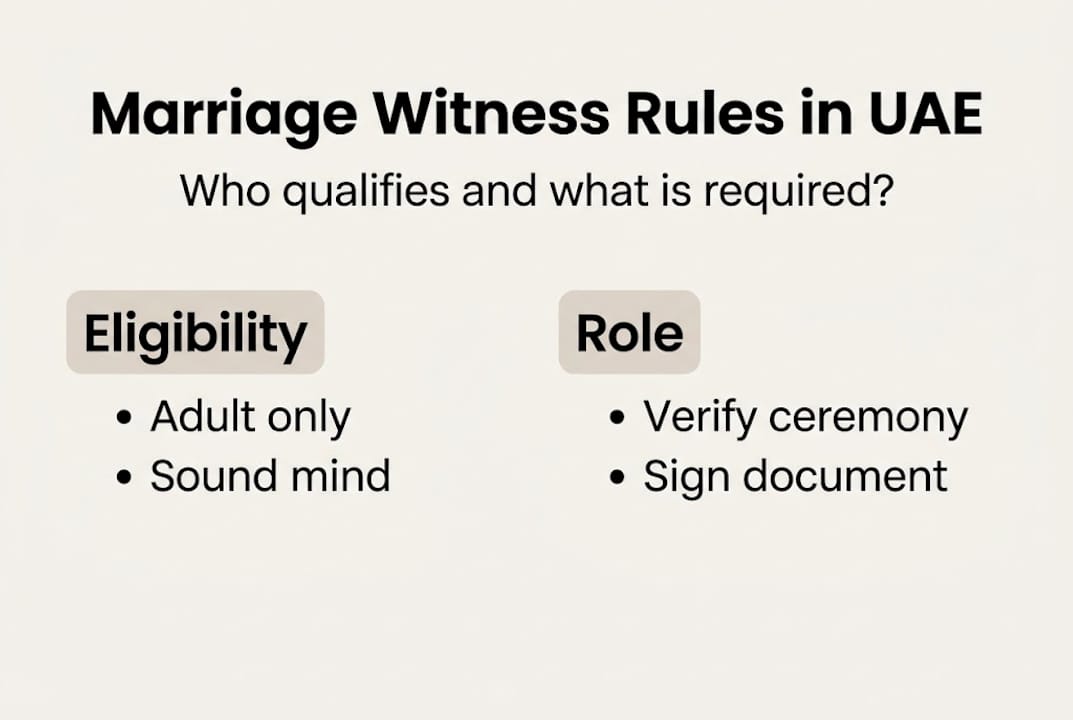
Understanding the witness roles in UAE marriage helps couples see why this step carries real legal weight. A witness who wasn’t actually present, didn’t hear the offer and acceptance, or didn’t meet eligibility criteria can render the entire ceremony legally incomplete.
Here’s a quick comparison of witness requirements across ceremony types:
Requirement | Civil wedding | Islamic wedding |
Minimum number of witnesses | 2 | 2 |
Age requirement | Adult (18+) | Adult (baligh) |
Mental capacity | Sane | Sane |
Gender | Male or female | Typically male (varies by school of thought) |
Physical presence | Mandatory | Mandatory |
Relationship to couple | No restriction | No restriction |
For a deeper look at how civil and Islamic rules differ in practice, it’s worth reviewing both sets of requirements before finalizing your plans.
Important: A witness who signs paperwork without being physically present during the ceremony is not a valid witness under UAE law. This is one of the most common errors couples make.
Witnesses also serve a protective function. If a marriage is ever disputed, witnesses can be called upon to confirm the circumstances of the ceremony. That’s why getting this right matters not just on the day, but for years to come.
Who qualifies as a marriage witness in the UAE
Not everyone can serve as a witness, and that surprises a lot of couples. The good news is that the eligibility criteria are straightforward once you know them. Witnesses must be of majority age, sane, and able to hear both parties give their consent during the ceremony.
For civil weddings, both male and female witnesses are accepted. For Islamic ceremonies, some schools of Islamic jurisprudence require male witnesses, though this can vary depending on the officiant and the emirate. Always confirm the specific requirements with the court or officiant handling your ceremony.
One of the biggest myths couples believe is that witnesses must be relatives. That’s simply not true. A friend, colleague, or even a professional witness arranged through a legal service can fulfill the role, as long as they meet the legal criteria. Another common misconception is that witnesses need to be UAE nationals or residents. They don’t. Residency or citizenship is not a factor under current law.
Before your ceremony, use this checklist to confirm your witnesses are ready:
Age: Both witnesses must be adults (18 or older for civil; baligh for Islamic)
Mental capacity: Both must be of sound mind
Physical presence: Both must be present in the room during the offer and acceptance
Ability to hear: Both must be able to hear the verbal exchange between the couple
Documentation: Both should bring valid ID (passport or Emirates ID)
Availability: Confirm attendance well in advance and have a backup option
Pro Tip: Don’t assume your witnesses know what to bring or what to do. Send them a short message outlining the date, time, location, and what ID they need to carry. A five-minute heads-up can prevent a two-week delay.
If you’re working through a civil marriage checklist, add witness confirmation as a separate line item. And if either of your witnesses is visiting from abroad, review the rules for tourists to make sure there are no additional steps required.
Marriage witness roles: Duties and obligations
Knowing who qualifies is only half the picture. Understanding what witnesses are actually expected to do on the day is equally important. Many couples brief their witnesses on where to stand but skip the part about what the role legally requires.
Witnesses must physically observe the offer and acceptance and attest to their presence. Here’s what that looks like in practice:
Arrive on time. Witnesses must be present before the ceremony begins. Late arrivals cannot retroactively serve as witnesses.
Be in the same room. Physical presence is mandatory. A witness joining via video call does not meet the legal standard.
Listen to the exchange. Both witnesses must hear the verbal offer and acceptance between the couple.
Sign the marriage contract. After the ceremony, witnesses sign the official documentation confirming their presence and the validity of the exchange.
Present valid identification. Witnesses must show their ID at the time of signing.
If a witness fails to complete any of these steps, the registration can be rejected. In some cases, the couple may need to repeat the ceremony with compliant witnesses, which adds both time and cost.
The most common mistake couples make is treating witnesses as guests who happen to sign a form. They forget to brief them on the sequence of events, which leads to confusion during the ceremony itself. A witness who doesn’t realize they need to be standing in the room during the verbal exchange, not waiting outside, can cause a last-minute scramble.
Pro Tip: Walk your witnesses through the ceremony structure at least a few days before. Let them know exactly when they’ll be needed, what they’ll be asked to sign, and how long the process takes. This removes uncertainty and keeps the day running smoothly.
For a full breakdown of what goes into official marriage documentation, it helps to understand how witness signatures fit into the broader paperwork process. You’ll also want to know how attestation works if you plan to use your marriage certificate outside the UAE.

Common pitfalls: Delays, legal risks, and how to avoid them
30% of UAE registrations are delayed due to incomplete documentation or missing witnesses. That’s a significant number, and most of those delays are entirely avoidable.
The top three reasons couples run into trouble are:
Witnesses who don’t show up. Life happens. A witness cancels last minute and the couple has no backup plan.
Ineligible witnesses. Someone who is underage, not mentally present, or unable to hear the exchange is brought in without the couple realizing the issue.
Missing or expired identification. A witness arrives without valid ID, and the registration cannot proceed.
Here’s a comparison of avoidable versus unavoidable delays:
Type of delay | Example | Avoidable? |
Missing witness | Witness cancels day of | Yes, with a backup |
Ineligible witness | Witness is a minor | Yes, with pre-screening |
Expired ID | Witness’s passport is expired | Yes, with advance checks |
Court backlog | High volume of registrations | No |
Legal document processing | Apostille delays from home country | Partially |
The solution is straightforward: treat witness preparation the same way you treat venue booking. Confirm early, check eligibility, verify ID validity, and always have a backup witness identified. If you’re working with a UAE documentation guide, make sure witness details are part of your pre-ceremony review.
Couples planning weddings across different emirates should also note that marriage laws compared between Dubai and Abu Dhabi can have procedural differences worth knowing in advance.
Missing documentation doesn’t just delay your wedding. It can affect visa applications, residency sponsorship, and other legal processes that depend on a recognized marriage certificate. Getting it right the first time protects you from a chain of administrative problems.
Our perspective: What most couples miss about marriage witnesses
After working with hundreds of couples across civil and Islamic weddings in the UAE, we’ve noticed a pattern. Couples spend weeks planning the ceremony and days reviewing documents, but they treat witness preparation as an afterthought. They assume that having two names on a list is enough.
It isn’t. Real readiness means your witnesses know the schedule, have confirmed their attendance, carry valid ID, and understand that they need to be physically present during the verbal exchange, not just at the reception afterward.
The couples who have the smoothest registration experiences are the ones who treat their witnesses like key vendors. They send reminders, confirm attendance twice, and identify a backup in case something changes. That level of preparation might feel excessive, but it takes less than an hour and eliminates one of the most common causes of registration delays.
We’ve seen couples marrying abroad face even more complexity when witnesses aren’t pre-briefed on local legal requirements. The peace of mind that comes from knowing every detail is handled is genuinely worth the extra effort.
Get expert support for your UAE wedding
Planning a wedding in the UAE involves more moving parts than most couples expect, and witness compliance is just one piece of the puzzle.

At Harris & Charms, we handle every detail of your civil or Islamic wedding, from confirming witness eligibility and preparing documentation to coordinating with courts and managing attestation. Our civil marriage packages are designed to take the guesswork out of legal requirements, and our comprehensive wedding services cover everything from venue coordination to post-ceremony paperwork. If you’re not sure where to start, contact our experts for a personalized consultation. We’ll make sure your wedding day is legally sound and completely stress-free.
Frequently asked questions
Can a family member serve as a marriage witness in the UAE?
Yes, adults of sound mind can serve as witnesses regardless of their relationship to the couple, as long as they meet all other legal requirements and are physically present during the ceremony.
What happens if a couple forgets to bring witnesses to their marriage ceremony?
The registration will likely be delayed, and the marriage may not be recognized as valid until proper witnesses are present. 30% of UAE registrations are already delayed due to missing witnesses, making advance preparation essential.
Are the requirements for marriage witnesses the same for civil and Islamic weddings in the UAE?
Both ceremony types require two adult, sane witnesses, but Islamic weddings may have gender-specific requirements depending on the school of thought followed. Always confirm with your officiant or court before the ceremony.
Do witnesses need to be UAE residents or citizens?
No. No residency or citizenship is required under UAE law. Witnesses simply need to meet the legal eligibility criteria: adult, sane, and physically present during the ceremony.
Recommended
Comments