
Muslim marriage rules UAE: Essential 2026 guide for couples


Navigating Muslim marriage rules in the UAE can feel overwhelming, especially for expats unfamiliar with how Shariah law intersects with local legal requirements. Whether you’re planning an Islamic wedding or simply want to understand your rights and obligations under UAE family law, knowing the essential contract elements, eligibility criteria, and documentation processes is crucial. This guide breaks down everything you need to know about Muslim marriage contracts, polygamy regulations, and the latest 2026 legal updates to help you approach your wedding with confidence and clarity.
Table of Contents
Key takeaways of Muslim Marriage Rules UAE
Point | Details |
Marriage contracts are legally binding | All Muslim marriages in the UAE require a contract aligned with Shariah law that defines rights, duties, and financial obligations. |
Essential contract elements | Valid contracts must include mahr (dowry), two witnesses, wali (bride’s guardian), and clear offer and acceptance. |
Customizable conditions allowed | Couples can add conditions to contracts provided they comply with Islamic principles and public order. |
Polygamy permitted with requirements | Muslim men may marry up to four wives but must provide separate housing with equal amenities for each. |
Civil marriage available for non-Muslims | Recent federal law updates allow non-Muslim residents to marry under secular law with simplified licensing. |
Understanding the legal foundation of Muslim marriage contracts in the UAE
Marriage contracts form the cornerstone of every Muslim marriage in the UAE. These documents aren’t just ceremonial, they’re legally binding agreements under Shariah law that outline each spouse’s financial rights, obligations, and expectations throughout the marriage.
Under UAE family law, your marriage contract must comply with both Islamic principles and public order to be enforceable. This means the terms you agree to must respect Shariah guidelines while also meeting local legal standards. The contract protects both spouses by creating clear, documented expectations that courts can reference if disputes arise.
Think of your marriage contract as a personalized roadmap for your relationship. It addresses everything from financial support to living arrangements, ensuring both parties understand their commitments before saying “I do.” For couples new to the UAE or unfamiliar with Islamic marriage procedures, grasping this legal foundation removes much of the confusion surrounding what an Islamic marriage in the UAE actually entails.
Marriage contracts in the UAE define not just the start of your union but the ongoing legal framework that governs your relationship under both religious and civil law.
Many expats assume marriage contracts are rigid, one-size-fits-all documents. In reality, they offer significant flexibility within Islamic boundaries, allowing you to customize terms that reflect your unique circumstances and mutual agreements.
Key requirements and components of a valid Muslim marriage contract
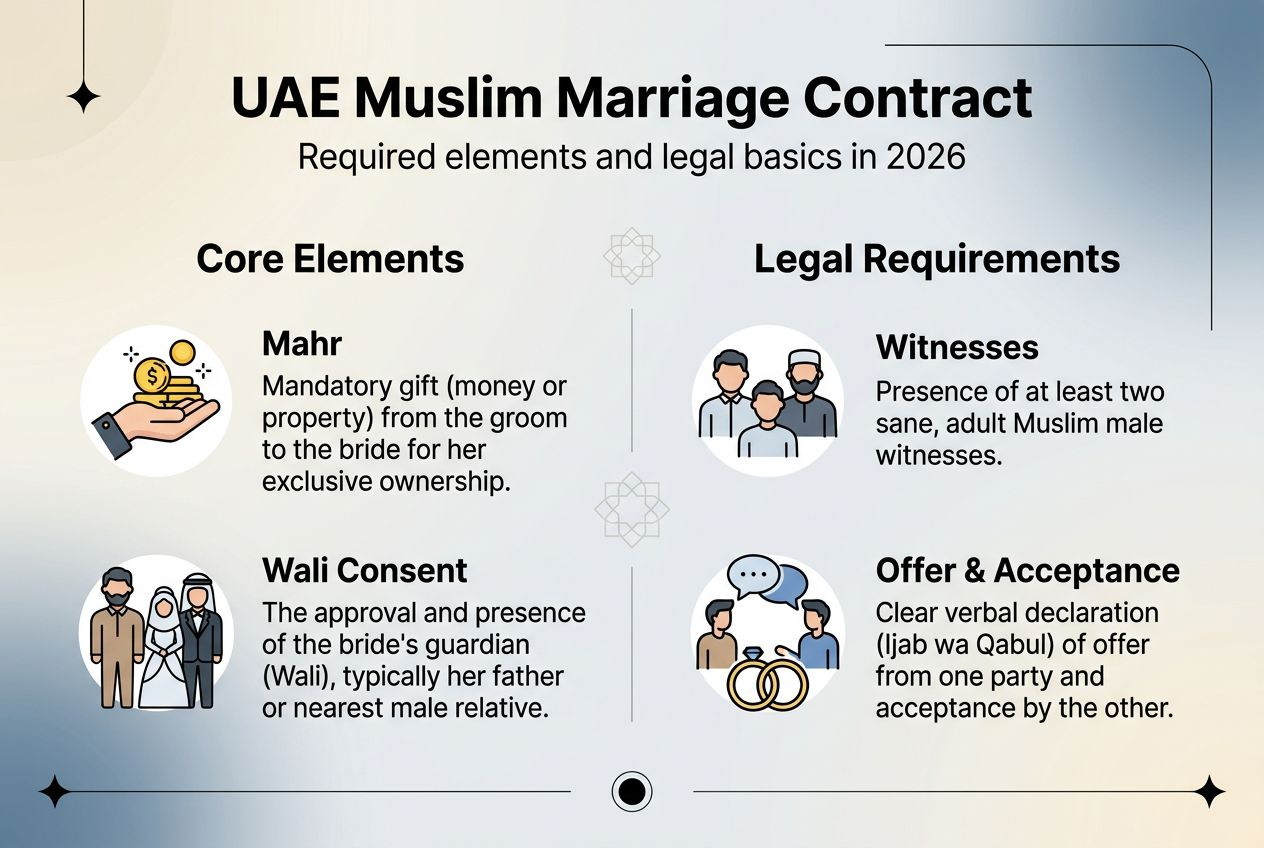
For your Muslim marriage contract to be valid and enforceable in the UAE, it must include several essential components under Shariah law. Missing even one element can render your contract invalid, so understanding these requirements is critical.
Eligibility of both parties: Both bride and groom must meet specific eligibility criteria including legal age, mental capacity, and religious status. The bride and groom must be Muslim, or the groom must convert to Islam if marrying a Muslim woman.
Mahr (dowry): The mahr represents a mandatory gift from the groom to the bride and serves as her financial security. You can structure it as prompt mahr (paid immediately) or deferred mahr (paid later, often upon divorce or death). Clearly specify the amount, type, and timing in your contract to avoid future disputes.

Wali (guardian): The bride’s wali, typically her father or closest male relative, must consent to the marriage and often participates in the contract signing. His role ensures the bride’s interests are protected and the marriage meets family and religious standards.
Two competent witnesses: Your contract signing requires two adult Muslim male witnesses of sound mind who observe the ceremony and can attest to its validity. Their presence makes the marriage legally and religiously recognized.
Offer and acceptance (Ijab and Qabul): The formal exchange where the wali offers the bride in marriage and the groom accepts creates the binding agreement. This ritual must occur in the presence of witnesses and be clearly documented.
Pro Tip: Always put mahr details in writing with specific amounts and payment terms. Verbal agreements lead to misunderstandings that can complicate divorce proceedings or inheritance claims down the line.
These components work together to create a marriage that satisfies both religious obligations and UAE legal requirements for couples. Skipping or mishandling any element can invalidate your entire contract, so careful attention to each detail matters.
Customizable conditions in Muslim marriage contracts and polygamy laws
Your marriage contract isn’t limited to basic requirements. UAE law allows you to include customizable conditions that address specific concerns, provided they don’t violate Islamic principles or public order.
Common conditions couples add include:
Right of the wife to work or pursue education
Residence location and living arrangement preferences
Financial responsibilities beyond basic maintenance
Travel permissions and restrictions
Conditions limiting or preventing polygamy
Dispute resolution mechanisms before divorce
You can craft conditions that reflect your values and circumstances, but they must align with Shariah law. For example, you cannot include a condition that forbids the husband from performing religious duties or permits the wife to avoid her Islamic obligations.
Polygamy regulations: Muslim men in the UAE can legally marry up to four wives, but strict requirements apply. Each wife must have separate housing with equal amenities, and the husband must demonstrate financial capacity to support multiple households fairly. Courts often require proof of fair treatment intentions before approving subsequent marriages.
The table below compares key differences between single and polygamous marriage contracts:
Aspect | Single Marriage | Polygamous Marriage |
Housing requirement | Shared residence permitted | Separate equal housing mandatory for each wife |
Financial obligation | Support one household | Equitable support across all households |
Contract complexity | Standard terms sufficient | Additional clauses detailing fair treatment required |
Court approval | Generally not required | Often required for second and subsequent marriages |
Wife’s consent | Not applicable | First wife may include conditions limiting polygamy |
Pro Tip: If you want to prevent your spouse from entering a polygamous marriage, explicitly include this condition in your contract. Courts will enforce such terms if properly documented and mutually agreed upon during the contract signing.
Understanding polygamy laws for expats helps you make informed decisions about what conditions to include in your contract. These customizations give you control over your marriage structure within Islamic legal boundaries.
Navigating marriage procedures for Muslim and non-Muslim residents in the UAE
The UAE offers distinct marriage pathways depending on your religious status and preferences. Understanding these differences helps you choose the right procedure and gather necessary documentation.
Islamic marriage procedures for Muslims: Muslim couples follow traditional Islamic marriage processes through approved courts or licensed marriage officials. You’ll need to complete premarital screening, obtain court approval, and sign your contract before authorized witnesses. The process typically takes several weeks from application to finalized contract.
Recent legal updates: Federal Decree-Law No. (41) of 2024 modernized UAE personal status law, clarifying marriage requirements and streamlining certain procedures. These 2026 regulations affect contract enforceability, custody arrangements, and divorce processes.
Civil marriage for non-Muslims: Non-Muslim residents can now marry under secular law with expedited licensing. Dubai offers a 24-hour civil marriage license service that bypasses religious requirements entirely. This option appeals to expats who prefer non-religious ceremonies or face complications with traditional Islamic procedures.
Documentation requirements:
Valid passports and UAE residency visas for both parties
Premarital medical screening certificates
Proof of eligibility (divorce decrees if previously married, death certificates if widowed)
Wali consent letter (Islamic marriages)
Two witness identifications (Islamic marriages)
Completed application forms from the relevant court or civil authority
Marriage contract specifying mahr and any special conditions (Islamic marriages)
Religious conversion requirement: Muslim women cannot marry non-Muslim men unless the groom converts to Islam before the marriage. This rule applies strictly across all UAE emirates. Male Muslims, however, may marry Christian or Jewish women without requiring conversion.
Islamic vs civil marriage process differences:
Islamic marriages require wali consent, witnesses, and Shariah-compliant contracts
Civil marriages skip religious requirements and offer faster processing
Islamic marriages must occur through authorized Islamic courts or officials
Civil marriages happen through designated civil registry offices
Islamic marriage costs vary by emirate but typically include court fees and contract registration
Civil marriage fees are standardized and generally lower
Expats should verify their eligibility for civil marriage or ensure they meet all requirements for Islamic procedures before beginning the application process. Understanding which path suits your situation saves time and prevents complications.
For non-Muslim couples, civil marriage offers simplicity and speed. For Muslim couples, following proper Islamic procedures ensures your marriage is recognized both religiously and legally, giving you full protection under UAE family law.
Discover hassle-free marriage services in the UAE
Navigating the complexities of Islamic marriage contracts, documentation requirements, and legal procedures can feel overwhelming, especially when you’re balancing wedding planning with legal compliance. That’s where expert guidance makes all the difference.

Harris N Charms specializes in comprehensive marriage services that handle both Islamic and civil marriage procedures across the UAE. Whether you need help preparing your marriage contract, coordinating with courts, gathering documentation, or planning your entire wedding celebration, our team ensures every detail meets 2026 legal requirements while reflecting your personal vision. We’ve helped countless Muslim couples and civil marriage seekers navigate UAE marriage laws smoothly, removing confusion and stress from what should be a joyful milestone. Ready to simplify your marriage process? Contact us today to discuss your needs and discover how we can make your wedding journey seamless and memorable.
FAQ
What are the key Islamic marriage rules to know in the UAE?
Muslim marriages in the UAE require a valid contract, mahr payment, bride’s wali consent, two witnesses, and full adherence to Shariah law principles. Polygamy is permitted for men with legal conditions, and Muslim women must marry Muslim men or require groom conversion.
Can non-Muslims get married under UAE law?
Yes, non-Muslims can marry under civil law with expedited licensing, including Dubai’s 24-hour service. They must meet eligibility criteria outlined in the federal law reforms enacted in 2024 and updated for 2026.
What documentation is needed for an Islamic marriage contract in UAE?
You need valid passports, UAE residency visas, premarital medical certificates, proof of eligibility, wali consent documentation, and witness identifications. The written marriage contract must specify mahr amount, payment terms, and any mutually agreed conditions.
How does polygamy work under UAE law for Muslim men?
Muslim men can legally marry up to four wives provided each wife receives separate housing with equal amenities and fair financial support. Marriage contracts for subsequent wives often require court approval to ensure equitable treatment, and first wives may include contract conditions limiting polygamy.
What happens if my marriage contract doesn’t include all required elements?
Contracts missing essential components like mahr, wali consent, witnesses, or proper offer and acceptance may be ruled invalid by UAE courts. This can affect your legal rights regarding inheritance, custody, financial support, and divorce proceedings, so ensuring completeness before signing is critical.
Recommended
Comments