
UAE Marriage and Pregnant: What to Do Next

Updated: Sep 2

Pregnancy outside marriage is no longer a criminal offense in the UAE. Your immediate priorities are three things: secure the hospital birth notification at delivery, acknowledge parentage in writing (or get legal help if the father is absent), and begin birth registration with the Federal Authority for Identity, Citizenship, Customs and Port Security (ICP). Every day you delay on paperwork adds risk of fines, court orders, or a child left without identity documents.
Your first 72 hours: a starting checklist for UAE Marriage
Ask the hospital for the official medical birth notification before you leave the ward.
Collect all prenatal records, ultrasound reports, and both parents’ Emirates IDs or passports.
If you are not yet married, prepare a written parentage acknowledgement and have it certified by your embassy or a UAE Notary Public.
Contact your embassy to confirm whether your home country requires additional attestation for the birth certificate.
Reach out to Harrisandcharms for civil marriage support or document attestation if you need to move fast.
Pro Tip: Start the parentage acknowledgement process before the birth if possible. A document signed and attested in advance removes one of the most common bottlenecks at the registry.
Key Takeaways
Pregnancy outside marriage in the UAE is decriminalized, but the child’s rights depend entirely on parents completing the administrative steps correctly and on time.
Point | Details |
Decriminalization is real but incomplete | Federal Decree-Law No. 31/2021 removed criminal liability; administrative friction at registries and insurers remains. |
Hospital notification starts everything | The medical birth notification from the hospital is the first document in the registration chain; obtain it before discharge. |
Parentage acknowledgement is the key document | For unmarried parents, an embassy or notary-attested acknowledgement of lineage replaces the marriage certificate for birth registration. |
Marriage before delivery simplifies the process | A valid marriage certificate removes the need for a separate parentage acknowledgement and puts registration on the standard married-parents track. |
Harrisandcharms covers the full workflow | Civil marriage packages, attestation, ICP liaison, and embassy coordination are available as a single managed service. |
Table of Contents
What UAE law now says about pregnancy and marriage
The legal picture changed materially in 2021. Article 410 of Federal Decree-Law No. 31/2021 decriminalized consensual sex and pregnancy outside marriage. The stated legislative intent was to shift focus from punishment to protecting the child’s right to identity, a passport, and access to services. That is a significant reform, but it did not eliminate administrative complexity.
Federal Decree-Law No. 41/2022 on Civil Personal Status then built the procedural framework. It establishes how parentage is proven (through marriage or formal acknowledgement), sets waiting-period rules for pregnant women under personal-status proceedings, and provides the legal basis for court-ordered DNA testing when parentage is disputed. Together, these two decrees define the rules you are working within.
The core shift: decriminalization moved the problem from criminal law to administrative compliance. The real friction is now documentation and parentage formalization, not prosecution. Getting that paperwork right, and attested correctly, is what determines whether your child gets an identity document in weeks or months.
Two government bodies publish the operational guidance you need:
ICP (Federal Authority for Identity, Citizenship, Customs and Port Security): publishes step-by-step guidance on birth registration, family book issuance, and Emirates ID eligibility for newborns.
MOFAIC (Ministry of Foreign Affairs and International Cooperation): handles attestation of foreign documents and coordinates with embassies for documents that originate outside the UAE.
One important caveat: decriminalization has not yet produced fully harmonized administrative practice. Reuters reported in 2021 that some private insurers and registry offices continued to request marriage certificates even after the law changed, leaving some women in procedural limbo. Hospitals, insurers, and registries may each apply slightly different requirements. Documenting parentage early, before any dispute or delay arises, is the single most effective way to avoid that friction.
Pro Tip: A parentage acknowledgement attested before the birth is far easier to process than one obtained under pressure after delivery. If both parents are present and willing, do it now.
What rights does a child born outside marriage actually have?
A child born outside marriage in the UAE has the right to a legal identity, and birth registration is what unlocks that identity. Once registration is complete, the child can access a birth certificate, passport application, Emirates ID eligibility, school enrollment, and healthcare services. These are not conditional on the parents’ marital status.
What a completed birth registration delivers:
An official UAE birth certificate issued by the health authority.
Eligibility to apply for an Emirates ID through ICP.
A basis for passport application through the relevant embassy.
School enrollment eligibility in UAE public and private institutions.
Access to immunization programs and scheduled pediatric care through the Department of Health (DOH) or Dubai Health Authority (DHA).
Nationality is a separate question and depends on the laws of the parents’ home countries, not the UAE alone. The UAE does not grant citizenship by birth on its territory. A child’s nationality follows the father’s in most Arab legal systems, but many Western countries grant citizenship through either parent. Your embassy is the right starting point for nationality questions, and their involvement is often required anyway for passport issuance.
Healthcare access is broader than many people expect. Emergency care and immunizations are available regardless of marital status. Scheduled maternity care and pediatric follow-ups are also accessible, though insurance coverage for the child may be affected until residency sponsorship and documentation are complete. Residency sponsorship, which allows a parent to sponsor the child’s UAE visa, typically requires a completed birth certificate and, for the sponsoring parent, a valid UAE residence visa of their own.
How to register a birth when parents are not married
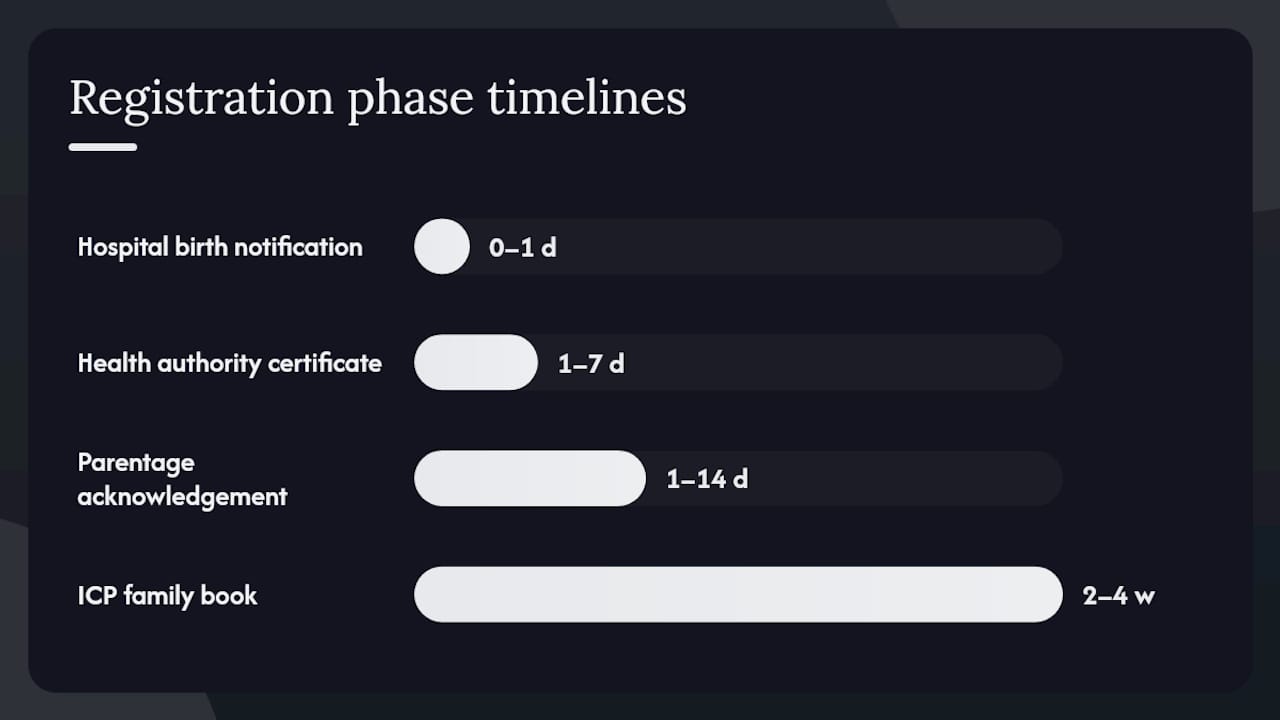
The process runs in five phases. Each has a responsible party and a realistic timeline.
Hospital birth notification (Day 0–1): The hospital issues a medical birth notification immediately after delivery. This document, issued under DOH or DHA oversight, starts the entire registration chain. Do not leave the hospital without it.
Health authority birth certificate (Days 1–7): Present the birth notification, both parents’ IDs, and any parentage acknowledgement to the relevant emirate’s health authority. They issue the official birth certificate. In Dubai, this is the DHA; in Abu Dhabi, the DOH.
Parentage acknowledgement or court order (Days 1–14, or longer if contested): For unmarried parents, a marriage certificate is replaced by a written acknowledgement of lineage from both parents. Under the registration rules, that acknowledgement must be certified by the parents’ embassy or by a UAE Notary Public. If the father is unwilling or absent, a court petition is required, and the court may order DNA testing under Federal Decree-Law No. 41/2022.
ICP registration and family book (Weeks 2–4): Once the birth certificate and parentage documents are in order, register with ICP to obtain the family book entry and begin the Emirates ID process for the child.
Embassy attestation, passport, and residency visa (Weeks 4–12): Submit attested documents to your embassy for passport issuance. MOFAIC handles attestation of foreign documents presented to UAE registries. Once the passport is issued, apply for the child’s UAE residency visa under a parent’s sponsorship.
Document map: who issues what
Document | Issuing body | Attestation required |
Medical birth notification | Hospital (DHA/DOH oversight) | No, but keep original |
Official birth certificate | Emirate health authority (DHA or DOH) | Yes, for foreign use |
Parentage acknowledgement | Parents, certified by embassy or UAE Notary Public | Embassy or Notary Public |
Family book entry | ICP | No |
Emirates ID (child) | ICP | No |
Passport | Home country embassy | MOFAIC attestation of UAE docs |
UAE residency visa | ICP / GDRFA | Completed passport required |
Pro Tip: Bring prenatal records, dated ultrasound images, and both parents’ full ID documents to every appointment. Registries use these to confirm parentage details and they can shorten the review period significantly.
When the father is unknown or refuses to acknowledge the child, the path runs through the courts. A competent UAE court can issue a judicial order for the birth certificate and may require DNA testing to establish paternity. This process takes longer, typically several weeks to a few months, so filing the petition early matters. An experienced family lawyer or documentation service can file the petition and manage the evidence requirements on your behalf.
Healthcare and maternity care for unmarried pregnant women
Hospitals in the UAE provide medical care regardless of marital status. The law does not permit a hospital to deny emergency obstetric care based on a patient’s relationship status. What varies is the administrative paperwork at admission, not the clinical care itself.
Documents hospitals typically request at admission:
Emirates ID or passport (both parents’ if possible).
Proof of UAE residence (visa page or residence permit).
Prenatal records and any existing medical reports.
Insurance card or proof of coverage.
Emergency contact details.
Insurance is where the practical complexity sits. Many private health insurance policies in the UAE list maternity care as a scheduled benefit that requires the policyholder to be married, or they apply waiting periods of 12 months from policy inception. Emergency delivery care is almost always covered regardless of marital status, but scheduled prenatal visits, elective procedures, and postnatal follow-ups may be subject to exclusions. Check your policy’s maternity section specifically, not just the general benefits summary.
If you are concerned about confidentiality, you can ask the hospital’s patient services team for a private consultation before admission. UAE hospitals are bound by patient confidentiality rules, and staff are not permitted to share your medical information without consent. The birth notification paperwork is an administrative document, not a public record.
Pro Tip: Call your insurer before your third trimester and ask specifically whether your maternity benefit requires a marriage certificate. If it does, you have time to either marry, switch plans, or arrange self-pay options before delivery.
Can you get married while pregnant in the UAE?
Yes. Marriage while pregnant is permitted in the UAE, and completing a marriage before delivery simplifies the birth registration process considerably. A valid marriage certificate replaces the need for a separate parentage acknowledgement, which removes one of the most document-intensive steps from the registration workflow.
Civil vs. Islamic marriage: a practical comparison
Civil marriage under the Personal Status Court (or the Abu Dhabi Civil Family Court for non-Muslims) suits non-Muslim couples or couples of different faiths. Islamic marriage (Nikah) is the standard route for Muslim couples and is registered through the marriage court. Both produce a legally recognized marriage certificate that UAE registries accept for birth registration.
Feature | Civil marriage | Islamic marriage |
Who it suits | Non-Muslim couples, mixed-faith couples | Muslim couples |
Typical timeline | 1–3 weeks from document submission | 1–2 weeks from document submission |
Key documents | Passports, birth certificates, proof of single status, translated and attested documents | Passports, proof of single status, guardian (wali) for bride in some cases |
Marriage certificate accepted for birth registration | Yes | Yes |
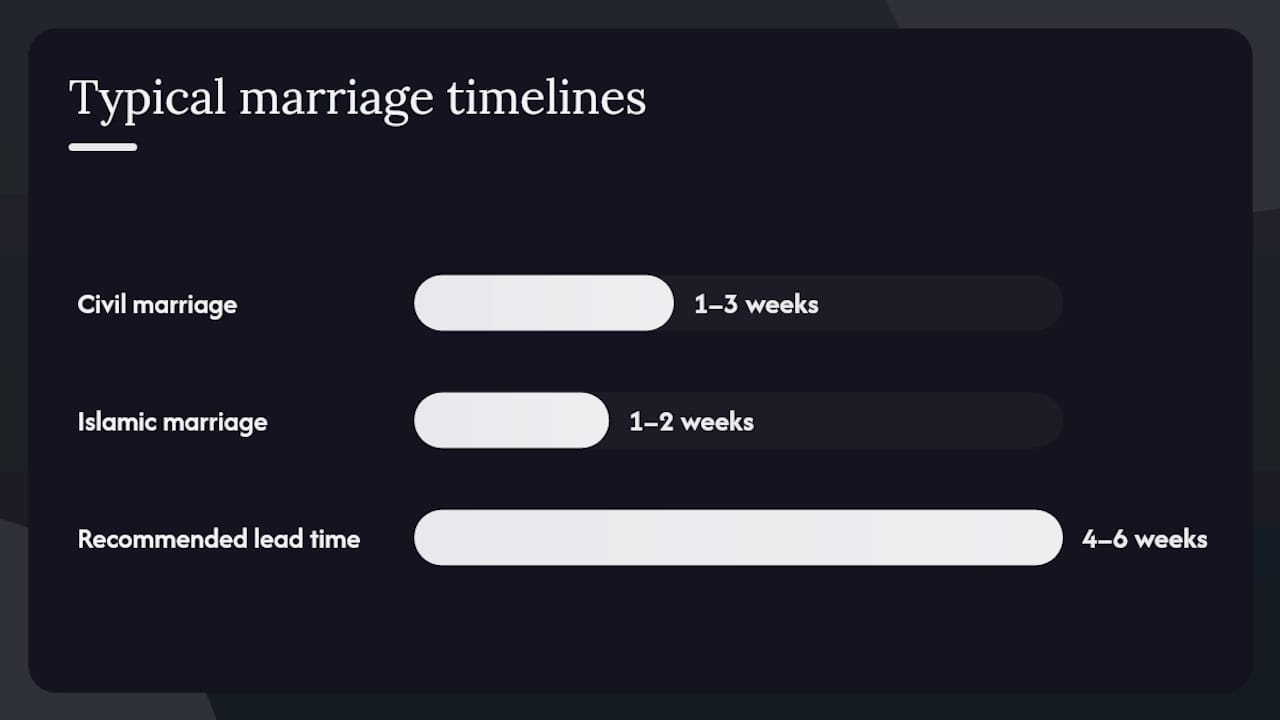
If timing matters, civil marriage can often be completed in under three weeks when documents are prepared correctly. The UAE marriage certificate process involves document attestation, translation, and court filing, and each step has a realistic minimum processing time. Starting the process at least four to six weeks before the expected delivery date gives a reasonable buffer.
Once married, the birth registration process uses the marriage certificate as the primary parentage document. The acknowledgement step is no longer required. The health authority issues the birth certificate with both parents’ names, and ICP registration follows the standard married-parents workflow.
Documents that change when you marry before delivery:
Marriage certificate replaces the parentage acknowledgement.
Birth certificate can list both parents without a court order.
Residency sponsorship application is straightforward once the birth certificate is issued.
For a full breakdown of what documents marriage registration requires, Harrisandcharms publishes a detailed guide covering both civil and Islamic routes.
When you need a lawyer and the mistakes that cost the most time
Get legal help immediately if any of the following apply: the father refuses to acknowledge the child, the hospital delays issuing the birth notification, either parent has a missing or expired ID, or there is a cross-jurisdictional nationality dispute (for example, one parent holds a nationality whose home country has different parentage rules).
Common administrative mistakes that delay or block registration:
Missing the ICP registration window, which can trigger fines.
Submitting un-attested foreign documents. Registries will not accept documents from abroad unless they carry MOFAIC attestation or embassy certification.
Inconsistent name spellings across parent IDs, the birth notification, and the acknowledgement document.
Assuming the hospital birth notification is sufficient on its own. It starts the process but does not complete it.
Failing to check insurance coverage before delivery, then discovering maternity claims are denied.
When to contact which body:
ICP: for birth registration timelines, Emirates ID applications, and family book queries.
Your embassy: for passport applications, nationality confirmation, and attestation of home-country documents.
UAE courts: when paternity is disputed, when a parent is absent, or when a document is legally challenged.
Pro Tip: Early involvement from a documentation service like Harrisandcharms reduces the chance of a delayed passport or residency visa for the child. The most expensive mistakes in this process are not legal fees; they are the weeks lost correcting an un-attested document or a misspelled name.
Your six-month checklist after birth (unmarried parents)
This checklist covers the tasks, responsible parties, and target timing for the first six months.
Immediate (Day 0–3):
Obtain medical birth notification from the hospital. Responsible: Hospital/parents.
Confirm both parents’ IDs are valid and consistent in spelling. Responsible: Parents.
Contact embassy to confirm nationality and passport requirements. Responsible: Parents.
Weeks 1–4:
Submit birth notification and parent IDs to the health authority (DHA or DOH) for the official birth certificate. Responsible: Parents.
Have the parentage acknowledgement signed, translated if needed, and attested by the embassy or UAE Notary Public. Responsible: Parents/legal service.
Register with ICP to open the family book entry and begin Emirates ID application. Responsible: Parents.
Months 1–3:
Submit attested documents to the embassy for passport application. Responsible: Parents/embassy.
Obtain MOFAIC attestation for any UAE-issued documents required by the embassy. Responsible: Parents/documentation service.
Apply for the child’s UAE residency visa under a parent’s sponsorship once the passport is issued. Responsible: Parents/ICP.
Months 3–6:
Confirm Emirates ID has been issued for the child. Responsible: ICP/parents.
Enroll the child in a health insurance plan and update the sponsoring parent’s policy. Responsible: Parents/insurer.
Register the child for school if applicable. Responsible: Parents/school.
Harrisandcharms typically slots into this timeline at steps 5, 7, and 8: parentage acknowledgement handling, embassy liaison for passport documents, and MOFAIC attestation. For couples who also need to marry before or shortly after delivery, the civil marriage package can run in parallel with steps 4 and 5.
Pro Tip: Keep a single folder, physical or digital, with every document in this checklist. Registries, embassies, and insurers will each ask for overlapping sets of the same papers. Having clean, attested copies ready to go saves days at each step.
A note from Harris
Sensitive cases are the ones we handle most carefully. Over the years, Harrisandcharms has supported couples and individuals navigating exactly this situation: a pregnancy that arrived before the paperwork, a partner abroad, a deadline approaching faster than expected. The work is confidential, practical, and focused on one outcome: getting the child’s documents in order as quickly as the system allows.
What I have seen repeatedly is that the families who move fastest are the ones who ask for help early, before a missed deadline or a refused document forces them into a court process. The law has changed; the administrative steps have not simplified themselves. A clear plan, prepared documents, and the right contacts at ICP, MOFAIC, and the relevant embassy make the difference between a six-week process and a six-month one.
If you are reading this and unsure where to start, the answer is the same every time: secure the hospital notification, get the parentage acknowledgement attested, and call someone who knows the registry workflow. That is what we are here for.
How Harrisandcharms handles marriage registration and birth documentation
Harrisandcharms offers a direct route through the paperwork that unmarried pregnant couples and individuals face in the UAE. The services most relevant to this situation include rapid civil marriage packages in Dubai, parentage acknowledgement handling, MOFAIC and embassy attestation, birth registration assistance, and passport and Emirates ID support.

The practical advantages: Harrisandcharms works directly with ICP and MOFAIC procedures, handles document translation and attestation in-house, and has established embassy contacts for the most common nationalities in the UAE. Turnaround on civil marriage packages typically runs one to three weeks when documents are complete. Attestation and liaison services are available as standalone engagements for couples who are already married but need help with the birth registration steps.
Confidentiality is standard, not optional. Every case is handled privately, and no client information is shared outside the team without explicit consent.
To get started, contact Harrisandcharms for a documents review. Bring your IDs, any existing prenatal records, and a note of your expected delivery date. The team will map the exact steps your situation requires and give you a realistic timeline. Visit Harrisandcharms marriage and documentation services to request a consultation or check availability.
Authoritative sources to consult
These are the primary official sources for the rules and procedures covered in this article.
Federal Decree-Law No. 31/2021 (Crimes and Penalties): — the legislation that decriminalized consensual sex and pregnancy outside marriage under Article 410. Available through the UAE Legislation portal.
Federal Decree-Law No. 41/2022 on Civil Personal Status: — governs parentage acknowledgement, waiting periods, and the legal basis for court-ordered DNA testing. Available through the UAE Legislation portal.
ICP (Federal Authority for Identity, Citizenship, Customs and Port Security): — publishes step-by-step guidance on birth registration, family book issuance, and Emirates ID applications at icp.gov.ae.
MOFAIC (Ministry of Foreign Affairs and International Cooperation): — publishes attestation procedures for foreign documents at mofa.gov.ae. Use this for any document originating outside the UAE that must be presented to a UAE registry.
Department of Health (DOH) and Dubai Health Authority (DHA): — publish hospital admission procedures and birth notification requirements. Check the relevant authority for your emirate.
This article is general information, not a substitute for advice from a qualified lawyer. Consult a qualified legal professional about your own circumstances before acting on anything here.
Recommended
Comments