
Validity of UAE Marriage Abroad: Ensuring Legal Recognition

Sorting through the maze of legal paperwork can feel overwhelming when couples in the United Arab Emirates plan to validate their marriage abroad. The journey goes beyond simply celebrating a union and extends into rigorous steps that affect residency, family rights, and travel. For both civil and Islamic marriages, securing international marriage recognition means tackling official documentation, attestation requirements, and embassy procedures. This guide sheds light on the essentials every expat couple needs for a legally recognized marriage outside the UAE.
Table of Contents
Key Takeaways
Point | Details |
International Marriage Validity | Couples must navigate a complex process involving documentation, attestation, and legal compliance in both the UAE and the destination country to ensure their marriage is legally recognized abroad. |
Civil vs. Islamic Marriages | Understanding the differences between civil and Islamic marriage frameworks is critical, as each has distinct legal requirements and implications for recognition outside the UAE. |
Document Requirements | Key documents, such as the official marriage certificate, passport copies, and proof of residency, must be meticulously prepared and authenticated to avoid legal complications. |
Common Pitfalls | Documentation errors, including incomplete certificates or improper translations, can lead to non-recognition of marriage, so thorough checks and consultations with legal professionals are essential. |
Defining Validity of UAE Marriage Abroad
Marriage validity across international borders requires precise legal documentation and strategic navigation of complex regulatory frameworks. In the United Arab Emirates, understanding the nuanced requirements for marriage recognition abroad is critical for couples seeking legal acknowledgment of their union across different jurisdictions.
According to the UAE’s Federal Decree Law No. 41 of 2022, non-Muslim residents now have comprehensive legal provisions for civil marriage registration, which significantly impacts international marriage validity. The law establishes clear guidelines for marriage certificate documentation that facilitate smoother cross-border legal recognition.
To ensure international marriage validity, couples must typically complete several key steps:
Obtain an official marriage certificate from UAE authorities
Have the certificate attested by the UAE Ministry of Foreign Affairs
Translate the document into the target country’s primary language
Get authentication from the relevant embassy or consulate
Ensure compliance with the specific legal requirements of the destination country
The legal recognition process involves multiple administrative checkpoints designed to validate the marriage’s authenticity. Couples must provide comprehensive documentation that meets both UAE and international standards, which often includes:
Original marriage certificate
Passport copies of both partners
Proof of marital status
Residency documents
Completed embassy-specific application forms
International marriage validity hinges on meticulous documentation and adherence to procedural requirements across different legal jurisdictions.
Pro tip: Always consult with official embassy representatives and legal professionals to confirm specific documentation requirements for your target country.
Civil vs. Islamic Marriages: Key Differences
The United Arab Emirates offers two distinct marriage frameworks that cater to different religious and cultural backgrounds: Islamic marriage and civil marriage. These two legal pathways provide couples with unique options for formalizing their union, each with its own set of procedural requirements and legal implications.
Islamic marriages are fundamentally rooted in Sharia law and primarily serve Muslim couples, following traditional religious protocols. Civil marriages in Dubai represent a more secular approach, designed specifically for non-Muslim residents and expatriates seeking legal recognition without religious constraints.
Key differences between civil and Islamic marriages include:
Religious Framework
Islamic Marriage: Governed by Sharia law
Civil Marriage: Secular legal contract
Participant Requirements
Islamic Marriage: Typically requires Muslim participants
Civil Marriage: Open to non-Muslims and mixed-faith couples
Procedural Specifications
Islamic Marriage: Requires guardian consent, religious witnesses
Civil Marriage: Focuses on legal consent and documentation
The administrative procedures for each marriage type reflect their distinct legal foundations. Islamic marriages demand specific religious protocols, including:
Presence of a male guardian (wali)
Religious officiating by an approved imam
Mandatory witnesses from the Muslim community
Compliance with Sharia legal interpretations
Conversely, civil marriages prioritize legal uniformity and individual consent:
Here’s a concise summary of how civil and Islamic marriages in the UAE differ across key criteria:
Criteria | Civil Marriage (UAE) | Islamic Marriage (UAE) |
Legal Basis | Secular law, civil contract | Sharia law, religious contract |
Who Can Marry | Non-Muslims, mixed-faith couples | Muslims only, both partners usually required to be Muslim |
Consent | Legal consent, personal autonomy | Guardian (wali) and religious witness required |
Documentation | Standardized legal documents, easier for expatriates | Religious and legal documents, often more complex |
Validity Abroad | Typically aligns with international standards | May face challenges in secular countries |
No religious prerequisites
Equal rights for both partners
Simplified documentation process
Alignment with international legal standards
Civil and Islamic marriages in the UAE represent parallel legal systems that accommodate diverse cultural and religious backgrounds.
Pro tip: Carefully research the specific requirements of your chosen marriage type and consult legal professionals to ensure complete compliance with UAE regulations.
Legal Requirements for International Recognition
Ensuring international legal recognition of a marriage requires navigating a complex landscape of bureaucratic procedures and regulatory compliance. Legal recognition extends beyond simply obtaining a marriage certificate, demanding a strategic approach to documentation and authentication across multiple jurisdictions.

The process of international marriage validation involves multiple critical steps, with marriage certificate documentation serving as the foundational element. Couples must meticulously prepare and authenticate their marriage documents to meet both UAE and international legal standards.
Key international recognition requirements include:
Obtaining an official marriage certificate from UAE authorities
Completing comprehensive document authentication
Ensuring proper translation of marriage documents
Meeting specific embassy and consular requirements
Verifying legal compliance in the target country
The authentication process typically involves several crucial administrative steps:
Obtain original marriage certificate from UAE authorities
Get certificate attested by UAE Ministry of Foreign Affairs
Translate document into the target country’s official language
Obtain embassy authentication and legalization
Submit documents to relevant legal authorities in destination country
Documentation requirements can vary significantly between different countries, necessitating careful research and preparation:
Apostille Certification: Some countries require an apostille stamp
Translated Documents: Certified translations may be mandatory
Notarization: Additional legal verification might be necessary
Specific Embassy Requirements: Each country has unique documentation standards
International marriage recognition is a complex process that demands precision, patience, and thorough documentation.
Couples must also be prepared for potential additional requirements:
Proof of marital status
Individual identification documents
Proof of legal eligibility to marry
Evidence of previous marriage dissolution (if applicable)
Pro tip: Consult with the specific embassy of your destination country and consider hiring a legal professional specializing in international marriage documentation to navigate complex recognition processes.
Process of Marriage Certificate Attestation
The marriage certificate attestation process represents a critical legal procedure for couples seeking to validate their marriage documents internationally. Navigating this complex administrative journey requires precision, patience, and a thorough understanding of multiple bureaucratic requirements.
Official attestation transforms a simple marriage certificate into a legally recognized document across different jurisdictions. Marriage certificate documentation serves as the foundation for establishing the marriage’s legal credibility and ensuring its acceptance in various governmental and administrative contexts.
The comprehensive attestation process typically involves several critical stages:
Original document verification
Notarization in the marriage location
Embassy authentication
Ministry of Foreign Affairs attestation
Translation requirements (if applicable)
Detailed steps for marriage certificate attestation include:
Obtain certified original marriage certificate
Get document notarized in the country of marriage
Authenticate the document at the UAE embassy or consulate
Submit for final attestation at UAE Ministry of Foreign Affairs
Obtain certified Arabic and English translations
Key documentation requirements for successful attestation:
Original Marriage Certificate: Must be a certified original document
Passport Copies: Of both partners
Proof of Residency: Current legal documentation
Translation Documents: Certified by authorized translators
Identification Proofs: Government-issued identification
Marriage certificate attestation is a meticulous process that bridges legal systems across international boundaries.
Additional considerations for couples include:
Verifying specific embassy requirements
Understanding potential processing times
Budgeting for potential translation and attestation fees
Maintaining multiple certified document copies
Pro tip: Initiate the attestation process well in advance and maintain digital and physical copies of all original documents to streamline your authentication journey.
Risks of Non-Recognition and Common Pitfalls
Navigating the complex landscape of international marriage recognition involves understanding the significant legal consequences of documentation errors. A single mistake in the attestation process can trigger a cascade of administrative challenges that potentially undermine the entire legal standing of a marriage.
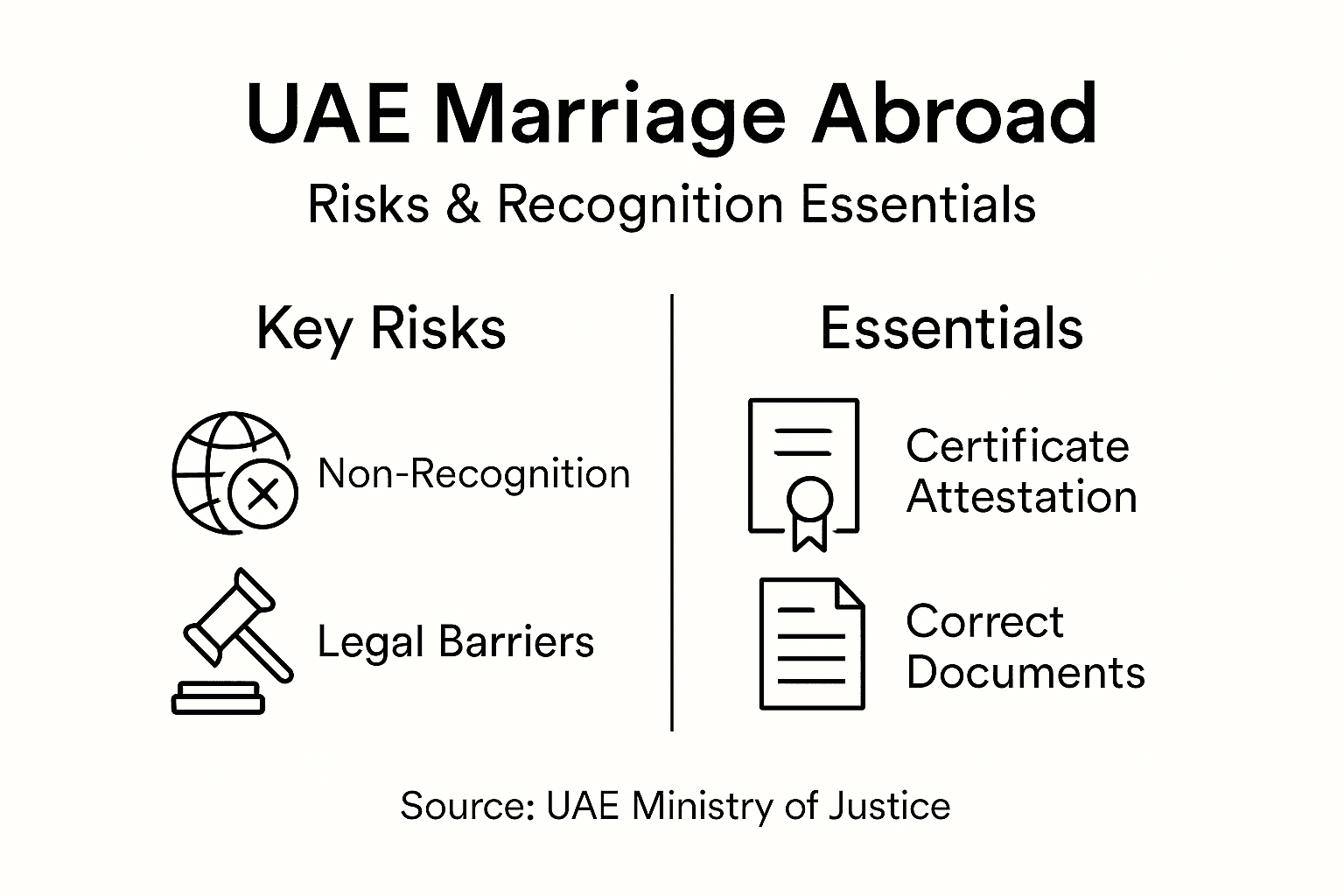
Marriage attestation processes represent critical legal checkpoints where couples must demonstrate precise compliance with administrative requirements. Failing to meet these stringent standards can result in comprehensive legal complications that extend far beyond simple paperwork rejections.
Significant risks of marriage non-recognition include:
Loss of spousal sponsorship rights
Inability to register children legally
Complications with inheritance claims
Challenges in obtaining family visas
Potential immigration and residency difficulties
Common documentation pitfalls that trigger non-recognition involve:
Incomplete original marriage certificates
Improper translations
Missing embassy attestations
Expired document validations
Incorrect notarization procedures
Documentation errors can manifest in several critical areas:
This overview highlights the most frequent risks and legal pitfalls when pursuing international marriage recognition:
Risk Area | Impact if Unaddressed | Prevention Strategies |
Document Translation | Rejection by foreign authorities | Use certified translators |
Expired Authentications | Loss of legal validity | Regularly verify dates, renew as needed |
Embassy Attestation | Delay or denial of recognition | Start process early, consult embassy |
Incomplete Records | Visa, inheritance complications | Double-check all documentation |
Format Inconsistencies | Administrative rejection | Follow standardized templates |
Translation Inaccuracies: Mistranslated documents invalidate legal processes
Attestation Gaps: Missing official stamps compromise document legitimacy
Timing Issues: Expired certifications render documents invalid
Format Inconsistencies: Non-standard document presentations trigger rejections
Legal recognition of marriages demands absolute precision in documentation and procedural compliance.
Critical consequences of marriage non-recognition encompass:
Potential deportation risks
Financial vulnerability
Complex legal disputes
Challenges in child custody scenarios
Limited healthcare and insurance access
Pro tip: Maintain multiple certified document copies and consult legal professionals specializing in international marriage documentation to preemptively address potential recognition challenges.
Secure Your UAE Marriage Validity Abroad with Expert Support
Navigating the complex process of ensuring your UAE marriage is legally recognized abroad can feel overwhelming. From obtaining official marriage certificates to completing intricate attestation and embassy authentication steps, there is no room for error. Common challenges include managing precise documentation, securing timely attestations, and understanding differing international legal requirements that directly impact your spousal rights, residency, and family sponsorship.
Harris & Charms is here to streamline your journey by offering personalized assistance with civil and Islamic marriage documentation, expert guidance on marriage certificate attestation, and comprehensive legal support tailored for international recognition. We take pride in simplifying this daunting process, ensuring that your marriage is fully valid and accepted worldwide so you can focus on building your life together.
Take the first step toward hassle-free international marriage recognition with trusted professionals who understand the stakes. Discover our complete range of services by visiting Harris & Charms.

Ready to guarantee your marriage validity abroad? Contact Harris & Charms today for expert help on marriage documentation, attestation, and legal compliance. Protect your rights and peace of mind now by exploring how we can assist at Harris & Charms. Learn more about marriage certificate attestation and how to navigate the legal requirements for successful international marriage recognition.
Frequently Asked Questions
What steps are involved in ensuring the validity of a marriage in the UAE for international recognition?
To ensure international marriage validity, couples should obtain an official marriage certificate from UAE authorities, have it attested by the UAE Ministry of Foreign Affairs, translate it into the target country’s primary language, obtain authentication from the relevant embassy or consulate, and comply with the specific legal requirements of the destination country.
What are the key differences between civil and Islamic marriages in the UAE?
Civil marriages are secular legal contracts primarily for non-Muslims and mixed-faith couples, while Islamic marriages are governed by Sharia law and primarily cater to Muslim couples. Each type has distinct procedural specifications, legal implications, and requirements for participants.
Why is marriage certificate attestation important for international legal recognition?
Marriage certificate attestation is crucial because it transforms a marriage certificate into a legally recognized document across jurisdictions. This process involves verifying the original document, getting necessary endorsements, and ensuring the document meets international legal standards for validation abroad.
What are common pitfalls that can lead to non-recognition of a marriage abroad?
Common pitfalls include incomplete original marriage certificates, improper translations, missing embassy attestations, expired document validations, and incorrect notarization procedures. These errors can lead to significant legal complications, including the loss of spousal rights and difficulties with immigration procedures.
Recommended
Comments