
What Is Family Court Marriage UAE – Expat Solutions


Securing a legal family court marriage in the United Arab Emirates can surprise even the most prepared American expats with its unique regulations and documentation standards. With over 80 percent of UAE marriages involving at least one foreign national, understanding your legal options becomes crucial. Whether planning a civil or Islamic ceremony, this guide sheds light on the most important steps, legal distinctions, and paperwork essentials for a smooth marriage process.
Table of Contents
Key Takeaways
Point | Details |
Family Court System | The UAE’s family court marriage system provides legal recognition for both Muslim and non-Muslim couples through distinct pathways: Islamic marriages and civil marriages. |
Important Legislation | Federal Decree Law No. 41 of 2022 modernized marriage procedures, allowing non-Muslims to marry under secular laws in family courts. |
Documentation is Crucial | Comprehensive and accurate documentation is essential for successful marriage registration; couples should prepare necessary papers in advance. |
Professional Guidance Recommended | Consulting with legal professionals specializing in UAE marriage laws can help expatriates navigate the complexities of the registration process effectively. |
Defining Family Court Marriage In The UAE
Family court marriage in the United Arab Emirates represents a sophisticated legal mechanism designed specifically to address the complex marital needs of a diverse expatriate population. Unlike traditional marriage registration processes, the UAE’s family court system provides comprehensive legal frameworks for both Muslim and non-Muslim residents, ensuring comprehensive recognition of marital unions across different cultural and religious backgrounds.
The legal foundation for family court marriages stems from Federal Decree Law No. 41 of 2022, which modernized marriage procedures for expatriates. This legislation enables non-Muslim residents to legally marry under secular procedures within designated family courts, transforming previous restrictive marriage registration practices. The system fundamentally distinguishes between two primary marriage registration pathways:
Islamic Marriages: Processed through Sharia courts for Muslim couples
Civil Marriages: Managed by secular family courts for non-Muslim expatriates
The Abu Dhabi Civil Family Court exemplifies this progressive approach, offering streamlined marriage registration processes that accommodate the international demographic of the UAE. By providing legal marriage frameworks that respect individual religious and cultural backgrounds, the system ensures legal protection and recognition for all residents.
Understanding the nuanced legal landscape is crucial for expatriates planning to marry in the UAE. The family court system does not just register marriages but provides a comprehensive legal infrastructure that addresses personal status matters, documentation requirements, and cross-cultural marriage complexities. Each marriage registration involves meticulous verification of documentation, legal eligibility, and compliance with both federal regulations and individual emirate-specific guidelines.
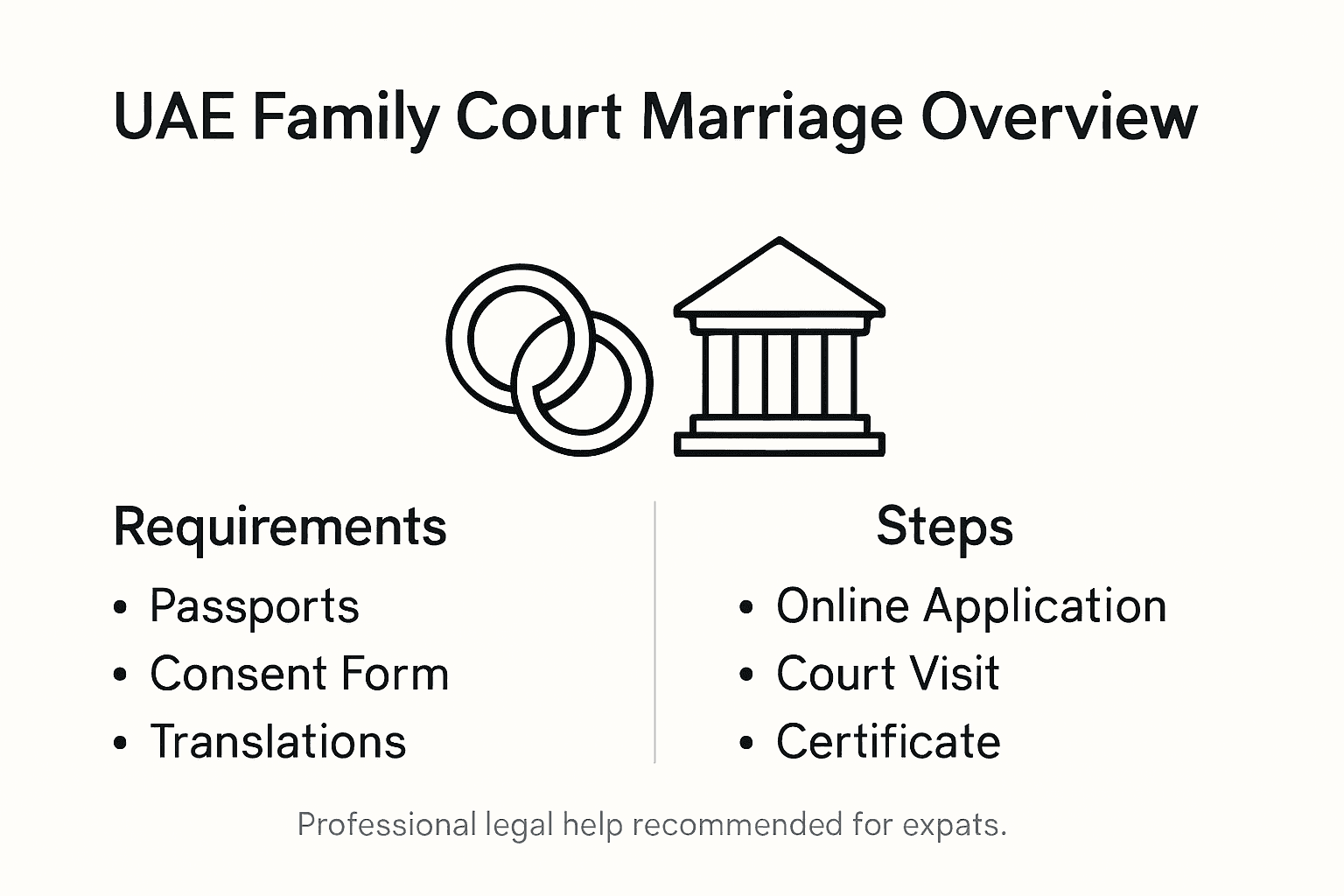
Pro tip: Always consult official family court resources and consider professional legal assistance to navigate the specific documentation and procedural requirements for your unique marital situation.
Civil Vs Islamic Family Court Marriage Options
The United Arab Emirates offers two distinct marriage pathways that reflect its diverse population’s complex legal and cultural needs: Islamic marriages and civil marriages. These frameworks provide comprehensive legal recognition for residents, ensuring that both Muslim and non-Muslim couples can formalize their unions through legally sanctioned processes.
Islamic marriages remain deeply rooted in traditional Sharia law principles, applying specifically to Muslim couples and following religious guidelines for marital union. These marriages are processed through specialized Sharia courts that interpret personal status laws according to Islamic jurisprudence. Key characteristics include:
Marriages conducted under religious protocols
Strict adherence to Islamic legal principles
Jurisdiction primarily for Muslim residents
Detailed religious documentation requirements
In contrast, civil marriage procedures represent a modern, secular approach designed to accommodate the UAE’s substantial expatriate population. These marriages, enabled by recent legal reforms, provide a flexible framework for non-Muslim residents to marry without religious constraints. The civil marriage system emphasizes:
Consent-based union registration
Secular legal processing
Equal rights for international couples
Simplified documentation procedures
The evolution of these marriage options reflects the UAE’s progressive approach to personal status laws. Recent legislative changes, particularly Federal Decree Law No. 41 of 2022, have significantly expanded marriage registration possibilities, allowing greater flexibility for residents from diverse backgrounds. This legal framework ensures that regardless of religious affiliation, couples can access comprehensive legal protections and recognition.
Here’s a summary comparing Islamic and Civil Family Court marriage processes in the UAE:
Aspect | Islamic Marriage | Civil (Non-Muslim) Marriage |
Legal Basis | Sharia law and religious courts | Federal secular law (Decree No. 41/2022) |
Main Audience | Muslim residents | Non-Muslim expatriates |
Documentation Review | Extensive religious validation | Standardized modern forms |
Flexibility for Expats | Limited by religious law | Broad, caters to international couples |
Emirate Differences | Strict local requirements | Abu Dhabi allows non-residents |
Pro tip: Consult with a legal professional specializing in UAE marriage laws to understand the specific requirements and implications of your chosen marriage pathway.
Step-By-Step Court Marriage Process Explained
Navigating the family court marriage process in the United Arab Emirates requires understanding the precise legal procedures that differ for civil and Islamic marriage registrations. For non-Muslim expatriates seeking to marry, the process involves a structured approach that emphasizes legal compliance, documentation accuracy, and official verification.
The initial stage of the court marriage process centers on document preparation. Couples must gather and submit comprehensive documentation, including:
Valid passports for both partners
Proof of current marital status (single/divorced/widowed certificates)
Passport-sized photographs
Completed court marriage application forms
Translated and authenticated legal documents
Civil marriage step-by-step procedures typically involve an online application submission through official UAE government portals. The Abu Dhabi Civil Family Court, for instance, provides a digital platform where couples can initiate their marriage registration process. This digital approach streamlines documentation review and reduces processing times significantly.

After document submission, couples must attend a mandatory court appointment where mutual consent is verified and marriage requirements are assessed. During this session, both partners appear before a court official who confirms their willingness to marry, reviews submitted documentation, and ensures all legal prerequisites are met. The process includes a formal declaration of intent, verification of individual identities, and payment of required court fees.
The final stage involves the official marriage contract signing and certificate issuance. Once all legal requirements are satisfied, the court issues an internationally recognized marriage certificate. This document serves as legal proof of marriage and can be used for various administrative purposes, including visa applications, residency permits, and other official documentation.
Pro tip: Ensure all personal documents are professionally translated and authenticated by recognized translation centers before submission to expedite your court marriage process.
Legal Requirements, Documents, And Residency Rules
Family court marriages in the United Arab Emirates require strict adherence to comprehensive legal requirements that vary significantly between civil and Islamic marriage processes. Expatriates must navigate a complex landscape of documentation, residency rules, and legal prerequisites to successfully register their marriage in the UAE.
Legal eligibility for court marriages involves several fundamental criteria:
Minimum age requirement of 18 years for both partners
Valid passport and identification documents
Proof of current marital status (single/divorced/widowed)
No existing marriage at the time of application
No blood relations up to the second degree
Residency plays a crucial role in marriage registration. Marriage requirements for UAE residents differ across emirates, with most requiring at least one partner to have a valid UAE residency permit. Abu Dhabi offers a unique exception, allowing non-residents to pursue civil marriage through its Family Court, providing greater flexibility for international couples.
Documentation represents the most critical aspect of the marriage process. Expatriate couples must prepare a comprehensive portfolio of authenticated documents, including:
Translated and notarized birth certificates
Single status certificates from home countries
Divorce or death certificates (if previously married)
Medical fitness certificates (required for some marriage types)
Valid passport copies with residency stamps
Special considerations exist for different categories of residents. Muslim couples typically undergo additional premarital medical screenings, while non-Muslim civil marriages have more streamlined documentation requirements. The specific documentation can vary depending on the emirate and the couple’s individual circumstances, making professional guidance often necessary to navigate the complex legal landscape.
Pro tip: Consult with a legal professional specializing in UAE marriage laws to ensure your documentation is completely accurate and meets all emirate-specific requirements.
Common Challenges And What Expats Should Avoid
Navigating family court marriages in the UAE presents a complex landscape of potential pitfalls for expatriates, with numerous legal and procedural challenges that can derail the marriage registration process. Understanding these obstacles is crucial for ensuring a smooth and successful marriage registration experience.
Documentation complexities represent the most significant challenge for international couples. Common issues include:
Incorrect or incomplete document translations
Failure to properly authenticate international certificates
Misunderstanding emirate-specific documentation requirements
Overlooking critical residency and visa-related prerequisites
Submitting outdated or improperly formatted documents
Legal implications of marriage registration require meticulous attention to detail. Expatriates frequently encounter roadblocks when they fail to understand the nuanced differences between civil and Islamic marriage frameworks. Each emirate maintains unique procedural requirements, making it essential to research and verify specific local regulations before initiating the marriage registration process.
Residency and legal status complications can create significant challenges for international couples. Some critical areas of concern include verifying the correct marriage process based on individual residency types, understanding which court has jurisdiction, and ensuring all documentation aligns with current UAE legal standards. Muslim and non-Muslim couples face different screening and documentation requirements, adding another layer of complexity to the marriage registration process.
Cultural and legal misunderstandings can lead to costly delays or outright rejection of marriage applications. Expatriates must be particularly cautious about assumptions regarding marriage procedures, documentation standards, and legal interpretations. Professional legal consultation can help navigate these intricate requirements and minimize the risk of administrative complications.
For quick reference, here are common challenges and strategies to avoid them when registering a marriage in the UAE:
Challenge | Description | Avoidance Strategy |
Document Authenticity | Wrong translations or missing stamps | Use licensed translation centers |
Emirate Variations | Different requirements by location | Check specific court guidelines |
Eligibility Errors | Overlooking age or marital status | Double-check legal minimums |
Residency Proof | Incorrect visa details or outdated permits | Update residency documents timely |
Pro tip: Engage a specialized UAE marriage registration consultant who understands the specific legal requirements of your emirate to avoid potential documentation and procedural errors.
Simplify Your Family Court Marriage Journey with Harris & Charms
Navigating the legal complexities of family court marriage in the UAE can be overwhelming, especially when dealing with varying documentation rules and emirate-specific requirements. Whether you are pursuing an Islamic marriage through Sharia courts or a civil marriage under Federal Decree Law No. 41 of 2022, the challenges of paperwork, legal compliance, and residency validations can quickly become stressful. Harris & Charms understands these precise difficulties and offers tailored solutions that make your marriage registration smooth and hassle-free.
Our personalized approach ensures your documents are professionally managed and your legal requirements fully met, respecting the unique needs of expatriates across all UAE emirates. From helping with authenticated translations to guiding you through court procedures and assisting with event planning and photoshoots, we cover all aspects of your matrimonial journey. Discover how easy formalizing your union can be by visiting Harris & Charms and exploring our comprehensive services designed just for you.
Ready to overcome the typical pitfalls and enjoy a seamless marriage registration process?

Contact Harris & Charms today to start your personalized family court marriage support. Let us help you turn your legal obligations into joyful beginnings with trusted expertise and heartfelt dedication. Visit our website now at Harris & Charms and explore how you can benefit from our expert assistance for both civil and Islamic marriages in the UAE. For detailed guidance on legal implications and step-by-step civil marriage support, check out our resources on legal marriage frameworks and civil marriage process. Your stress-free marriage journey starts here.
Frequently Asked Questions
What is the difference between Islamic and civil marriage in the UAE?
Islamic marriage is based on Sharia law and processed through religious courts for Muslim couples, while civil marriage is a secular option for non-Muslim expatriates, allowing them to marry without religious constraints under federal law.
What are the key legal documents required for a family court marriage?
Couples must submit valid passports, proof of marital status (single/divorced/widowed certificates), passport-sized photographs, completed marriage application forms, and translated and authenticated legal documents.
How can expatriates navigate the marriage registration process in the UAE?
Expatriates should prepare their documentation accurately, understand specific emirate requirements, and consider consulting a legal professional specialized in UAE marriage laws to ensure compliance with regulations and streamline the process.
What are common challenges faced when registering a marriage in the UAE?
Common challenges include incorrect or incomplete document translations, misunderstanding emirate-specific requirements, failing to verify residency proofs, and not recognizing eligibility criteria, which can lead to delays or rejections in the application process.
Recommended
Comments