
Civil Marriage in UAE: Legal Process for Expats


Nearly half of all American and European expatriates in the United Arab Emirates discover unexpected legal hurdles when planning a civil marriage. Securing government approval is often far more complex than booking a venue or writing vows. If you want to protect your international rights, avoid costly delays, and bring clarity to every document, understanding the UAE’s civil marriage framework is essential. This guide reveals strategies and solutions for expat couples, from legal paperwork to personalized planning services.
Table of Contents
Key Takeaways
Point | Details |
Civil Marriage Definition | A civil marriage in the UAE offers a modern legal method for non-Muslim expatriates to formalize their relationship through government recognition. |
Eligibility Requirements | Couples must be over 18, demonstrate free consent, and provide specific documentation including valid passports and proof of single status. |
Marriage Process Steps | The process includes document preparation, application submission, a marriage ceremony, and certificate issuance, typically taking 1 to 3 weeks. |
Rights After Marriage | Couples gain legal rights including spousal visa eligibility, joint property ownership, and medical decision-making authority upon marriage. |
Defining Civil Marriage in UAE for Expats
A civil marriage in the United Arab Emirates represents a modern legal pathway for non-Muslim expatriates seeking to formalize their relationship through a secular, government-recognized union. Unlike traditional religious marriage ceremonies, civil marriages in the UAE offer a flexible framework that allows international residents to marry according to their personal preferences and legal requirements.
Under the Federal Decree Law No. 41 of 2022, civil marriages are designed specifically to accommodate the diverse expatriate population in the UAE. The legal process enables non-Muslim couples to select marriage protocols that align with their cultural background or personal legal preferences. This innovative approach means couples can choose to follow their home country’s marriage laws or opt for alternative personal status regulations recognized within the UAE legal system.
The core characteristics of a civil marriage in the UAE include mandatory elements such as mutual free consent, legal marriageable age, and the absence of legal impediments like existing marriages or prohibited familial relationships. Importantly, these marriages are conducted through official government channels, ensuring complete legal recognition and providing couples with comprehensive documentation for their marital status.
Pro Tip: Before initiating your civil marriage process, carefully review all required documentation and consult with local authorities to ensure you meet all specific legal requirements for your specific nationality and residency status.
Eligibility and Key Requirements Explained
To be eligible for a civil marriage in the United Arab Emirates, couples must meet several specific legal criteria designed to ensure a transparent and legally sound union. The primary eligibility requirements center around age, nationality, marital status, and personal consent, creating a comprehensive framework that protects the rights of both parties involved in the marriage process.
The fundamental prerequisites for civil marriage include being over 18 years old, having the legal capacity to marry, and demonstrating free consent without any external coercion. Specific documentation requirements vary depending on the couple’s nationality and residency status, but generally encompass several key documents:
Valid passports for both partners
Proof of single status (single-status certificate)
Birth certificates
Passport-sized photographs
Emirates ID (for residents)
Consular letters or civil status extracts from home countries
Particularly important is the requirement that at least one partner must be a non-Muslim, especially if UAE nationals are involved. The marriage process allows for significant flexibility, permitting couples of different nationalities to marry, including tourists and temporary visitors. Crucially, marriages are not restricted by nationality, making the UAE an attractive destination for international couples seeking a straightforward civil marriage process.
Pro Tip: Always obtain and authenticate all required documents through official channels at least three months before your planned marriage date to avoid potential processing delays.
Here’s a quick guide to essential document roles for UAE civil marriage:
Document Type | Purpose in Marriage Process | Typical Source |
Passport | Confirms identity and nationality | Issuing country government |
Birth Certificate | Verifies date of birth and parentage | Civil registry of home country |
Emirates ID | Validates UAE residency status | UAE government |
Single-Status Proof | Affirms legal eligibility to marry | Consulate or local authorities |
Passport Photo | Required for application formalities | Professional photo studio |
Consular Letter | Clarifies marital status or details | Embassy or consulate |
Step-by-Step Civil Marriage Process
The civil marriage process in the United Arab Emirates is designed to be straightforward and accessible for expatriate couples, with clear procedural steps that ensure legal compliance and smooth documentation. Civil marriage procedures vary slightly between emirates, but generally follow a consistent national framework that prioritizes efficiency and legal transparency.
The typical civil marriage process encompasses several crucial stages:
Document Preparation
Collect all required personal documents
Obtain single-status certificates
Translate and authenticate documents through official channels
Prepare passport copies and photographs
Application Submission
Complete online pre-registration
Submit documentation to civil family court
Pay required administrative fees
Schedule official marriage appointment
Marriage Ceremony
Attend scheduled appointment at designated court
Sign marriage contract before official
Provide mutual consent
Complete final legal verification
Certificate Issuance
Receive bilingual marriage certificate
Obtain official attestation if needed for international recognition
Register marriage with relevant authorities
The entire process typically ranges from one to three weeks, depending on the specific emirate and completeness of submitted documentation. Couples should anticipate potential variations in processing times and remain flexible throughout the legal proceedings.

Pro Tip: Arrange for certified translations of all foreign-language documents well in advance, as accurate translations are critical for smooth processing of your civil marriage application.
Legal Rights and Responsibilities After Marriage
Upon completing a civil marriage in the United Arab Emirates, couples gain a comprehensive set of legal rights and responsibilities that provide a robust framework for their shared life. Legal implications of marriage are carefully defined under Federal Decree Law, ensuring both parties have clear protections and obligations within the UAE’s legal system.
The primary legal rights established through civil marriage include:
Spousal visa eligibility
Joint property ownership rights
Inheritance entitlements
Medical decision-making authority
Financial support obligations
Child custody and guardianship provisions
Couples must understand their mutual responsibilities, which extend beyond emotional commitment to legally binding financial and personal commitments. This includes financial transparency, mutual support, and adherence to UAE’s legal framework governing marital relationships. The marriage certificate serves as a crucial legal document that validates these rights, enabling couples to access various administrative and legal services.
Specifically, the legal system provides structured mechanisms for resolving potential disputes, protecting both parties’ interests through secular laws that emphasize equality and mutual consent. Couples should be aware that their legal rights can vary depending on specific circumstances, including nationality, residency status, and individual marriage agreements.
Pro Tip: Consult with a local legal professional to fully understand the nuanced legal rights and responsibilities specific to your unique marital situation in the UAE.
Common Pitfalls and How to Avoid Them
Navigating the civil marriage process in the United Arab Emirates requires careful attention to detail and proactive preparation. Civil marriage documentation strategies can help couples avoid the most common administrative and legal challenges that frequently derail marriage applications.
The most critical pitfalls couples encounter include:
Document Authentication Issues
Expired passport validity
Incomplete translation certifications
Missing official attestations
Incorrect document formatting
Eligibility Misunderstandings
Nationality restrictions
Religious marriage limitations
Age and consent requirements
Residency status complications
Procedural Errors
Missed court appointment windows
Incorrect fee submissions
Incomplete application packages
Miscalculated document validity periods
Many expatriate couples underestimate the complexity of UAE’s civil marriage regulations, which can vary significantly between different emirates. Understanding the nuanced requirements demands meticulous preparation and sometimes professional guidance. Each document must be carefully verified, translated, and authenticated through official channels to ensure smooth processing.
Pro Tip: Create a comprehensive document checklist at least three months before your planned marriage date, and consider consulting an immigration lawyer specializing in UAE civil marriage procedures to review your documentation.
Civil vs. Islamic Marriage: Key Differences
The United Arab Emirates offers two distinct marriage pathways that cater to its diverse population: civil marriage for non-Muslims and Islamic marriage governed by Sharia law. Islamic marriage processes and civil marriage differ fundamentally in their legal, procedural, and cultural frameworks, each designed to meet specific religious and secular requirements.
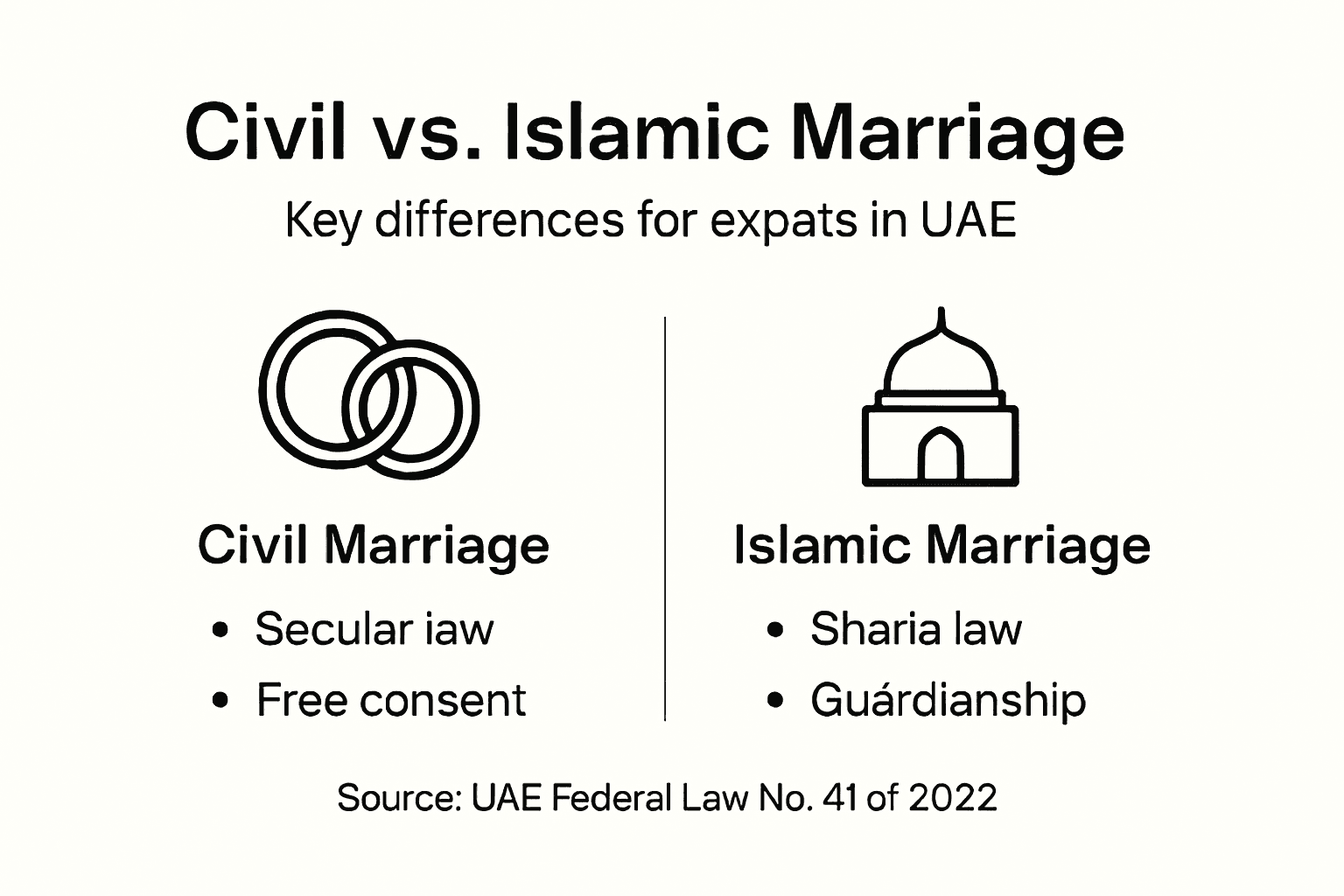
Key differences between civil and Islamic marriages include:
Legal Framework:
Civil Marriage
Secular legal governance
Based on Federal Decree Law
No religious prerequisites
Applicable to non-Muslims
Islamic Marriage
Governed by Sharia law
Religious rites mandatory
Strict religious eligibility criteria
Mandatory for Muslim nationals
Consent and Procedural Requirements:
Civil Marriage
Free consent without guardian approval
No mandatory pre-marital medical tests
Flexible for international couples
Islamic Marriage
Guardian consent often required
Mandatory pre-marital medical tests
Restricted interfaith marriage options
The secular nature of civil marriage provides a flexible alternative for expatriates and non-Muslim residents, allowing them to marry according to their personal preferences while maintaining legal recognition within the UAE’s comprehensive legal system.
This table compares how civil and Islamic marriages impact daily life in the UAE:
Area of Impact | Civil Marriage Approach | Islamic Marriage Approach |
Administrative Access | Open to non-Muslims; secular | Mainly for Muslims; Sharia-based |
Spousal Visa Rules | Recognized for expats | Governed by religious guidelines |
Property Rights | Joint ownership permitted | Sharia inheritance applies |
Medical Decisions | Spouses have legal authority | Follows Islamic family structure |
Pro Tip: Consult with legal professionals who specialize in UAE marriage laws to understand the nuanced requirements specific to your individual circumstances and nationality.
Simplify Your Civil Marriage Journey in the UAE
Navigating the civil marriage legal process as an expat in the UAE can feel overwhelming with strict documentation requirements, eligibility criteria, and procedural steps to follow. If you are concerned about document authentication, scheduling court appointments, or understanding your legal rights and responsibilities after marriage, you are not alone. Many couples face uncertainties when trying to comply with Federal Decree Law and local regulations.
At Harris & Charms, we specialize in offering personalized support designed to ease every step of your civil marriage journey. From helping you prepare and authenticate all necessary documents to managing your wedding planning and ensuring full legal compliance, our team is here to make the entire process stress-free. Rely on our expertise in civil and Islamic marriages along with trusted attestation services to secure your future together confidently.
Take control of your civil marriage plans today and avoid common pitfalls that cause delays and frustration.
Ready to get started with expert guidance and complete legal support?
Discover how we assist expat couples and explore our range of wedding services that bring your special day to life perfectly.

Contact us now at Harris & Charms to begin your hassle-free civil marriage experience and turn your dream wedding into a reality.
Frequently Asked Questions
What is civil marriage in the UAE for expats?
Civil marriage in the UAE is a secular legal process that allows non-Muslim expatriates to formalize their relationship through a government-recognized union, distinct from traditional religious ceremonies.
What are the eligibility requirements for civil marriage in the UAE?
To be eligible for civil marriage, couples must be over 18 years old, must have legal capacity to marry, demonstrate mutual consent, and provide the necessary documentation, including valid passports and proof of single status.
How does the civil marriage process work in the UAE?
The civil marriage process typically consists of document preparation, application submission, a marriage ceremony at a designated court, and the issuance of a bilingual marriage certificate, usually completed within one to three weeks.
What legal rights do couples gain after a civil marriage in the UAE?
After civil marriage, couples acquire several legal rights including spousal visa eligibility, joint property ownership, inheritance rights, and decision-making authority in medical matters, along with responsibilities pertaining to support and custody.
Recommended
Comments