
Court Marriage Procedure in the U.S.: A Guide for UAE Couples


TL;DR:
A U.S. civil marriage requires obtaining a license, holding a ceremony with an authorized officiant, and filing the signed license.
UAE couples must plan for apostille and attestation to ensure their U.S. certificate is recognized abroad.
A U.S. civil (court) marriage is completed through your county or city clerk’s office and requires four things: a marriage license application, any state-mandated waiting period, a ceremony before an authorized officiant, and the signed license returned to the clerk for filing. Here is what you need to know before you start.
TL;DR:
Start at the county clerk’s office or its official website for your chosen U.S. county
Bring a government-issued photo ID, proof of any prior marriage termination, and a birth certificate
Many counties require witnesses with valid photo ID at the ceremony
Next step for UAE couples: pull up the county clerk’s website today, then arrange apostille and certified translation services so your U.S. certificate is accepted for UAE residency or visa purposes
UAE couples who need the U.S. certificate recognized back home should plan for apostille processing through the relevant U.S. Secretary of State’s office and, where required, further attestation through the UAE embassy.
Table of Contents
What is the procedure of court marriage in the U.S.?
The sequence runs: apply for a license → satisfy any waiting period → hold the ceremony with an authorized officiant → file the signed license → request certified copies. Each step has county-specific rules, so confirming local requirements before you travel is non-negotiable.
Step 1: Determine county and state rules
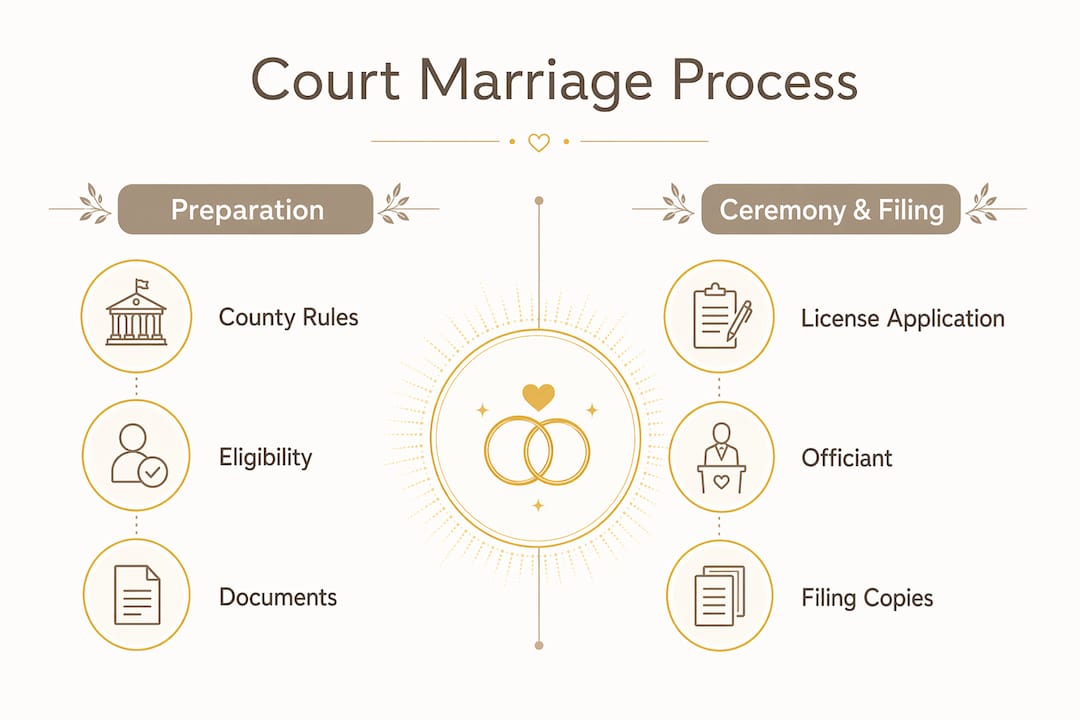
Marriage law in the U.S. is state-governed, and counties administer it. Eligibility requirements — minimum age, residency, prohibited relationships — differ by state. Check the state’s vital records office website and the specific county clerk’s page before anything else.
Step 2: Gather your documents
At minimum, expect to bring:
Valid government-issued photo ID (passport or driver’s license)
Birth certificate or equivalent age proof
Divorce decree or death certificate if either party was previously married
Proof of residency if the county requires it
Certified translations of any foreign-language documents
Step 3: Apply for the marriage license
Many counties now accept online pre-filing, which saves time at the counter. However, both parties typically must appear in person to sign the final application. Fees are paid at this stage. For UAE couples using a court marriage documents checklist, cross-referencing the U.S. county’s list against UAE attestation requirements early prevents duplicate trips.

Step 4: Satisfy any waiting period
Some states impose a waiting period between license issuance and the ceremony to protect voluntary consent, and this cannot be waived in jurisdictions that require it. A handful of states have no waiting period at all. This statutory pause exists to protect voluntary consent and cannot be waived in jurisdictions that require it. Confirm your county’s rule before booking travel.
Step 5: Schedule the ceremony and identify your officiant
Authorized officiants typically include judges, justices of the peace, magistrates, and ordained clergy. Some states allow a friend to become a one-day officiant through online ordination. The ceremony can take place at the clerk’s office or another approved location. The core legal act is a verbal declaration before the officiant and witnesses.
Step 6: Sign the license at the ceremony
Both parties, the officiant, and the required witnesses sign the license immediately after the ceremony. Most counties require one to two witnesses with valid photo ID. Witness ID is routinely checked, and a mismatch or missing ID can postpone the solemnization on the spot.
Step 7: File the signed license and request certified copies
The officiant or the couple returns the signed license to the clerk within the timeframe the county specifies, usually within a few days. Once recorded, you can request certified copies. If you need the certificate for UAE use, request at least three certified copies and initiate apostille processing through the Secretary of State’s office immediately.
What documents do you need, and what errors cause rejections?
Original documents and accurate affidavits substantially reduce the risk of rejection at the clerk’s office. Legal practitioners consistently identify administrative preparation, not the underlying law, as the most frequent source of delay.
Standard document checklist:
Government photo ID (passport preferred for foreign nationals)
Birth certificate (original or certified copy)
Divorce decree or death certificate for any prior marriage
Proof of nationality and current address if the county requests it
Witness photo IDs (originals, not photocopies)
Certified English translations of any foreign-language documents
Most common administrative errors:
Address discrepancies between ID and supporting documents
Name or date-of-birth mismatches across documents
Missing or unsigned affidavits of single status
Witness IDs that are expired or photocopied
Foreign documents without certified English translations
Pro Tip: Pre-validate your packet before visiting the clerk. Bring original documents, not photocopies, and have any foreign-language records translated by a certified translator. If you plan to use the U.S. certificate in the UAE, check the common mistakes in UAE marriage applications to avoid double errors on both ends.
Apostille processing adds a layer of preparation. The U.S. Secretary of State’s office (for the state where the marriage occurred) issues the apostille. Some UAE authorities then require further embassy attestation. Starting this chain early, ideally before the ceremony date, keeps the overall timeline manageable.
How do special situations change the process?
Special cases add documentary or jurisdictional steps to the standard workflow. The most common ones are foreign nationals, prior marriages, minors, military personnel, and situations where parties cannot appear together.
Foreign nationals: A valid passport and visa are required. Some counties request a notarized affidavit of single status or a Certificate of No Impediment from the applicant’s home country embassy. Confirm whether the county accepts foreign documents without prior legalization.
Prior marriages: A final divorce decree or death certificate is mandatory. Some counties require the decree to show a specific finality date before remarriage is permitted.
Minors: Most U.S. states have raised minimum marriage ages in recent years. Where exceptions exist, parental consent or a court order is required. Always check current state law directly.
Military personnel: Service records may affect timing. Power of attorney rules vary, and most counties do not allow a POA to substitute for the final in-person signing at solemnization.
Proxy or remote appearances: Proxy marriage is permitted in only a small number of U.S. states and only under specific conditions, such as active military deployment. In most counties, both parties must appear in person.
How long does the process take, and what does it cost?
Turnaround varies by county. Some issue a license the same day; others have multi-day processing plus a mandatory waiting period. For UAE couples coordinating travel, build in buffer time.
Fee category | Typical range | Notes |
Marriage license fee | Varies by county | Confirm on the county clerk’s published fee schedule |
Officiant fee | Varies | Judge/magistrate fees differ from private officiants |
Certified copy fee | Per copy, varies | Request multiple copies for UAE use |
Apostille fee | Per document, varies | Paid to the Secretary of State’s office |
Certified translation | Per page, varies | Required for foreign-language documents |
Expedited processing | Additional fee | Available in some counties |
Always pull the exact figures from the county clerk’s published fee schedule before you travel. Fees are not standardized across counties, and some clerks accept payment only in specific forms (cash, money order, or card). Ask when you call whether expedited certified copies or apostille routing is available.
What happens if a document is rejected or the filing fails?
Small administrative errors can usually be corrected by resubmitting or attending an in-person verification. Legal objections are rarer but require a more formal response.
Identify the rejection reason in writing. Ask the clerk for a written explanation. Verbal explanations are easy to misremember.
Gather corrected originals or certified documents. Address the specific deficiency, whether that is a certified translation, a corrected affidavit, or a replacement ID.
Return to the clerk for re-filing. Most clerical errors are resolved at this stage without legal intervention.
If an objection is filed, request written reasons and consider filing an appeal. Objections alleging bigamy, a prohibited relationship, or age disputes may require an attorney.
Consult an attorney when: the objection raises a legal bar (bigamy, prohibited relationship, age dispute); the clerk refuses without written explanation; or international recognition of the certificate is at stake. For UAE couples, Harrisandcharms can assist with re-filings, certified translations, apostille coordination, and couriering certified copies.
Why do couples choose a civil marriage over a religious ceremony?
A civil marriage certificate is government-issued legal proof, and it travels. Passports, visas, property records, and inheritance matters across most countries require exactly this kind of document.
Legal recognition: A civil certificate is universally recognized by government agencies; a religious ceremony alone may not be.
International use: Civil certificates are the standard starting document for apostille and attestation chains used in UAE immigration and Golden visa applications.
Neutrality: The ceremony has no religious requirement, making it accessible regardless of faith.
Speed: The civil process can be completed in a single day in many counties once the license is issued.
Name change and record updates: Social Security Administration, passport agencies, and financial institutions all require a certified civil certificate to process a legal name change.
A religious ceremony can follow a civil registration without any conflict. Many couples do both.
Key Takeaways
A U.S. civil marriage requires a county-issued license, an authorized officiant, witnesses with valid ID, and a filed signed certificate — UAE couples should add apostille and attestation planning from day one.
Point | Details |
Start at the county clerk | Confirm eligibility, fees, and waiting periods on the county clerk’s official website before booking travel. |
Prepare certified originals | Bring original documents and certified translations; photocopies and uncertified foreign records are the top rejection triggers. |
Plan for apostille early | Request multiple certified copies and start apostille processing through the Secretary of State immediately after filing. |
Witness ID matters | Bring witnesses with valid, unexpired photo ID; a mismatch can postpone the ceremony on the day. |
Harrisandcharms for UAE use | Harrisandcharms handles document attestation, certified translations, apostille coordination, and civil marriage packages for couples bridging U.S. and UAE requirements. |
What practitioners see most often go wrong
Most delays in civil marriage documentation come from small mismatches, not legal barriers. A name spelled differently on a birth certificate versus a passport, an address that does not match across two documents, or a witness who shows up with an expired ID — these are the things that derail a carefully planned trip to the clerk’s office.
Foreign-certified documents add another layer. A divorce decree issued in a non-English-speaking country needs a certified translation, and that translation needs to match the original character for character. Apostille chains for UAE use require the U.S. Secretary of State’s apostille first, then UAE embassy attestation. Couples who treat this as an afterthought often find themselves waiting weeks for documents they needed last month.
Where professional help genuinely pays for itself is in the coordination: getting translations done to the right standard, routing apostilles correctly, and making sure the certified copies that land in the UAE are in the exact format the relevant authority expects. Harrisandcharms covers that coordination, alongside event photography, yacht weddings, and Golden visa marriage registration support for couples whose paperwork needs to work in both countries.
Authoritative resources to check before you apply
Always confirm three sources before filing: the county clerk’s official website, the state vital records office, and the Secretary of State’s office for apostille instructions.
County clerk website: Fee schedules, required documents, waiting periods, and appointment booking
State vital records office: Certified copy requests and record corrections after filing
U.S. Secretary of State (state level): Apostille issuance for documents used abroad
UAE embassy or consulate in the U.S.: Guidance on whether a U.S. apostille is sufficient or further attestation is required
U.S. Department of State: Federal-level guidance on document authentication for international use
Consult an attorney when an objection alleges bigamy or a prohibited relationship, when an age dispute arises, or when cross-border recognition of the certificate is in question. For UAE-specific registration, the court marriage process in UAE guide covers what happens after your U.S. certificate arrives.
Request at least three certified copies at filing. Immigration applications, Golden visa submissions, and property transfers each typically require a separate original certified copy, not a photocopy.
This article is general information, not legal advice. Confirm current rules with your county clerk, state vital records office, or a qualified attorney for your specific situation.
Harrisandcharms makes the paperwork work for UAE couples
Getting legally married in the U.S. is straightforward once you know the steps. Getting that certificate to do its job in the UAE — apostilled, attested, translated, and accepted by the right authority — is where most couples hit unexpected friction.
Harrisandcharms is built for exactly that gap. The team handles certified translations, apostille routing, UAE embassy attestation, and couriering of certified copies so you are not chasing paperwork across two countries. Beyond the documents, the full-service offering covers civil marriage packages, event photography, yacht wedding packages, and Golden visa marriage registration support. Whether you need a clean legal registration or a complete wedding experience with every document in order, the team puts it together as one coordinated package.
Ready to get started? Explore civil marriage packages or browse the full range of marriage services to find the right fit for your situation.
Recommended
Comments