
What You Need for a Civil Marriage in the UAE


TL;DR:
A civil marriage in the UAE is a legally recognized union for non-Muslim couples, processed through court-driven procedures requiring specific documents and attestation. Abu Dhabi offers the fastest, most digitalized system, with same-day certificates available, while Dubai’s process is more in-person and lengthy. Proper preparation of documentation and simultaneous legalization steps help couples avoid delays and streamline their marriage process abroad.
A civil marriage is a legally recognized union formalized through a civil contract under UAE law, distinct from religious ceremonies and governed by civil family courts. If you are a non-Muslim couple planning to marry in the UAE, knowing exactly what documents and eligibility criteria you need before you walk into any government office will save you weeks of back-and-forth. The civil marriage legal framework in the UAE is court-driven, meaning strict documentation and judicial approval are the foundation of the entire process, not ceremony or tradition.
What do you need for a civil marriage in the UAE?
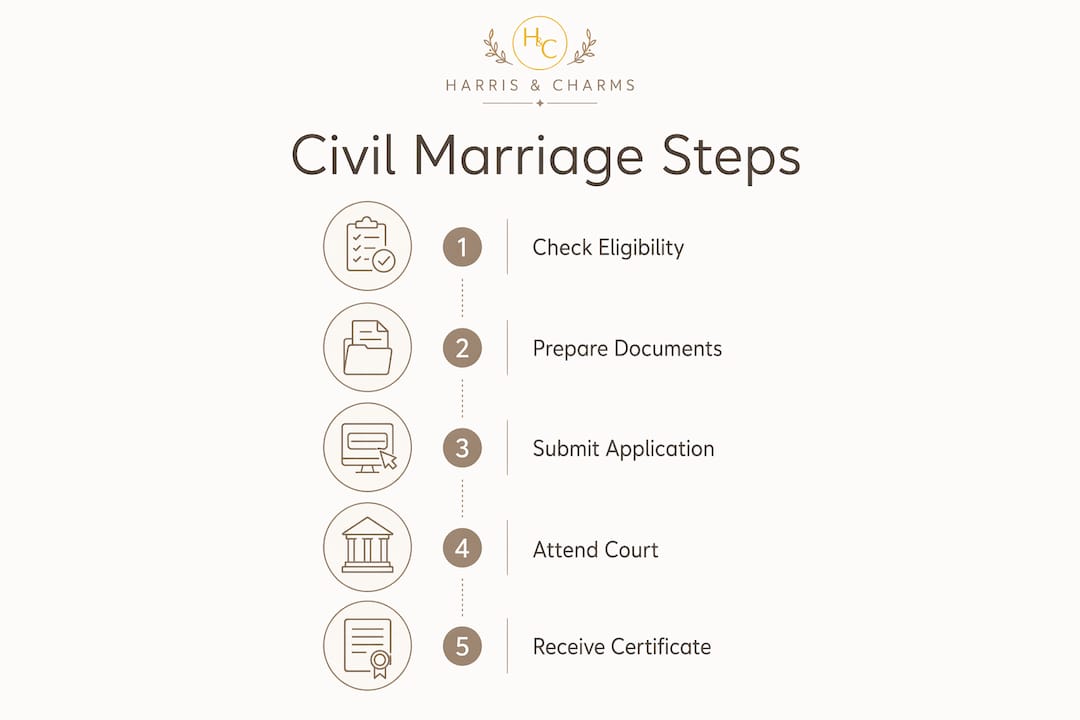
Civil marriage in the UAE is available to non-Muslim couples and is processed through civil family courts, with Abu Dhabi leading the way as the most accessible emirate for this pathway. The process requires meeting specific eligibility criteria, submitting a defined set of legal documents, and attending an in-person signing of the marriage contract. Understanding the full picture before you start prevents the most common and costly mistakes couples make.
Who is eligible for a civil marriage?
Eligibility for UAE civil marriage requires both parties to be at least 18 years old, have full legal capacity, give free and mutual consent, and not be currently married to anyone else. Neither party can be related within prohibited degrees of kinship. One critical rule that surprises many couples: at least one party must be a non-UAE national, since the Abu Dhabi civil marriage ordinance explicitly excludes UAE citizens from this pathway.

Residency status matters too. Both residents and visitors can apply, though the documents required differ slightly depending on whether you hold an Emirates ID or are entering on a tourist visa. Mixed nationality couples, including those where one partner holds residency and the other does not, are fully eligible as long as all other criteria are met. Emirate-specific rules apply, so couples marrying in Abu Dhabi face slightly different procedural requirements than those in Dubai or Ras Al Khaimah.
One detail that often surprises couples: no witnesses or premarital medical screening are required for a civil marriage in Abu Dhabi. This is a meaningful departure from religious marriage formalities and significantly simplifies the process for international couples who may not have family present in the UAE.
What documents do you need for a civil marriage application?
The civil marriage checklist is the most critical part of your preparation. Submitting incomplete or incorrectly formatted documents is the single biggest reason applications stall before the ceremony stage. The online upload portal acts as a compliance gate, and your application will not advance until every document meets the required standard.
Here is the standard list of documents for civil marriage in the UAE:
Valid passports for both parties (copies and originals)
Emirates ID for UAE residents; entry stamp or visa page for visitors
Proof of single status, such as a certificate of no impediment or a statutory declaration from your home country’s embassy
Divorce certificate if either party was previously married, attested and translated if not in Arabic or English
Death certificate if either party is widowed, with the same attestation requirements
Attested translations of any document not originally in Arabic or English
Completed application form submitted through the relevant emirate’s portal, such as the Abu Dhabi Judicial Department (ADJD) platform
Prenuptial agreement (optional), which can include customizable clauses agreed upon by both parties. This is a feature absent in most religious marriage contracts and gives civil marriage couples meaningful legal flexibility.
Pro Tip: Get your proof of single status and any divorce or death certificates attested by your home country’s foreign affairs ministry and then by the UAE embassy in your home country before you arrive. Doing this after you land adds at least two to three weeks to your timeline.
Documents not in Arabic or English must be attested and translated before submission. A certified legal translator recognized by UAE courts must handle this. Using an unofficial translation service is one of the most common reasons applications are rejected at the document review stage.
How does the civil marriage process work in Abu Dhabi vs. Dubai?
The procedures for a civil wedding differ meaningfully between Abu Dhabi and Dubai, and choosing the right emirate based on your timeline and residency can make a significant difference. Abu Dhabi currently offers the most developed digital infrastructure for civil marriage applications in the UAE.
The Abu Dhabi Judicial Department runs a digital marriage contract service that allows couples to complete most steps online, including document submission and fee payment. The service fee is Dh800, with average processing taking around two working days. After online approval, both parties attend an in-person signing of the contract at the ADJD office. The certificate is issued same-day for express service, or within three days for the regular service option.
Feature | Abu Dhabi (ADJD) | Dubai |
Online application | Yes, full digital portal | Partial, in-person steps required |
Service fee | Dh800 | Varies by court |
Express certificate | Same day | Not widely available |
Regular processing | Up to 3 working days | Typically longer |
Witnesses required | No | Depends on court |
Digital document upload | Yes | Limited |
Dubai’s civil marriage process runs through the Personal Status Court and involves more in-person steps. Processing timelines are generally longer, and the digital convenience available through Abu Dhabi’s ADJD platform is not yet replicated at the same level. For couples under time pressure, Abu Dhabi is the more practical choice. For couples based in Dubai who want to explore their civil marriage application options, understanding both pathways before committing saves time and unnecessary travel.
The Abu Dhabi electronic system improves convenience significantly, but it does not replace the need for correctly attested legal documents. The digital portal is only as fast as the documents you bring to it.
What steps are needed to legalize your UAE civil marriage certificate abroad?
A UAE civil marriage certificate is legally valid within the UAE from the moment it is issued. Using it abroad is a separate process that requires additional steps, and many couples underestimate how much time this takes.
Here is what you need to do to use your certificate internationally:
Ministry of Foreign Affairs (MOFA) attestation: This is the first mandatory step for international recognition of your UAE certificate. MOFA stamps the document to confirm its authenticity.
Embassy or consulate legalization: After MOFA attestation, you submit the certificate to the embassy of the country where you intend to use it. Each country has its own requirements and fees.
Apostille certification: If your destination country is a signatory to the Hague Convention, an apostille may replace the embassy legalization step. The UAE joined the Hague Apostille Convention in 2021, which has simplified this process for many couples.
Certified translation: If the destination country requires documents in its official language, a certified translation must accompany the attested certificate.
Pro Tip: Start your MOFA attestation and embassy legalization process at the same time as your court application, not after. Couples who wait until after the ceremony routinely lose three to six weeks on translations and embassy queues.
Starting legalization simultaneously with your court application is the single most effective way to avoid post-marriage delays. For a detailed breakdown of the attestation steps, the marriage certificate attestation guide from Harrisandcharms covers the MOFA and consulate process step by step.
Key takeaways
A civil marriage in the UAE requires valid passports, proof of single status, attested translations, and court-approved documentation, with Abu Dhabi offering the fastest and most digitized process for non-Muslim couples.
Point | Details |
Eligibility basics | Both parties must be 18+, non-Muslim, and at least one must be a non-UAE national. |
Core documents | Passports, Emirates ID or visa, proof of single status, and attested translations are required for all applicants. |
Abu Dhabi vs. Dubai | Abu Dhabi’s ADJD portal offers same-day express certificates; Dubai requires more in-person steps. |
Legalization timing | Begin MOFA attestation and embassy legalization at the same time as your court application to avoid delays. |
Optional prenuptial clauses | Civil marriage contracts in the UAE can include customizable prenuptial terms, unlike religious marriage contracts. |
What I have learned from helping couples navigate UAE civil marriage
After working with dozens of couples through the UAE civil marriage process, the pattern I see most often is this: couples who prepare their documents correctly the first time move through the entire process in under a week. Couples who do not spend two to four weeks fixing avoidable mistakes.
The most common error is assuming that a document attested in your home country is automatically ready for UAE submission. It is not. The attestation chain matters. Your document needs to be authenticated by your home country’s foreign affairs ministry, then by the UAE embassy in your home country, and in some cases by MOFA in the UAE itself. Skipping or reversing any step means starting over.
I also see couples get tripped up by emirate choice. If you are based in Dubai but your timeline is tight, traveling to Abu Dhabi to use the ADJD express service is genuinely worth it. The same-day certificate option is not a marketing claim. It works, and I have seen couples walk out with a signed certificate the same afternoon they arrived.
For mixed nationality couples, especially those where one partner is on a visit visa, the process is entirely doable. You do not need residency to marry civilly in the UAE. You need the right documents and the right preparation. The civil marriage requirements in Abu Dhabi are clear and publicly available. The process is not complicated when you know exactly what to bring.
My honest advice: treat the document checklist as a legal compliance exercise, not a formality. Every item on that list exists because the court needs it to verify your legal capacity to marry. Respect the process and it moves fast.
— Harris
How Harrisandcharms can help you prepare for your civil marriage

Harrisandcharms offers tailor-made civil marriage packages designed specifically for couples navigating the UAE’s legal requirements, whether you are residents, visitors, or a mixed nationality couple. The team handles document review, attestation coordination, and ceremony logistics so you are not piecing together the process from multiple sources. From your first inquiry to the moment you receive your marriage certificate, Harrisandcharms manages the details that typically cause delays. If you want expert support with your documentation and a ceremony that reflects your relationship, reach out to the team directly through the full range of marriage services available across the UAE.
FAQ
What are the basic requirements for a civil wedding in the UAE?
Both parties must be at least 18 years old, non-Muslim, free to marry, and at least one must be a non-UAE national. Valid passports, proof of single status, and attested documents are required for all applicants.
Can tourists get a civil marriage in the UAE?
Yes. Visitors on a tourist visa can apply for a civil marriage in the UAE, provided they meet all eligibility criteria and submit the required documents including their visa or entry stamp in place of an Emirates ID.
How long does the civil marriage process take in Abu Dhabi?
The Abu Dhabi Judicial Department issues certificates on the same day for express service and within three working days for the regular service, following successful document review and in-person contract signing.
Do you need witnesses for a civil marriage in the UAE?
No. Abu Dhabi’s civil marriage law does not require witnesses or premarital medical screening, which simplifies the process considerably compared to religious marriage formalities.
How do you use a UAE civil marriage certificate in another country?
You need Ministry of Foreign Affairs (MOFA) attestation first, followed by embassy legalization or an apostille depending on your destination country. Starting this process at the same time as your court application avoids weeks of post-marriage delays.
Recommended
Comments