
Avoid Attestation Delays: UAE Destination Wedding Rules for Expats

A legally valid destination wedding in the UAE is entirely achievable, and most tourist couples get there through the Abu Dhabi civil route, which accepts non-residents and does not require UAE residency. Dubai’s civil service works too, but only if one partner already holds Dubai residency. Muslim couples marry under the Sharia route, and some couples marry through their embassy or home country instead. Whichever path fits, start document attestation now, since that step usually takes longer than the ceremony itself.
TL;DR:
Most couples use the Abu Dhabi civil route, which accepts tourists and requires no residency, but document attestation can take several weeks.
Dubai civil marriages are fast but only available to residents holding a Dubai visa, limiting most tourists from using this path.
Muslim couples marry under the Sharia system, which follows separate procedures and documentation standards, regardless of residency.
Attestation of foreign documents involves multiple steps: origin authentication, embassy attestation, and MOFAIC stamping, and apostilles are not accepted by UAE authorities.
Planning the wedding typically requires 3 to 6 months due to processing times for documents, attestations, and court scheduling; full-service providers can streamline this.
Table of Contents
Which legal route applies to your destination wedding UAE legalities?
What documents and attestation steps do foreign couples need?
When should you use an embassy or home-country marriage instead?
What is the ideal timeline for planning a legally valid UAE wedding?
Civil, Sharia, or embassy: which governing law fits your future?
Let Harrisandcharms Handle the Legal Side of Your UAE Wedding
Which legal route applies to your destination wedding UAE legalities?
Three separate legal systems govern marriage in the UAE, and picking the wrong one is the single most common reason applications get rejected outright.
Abu Dhabi civil route: Run by the Abu Dhabi Civil Family Court under the Abu Dhabi Judicial Department (ADJD), this path operates under Abu Dhabi Law No. 14 of 2021 and accepts tourists with no residency requirement. It’s the default choice for foreign couples flying in specifically to marry.
Dubai civil route: Dubai Courts offers a 24-hour civil marriage license for eligible non-Muslim couples, but at least one partner must hold a Dubai residence visa. It’s fast once you qualify, but the eligibility bar shuts most tourists out.
Sharia route: For Muslim couples, marriage falls under Federal Decree-Law No. 41 of 2024, which governs personal status matters rooted in Sharia. This route has its own judicial procedures and documentation standards, separate from the civil system.
Embassy or home-country route: Some couples skip UAE civil marriage entirely and marry through their embassy or back home, then legalize that certificate for UAE use later.
Federal Decree-Law No. 41 of 2022 sits underneath all of this for non-Muslims, establishing civil marriage as an option and letting couples elect their home country’s law where applicable.
Do you meet the eligibility and residency rules?
Age and residency requirements shift depending on which court you approach, and this is where a lot of couples waste weeks chasing the wrong option.
Age: Abu Dhabi’s civil route generally works from age 18, with some flexibility in specific cases. Dubai’s civil service tends to apply stricter age thresholds, commonly 21, for its own licensing. Sharia marriages follow separate age and guardian rules.
Residency: Abu Dhabi accepts tourists outright. Dubai requires at least one partner to hold a Dubai residence visa, which rules out most fly-in couples.
Nationality and religion: Non-Muslim foreign nationals typically use the civil routes; UAE nationals and Muslim couples generally fall under the Sharia framework regardless of where they live.
Special cases: Anyone previously married needs a divorce or death certificate for the prior spouse. Prohibited-relation rules, guardian consent for younger applicants, and language barriers at the ceremony itself can also complicate an otherwise straightforward application.
Confirm your category before booking flights or a venue. It shapes everything downstream, from paperwork to which office you show up at.
What documents and attestation steps do foreign couples need?
Every foreign document you bring into a UAE court needs to survive a legalization chain before any clerk will accept it, and this is where timelines slip the most.
Standard documents required:
Valid passports for both parties
Proof of single status (or divorce/death certificate if previously married)
Birth certificates
Emirates ID, for any partner who is a UAE resident
Certified Arabic translations of every foreign-language document
Pro Tip: Order two or three certified copies of each document up front. Reprinting or re-authenticating a single missing paper later can add weeks back onto your timeline.
The attestation chain runs in a strict order: authentication in the document’s country of origin, then attestation by the UAE embassy or consulate in that country, then final stamping by the Ministry of Foreign Affairs and International Cooperation (MOFAIC) once you’re inside the UAE. This matters because the UAE is not party to the Hague Apostille Convention, so an apostille alone will not satisfy UAE authorities. Many couples assume it will and lose real time correcting that assumption. Translations must come from an authorized translator, and some documents may also need Ministry of Justice stamping.
What are the fees, timelines, and ceremony logistics?
Money and time both scale with how much flexibility you need, and the numbers vary sharply between a regular filing and an express one.
ADJD regular service: AED 300, with a processing time of around ten working days.
ADJD express service: AED 2,500, processed in one working day, ideal when your wedding date is fixed and non-negotiable.
Ceremony length: Approximately 15 minutes, with multilingual options available so neither partner needs to navigate the proceedings in a second language.
Dubai civil service: Offers 24 hour licensing, but only for eligible residents who clear the residency and age conditions first.
MOFAIC attestation fee: Commonly cited around AED 150 per document, on top of any fees charged by the embassy for its own attestation step.
Court ceremony day itself is brief: you show up with originals, sign in front of a judge or authorized officer, and walk out with a registered certificate. The paperwork leading up to that moment is where the real time goes.
When should you use an embassy or home-country marriage instead?
Marrying through your embassy or back home makes sense when you want your marriage governed entirely by your own country’s law rather than any UAE personal-status framework. Federal Decree-Law No. 41 of 2022 explicitly allows non-Muslim residents to elect their home country’s law, which is exactly what an embassy marriage locks in.
Avoids UAE court eligibility rules entirely, since the ceremony itself happens under foreign jurisdiction.
Still needs full legalization for UAE use: consular attestation in the home country, followed by MOFAIC stamping once you’re back in the UAE.
Best suited to couples who plan to eventually leave the UAE and want a marriage record that translates cleanly at home without a second layer of conversion.
The certificate carries no weight for UAE visa sponsorship or government transactions until it clears that same MOFAIC step.
What is the ideal timeline for planning a legally valid UAE wedding?
Treat this like a project with hard external dependencies, because embassy and MOFAIC processing times are outside your control.
3 to 6 months out: Decide your legal route and start collecting documents. Begin origin-country authentication immediately, since this step alone can eat several weeks.
6 to 8 weeks out: Submit for embassy attestation and order certified Arabic translations in parallel, not sequentially.
2 to 4 weeks out: Submit documents to MOFAIC and confirm your court booking, or lock in an ADJD express slot if your date is fixed.
Week of the ceremony: Verify every ID, print fresh originals, and confirm who needs to physically appear versus who can act through power of attorney where permitted.
Pro Tip: Build in extra buffer around embassy queues and UAE public holidays. Those two factors cause more schedule slippage than the court process itself.
How do wedding professionals prevent legal delays?
Professionals working this process daily catch the failure points before they cost you a rebooked flight or a missed ceremony date.
Pre-checking every document against both the issuing embassy’s requirements and MOFAIC’s current rules, before submission.
Managing the consular attestation chain directly, rather than leaving a couple to navigate a foreign embassy’s booking system alone.
Coordinating certified translations so nothing gets rejected for a mismatched name spelling or missing stamp.
Selecting the correct court, since applying to Dubai when you should have gone to Abu Dhabi Civil Family Court causes automatic rejection.
Coordinating ceremony-day logistics so witnesses, translators, and officiants are all in the same place at the same time.
A full-service provider can handle the entire process for couples arranging civil and Islamic marriage registration across the UAE, including document processing and court liaison.
Civil, Sharia, or embassy: which governing law fits your future?
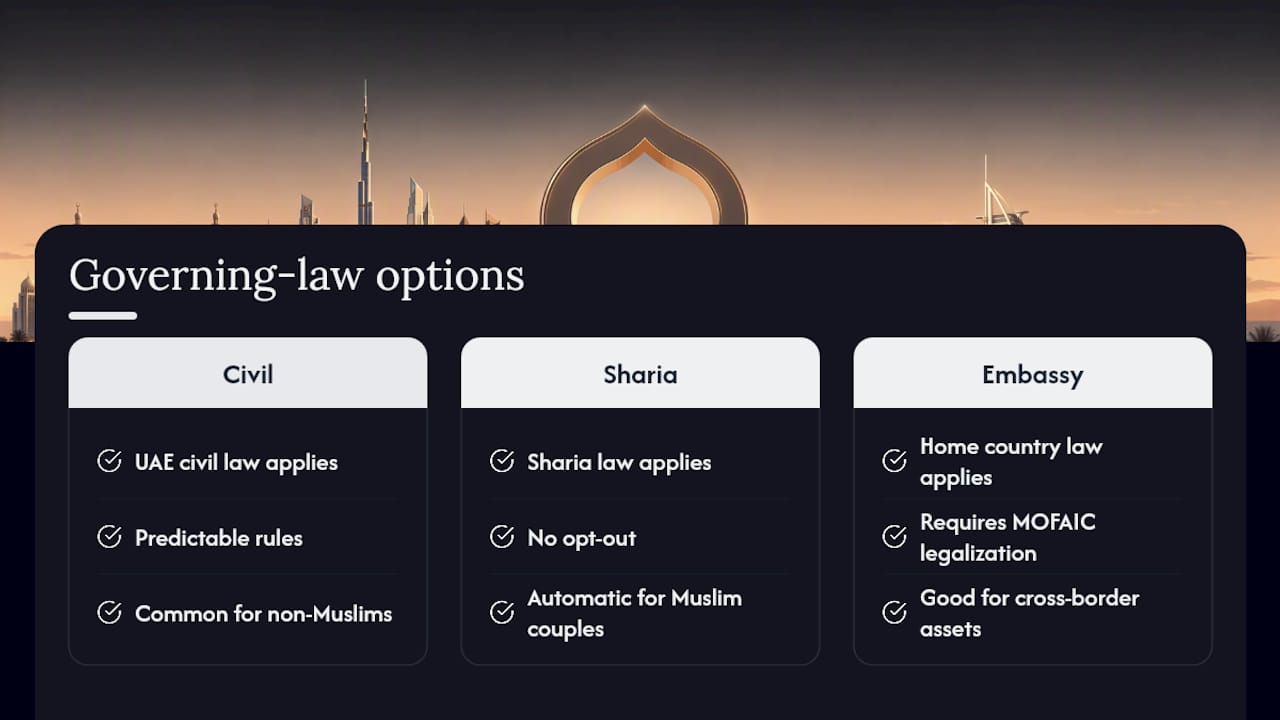
The route you choose isn’t just paperwork. It sets which legal system governs your marriage if you ever divorce, split assets, or raise children in the UAE. Civil marriage gives clear, predictable rules inside the UAE. Sharia governs Muslim couples by law, with no opt-out. Embassy marriages preserve your home country’s legal framework, but only after MOFAIC legalization makes that framework recognizable here.
If you have children, cross-border assets, or a prenuptial agreement in mind, talk to a family-law professional before you file, not after. The governing law you pick now follows you long after the ceremony ends.
— Harris
Let Harrisandcharms Handle the Legal Side of Your UAE Wedding
Chasing embassy attestation, MOFAIC stamps, and the right court booking is a full-time job on top of planning an actual wedding, and it’s the part most couples get stuck on. Harrisandcharms exists specifically to close that gap: full document processing, embassy liaison, MOFAIC attestation, and court booking handled alongside venue and ceremony coordination, so you’re not juggling three government offices while also picking a photographer.

Whether you need the standard ADJD timeline or an express turnaround for a fixed date, Harrisandcharms coordinates civil and Islamic marriage registration end to end, plus yacht wedding packages and full event planning for couples marrying anywhere in the UAE. If you’re an expat couple juggling a foreign document trail, the marriage attestation guidance walks through exactly what your embassy chain needs before MOFAIC will stamp it. Ready to get your documents moving? Reach out through the comprehensive marriage services page to start a document check and lock in your ceremony date.
Official Sources for UAE Marriage Procedures
Verify current fees and forms directly before you file, since court schedules and fee tables do shift.
ADJD civil marriage service page, for Abu Dhabi fees and booking.
Dubai Courts civil marriage information, for eligibility and licensing steps.
u.ae, the UAE government’s official guidance portal.
MOFAIC, for attestation requirements and current fees.
Your national embassy page in the UAE, for nationality-specific document rules. For broader context on how UAE legal regimes intersect with residency, this guide to living in Abu Dhabi is a useful companion read.
FAQ
What are the rules for a destination wedding in the UAE?
Non-resident couples generally use the Abu Dhabi civil route, which accepts tourists under Abu Dhabi Law No. 14 of 2021, while Dubai’s civil service requires at least one partner to hold Dubai residency. Muslim couples marry under the Sharia framework instead.
Can I sleep in the same hotel room as my partner in Dubai?
Unmarried couples sharing a hotel room is generally tolerated in practice across UAE hotels, though public decency laws technically still apply. This falls outside marriage law itself, so check current hotel policies and, when in doubt, confirm status with your accommodation directly.
What is the 30-minute rule for weddings?
There’s no official court ceremony duration rule tied to UAE marriage law. Court ceremonies at ADJD typically run around 15 minutes once all documents are approved and both parties are present.
Who pays for a destination wedding?
UAE marriage law doesn’t dictate who pays for the wedding itself. That’s a personal or family decision, though couples using a full-service provider like Harrisandcharms can bundle legal processing, venue, and ceremony costs into one package for easier planning.
Is a UAE marriage certificate recognized outside the UAE?
Yes, once it goes through the correct legalization chain, though the exact steps abroad depend on the receiving country. Most couples need the UAE certificate attested by MOFAIC first, then legalized again through their home country’s embassy in the UAE for full international recognition.
Recommended
Comments