
What is a marital status certificate? UAE guide 2026

Updated: Mar 23

Navigating marriage documentation in the UAE can feel overwhelming, especially when terms like marital status certificate appear in legal requirements. Many couples, particularly expatriates, assume this document is just another bureaucratic formality, but it serves a crucial legal function that affects everything from visa applications to inheritance matters. Understanding what a marital status certificate is and how to obtain it correctly can save you significant time and prevent legal complications down the road. This guide breaks down everything you need to know about marital status certificates in the UAE, from legal frameworks to practical application steps.
Table of Contents
Key takeaways
Point | Details |
Legal proof of status | A marital status certificate officially documents whether you are single, married, divorced, or widowed for UAE legal procedures. |
Federal law options | Federal Decree Law No. 41 of 2022 gives non-Muslims choices in applying personal status laws. |
Required documentation | You need valid passport, visa, and any previous marriage or divorce certificates to apply. |
Expatriate flexibility | Non-Muslim residents can choose between home country laws or UAE regulations for certain personal status matters. |
Processing varies | Certificate issuance timelines differ by emirate and document complexity, ranging from days to weeks. |
Understanding what a marital status certificate is
A marital status certificate is an official government document that certifies your current relationship status, whether single, married, divorced, or widowed. This seemingly simple piece of paper carries significant legal weight in the UAE, serving as foundational evidence for numerous official procedures. You’ll encounter requests for this certificate when applying for marriage licenses, processing visa applications, handling inheritance claims, or managing divorce proceedings.
For expatriates living in the UAE, this certificate becomes even more critical because it bridges your home country’s legal system with UAE requirements. Federal Decree Law No. 41 of 2022 provides non-Muslim residents options regarding personal status laws including marriage, creating flexibility but also requiring clear documentation of your status. Without proper certification, you may face delays or rejections in important life events and legal matters.
The certificate confirms your eligibility to marry, proves your freedom from existing marital obligations, and establishes your legal standing for family matters. Think of it as your relationship passport within the UAE legal system. Common situations requiring this document include:
Registering a new marriage with UAE authorities
Applying for spouse visas or family residence permits
Finalizing divorce proceedings or separation agreements
Managing estate planning and inheritance documentation
Updating civil status records with government agencies
Pro Tip: Request your marital status certificate well before you need it for official procedures. Processing times vary, and having it ready prevents last minute stress when deadlines approach.
Understanding your marital status as a UAE expat involves recognizing how this certificate fits into broader legal frameworks. The document isn’t just a formality but rather a legal instrument that protects your rights and clarifies your standing in personal status matters. Whether you’re planning to marry, divorce, or handle family legal affairs, this certificate serves as your starting point for navigating UAE’s personal status system effectively.
Legal framework and personal status laws for marital status in the UAE
The UAE’s approach to marital status certificates reflects its diverse population and commitment to accommodating different legal traditions. Federal Decree Law No. 41 of 2022 represents a landmark shift, enabling non-Muslims to choose applicable personal status laws in the UAE. This flexibility means you can opt to follow your home country’s regulations or adopt UAE civil law frameworks for marriage, divorce, and related matters.

Abu Dhabi introduced additional options through its Personal Status Law for non-Muslims, which provides a judicial mechanism for personal disputes including marriage. This creates multiple pathways for obtaining and using marital status certificates, depending on which legal framework you select. The choice you make affects everything from marriage contract terms to divorce procedures and inheritance rights.
Here’s how different legal frameworks compare for marital status matters:
Legal Framework | Applicable To | Key Features | Certificate Requirements |
Federal Decree Law No. 41 | Non-Muslim UAE residents | Optional civil marriage and divorce procedures | Standard UAE marital status certificate |
Abu Dhabi Personal Status Law | Non-Muslims in Abu Dhabi | Specialized court system for family matters | Abu Dhabi specific documentation |
Home Country Laws | Expatriates choosing origin laws | Follow native legal traditions | Home country certificate plus UAE validation |
Islamic Sharia Law | Muslim residents | Traditional Islamic marriage and family law | Sharia compliant status documentation |
These legal options create important considerations for your marital status certificate. If you choose to follow your home country’s laws, your certificate must be properly authenticated and translated. Selecting UAE civil law simplifies the process but requires understanding local requirements. The flexibility benefits couples from diverse backgrounds but demands careful planning to ensure your certificate aligns with your chosen legal pathway.
Understanding legal marriage documents in the UAE helps you navigate which framework best suits your situation. Each option carries different implications for how your marital status certificate will be issued, recognized, and applied in legal proceedings. The key is selecting the framework that aligns with your long term plans while ensuring your documentation meets all necessary requirements.
Pro Tip: Consult with legal professionals before choosing which personal status law framework to follow. Your decision affects not just your marriage but also future matters like child custody, property rights, and inheritance.
How to obtain a marital status certificate in the UAE: documents and process
Obtaining your marital status certificate requires following documented procedures including submission of identification and supporting marriage or divorce paperwork. The process varies slightly depending on your emirate, nationality, and chosen legal framework, but core requirements remain consistent across the UAE.
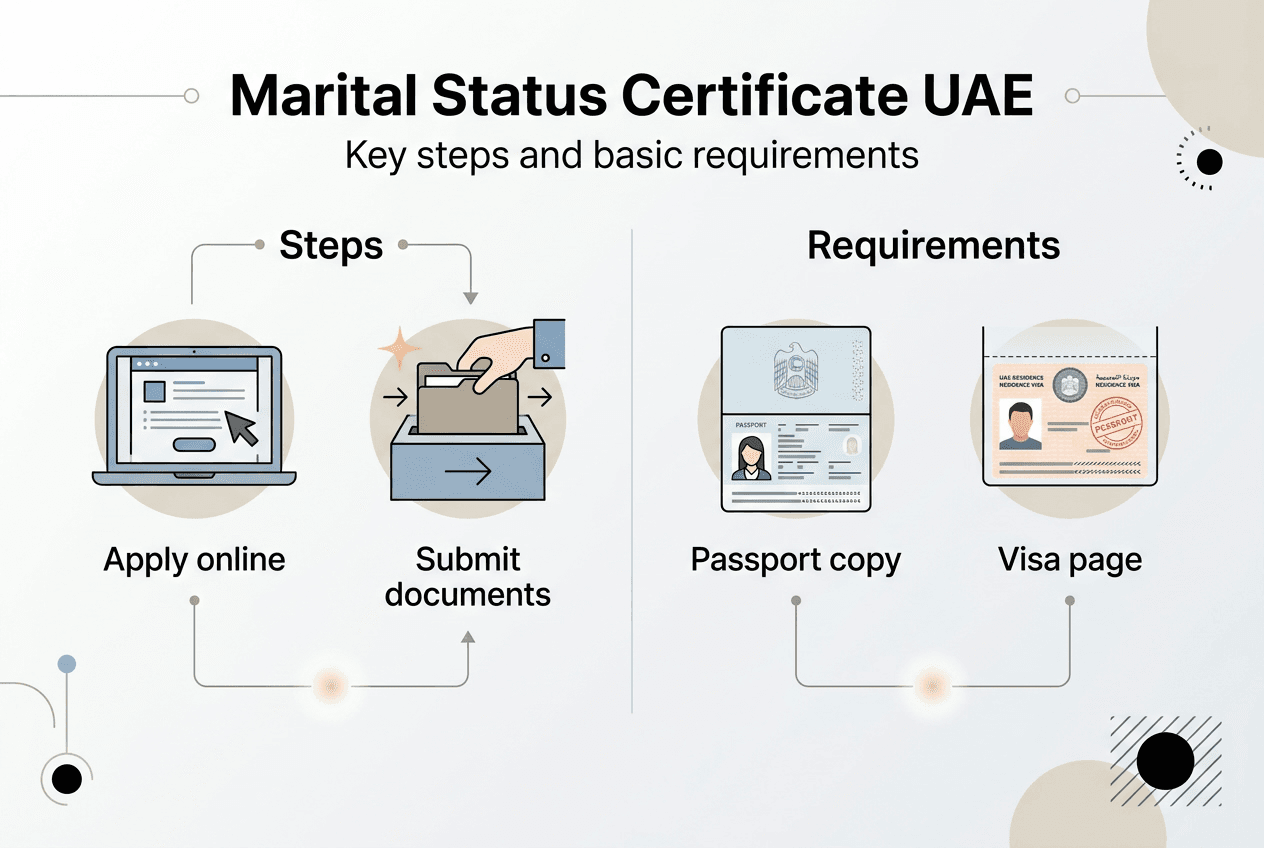
Essential documents you’ll need include:
Valid passport with current UAE residence visa
Original birth certificate with official translation if not in Arabic or English
Previous marriage certificates if you’ve been married before
Divorce decrees or death certificates if previously married
Passport sized photographs meeting UAE specifications
Completed application forms from relevant authorities
Follow these steps to obtain your certificate:
Determine which authority handles your application based on your emirate and nationality. Most expatriates apply through their embassy or consulate, while some can use UAE government portals.
Gather all required documents and ensure translations are certified by approved translation services. Missing or incorrect translations cause the most common delays.
Submit your application through the designated channel, whether online portal, embassy visit, or courthouse filing. Pay required fees and obtain receipt confirmation.
Attend any required interviews or appointments. Some authorities require personal appearances to verify information and answer questions about your marital history.
Track your application status and respond promptly to any requests for additional documentation. Processing times vary from several days to multiple weeks.
Collect your certificate once approved and verify all information is accurate before leaving the issuing office. Errors discovered later require reapplication.
The marriage certificate process in the UAE shares similarities with obtaining marital status certificates, and understanding both helps streamline your documentation journey. Many couples find it helpful to prepare both simultaneously when planning weddings.
Common mistakes that delay certificate issuance include submitting expired documents, providing uncertified translations, missing required signatures or stamps, and failing to disclose previous marriages. Double checking your application against the 7 step checklist for marriage documents ensures you haven’t overlooked critical requirements.
Different emirates maintain varying processing speeds and requirements. Dubai typically processes applications faster than other emirates, while Abu Dhabi offers specialized services for those choosing its Personal Status Law framework. Expatriates should confirm specific requirements with their embassy, as some nationalities face additional documentation needs or longer processing periods.
Pro Tip: Request multiple certified copies of your marital status certificate when it’s issued. You’ll likely need copies for different procedures, and obtaining additional copies later often requires repeating the entire application process.
Common scenarios and considerations for expatriates and couples in the UAE
Expatriates face unique challenges when managing marital status certificates because they must balance home country requirements with UAE regulations. Non-Muslim residents can follow home country laws or UAE personal status laws in certain cases, impacting their marital documentation. This flexibility creates opportunities but also potential confusion about which path provides the best outcome for your specific situation.
Consider these real world scenarios that commonly affect couples in the UAE:
A British expatriate divorced in the UK needs her decree recognized in the UAE before remarrying. She must obtain a marital status certificate showing divorced status, have her UK divorce decree authenticated by the UAE embassy in London, and submit both documents to UAE authorities.
An American couple married in the US wants to sponsor family visas in Dubai. They need a marital status certificate proving their marriage, which requires their US marriage certificate to be authenticated by the UAE embassy and translated into Arabic.
A Filipino professional planning to marry a European partner in Abu Dhabi must decide whether to follow Philippine law, European law, or Abu Dhabi’s civil marriage framework. Each choice requires different marital status documentation and affects future legal rights.
The table below compares key differences between local and expatriate certificate processes:
Aspect | UAE Nationals | Expatriates |
Issuing Authority | UAE Ministry of Justice or local courts | Home country embassy or consulate plus UAE validation |
Processing Time | Typically 3 to 7 days | Can extend to 2 to 6 weeks depending on country |
Required Documents | Emirates ID and family book | Passport, visa, home country certificates with authentication |
Legal Framework | Islamic Sharia or UAE civil law | Choice of home country law or UAE frameworks |
Translation Needs | Usually none | Often requires certified Arabic translations |
Cost Range | Lower government fees | Higher due to embassy, authentication, and translation fees |
Divorce situations present particular complexity. If you divorced outside the UAE, your divorce must be recognized by UAE authorities before your marital status certificate will reflect divorced status. This recognition process varies by country and can take months, so planning ahead is essential. Similarly, remarriage after divorce requires proving your previous marriage legally ended, which means coordinating documentation across multiple jurisdictions.
Inheritance matters also depend heavily on accurate marital status certificates. UAE inheritance laws differ significantly from Western systems, and your certificate establishes your legal standing to inherit or distribute assets. Choosing the wrong legal framework or having inaccurate status documentation can lead to prolonged legal battles and financial losses.
The Abu Dhabi marriage guide provides detailed insights into navigating these complexities within the capital emirate’s specific requirements. Abu Dhabi’s specialized Personal Status Law for non-Muslims offers streamlined procedures but requires understanding its unique documentation standards.
Pro Tip: Keep digital and physical copies of all marital status documents in secure locations. You’ll reference these documents repeatedly throughout your time in the UAE, and replacing lost certificates from foreign embassies can take months.
Simplify your marriage documentation with Harris & Charms
Navigating the complexities of marital status certificates and marriage documentation doesn’t have to be overwhelming. Harris & Charms specializes in helping couples like you manage every aspect of marriage procedures in the UAE, from obtaining essential certificates to planning your perfect wedding day. Our team understands the intricacies of UAE personal status laws and can guide you through documentation requirements tailored to your unique situation.

Whether you’re planning a civil marriage in Dubai or need assistance gathering legal documents, we offer personalized support that removes the stress from bureaucratic processes. Our comprehensive marriage services cover everything from document preparation and attestation to venue coordination and photography. We’ve helped hundreds of expatriate couples successfully navigate UAE marriage requirements, and we’re ready to make your journey smooth and memorable. Contact us today to discuss how we can support your marriage documentation needs and create the celebration you’ve been dreaming of.
Frequently asked questions
What is a marital status certificate and why do I need it in the UAE?
A marital status certificate is an official document that legally proves whether you are single, married, divorced, or widowed. You need it in the UAE for marriage registration, visa applications, divorce proceedings, inheritance matters, and updating government records. The certificate serves as foundational evidence of your relationship status for all personal status legal procedures.
Can expatriates use their home country’s marital status certificate in the UAE?
Home country marital status certificates can be recognized in the UAE if properly authenticated and translated. Federal Decree Law No. 41 of 2022 allows non-Muslim residents to follow their home country’s personal status laws or UAE laws. You typically need your home certificate authenticated by the UAE embassy in your country, translated into Arabic by certified translators, and validated by UAE authorities.
What documents are needed to apply for a marital status certificate in the UAE?
You need a valid passport with current UAE residence visa, original birth certificate with certified translation if necessary, and previous marriage certificates or divorce decrees if you’ve been married before. Additional requirements include passport photographs, completed application forms from UAE authorities or your embassy, and payment of processing fees. Check the UAE marriage documents checklist for comprehensive requirements.
How long does it take to get a marital status certificate in the UAE?
Processing times vary significantly based on your emirate, nationality, and application method. UAE nationals typically receive certificates within 3 to 7 days through local courts. Expatriates applying through embassies or consulates may wait 2 to 6 weeks depending on their country’s procedures and document authentication requirements. Complex cases involving previous marriages or divorces can extend processing times further.
Recommended
Comments