
How to Get a Civil Marriage: Guide for UAE Couples

Updated: Aug 1

TL;DR:
Getting a civil marriage in the U.S. requires applying for a license, having an authorized officiant solemnize the ceremony, and filing the signed license to obtain a legal marriage certificate. Couples must verify residency, age, marital status, and capacity, with specific rules on licensing and officiant authorization varying by state. Proper filing of the license produces a marriage certificate that serves as legal proof and must be accompanied by ordered certified copies for future use.
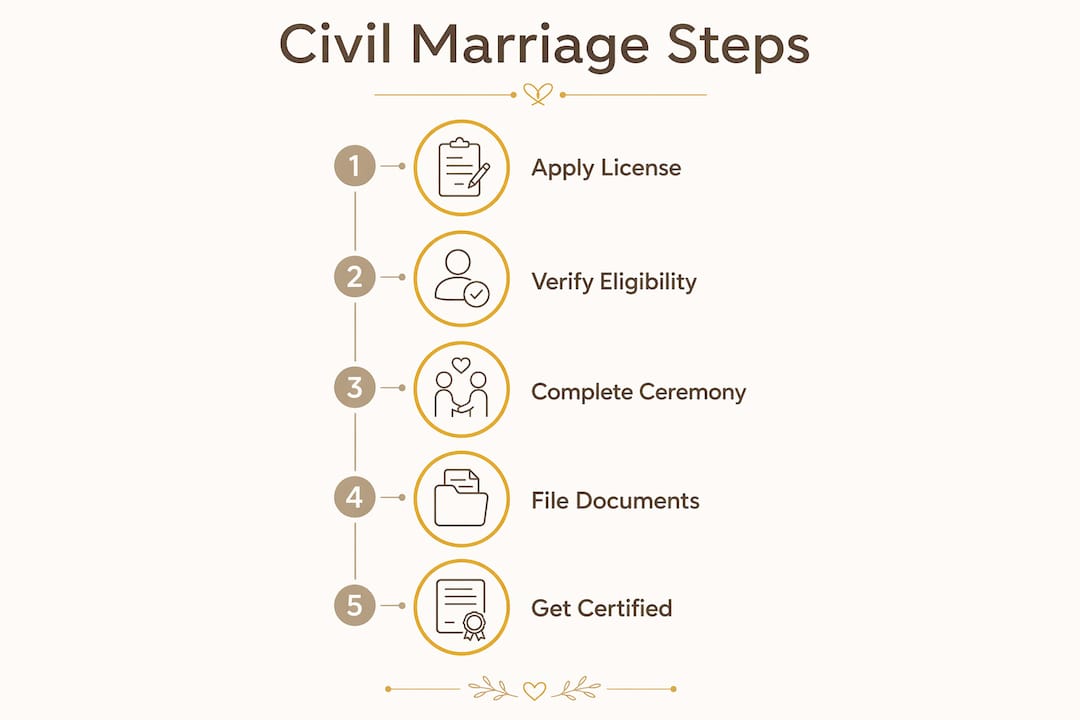
Getting a civil marriage in the United States requires three legal acts: apply for a marriage license at the county clerk’s office, have an authorized officiant solemnize the ceremony, then file the signed license to receive a certified marriage certificate. That certificate is the document that proves your marriage legally.
Start here:
Apply at the county clerk’s office in the county where the ceremony will take place. Bring valid government-issued photo IDs for both parties.
Gather proof of prior marriage termination if either of you has been married before. A certified divorce decree or death certificate is required.
Book your officiant and confirm filing duties before the ceremony date. Confirm they will return the signed license to the clerk within the required window.
A civil marriage carries the same legal weight as a religious one at both the state and federal levels. Start with the county clerk where you plan to marry, confirm the local waiting period, and build your travel schedule around the license’s validity window.
Table of Contents
Who can get a civil marriage in the U.S.: eligibility rules to check first
Step-by-step civil marriage process: from application to certificate
Foreign nationals, non-residents, and using your U.S. certificate abroad
How to get certified copies and handle the next administrative steps
Harrisandcharms handles the paperwork so you can focus on the wedding
Who can get a civil marriage in the U.S.: eligibility rules to check first
Most couples qualify without issue, but four eligibility gates trip people up before they even reach the clerk’s window.
Age. Every U.S. state sets a minimum age, typically 18 without parental consent. Some states permit marriages at 16 or 17 with a parent or guardian’s written approval. A handful of states have recently raised the floor to 18 with no exceptions.
Marital status. You must be legally free to marry. If either party has been previously married, you need a certified copy of the divorce decree or a death certificate. A self-declaration is not enough.
Legal capacity and consent. Both parties must enter the marriage voluntarily and with the mental capacity to understand what they are agreeing to. A marriage signed under duress or by someone lacking legal capacity can be voided.
Residency. This is where UAE-based couples often get caught off guard. Many states allow non-residents to apply, but the rules on where to apply vary. In New Jersey, for example, if neither party is a resident, the license must be obtained in the municipality where the ceremony will occur, and it may only be valid within that municipality. New York lets any couple apply at any town or city clerk’s office, regardless of residency.
The marriage license is not proof that your marriage happened. It is authorization to marry. The signed license, once filed with the government, produces the marriage certificate that serves as legal proof. Couples who skip or delay the filing step have no official record.
Waiting periods between license issuance and ceremony vary by state. License validity windows range from about a month to a year, with many states having a typical range around two months. Plan your travel dates around these windows, not the other way around.
Pro Tip: If you are traveling from the UAE specifically to marry in the U.S., confirm the waiting period and validity window for your chosen county before booking flights. A 72-hour waiting period plus a 30-day validity window in a short-stay visa scenario can make timing very tight.
Step-by-step civil marriage process: from application to certificate
Follow these steps in order. Skipping or reversing them is the most common reason couples end up with an invalid record.
Step 1: Choose your county. Apply in the county where the ceremony will take place. If you are a non-resident, this is especially important because some jurisdictions limit license validity to the issuing municipality.
Step 2: Book a clerk appointment. Many county clerks require or strongly prefer appointments. Walk-in availability is not guaranteed, and clerks can turn applicants away for missing documents or incorrect translations.
Step 3: Gather your documents. Both parties need valid government-issued photo ID (passport works for foreign nationals), Social Security numbers if applicable (or a signed declaration if you have none), birth dates and birthplaces, and certified copies of any divorce decrees or death certificates for prior marriages. Foreign-language documents require certified English translations.
Step 4: Pay the license fee and apply in person. Most counties require both parties to appear together and sign the application. Marriage license fees typically range from $20 to $115, with some counties offering discounts for completion of premarital counseling.
Step 5: Observe the waiting period. If your state imposes one, you cannot legally marry until it passes.
Step 6: Hold the ceremony with an authorized officiant. The officiant must be legally authorized in the state where the ceremony occurs. See the next section for who qualifies.
Step 7: File the signed license. The officiant is typically responsible for returning the signed license to the clerk, usually within 5–10 business days of the ceremony. Confirm this obligation with your officiant before the wedding day.
Step 8: Order certified copies. Request multiple certified copies at the time of filing. Most counties charge a fee per certified copy. Couples are advised to order multiple copies to cover needs such as passports, immigration, banking, and employer records.
Step | Typical Cost | Typical Timeline |
Marriage license fee | $20–$115 | Same day as application |
Waiting period | No fee | up to 72 hours after issuance |
License validity window | No fee | about a month to a year |
Officiant filing deadline | No fee | 5–10 business days post-ceremony |
Certified copy (each) | $7–$15 | At filing or by mail request |
For a civil marriage checklist tailored to expats, that resource walks through each document category in detail.
Who may officiate and where a civil ceremony can take place
Under U.S. statutory law, consent alone does not create a legal marriage. The ceremony must be solemnized by a person authorized by state law. Nevada’s statutes make this explicit, and most states follow the same principle.
Authorized officiants generally include judges, magistrates, justices of the peace, county clerks, and ordained ministers registered with the state. Some states also recognize online ordinations, but acceptance varies by county. An unregistered or unrecognized officiant means the ceremony has no legal effect, even if it felt official.
An unauthorized officiant creates a ceremony with no legal standing. The couple leaves believing they are married, but no valid record exists. Correcting this later requires a new license, a new ceremony, and sometimes a court proceeding.
Venue rules are more flexible. Courthouse and city hall ceremonies are the most straightforward because the clerk can often serve as officiant on the spot. Off-site locations, including hotels, parks, and private properties, are generally permitted as long as the officiant is authorized. Some counties require off-site officiants to register or obtain a permit before performing ceremonies outside the courthouse.
Pro Tip: Ask your officiant directly: “Will you personally return the signed license to the clerk within the required deadline?” Get that confirmation in writing. A delayed or lost filing means your marriage has no official record until the issue is resolved, which can take weeks.

Foreign nationals, non-residents, and using your U.S. certificate abroad
UAE-based couples face a specific set of considerations that most U.S.-focused guides skip entirely.
Applying as a non-resident or tourist:
Apply in the county where the ceremony will occur, not where you live.
Confirm whether the license is valid statewide or only within the issuing municipality. New Jersey, for example, limits non-resident licenses to the issuing municipality.
Bring your passport as your primary ID. Foreign nationals do not need a U.S. Social Security number but may need to sign a declaration confirming they have none.
If your prior marriage was dissolved abroad, bring a certified translation of the divorce decree alongside the original.
Using the U.S. certificate in the UAE:
A U.S. marriage certificate is not automatically recognized in the UAE. It must go through apostille certification, followed by UAE Ministry of Foreign Affairs attestation and, in some cases, consular legalization. Skipping any step in that chain means the document has no legal standing in the UAE.
The apostille process starts with the Secretary of State’s office in the state where the certificate was issued. Once apostilled, the document typically goes to the UAE Embassy or consulate for further attestation. For couples who need the certificate recognized for a UAE residency visa, Golden visa application, or family sponsorship, the full attestation chain is non-negotiable.
For a detailed breakdown of UAE-side requirements, the civil marriage requirements UAE guide covers the attestation steps specific to the UAE process.
Most common mistakes and how to avoid them
The civil marriage process is straightforward when every step lands in the right order. Most failures come from a small set of recurring errors.
The single most common mistake: couples confuse the marriage license with the marriage certificate. The license is a time-limited permission slip. The certificate is the legal record. Missing the filing step between them is what invalidates most marriages that “felt” complete.
Mistakes to avoid:
Arriving at the clerk’s office without both parties present, or without certified (not photocopied) divorce or death records.
Booking travel around the ceremony date without checking the license validity window. An expired license means starting over, including repaying fees.
Assuming an informal ceremony with an unregistered officiant counts as legal solemnization. It does not.
Ordering only one certified copy at filing. One copy gets lost, damaged, or held by an institution, and ordering replacements later costs more time and money.
Pro Tip: Before you travel, call the county clerk’s office directly and ask: “Do you accept foreign-language documents with certified translations?” and “Is an appointment required?” Clerks can and do turn applicants away for missing items, and a missed appointment in a short-stay visa window can derail the entire trip.
For a broader look at documentation oversights, the marriage pitfalls UAE guide covers the same category of errors on the UAE side of the process.
How to get certified copies and handle the next administrative steps
Once the signed license is filed and the marriage certificate is issued, the administrative work is not quite finished.
Ordering certified copies:
Request copies at the time of filing. Most counties process them the same day.
Order at least 5–8 copies if you need the certificate for passports, immigration, banking, employer records, and UAE attestation.
Each certified copy typically costs $7–$15. Ordering them all at once is cheaper and faster than requesting them individually later.
Name change steps (if applicable):
Social Security Administration: bring the certified marriage certificate and your current ID to update your Social Security record first. Other agencies require the SSA update before they will act.
DMV or state motor vehicle authority: update your driver’s license or state ID with the new SSA card and marriage certificate.
Passport: submit Form DS-5504 (if within one year of issuance) or DS-82/DS-11 with the certified certificate and current passport.
Bank and financial accounts: each institution has its own process, but most require a certified copy and updated government ID.
Employer and insurance records: HR departments typically accept a certified copy for benefits and payroll updates.
For couples returning to the UAE:
Apostille the certificate through the issuing state’s Secretary of State office before leaving the U.S. if possible. Once back in the UAE, Harrisandcharms can coordinate the Ministry of Foreign Affairs attestation and any consular legalization steps needed for residency, visa, or Golden visa applications.
Pro Tip: If you are short on time before your return flight, at minimum order the certified copies and confirm the apostille mailing address. The apostille can be processed by mail, but the certified copies must come from the issuing county clerk first.
Key Takeaways
Getting a U.S. civil marriage legally requires a valid license, an authorized officiant, and a filed signed license that produces the marriage certificate used for all legal purposes.
Point | Details |
License vs. certificate | The license authorizes the ceremony; the filed signed license produces the certificate that is legal proof. |
Fees and validity | License fees run $20–$115; most licenses are valid for 60 days, with waiting periods of up to 72 hours. |
Officiant filing duty | Confirm your officiant will file the signed license within 5–10 business days or your record may not exist. |
Order multiple copies | Request 5–8 certified copies at $7–$15 each at filing for passports, immigration, banking, and UAE attestation. |
Harrisandcharms support | Harrisandcharms coordinates apostille processing, UAE Ministry attestation, and post-marriage registration for couples returning to the UAE. |
What experienced planners know that most guides leave out
The procedural steps for a U.S. civil marriage are well-documented. What is less discussed is the gap between a ceremony that feels complete and one that is legally complete. That gap is almost always a filing problem.
Couples traveling from the UAE face a compressed timeline that makes this gap more dangerous. A 72-hour waiting period, a 30-day validity window, and a return flight booked before the officiant has filed the license is a combination that produces a lot of panicked follow-up calls. The fix is not complicated: confirm the officiant’s filing obligation before the ceremony, not after.
The apostille question is similarly underestimated. Many couples assume the U.S. certificate is automatically usable in the UAE. It is not. The apostille is not a formality. It is the legal mechanism that makes a U.S. document readable by a foreign government. Skipping it means the document has no standing in the UAE, regardless of how official it looks.
One practical tip worth repeating: order more certified copies than you think you need. Institutions hold originals. Banks, embassies, and HR departments rarely return documents. Running out of certified copies six months after the wedding, when the county clerk requires a written request and a processing wait, is an avoidable problem.
Harrisandcharms handles the paperwork so you can focus on the wedding
Coordinating a U.S. civil marriage from the UAE means managing two legal systems at once. Harrisandcharms specializes in exactly that overlap: civil marriage packages, legal document attestation, apostille processing, and UAE post-marriage registration for couples who need their U.S. certificate recognized for residency, family sponsorship, or Golden visa applications.

Beyond the paperwork, Harrisandcharms offers event photography, yacht wedding packages, and premium registration services for Golden visa holders who need a fully documented marriage record for their UAE status. Whether you are planning a destination ceremony or need a U.S. certificate attested for UAE legal use, the team handles filing coordination, apostille logistics, and Ministry of Foreign Affairs attestation from start to finish.
Book a document-check consultation or explore civil marriage packages to confirm exactly what your situation requires. For couples who need broader event and registration support, the full wedding services page covers every package in detail.
Official resources to verify before you apply
Before traveling or booking any appointments, confirm the current rules directly with the issuing authority. Requirements, fees, and waiting periods change without notice.
Your chosen county clerk’s website: Search “[county name] marriage license” to find the official application page, fee schedule, and appointment booking system.
Your state’s vital records office: Handles certified copy requests after the certificate is issued and can confirm apostille procedures for that state.
U.S. Department of State apostille page: The official resource for understanding which documents require an apostille and which Secretary of State office handles your state’s requests.
UAE Embassy or consulate in the U.S.: Confirm current attestation requirements for U.S. marriage certificates before you leave the country.
State-specific guides: Requirements vary significantly by state. The Georgia marriage requirements guide is one example of how state-level rules differ from the general framework described here.
Call the county clerk’s office directly before your appointment. Confirm they accept foreign-language documents with certified translations, whether both parties must appear in person, and the current wait time for certified copies. A five-minute phone call prevents a wasted trip.
Recommended
Comments