
Avoid Attestation Delays When Marrying in the UAE as a British Expat: Tips on british expat marriage uae

Updated: Sep 7
Most British expats marrying in the UAE will use one of two civil routes: Abu Dhabi’s civil marriage service if either partner is a tourist or non-resident, or Dubai’s civil marriage service if one partner holds Dubai residency. Muslim couples typically go through a Sharia court instead. Start by gathering both passports, checking your residency status, and confirming which emirate’s requirement you meet, or contact Harris & Charms to handle the paperwork for you.
TL;DR:
Couples should prioritize gathering valid passports, residency proofs, and single status documents early to avoid delays in the attestation process.
Passport mismatches, uncertified translations, or leaving attestation until deadlines can significantly stall the marriage certification timeline.
Abu Dhabi offers a quicker civil marriage option at AED 300 with a ten-day wait, while Dubai’s 24-hour service requires Dubai residency for faster processing.
Most delays stem from incomplete or improperly attested documents, especially failing to follow the full legalization chain with embassy and MOFAIC attestations.
Using a managed service like Harris & Charms can streamline paperwork, legal procedures, and logistics, reducing errors and expediting your marriage process.
Table of Contents for British expat marriage
Quick Checklist: What To Prepare Before You Apply
Before touching a single form, get your documents in order. British nationals underestimate how much of the delay in expat marriage process UAE applications comes from missing paperwork, not court backlogs.
Passports and Emirates ID copies. Both partners need valid passports; if either of you is a UAE resident, bring your Emirates ID too.
Visa or residency status confirmation. This determines whether you’re eligible for Dubai’s faster route or need to apply through Abu Dhabi instead.
Proof of single status. If either of you was previously married, you’ll need a final divorce decree or a death certificate for a deceased former spouse.
Certified translations. Any document not in English or Arabic needs a certified translation before submission.
MOFAIC attestation planning. If you’re using a UK-issued certificate, budget time for the full legalization chain, not just a quick stamp.
Pick your emirate. Decide between Abu Dhabi civil, Dubai civil, or a Sharia court based on your eligibility, then book your slot or hand the whole thing to Harris & Charms.
Pro Tip: Photocopy everything twice before you leave home. UAE court clerks routinely ask for a duplicate set on the day, and scrambling for a copy shop mid-appointment is a wasted morning.
Which Legal Route Fits Your Situation?
The UAE runs several parallel marriage systems, and picking the wrong one wastes weeks. Here’s how they actually differ for requirements for marrying in UAE as a British national.
Abu Dhabi civil marriage. The Abu Dhabi Civil Family Court accepts both tourists and residents, which makes it the default choice for couples who don’t meet Dubai’s residency bar. Fees run AED 300 for the standard service and AED 2,500 for express processing, which can shorten the wait to a single working day.
Dubai civil marriage. Dubai Courts offers a 24-hour civil marriage service, but at least one partner must hold Dubai residency. If neither of you does, Abu Dhabi is your realistic option.
Sharia court marriage. This applies when one or both partners are Muslim. Rules here differ meaningfully from civil marriage, including restrictions on a Muslim woman marrying a non-Muslim man, and Emirati Muslim nationals fall under a separate personal status framework.
Embassy or consular ceremonies. Some British couples choose to marry through embassy channels abroad, then bring the certificate back for UAE recognition. This works, but it adds a legalization step you wouldn’t face marrying directly in the UAE.
Federal Decree-Law No. 41 of 2022, combined with Abu Dhabi Law No. 14 of 2021, is what opened civil marriage to non-Muslim expats and tourists in the first place. Before 2021, options for non-Muslim foreign couples were far narrower.
Getting Your Paperwork Legally Recognized
This is where most delays happen, and it’s almost entirely avoidable if you sequence things correctly.
For British nationals, the standard document set includes both passports, proof of single status (a decree absolute if divorced, a death certificate if widowed), and in some cases an affidavit or affirmation of marital status, which GOV.UK notes UAE authorities may request directly from British nationals. If a document has gone missing, your local British consulate can usually help you obtain a replacement or a substitute affidavit.
The attestation sequence matters more than most guides admit:
If your marriage certificate is issued abroad (in the UK, for example) and you need it recognized in the UAE, it must first be authenticated in its country of origin, then attested by the UAE embassy or consulate there, and only then submitted to MOFAIC inside the UAE.
If your certificate is issued inside the UAE, it’s already accepted nationwide. No further attestation is needed for domestic use.
An apostille alone does not satisfy UAE requirements. This trips up more British couples than any other step, since apostilles are the standard shortcut in most of Europe. The UAE wants the full embassy attestation plus MOFAIC processing, not a single stamp.
Common pitfalls worth flagging: names that don’t match exactly across your passport, birth certificate, and marriage documents; translations completed by an uncertified translator; and leaving the MOFAIC step until the week before a visa deadline.
Pro Tip: Book your MOFAIC appointment before you finalize travel dates for any UK-based ceremony guests. The attestation leg is the single most unpredictable part of the whole process, and it’s the one step you can’t rush with an express fee.
How Long Will This Take and What Will It Cost?
Abu Dhabi’s civil marriage service runs two speeds. The standard route costs AED 300 and typically takes around ten working days. The express option is available at a premium fee and can compress the whole process into a single working day, according to the Abu Dhabi Civil Family Court.
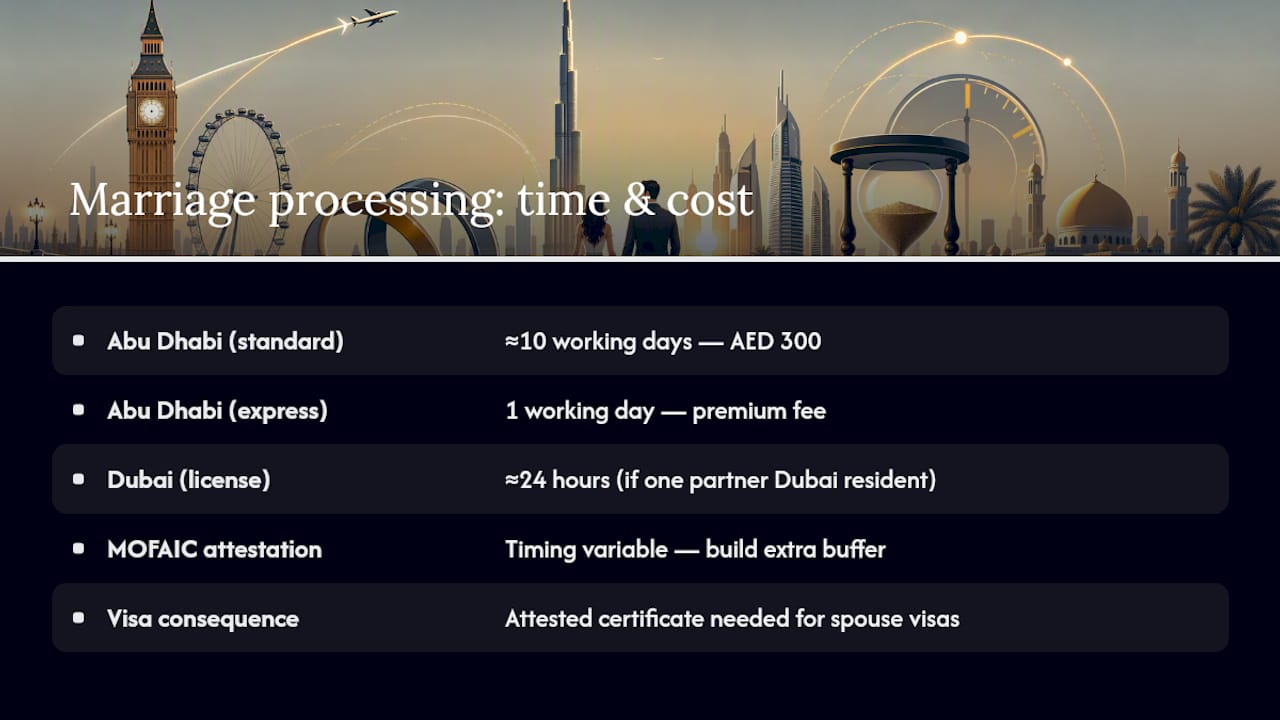
Dubai’s civil marriage service can issue a license in as little as 24 hours, but only for couples where one partner already holds Dubai residency. If that condition isn’t met, Abu Dhabi remains your fastest realistic path.
MOFAIC attestation and embassy legalization steps don’t run on a fixed clock the way court fees do. Build in extra buffer time, particularly if you’re waiting on a UK-issued document to move through its own authentication chain before it even reaches the UAE embassy. These timelines matter beyond the wedding day too: spouse visa applications and dependent registration both hinge on having a fully attested marriage certificate in hand, so a rushed attestation now can stall your visa paperwork later.
How Harris & Charms Supports British Expat Couples
We handle the parts of this process that eat the most time and cause the most stress for British couples navigating UAE marriage cultural differences alongside unfamiliar court systems.
Document processing, including certified translation and notarization
Court submissions through ADJD or Dubai Courts on your behalf
MOFAIC attestation coordination for foreign-issued certificates
Ceremony logistics, from venue to photography
Visa referrals through partner services for spouse sponsorship
Our civil marriage guide for expats breaks down the process in more depth, and our step-by-step legal marriage checklist is a good companion reference if you’re handling parts of this yourself.
Pro Tip: Most delays we see come from couples starting attestation after booking flights for family. Reverse that order.
Your Two-Week and One-Month Action Plan
If you’re getting married within a month, front-load the paperwork. In the first two weeks, gather passports and status documents, arrange certified translations, contact the British consulate for any needed affidavits, and book your court slot with ADJD or Dubai Courts.

In the following two weeks, work through the MOFAIC attestation chain, confirm travel dates for any guests, and lock in ceremony details like photography or a venue. If you’d rather skip the coordination entirely, the Abu Dhabi civil marriage guide or a direct conversation with our team can take that off your plate.
A Straight Answer From Someone Who’s Watched This Process Fail
The conventional advice about expat marriage guidance UAE treats every couple’s situation as roughly the same: gather documents, pick a court, done. That’s not accurate, and it’s why so many British couples hit a wall at the attestation stage rather than the application stage.
The real risk in this whole process isn’t legal eligibility. Federal and emirate law now make civil marriage genuinely accessible to non-Muslim British expats, a shift that’s only a few years old and still catches people off guard when they compare notes with friends who married before 2021. The real risk is sequencing. Couples who book flights, invite family, and reserve a venue before their MOFAIC attestation clears end up rescheduling everything, sometimes twice.
There’s also a legal blind spot worth naming plainly: a UAE civil marriage doesn’t automatically settle cross-border questions like prenuptial enforceability or future custody jurisdiction. Legal commentary on this is consistent. Couples who want protections that hold up in both English and UAE courts need an agreement drafted with both jurisdictions in mind, not a UAE notarization alone. That’s not a step most couples think to ask about until a relationship hits trouble, which is exactly the wrong time to discover your paperwork only works in one country.
Get the sequence right, and this process is genuinely straightforward. Get it backward, and it’s the reason your visa application, your venue deposit, and your family’s flights all end up in limbo at once.
— Harris
Book Your Marriage Service With Harris & Charms
Handling ADJD applications, MOFAIC attestation, translations, and ceremony logistics on your own is doable, but it’s a lot of moving parts for two people who also have jobs and a wedding to actually enjoy. Harris & Charms runs the full package for British expat couples in the UAE, civil or Islamic, so you’re not the one chasing court clerks and embassy stamps in the same week.

Our comprehensive marriage services cover document processing, court submissions, MOFAIC coordination, ceremony planning, and photography, bundled so you deal with one point of contact instead of five separate offices. We also handle yacht wedding packages for couples who want their ceremony on the water and can coordinate makeup services and event photography around your date. If you’re ready to move forward, request a quote through our wedding services page and we’ll map out your timeline based on your specific route and travel plans.
Where To Check the Official Rules Yourself
If you’d rather verify anything directly, these are the bodies that actually set the rules, not just repeat them.
Abu Dhabi Judicial Department (ADJD): the portal for Abu Dhabi civil marriage applications, current fees, and eligibility for tourists and residents.
Dubai Courts: the source for Dubai’s 24-hour civil marriage service and its residency requirement.
MOFAIC: the authority for attestation and legalization of both foreign and UAE-issued certificates.
GOV.UK: British consular guidance on affidavits, affirmations of marital status, and what British nationals need when marrying abroad.
Each one governs a different link in the chain, and skipping ahead of any of them is usually what causes a rejected application.
Recommended
Comments