
Christian Muslim Marriage: U.S. Legal Guide for Couples


TL;DR:
A Christian and a Muslim can legally marry in the United States without restriction, as marriage laws are state-controlled. Religious acceptance of interfaith unions varies by tradition, with Islamic law permitting Muslim men to marry Christian women but traditionally prohibiting Muslim women from marrying non-Muslim men. Couples should ensure legal paperwork is completed before planning ceremonies or international recognition, considering both civil and religious requirements.
A Christian and a Muslim can legally marry in the United States. No federal law restricts marriage based on religion, and every state issues marriage licenses without regard to the couple’s faith. The religious picture is more layered: traditional Islamic jurisprudence generally permits a Muslim man to marry a Christian woman (she qualifies as a “Person of the Book”), but traditionally prohibits a Muslim woman from marrying a non-Muslim man. Modern reformist scholars challenge that second rule, and Christian denominations vary widely in how they approach interfaith unions.
Three things to know right now:
Legal status: Fully recognized in all 50 states when you meet the issuing state’s civil requirements.
Religious permissibility: Depends on which tradition and gender is involved; classical Islamic law draws a clear distinction.
Next step: Decide whether you want a civil-only ceremony, a religious ceremony, or both — then gather documents accordingly.
The sections below walk through state paperwork, ceremony options, what to ask your officiant, and how to plan a UAE ceremony if that’s part of your picture.
Table of Contents
What do Islamic and Christian authorities say about marrying between faiths?
Documents you need for a U.S. civil license and religious ceremonies
Questions to ask your officiant or wedding planner before you commit
How do you handle family, children, and long-term religious life?
Harrisandcharms helps Christian–Muslim couples marry in the UAE
Is a Christian–Muslim marriage legal in the United States?
Marriage law in the U.S. is entirely state-controlled. There is no federal marriage license, no federal ban on interfaith unions, and no religious test of any kind. A couple meets the requirements of the issuing state, and the marriage is valid.
Most states share a common core of requirements:
Valid government-issued photo ID (passport, driver’s license, or state ID)
Proof of age (usually 18; some states allow younger with parental or judicial consent)
Social Security number where required by state law
Proof that any prior marriage has ended (certified divorce decree or death certificate)
Application fee (varies by county, typically $25–$100)
Waiting period (some states impose a 24–72 hour waiting period after issuance before the ceremony)
One practical gap many couples miss: a religious ceremony alone does not automatically create a civil marriage. If an imam performs a nikah without a state-issued license, or a pastor blesses a union in a private ceremony, neither event changes your legal status. A licensed officiant must sign and return the civil license for the marriage to be recorded.
Pro Tip: Call or visit the county clerk’s office in the county where you plan to marry — not just the state website. County-level requirements for in-person appearance, acceptable ID, and fees sometimes differ from what the state’s general guidance says.
What do Islamic and Christian authorities say about marrying between faiths?
The traditional Islamic position draws a firm gender line. A Muslim man marrying a Christian or Jewish woman is permitted under classical fiqh because she is considered a Person of the Book. A Muslim woman marrying a non-Muslim man is traditionally prohibited, on the reasoning that the husband’s faith shapes the household’s religious character. That prohibition is not universal today. Reformist scholars and some contemporary Muslim communities take a different view, arguing the restriction reflects historical context rather than immutable doctrine.
Christian denominations cover a wide spectrum. The Catholic Church requires a dispensation for a Catholic to marry a non-Christian and typically asks the Catholic partner to commit to raising children in the faith. Many Protestant denominations have no formal prohibition but encourage pre-marital counseling with a pastor. Some evangelical communities strongly discourage the union on theological grounds.
The deeper tension is structural, not just doctrinal. As family therapist and researcher Dr. Manijeh Daneshpour has noted:
That gap matters practically. A nikah is a legal contract with defined terms (mahr, witnesses, guardian consent in some traditions). Many Christian ceremonies treat marriage as a sacred covenant with theological weight that cannot simply be replicated by signing a document. Neither framing is wrong; they just require couples to talk explicitly about what “valid” means to each of them.
Islamic scholars also frequently raise child-rearing as a concern. Classical opinions often caution that raising children in a religiously mixed household risks confusion about religious identity, and some scholars advise against the union on those grounds alone.
What ceremony options work for Christian–Muslim couples?
Five paths are commonly used:
Civil-only ceremony: A licensed officiant (judge, clerk, or civil celebrant) performs a brief legal ceremony. Fastest, simplest, and fully recognized. Either partner can then pursue a separate religious blessing privately.
Nikah only: An imam performs the Islamic marriage contract. Legally valid in the U.S. only if the imam is a licensed officiant in that state and the civil license is signed and filed.
Christian ceremony only: A pastor or priest officiates. Same civil-license requirement applies.
Two separate ceremonies: A nikah on one day (or in one location) and a Christian ceremony on another. Common when families have strong separate expectations.
Blended ceremony: One service with two officiants or a single interfaith officiant, incorporating elements from both traditions.
The nikah has specific structural requirements: a mahr (gift from groom to bride), two Muslim witnesses, and in many traditions a wali (guardian) for the bride. For a deeper look at how those contract terms work, the Islamic marriage contract guide on the Harrisandcharms site covers each element clearly.
For a blended ceremony, sample vow language that avoids theological conflict tends to focus on shared promises rather than invoking either tradition’s theological claims. Something like: “I promise to honor your faith, support your practice, and build a life with you grounded in mutual respect” works across both traditions without requiring either partner to affirm the other’s theology.

Pro Tip: If you want a single combined service, get written confirmation from each officiant about what makes the ceremony valid in their tradition — and confirm separately that the civil license will still be signed and filed. Verbal assurances are not enough.
Documents you need for a U.S. civil license and religious ceremonies
Document | When required | Who issues it |
Government-issued photo ID | All civil licenses | Federal/state government |
Proof of age | All civil licenses | Same as ID, or birth certificate |
Social Security number | Most U.S. states | Social Security Administration |
Divorce decree / death certificate | Prior marriage ended | Court or vital records office |
Nikah contract (mahr details) | Islamic ceremony | Drafted by couple/imam |
Witness IDs (×2) | Nikah | Witnesses themselves |
Guardian consent letter | Nikah (if wali required) | Bride’s family/guardian |
Baptism certificate or church membership | Some Christian denominations | Issuing church |
Pre-marital counseling certificate | Some churches | Counselor or clergy |
Passport + visa/status documents | Foreign nationals | Issuing government |
Certified translations | Foreign-language documents | Certified translator |
Apostille | Documents for use abroad | Secretary of State (U.S.) |
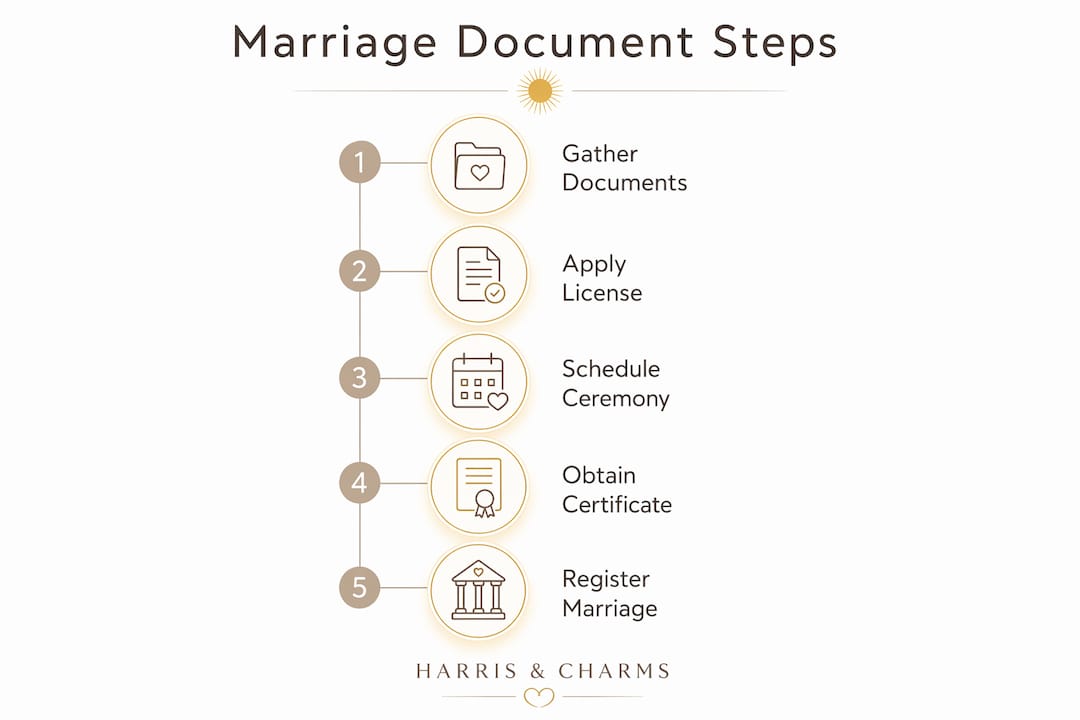
Foreign nationals should note that a U.S. marriage certificate used in another country — including the UAE — typically requires an apostille from the Secretary of State in the issuing state, plus certified translation if the destination country requires it. The expat Islamic marriage checklist at Harrisandcharms walks through the cross-border documentation sequence step by step.
Questions to ask your officiant or wedding planner before you commit
For an imam or pastor:
Are you a licensed officiant in this state, authorized to solemnize civil marriages?
Have you officiated Christian–Muslim ceremonies before?
Do you require conversion, and if so, is that a hard requirement or a preference?
What pre-marital counseling do you require, and how many sessions?
How do you handle ceremony elements from the other tradition?
For a wedding planner:
Have you coordinated interfaith ceremonies involving both an imam and a Christian officiant?
Can you manage the civil license filing and timeline alongside the religious ceremony?
Do you provide document handling or attestation support for international recognition?
What is your process if the two officiants disagree on ceremony structure?
Red flags: Any officiant who refuses to discuss children’s faith arrangements, insists conversion is the only path forward, or cannot clearly explain the civil-license filing process. A planner who has never coordinated two officiants simultaneously will likely struggle with the logistics.
How long does it take, and what does it cost?
Typical timeline:
Apply for the marriage license 1–4 weeks before your ceremony date (varies by state waiting period and document gathering time).
Allow an additional 2–4 weeks if you need apostilles or certified translations.
Book your officiant and venue before paying nonrefundable vendor deposits.
File the signed license within the window your state requires (usually 30–60 days after the ceremony).
Typical cost ranges:
County marriage license fee: roughly $25–$100 depending on the state
Officiant honorarium: $150–$500 for a civil officiant; imam or pastor fees vary widely
Basic wedding planner package: $1,500–$5,000 for a simple ceremony; full-service packages run higher
Apostille processing: $20–$50 per document through most Secretary of State offices
Certified translation: $50–$150 per page depending on the language
Secure your civil paperwork and confirm officiant availability before signing any nonrefundable vendor contracts. A venue deposit paid before the license is confirmed is a common and avoidable mistake.
How do you handle family, children, and long-term religious life?
Family resistance is one of the most consistent challenges in Christian–Muslim marriages. Research from interfaith communities shows that family rejection and child-rearing disputes are both common outcomes, even in marriages that are otherwise strong. The couples who navigate it best tend to address it early and directly, not after the wedding.
Practical steps that work:
Disclose the relationship to key family members before the engagement, not after.
Hold joint conversations with parents from both sides when possible, framing it as information-sharing rather than seeking approval.
Set clear boundaries on extended family involvement in religious decisions about the household.
Negotiate child-rearing arrangements before the wedding and document them: single-faith upbringing, dual participation, or alternating religious education are all options — but the choice needs to be explicit.
Pro Tip: Shift from a persuasion mindset to a curiosity mindset. Relationship experts consistently find that couples who approach each other’s faith with genuine curiosity — attending a service, asking questions without an agenda — reduce long-term conflict far more effectively than couples who try to convince each other. Conversion is not a prerequisite for a healthy interfaith marriage.
Interfaith counseling, either through a therapist who specializes in multicultural couples or through a community support group, gives couples a structured space to work through these questions before they become arguments. The Gottman Institute’s guidance for interfaith couples specifically recommends avoiding avoidance — meaning, don’t table the hard conversations about faith until they explode.
Step-by-step: how to complete a U.S. civil marriage
Identify your county clerk’s office. Confirm the exact documents required, the fee, and whether an in-person appearance is mandatory. Do this first — requirements vary more than most couples expect.
Gather your documents. Both partners need valid ID and proof of age. Add divorce decrees or death certificates if applicable. Foreign nationals add passport, visa/status documents, and certified translations of any foreign-language records.
Apply for the license. Appear in person if required. Confirm your officiant’s legal authority to solemnize marriages in that state at this step, not the day of the ceremony.
Hold the ceremony. The officiant signs the license at or after the ceremony. Keep track of the filing deadline — missing it means starting over.
File and obtain certified copies. The officiant or couple returns the signed license to the county clerk. Order at least three certified copies: one for name-change processes, one for immigration or visa applications, and one for foreign registration or apostille if needed.
Step | Typical duration |
Document gathering | 1–3 weeks |
License application to issuance | Same day to 72 hours (state-dependent) |
Waiting period (where applicable) | 24–72 hours |
Ceremony scheduling | Your timeline |
Apostille/translation (if needed) | 2–4 weeks |
Key Takeaways
A Christian–Muslim marriage is fully legal in the United States, but religious permissibility, ceremony structure, and documentation requirements vary enough that couples who plan carefully avoid most of the common delays and disputes.
Point | Details |
Legal status | Interfaith marriage is recognized in all 50 U.S. states; no religious test applies to civil licenses. |
Religious permissibility | Classical Islamic law permits Muslim men to marry Christian women; Muslim women marrying non-Muslim men is traditionally restricted but debated. |
Secure the state marriage license before committing to nonrefundable vendors or ceremony bookings. | |
Cross-border recognition | U.S. marriages used abroad (including UAE) typically require an apostille and certified translation. |
Harrisandcharms | Supports Christian–Muslim couples with civil and Islamic marriage packages, document attestation, and UAE ceremony planning. |
Why interfaith couples deserve better than generic advice
Most guides on this topic either oversimplify the religious question (“just get a civil license and you’re fine”) or overcomplicate it with theological debate that doesn’t help a couple plan a wedding. The part that actually trips people up is the gap between what feels spiritually valid and what is legally recorded.
A nikah performed by an imam who isn’t a licensed civil officiant is a meaningful religious event. It is not, by itself, a legal marriage in the United States. That distinction matters enormously for immigration, inheritance, and any future cross-border recognition. Couples who learn this after the fact face real administrative problems.
The other thing most guides miss: the sacrament-versus-contract framing isn’t just theological trivia. It shapes what each partner expects from the ceremony, from the vows, and from the marriage itself. A Christian partner who grew up understanding marriage as a sacred, indissoluble covenant and a Muslim partner who understands it as a defined contract with negotiated terms are starting from genuinely different places. That’s not a problem — it’s a conversation that needs to happen before the ceremony, not during it.
Harrisandcharms helps Christian–Muslim couples marry in the UAE
Planning a wedding that crosses two faiths and potentially two countries is genuinely complex. Harrisandcharms handles the parts that slow couples down: civil and Islamic marriage packages, legal documentation, court application support, and full attestation for UAE recognition. For couples who want more than a courthouse appointment, there are also yacht wedding packages, event photography, makeup services, and premium marriage registration for Golden Visa holders.

The process starts with a document checklist review and a consultation to match your ceremony goals to the right package. Whether you need a civil marriage registered in the UAE, an Islamic nikah with full documentation, or a combined ceremony with photography and venue coordination, the marriage services page at Harrisandcharms covers the full range. Reach out to start the conversation and get a clear proposal before you book anything else.
Useful resources for Christian–Muslim couples
Verifying requirements directly with the issuing authority is always the right move. State marriage license rules change, and county-level offices often have requirements that don’t appear on state websites.
County clerk’s office in your ceremony state: the authoritative source for license fees, waiting periods, and required documents.
Islamic scholarship on interfaith marriage: IslamOnline and similar fiqh resources summarize classical and contemporary positions on Muslim–non-Muslim unions.
Interfaith counseling: The Gottman Institute publishes communication guidance specifically for interfaith couples, including structured exercises for navigating religious differences.
UAE-specific marriage requirements: The Harrisandcharms guide on Muslim marriages in the UAE covers local registration requirements and cultural expectations.
For immigration and visa implications specifically, the MNS Solicitors blog post on why a religious ceremony alone is insufficient for a visa is worth reading before you finalize your ceremony plan.
This article provides general information only, not legal or religious advice. Confirm current requirements with your county clerk, a qualified attorney, and your clergy for your specific situation.
Recommended
Comments