
GCC Residents Marrying Abroad: 4-8 Week UAE Validation


Marrying abroad offers freedom and romance, but many GCC residents mistakenly assume their foreign marriage certificate automatically guarantees UAE recognition. The reality is far more complex. Without proper attestation, translations, and embassy coordination, your marriage may face rejection or months of delays. This guide walks you through every requirement, legal framework, and procedural step to ensure your marriage abroad is fully validated in the UAE, protecting your rights and simplifying your future.
Table of Contents
Key Takeaways
Point | Details |
Attestation is mandatory | Foreign marriages require multi-authority attestation for UAE recognition. |
Embassy approval required | No Objection Certificate (NOC) from your embassy is essential before marrying abroad. |
Civil marriage recognized | Federal Decree Law No. 41 of 2022 enables civil marriage recognition for non-Muslims. |
Processing timelines vary | Proper procedures yield validation in 4-8 weeks; errors cause 3-6 month delays. |
Arabic translation mandatory | All foreign marriage documents need certified Arabic translations for UAE submission. |
Prerequisites and Documentation for Marrying Abroad
Before you book flights or reserve venues abroad, gather every required document. Missing even one piece can derail your entire validation process. Non-Muslim residents marrying abroad must ensure their foreign marriage certificate is legalized and attested by the UAE Ministry of Foreign Affairs and International Cooperation.
Start with your No Objection Certificate. GCC residents marrying abroad should obtain a certificate of marital status or NOC from their embassy or home country to fulfill UAE requirements. This document confirms you’re legally free to marry and meets UAE validation standards.
Essential documents include:
Valid passports with at least six months validity for both partners
Current UAE residence visas showing legal residency status
No Objection Certificates issued by your respective embassies
Birth certificates with apostille or consular legalization
Divorce decrees or death certificates if previously married
Passport photographs meeting embassy specifications
Document legalization follows a strict hierarchy. First, authenticate your marriage certificate through the foreign country’s ministry of foreign affairs. Next, present it to the UAE embassy in that country for consular attestation. Finally, complete the marriage attestation process in UAE through MOFAIC in Abu Dhabi or Dubai.
Certified Arabic translations are non-negotiable. Every foreign language document requires translation by accredited translation offices approved by UAE courts. Generic translations get rejected instantly. Pro Tip: Request translations from offices listed on the UAE Ministry of Justice website to avoid costly resubmissions.
Document validity matters critically. NOCs typically expire within three to six months. Embassy approvals have similar lifespans. If your marriage date shifts or delays occur, renew these documents immediately. Expired paperwork triggers automatic rejection, forcing you to restart the entire application. Follow this 7-step checklist for UAE marriage documents to track expiration dates and renewal requirements systematically.
Legal Framework for Marriages Abroad and UAE Recognition
UAE law distinguishes sharply between Muslim and non-Muslim marriages. Understanding which legal framework applies to you prevents validation nightmares. Federal Decree Law No. 41 of 2022 enables civil marriage recognition for non-Muslim residents, creating a parallel legal pathway alongside Sharia courts.
Non-Muslim couples enjoy broader flexibility. You can marry civilly abroad in any jurisdiction, then validate through UAE civil channels. The 2026 legal framework simplifies this process significantly compared to previous years. Civil marriages from Western countries, Asian nations, or other regions all qualify for recognition provided attestation is complete.
Muslim marriages face stricter requirements. Muslim GCC residents marrying abroad must ensure their marriage complies with Sharia law conditions, including confirmation of consent and age. Key Sharia conditions include:
Mutual consent documented by witnesses at the ceremony
Male guardian’s approval for the bride in traditional contexts
Minimum age requirements met by both partners
Absence of prohibited relationships or impediments
Proper mahr (dowry) agreement recorded
Age and consent validation protects both parties. UAE authorities scrutinize marriage certificates for evidence that both individuals entered willingly and met legal age thresholds. Forced marriages or unions involving minors face immediate rejection, regardless of where the ceremony occurred.
Recognition conditions extend beyond ceremony details. The marriage must be legal in the country where it took place. Marriages performed in jurisdictions where they violate local law cannot be validated in the UAE, even if compliant with Sharia or UAE civil standards. This creates a three-way compliance requirement: the foreign country’s law, UAE law, and religious law if applicable.
Navigate these legal waters carefully by consulting legal marriage steps for expats UAE and understanding civil marriage requirements in UAE before making commitments. Review marriage eligibility requirements UAE to confirm both partners meet all criteria.
Step-by-Step Process for Marrying Abroad and Registering in UAE
Follow this sequence exactly to avoid backtracking or reapplication. Each step builds on the previous one, creating a validation chain that UAE authorities will accept.
Obtain your No Objection Certificate or marital status certificate from your embassy at least two months before your planned marriage date. Schedule appointments early since embassy processing can take several weeks. Understand embassy’s role in UAE marriage process before initiating contact.
Conduct your marriage abroad following the foreign country’s legal requirements precisely. Ensure the ceremony is recorded officially with a government-issued marriage certificate. Tourist or religious-only ceremonies without legal registration will not validate in the UAE.
Secure your foreign marriage certificate immediately after the ceremony. Present it to the foreign ministry of that country for authentication within two weeks while you’re still in the country. Then visit the UAE embassy in that country for consular attestation before returning home.
Return to the UAE and engage accredited translation offices to create certified Arabic versions of your marriage certificate and any supporting documents. Request multiple certified copies since various authorities may require originals.
Submit all authenticated and translated paperwork to UAE Courts or the Ministry of Justice for official registration. Dubai Courts handle civil marriages for residents. Abu Dhabi courts accept both residents and tourists. Choose based on your residency status and location.
Receive your UAE-recognized marriage certificate after the court reviews and approves your submission. This document provides full legal recognition, enabling you to update passports, sponsor family members, and access spousal benefits. Complete marriage certificate attestation steps systematically using this expat marriage legal guide UAE as your reference.
Pro Tip: Create a dedicated folder with digital and physical copies of every document at each stage. Label files with dates and attestation stages. This organization saves hours when authorities request specific versions or clarifications.

Common Mistakes and Troubleshooting When Marrying Abroad
Most rejections stem from avoidable errors. Learn from others’ mistakes to protect your timeline and budget. Failure to properly legalize and attest foreign marriage documents results in rejection, causing delays that average 3-6 months.
Skipping attestation stages ranks as the top mistake. Some couples assume embassy stamps suffice without MOFAIC attestation. Others legalize through the foreign ministry but forget UAE embassy approval. Both errors trigger automatic rejection. Complete every attestation layer without shortcuts.
Using unaccredited translators creates another frequent pitfall. Budget translation services may offer lower prices but their certifications lack UAE court recognition. When authorities spot unapproved translator stamps, your entire application gets denied. The cost of rejection and resubmission far exceeds the savings from cheap translations.
Submitting expired NOCs causes instant application failure. Embassies clearly print validity dates on these certificates, yet couples frequently overlook them. If your marriage date shifted after obtaining your NOC, verify it’s still valid before traveling abroad. Renew immediately if the expiration date approaches.
Not verifying age and consent requirements, especially for Muslim couples, can invalidate marriage recognition entirely. Some countries permit marriages at younger ages than UAE law allows. Even if your foreign marriage certificate is legal abroad, UAE authorities will reject it if either partner was underage by UAE standards at the ceremony date.
Lack of timely embassy coordination causes frustrating holdups. Embassies operate on their own schedules with varying wait times for appointments and document processing. Initiating contact just days before your wedding creates unnecessary stress and potential delays. Start embassy coordination three months ahead.
Consequences of failing to register are severe. Without UAE recognition, you lack legal spousal rights, cannot sponsor your partner, face housing complications, and may encounter difficulties with children’s documentation. Your marriage exists in legal limbo, recognized abroad but invisible to UAE authorities. Review common mistakes in UAE expat marriage and study attestation common errors and solutions to sidestep these issues.
Pro Tip: Contact the specific UAE court where you’ll register before traveling abroad. Confirm their current requirements since procedures occasionally update. This five-minute call can prevent catastrophic oversights.
Expected Outcomes and Timelines for Marrying Abroad and UAE Validation
Realistic expectations prevent frustration and help you plan life decisions around your validation timeline. The entire process typically takes 4-8 weeks when documents are prepared and attested correctly.
Break down the timeline into phases. Embassy NOC processing requires 1-2 weeks on average. The foreign marriage ceremony and immediate local attestation consume another 1-2 weeks. UAE embassy attestation abroad adds 3-5 business days. MOFAIC attestation in the UAE takes 2-3 business days. Translation requires 2-3 business days. Court submission and approval span 2-4 weeks. Total elapsed time from NOC application to UAE certificate in hand: 6-10 weeks typically.
Process Stage | Typical Duration | Potential Delays |
Embassy NOC | 1-2 weeks | 4-6 weeks if incomplete documents |
Foreign marriage + local attestation | 1-2 weeks | 2-3 weeks if remote location |
UAE embassy attestation abroad | 3-5 days | 2-3 weeks if errors found |
MOFAIC attestation UAE | 2-3 days | 1-2 weeks if missing steps |
Arabic translation | 2-3 days | 1 week if revisions needed |
Court registration | 2-4 weeks | 6-12 weeks if documentation issues |
Success metrics are straightforward. You receive an official UAE-recognized marriage certificate with both Arabic and English text. Your marriage number appears in UAE government systems. You can immediately use this certificate to update passports, apply for spousal sponsorship, and access joint benefits. No reapplication or clarification requests arrive from authorities.
Delays signal specific problems. If weeks pass beyond expected timelines, missing attestation or translation errors are usually responsible. Contact the court or Ministry of Justice using reference numbers from your submission. They’ll identify exactly which document needs correction. Track marriage attestation timeline and outcomes and use this checklist for successful marriage registration to monitor progress.
Pro Tip: Set calendar reminders for each expected milestone. If a stage exceeds its typical duration by three days, proactively contact the relevant authority. Early intervention often resolves issues before they cascade into month-long delays.
Alternative Validation Approaches and Tradeoffs
Multiple pathways exist for validating your foreign marriage in the UAE. Each offers distinct advantages and limitations based on your residency status, timeline needs, and budget.
Validation Route | Processing Time | Eligibility | Cost Range | Best For |
Dubai Courts | 24 hours to 1 week | UAE residents with valid visas | AED 500-1,000 | Residents prioritizing speed |
Abu Dhabi Courts | 2-8 weeks | Residents and tourists | AED 800-1,500 | Broader eligibility needs |
Embassy Channel | 4-12 weeks | All, including abroad residents | Varies widely | Couples residing outside UAE |
Dubai Courts deliver the fastest civil marriage registration for residents. If both partners hold UAE residence visas and present complete documentation, you can receive validation within 24 hours. This speed comes with strict residency requirements. Tourists and visit visa holders cannot use this route.
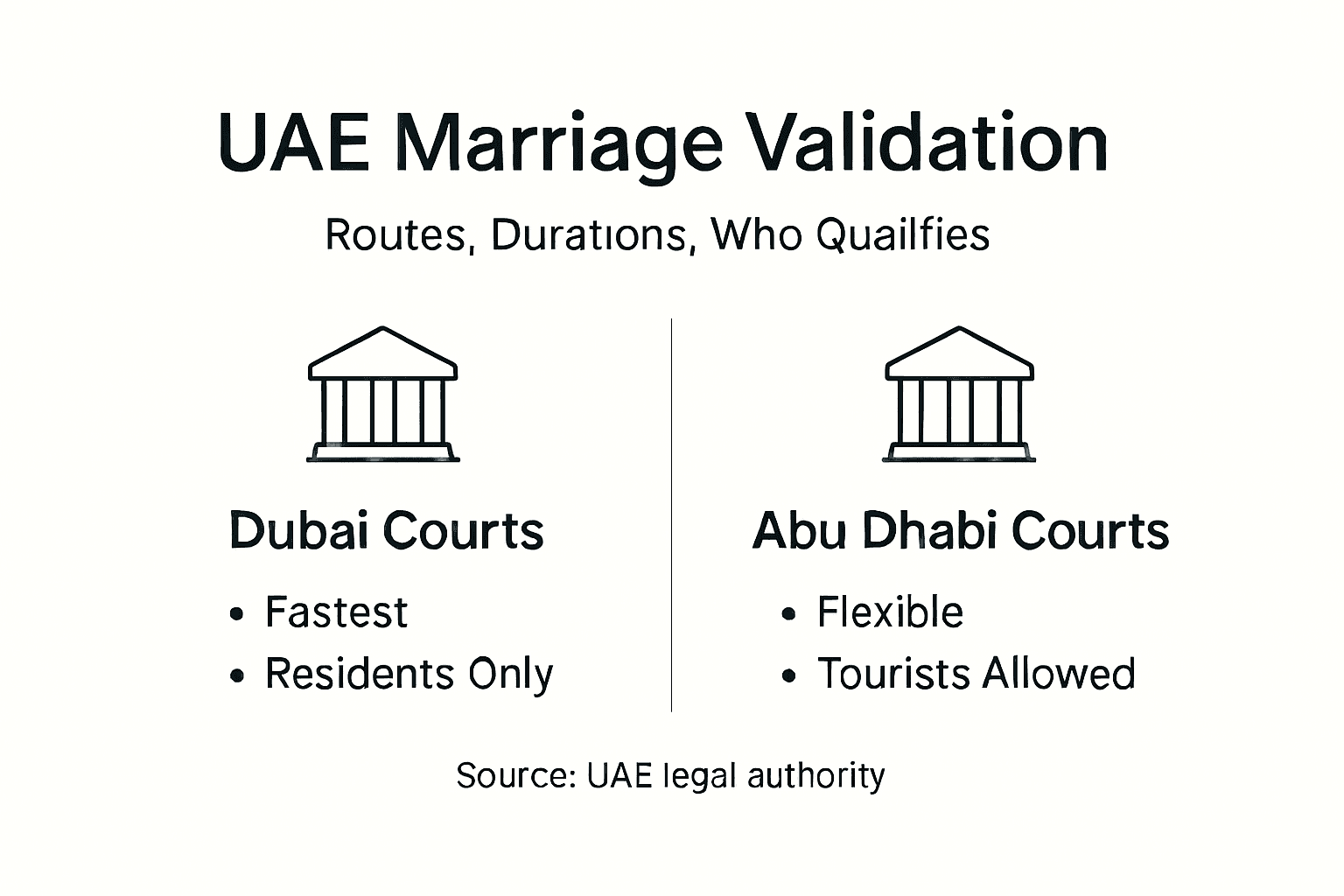
Abu Dhabi Personal Status Courts accept both residents and tourists, offering much broader eligibility. Processing takes longer, typically 2-8 weeks, but this flexibility helps couples who married abroad on tourist visas or who lack UAE residency yet. The tradeoff is patience versus access.
Embassy validation channels involve thorough attestation but suit couples residing abroad long term. If you married in your home country and plan to move to the UAE later, embassy-driven validation lets you prepare documents before relocating. Timelines vary dramatically by embassy and home country, ranging from 4-12 weeks. Costs also fluctuate based on embassy fee structures.
Key tradeoffs to weigh:
Speed versus eligibility: Fastest routes restrict who qualifies
Cost versus convenience: Premium services expedite processing but increase expenses
Documentation burden: Some routes require more attestation layers
Geographic requirements: Certain options mandate physical presence in specific emirates
Match your choice to circumstances carefully. Residents with urgent timelines benefit from Dubai Courts. Tourists or flexible couples gain from Abu Dhabi’s inclusivity. Long-distance couples appreciate embassy channels despite extended waits. Explore marriage attestation options and understand embassy-based marriage validation before committing to a pathway.
Get Expert Help for Your Marriage Abroad and UAE Registration
Navigating attestations, translations, and court submissions can overwhelm even detail-oriented couples. Professional assistance ensures nothing falls through the cracks. Harris & Charms specializes in documenting and legalizing foreign marriages for UAE recognition, handling every step from embassy coordination to final court registration.
Our team manages attestation through all required authorities, arranges certified Arabic translations, and submits your paperwork to the appropriate courts. We track timelines, troubleshoot delays, and keep you informed throughout the process. Whether you’re planning to marry abroad or already have a foreign marriage certificate needing validation, our comprehensive marriage services UAE simplify your journey.
Get personalized guidance on your specific situation. Our experts assess your documents, identify gaps, and create a customized validation roadmap. Learn more about marriage attestation assistance or contact Harris & Charms today to start your validation process with confidence.
Frequently Asked Questions
Can GCC residents marry abroad without UAE embassy involvement?
No, embassy involvement is mandatory. You must obtain a No Objection Certificate from your embassy before marrying abroad, and the embassy must attest your foreign marriage certificate afterward. Skipping embassy steps prevents UAE recognition entirely, regardless of how legal your marriage is in the foreign country.
What happens if marriage documents are not translated into Arabic?
UAE courts reject untranslated documents immediately. All foreign language marriage certificates and supporting paperwork require certified Arabic translations by accredited translation offices. Generic or uncertified translations also face rejection, forcing resubmission and extending your timeline by weeks.
Is renewal of NOC required if marriage is delayed abroad?
Yes, if the delay pushes your marriage date beyond the NOC’s validity period, which typically ranges from three to six months. Expired NOCs cannot be used for marriage or validation. Contact your embassy immediately if delays occur to renew the document before it expires, avoiding application rejection.
How does UAE recognize civil marriages from countries with no Sharia law?
The UAE recognizes civil marriages for non-Muslim residents under Federal Decree Law No. 41 of 2022, regardless of whether the foreign country follows Sharia law. Proper attestation and translation make the marriage legally valid in the UAE. Muslim couples marrying civilly abroad must ensure their marriage still meets Sharia conditions for UAE recognition.
Are there specific age requirements differing for Muslim and non-Muslim marriages?
Yes, age requirements vary. Non-Muslim civil marriages follow Federal Decree Law No. 41 standards, typically requiring both partners to be at least 18. Muslim marriages must comply with Sharia law requirements, which may have different age thresholds depending on the specific emirate’s interpretation. Verify minimum ages with your embassy and the UAE court where you’ll register before marrying abroad.
Recommended
Comments