
How Indians Can Marry in UAE: 2026 Legal Guide


TL;DR:
Indian couples in the UAE must choose between civil marriage for non-Muslims or Sharia court marriage for Muslims based on their religion and residency status.
Proper documentation and full attestation are essential to avoid delays, with civil marriages being more accessible to tourists and residents alike.
Preparation, including attestation and guardian arrangements, is crucial for a smooth marriage process, especially for Muslim couples needing a wali or power of attorney.
How Indians can marry in UAE follows two distinct legal routes: civil marriage for non-Muslims and Sharia court marriage for Muslims. The correct path depends on your religion and residency status, not a single universal process. Indian couples who assume one route fits all often face delays, rejected documents, and wasted fees. This guide breaks down both pathways, the exact documents you need, and the steps to get legally married in the UAE without unnecessary setbacks.
How Indians can marry in UAE: the two legal routes

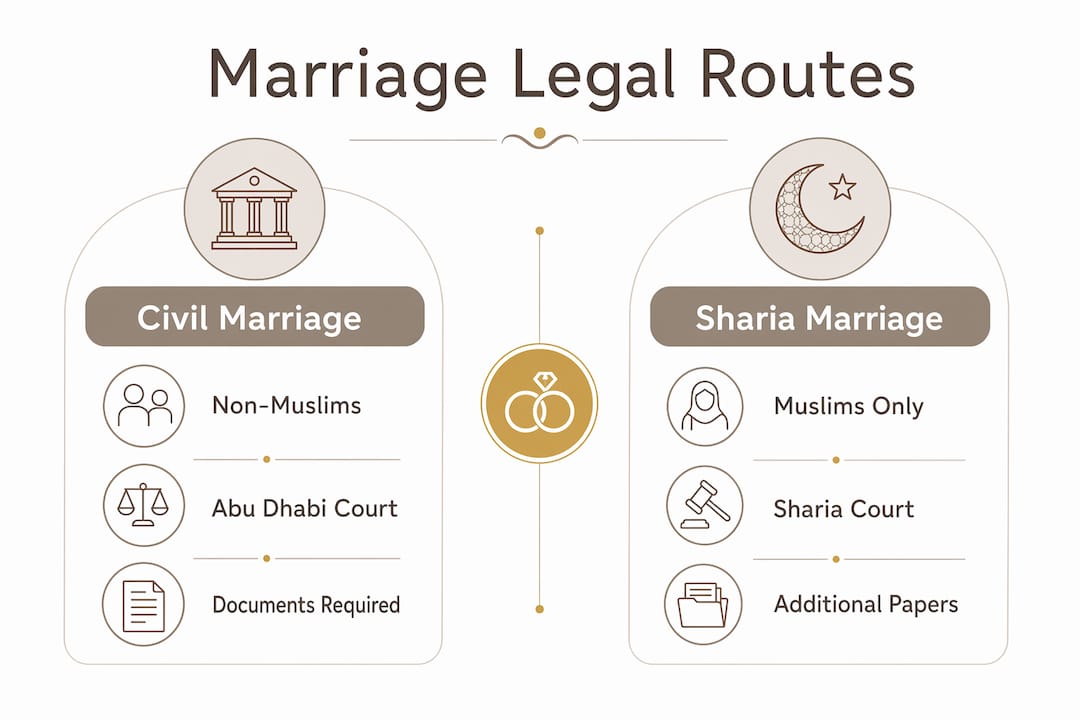
Indian couples have two recognized legal frameworks for marriage in the UAE. The route you take depends entirely on your religion.
Non-Muslim Indian couples marry through the civil court system. Federal Decree-Law No. 41 of 2022 modernized this process significantly, allowing non-Muslim foreigners, including tourists, to marry under their home country laws. The Abu Dhabi Civil Family Court accepts applications from residents and tourists from any emirate. Dubai Courts also handle civil marriages, but at least one partner must hold a Dubai residence visa to apply there.
Muslim Indian couples must register their marriage at a UAE Sharia court. The Indian Consulate in Dubai cannot register Muslim marriages under the Indian Foreign Marriage Act. Muslim couples who attempt the consular route will be redirected to Sharia courts, which adds time and cost to the process.
The key distinctions are:
Non-Muslim couples: Abu Dhabi Civil Family Court or Dubai Courts
Muslim couples: UAE Sharia courts only
Indian Consulate registration: available only for non-Muslim couples
Residency requirement: Abu Dhabi civil marriage accepts tourists; Dubai civil marriage requires one resident partner
Legal route depends on religious background and residency, not a blanket rule
Pro Tip: If you are a non-Muslim Indian couple visiting the UAE as tourists, Abu Dhabi Civil Family Court is your most accessible option. Tourist applications are often processed within one working day.
What documents do Indian couples need for legal marriage in the UAE?
Document preparation is where most Indian couples lose time. Missing one attestation can delay your entire application by weeks.
Core documents for all couples
Every Indian couple, regardless of religion, needs these foundational documents:
Document | Requirement |
Valid passport | Both partners; copy and original |
UAE visa | Residence visa or tourist visa stamp |
Certificate of Singleness | Issued in India, notarized, MEA apostilled, UAE MOFAIC attested |
Passport-size photos | Recent, white background |
Divorce or death certificate | If either partner was previously married; same attestation chain applies |
Additional documents for Sharia court marriage
Muslim Indian couples face a longer document checklist. The Sharia court requires a medical screening certificate from a government-approved UAE clinic. This certificate confirms the absence of infectious or genetic diseases and is valid for three months only. Timing matters: get the test close to your ceremony date, not months in advance.
The Sharia court also requires:
Presence of the bride’s male guardian (wali) or a properly attested power of attorney
Two Muslim male witnesses
Arabic translations of all foreign documents
UAE Ministry of Foreign Affairs and International Cooperation (MOFAIC) attestation on all Indian documents
The attestation chain you cannot skip
Foreign documents like your Certificate of Singleness or divorce decree follow a strict attestation process: notarization in India, MEA apostille, UAE Embassy or Consulate attestation in India, then UAE MOFAIC registration. Skipping any step renders the document invalid. A marriage certificate without this full chain cannot be used for residency applications or family sponsorship in the UAE.
Pro Tip: Start the attestation process at least six to eight weeks before your planned marriage date. MEA apostille processing in India alone can take two to three weeks during peak periods.
Step-by-step process to register your marriage in the UAE
The registration process differs by court and religion. Follow the correct sequence for your situation.
For non-Muslim Indian couples: civil marriage
Gather and attest all documents. Complete the full Indian attestation chain before arriving in the UAE.
Submit your online application. The Abu Dhabi Civil Family Court accepts applications through the Abu Dhabi Judicial Department portal. Civil marriage in Abu Dhabi is open to residents and tourists from all emirates.
Pay the court fee. Fees start at AED 300 for standard processing. An express option costs approximately AED 2,500 and reduces processing to one working day.
Attend the ceremony. Both partners must appear in person. The court schedules the solemnization after document verification.
Collect the marriage certificate. The court issues an official UAE marriage certificate. Get it attested by MOFAIC if you plan to use it in India.
Standard processing takes approximately 10 working days. The express route cuts this to one day, which is useful for couples on tourist visas with limited time.
For Muslim Indian couples: Sharia court marriage
Complete medical screening. Both partners visit a government-approved UAE clinic for the pre-marital screening test. Results are valid for three months.
Prepare all attested documents. Include the Certificate of Singleness, passport copies, visa copies, and Arabic translations.
Arrange the wali. The bride’s guardian must be physically present. If the wali is outside the UAE, obtain a power of attorney attested by the Indian MEA and the UAE Embassy in India.
File the application at the Sharia court. Submit all documents and pay the applicable court fees.
Attend the marriage contract session. The groom, bride, wali, and two Muslim male witnesses must all be present. The court officiates the Nikah and issues the marriage certificate.
Pro Tip: If the bride’s wali is in India, start the power of attorney process at least four weeks early. UAE Embassy attestation in India has limited appointment slots and can create unexpected delays.
Common challenges Indian couples face and how to avoid them
Indian couples consistently run into the same set of problems. Knowing them in advance saves you significant time and money.
Incomplete attestation chain. The most common reason for rejected applications is a document missing one step in the notarization, apostille, and MOFAIC chain. Double-check every document against the court’s current checklist before traveling.
Expired medical certificates. The pre-marital screening certificate is valid for only three months. Couples who get tested too early and then delay the ceremony must repeat the test.
Wali not available. For Muslim brides whose guardian is abroad, the power of attorney must be attested by both the Indian MEA and the UAE Embassy. This process is delay-prone and should never be left to the last week.
Interfaith marriage complications. Mixed-faith couples face the most complex legal situation. Interfaith marriage rules in the UAE apply Sharia law when one spouse is Muslim, which creates stricter requirements for the non-Muslim partner. Legal advice from a UAE-licensed family lawyer is strongly recommended in these cases.
Age and consanguinity rules. UAE law prohibits marriage between close relatives and sets minimum age requirements. Indian couples must confirm their eligibility before filing.
Consular marriages are officially recognized but represent the slowest, most bureaucratic path compared to civil court procedures. For non-Muslim Indian couples, the Abu Dhabi Civil Family Court is faster, more accessible, and better suited to tourists.
Pro Tip: Use a marriage registration guide designed specifically for UAE expats to cross-check your document list before submission. One missing attestation can push your ceremony back by weeks.
Key Takeaways
Legal marriage in the UAE for Indian couples requires choosing the correct court based on religion, completing a full document attestation chain, and meeting all residency and witness requirements before filing.
Point | Details |
Two legal routes | Non-Muslims use civil courts; Muslims must register at Sharia courts. |
Attestation is mandatory | Every Indian document needs notarization, MEA apostille, and UAE MOFAIC attestation. |
Medical certificate timing | Pre-marital screening is valid for three months; get it close to the ceremony date. |
Wali requirement | Muslim brides need a guardian present or a fully attested power of attorney. |
Express civil marriage | Abu Dhabi Civil Family Court offers a one-day express option for approximately AED 2,500. |
What I have learned from helping Indian couples marry in the UAE
Most Indian couples arrive thinking the UAE has one marriage process. It does not. I have seen non-Muslim couples waste weeks trying to register at a Sharia court because they assumed religion did not matter. It absolutely does.
The 2022 civil marriage law reform was a genuine turning point. Before it, non-Muslim tourists had almost no practical path to a legal UAE marriage. Now, an Indian Hindu couple visiting Dubai for two weeks can legally marry at the Abu Dhabi Civil Family Court with a one-day express option. That is a real shift, and not enough couples know about it.
For Indian Muslim couples, the Sharia court process is more involved but entirely manageable with the right preparation. The wali power of attorney is the single biggest source of delays I see. Families underestimate how long the UAE Embassy attestation in India takes. Start that process a month before everything else.
My honest advice: do not treat document attestation as a formality. It is the foundation of your entire application. A marriage certificate without the full attestation chain is legally useless for residency, sponsorship, or any official UAE government process. Get it right the first time.
— Harris
Harrisandcharms makes Indian marriage registration in the UAE straightforward
Indian couples navigating civil or Islamic marriage registration in the UAE face real paperwork complexity. Harrisandcharms specializes in exactly this process, handling documentation, attestation coordination, and court scheduling so you can focus on the marriage itself.

Harrisandcharms offers tailored civil marriage packages in Dubai designed for Indian couples, covering everything from document verification to ceremony management. For Muslim couples, the team coordinates Sharia court requirements including medical screening and wali arrangements. The full range of marriage services covers both civil and Islamic weddings, with legal support built into every package. Reach out to Harrisandcharms to start your inquiry and get a clear picture of what your specific situation requires.
FAQ
Can Indian tourists marry legally in the UAE?
Yes. Non-Muslim Indian tourists can marry at the Abu Dhabi Civil Family Court under Federal Decree-Law No. 41 of 2022, with tourist applications often processed within one working day.
Can the Indian Consulate register a Muslim marriage in the UAE?
No. The Indian Consulate in Dubai registers marriages only under the Indian Foreign Marriage Act, which excludes Muslim parties. Muslim Indian couples must register at a UAE Sharia court.
What is the cost of civil marriage in the UAE for Indian couples?
Fees at the Abu Dhabi Civil Family Court start at AED 300 for standard processing and approximately AED 2,500 for the express one-day option.
How long does the UAE marriage registration process take for Indian couples?
Civil marriage takes approximately 10 working days on the standard track or one working day on the express track. Sharia court timelines vary based on document readiness and court scheduling.
What happens if the bride’s wali is outside the UAE for a Sharia marriage?
The bride’s guardian must provide a power of attorney attested by the Indian MEA and the UAE Embassy in India. This process can take several weeks, so it should be started well in advance of the planned ceremony date.
Recommended
Comments