
Interfaith Marriage in the UAE: Laws, Rights, and Requirements

Updated: Sep 7
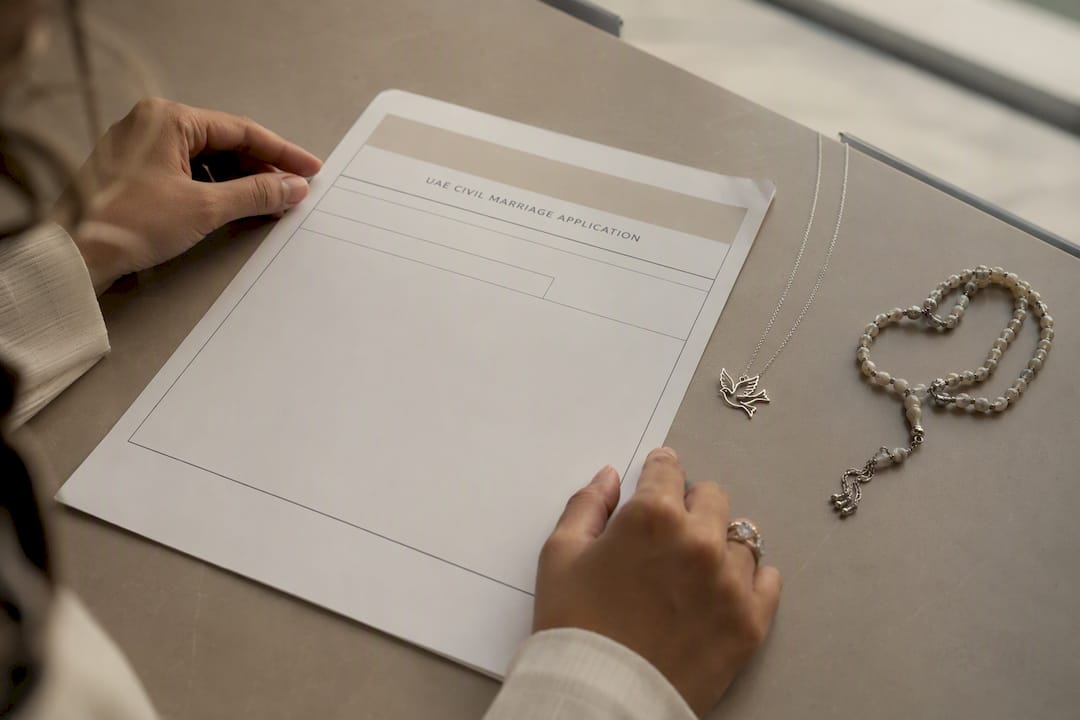
Yes, interfaith couples can legally marry in the UAE, but which law applies to your marriage depends on your religions and where you file. Non-Muslim couples can register a civil marriage under Federal Decree-Law No. 41 of 2022, a secular framework covering marriage, divorce, inheritance, and custody. Couples where one or both partners are Muslim generally fall under Sharia personal status rules that impose different conditions depending on gender.
That single choice, civil versus Sharia, shapes almost everything that follows: which documents you need, how long the process takes, and what happens to your assets and children years down the road.
Civil route: Governed by Federal Decree-Law No. 41 of 2022, filed through u.ae guidance or Abu Dhabi’s civil family court.
Sharia route: Applies when one or both partners are Muslim; requires specific pairings and documented conversion in some cases.
Long-term impact: Your chosen framework affects inheritance shares, custody rules, and which court has jurisdiction if you divorce.
The UAE has quietly become one of the more accommodating Gulf states for mixed-faith couples since the 2022 reforms, a shift many residents still don’t fully understand. If you want a second set of eyes on the paperwork, Harris & Charms assists couples with documentation and court liaison so nothing gets stuck at the attestation counter.
TL;DR:
Choosing between civil and Sharia marriage frameworks must occur before document collection to prevent delays and ensure compliant proceedings.
Medical screening certificates required for Sharia marriages expire within a set window, so timing the appointment carefully avoids redoing tests.
Foreign-issued documents need home-country legalization, MOFA attestation, and certified translation, which can significantly extend processing times.
Muslim women must convert and provide documentation before marrying a non-Muslim man, while Muslim men can marry Ahl al-Kitab women without conversion.
Proper professional support helps avoid costly errors in paperwork, attestation, and court liaison, streamlining the process and reducing long-term legal risks.
Table of Contents
Interfaith Marriage UAE: Civil Law vs. Sharia Explained
The UAE runs two parallel personal status systems, and knowing which one applies to you is the first real decision in any interfaith marriage UAE case.
Federal Decree-Law No. 41 of 2022 created a standalone civil personal status law for non-Muslims. It covers marriage, divorce, inheritance, and child custody, and it applies to non-Muslim residents unless they choose to apply their home country’s laws instead for personal status matters. This was a genuine turning point. Before 2022, non-Muslim couples in mixed-nationality relationships often had to navigate Sharia courts by default, even when neither partner was Muslim, which produced outcomes many found unpredictable.
Sharia personal status law, by contrast, governs marriages involving Muslim parties. It sets out who a Muslim man or woman may marry, requires specific formalities like witnesses and an authorized officiant, and applies UAE-wide through Sharia courts and licensed marriage authorities.
Where you file also matters. Abu Dhabi built its own civil family law system for non-Muslims, with a dedicated judicial mechanism for registering marriages and resolving personal status disputes outside Sharia court. Dubai, meanwhile, offers its own civil marriage service with a separate booking and registration process. Both emirates route Sharia marriages through their respective judicial departments and licensed mazoons.
Federal Decree-Law No. 41 of 2022: Applies to non-Muslim residents; governs marriage, divorce, custody, and inheritance under one civil code.
Sharia personal status law: Applies when one or both spouses are Muslim; sets pairing rules and formal requirements.
Abu Dhabi Judicial Department (ADJD): Runs Abu Dhabi’s civil family court procedures for non-Muslims.
u.ae: The official government platform outlining both civil marriage and Sharia marriage pathways.
Practitioners who work with interfaith couples routinely note that many arrive assuming there’s a single, unified process. There isn’t. The pathway splits early, based on religion and gender, and picking the wrong one wastes weeks. If either of you has already gathered documents for civil marriage in the UAE, confirm with ADJD or the Dubai civil marriage service before assuming those documents carry over to a Sharia filing.
Can Muslims Marry Non-Muslims in the UAE?
Sharia rules answer this question differently depending on which partner is Muslim, and the distinction catches a lot of couples off guard.

A Muslim man is permitted to marry a woman from Ahl al-Kitab, meaning a Christian or Jewish woman, without her needing to convert. A Muslim woman, however, cannot marry a non-Muslim man under UAE Sharia rules unless he formally converts to Islam and can document that conversion through a recognized authority. This asymmetry is the single most common source of confusion among interfaith couples researching their options, and it’s rarely explained clearly in general wedding guides.
Where conversion is required, the process typically involves these steps:
The non-Muslim partner completes a formal conversion, usually through a mosque or Islamic affairs department, and receives a conversion certificate.
A wali (male guardian) may need to be present or represented for the bride, depending on her family situation and the officiant’s requirements.
Two adult witnesses attend the contract signing, as required under Sharia marriage formalities.
An authorized officiant, known as a mazoon, conducts and registers the marriage contract.
Both partners complete mandatory pre-marital medical screening before the contract is finalized.
That last step trips up more couples than any other part of the Sharia process. The screening checks for specific communicable conditions and is a legal precondition for registering the marriage, not an optional health check. Certificates are issued by approved government health centers and carry a limited validity window, so couples who delay their court booking sometimes have to repeat the test.
Pro Tip: Book your medical screening only after you have a realistic court or mazoon appointment date. If the certificate expires before your registration, you’ll pay for and repeat the entire test, adding days you probably don’t have.
For a full breakdown of what the screening involves and how long results stay valid, see this guide on UAE pre-marital screening rules.
What Documents Do You Need to Marry in the UAE?
Paperwork is where most interfaith marriages actually stall, not the legal rules themselves. The exact list depends on whether you’re filing civil or Sharia, but both routes share a core set of requirements.
Every applicant needs a valid passport, Emirates ID (for residents), and passport-sized photographs. Beyond that, the two pathways diverge:
Both routes: Valid passports, Emirates ID copies, recent photographs, and proof of residency or visa status.
Civil marriage additions: Single-status affidavit or no-objection certificate from your embassy, and divorce or death certificates if either partner was previously married.
Sharia marriage additions: Conversion certificate where applicable, proof of religion, guardian documentation, and the pre-marital medical screening certificate.
Foreign documents: Birth certificates, prior divorce decrees, and single-status letters typically need home-country attestation before UAE authorities will accept them.
Attestation is where timelines quietly blow up. Documents issued outside the UAE generally need legalization in the home country, then attestation through the UAE Ministry of Foreign Affairs, and sometimes translation into Arabic by a certified legal translator. Skipping a step in that chain is the number one reason applications get bounced back at the court counter.
Document | Civil Route | Sharia Route |
Passport and Emirates ID | Required | Required |
Single-status affidavit | Required | Usually required |
Medical screening certificate | Not required | Required, limited validity |
Conversion certificate | Not applicable | Required if converting |
MOFA attestation of foreign documents | Required | Required |
Certified Arabic translation | Often required | Often required |
Certificates that carry expiry dates, particularly medical screening results and some embassy no-objection letters, deserve special attention. File too early and they lapse before your court date; file too late and you’re scrambling. Couples exploring the non-Muslim pathway can review a fuller checklist in this guide on how non-Muslims can get married in the UAE.
How Do You Register a Marriage in the UAE Step by Step?
The registration steps differ meaningfully depending on which legal framework applies to you, and mixing up the sequence is the fastest way to lose weeks.
Civil marriage (non-Muslim couples):
Confirm eligibility and gather single-status documentation, passports, and Emirates ID copies.
Apply through Abu Dhabi’s civil family court system or Dubai’s civil marriage service, depending on where you’ll register.
Book an appointment and submit documents for review.
Attend the civil ceremony, which is typically brief and administrative.
Receive your civil marriage certificate, valid for use in inheritance, custody, and divorce matters going forward.
Sharia marriage (where one or both partners are Muslim):
Complete pre-marital medical screening and obtain the certificate.
Book a mazoon or a court appointment for the marriage contract.
Arrange witnesses and, where applicable, guardian representation.
Sign the marriage contract in the presence of the mazoon.
Register the contract with the relevant judicial department to receive your certified marriage certificate.
Registering a foreign marriage:
Attest the foreign marriage certificate in the country of issuance, then through UAE authorities.
Submit a certified Arabic translation alongside the original.
File with the relevant emirate’s judicial department or the Ministry of Justice for recognition.
Understand that recognition can be refused if the marriage would violate UAE public policy, such as certain pairings not recognized under Sharia.
Once recognized, the marriage generally supports spousal residency sponsorship, though visa officers may request additional proof of the relationship.
The Ministry of Justice publishes e-services where couples can request marriage contracts and track filing steps online, which is worth checking before you show up in person. If your marriage happened abroad and you’re bringing it into the UAE system, budget extra time. Recognition isn’t automatic, and the attestation chain alone can take longer than the wedding planning did.
Realistic Timelines, Fees, and Common Delays
Most interfaith couples underestimate how long the paperwork phase takes and overestimate how long the ceremony itself takes. The ceremony typically takes less time compared to the paperwork phase.
Document collection and attestation typically take the longest stretch, especially for foreign-issued certificates that need legalization in the home country before UAE attestation. Medical screening usually returns results within a day or two, but booking the appointment and waiting for a court or mazoon slot can add more time than the test itself.
Document gathering and attestation: Often the single biggest time sink, particularly for divorce or birth certificates issued overseas.
Medical screening: Fast to complete, but has a limited certificate validity window.
Court or mazoon booking: Wait times vary by emirate and demand; Dubai and Abu Dhabi both allow appointment booking online.
Certificate issuance: Generally quick once the contract or civil ceremony is complete.
Fee categories typically include court or service fees, MOFA attestation charges, certified translation costs, and medical test fees, with totals varying by emirate and document volume. The most common causes of delay are missing apostille or embassy legalization steps, expired medical certificates, and last-minute guardian approval issues for Sharia marriages.
Pro Tip: Start attestation on any foreign document the moment you know you’ll need it, not after your court date is booked. Attestation queues, not the wedding itself, are what push interfaith marriages past their planned date.
What Happens Legally After You Marry an Interfaith Partner?
The framework you choose at the altar keeps mattering for decades, particularly around inheritance, custody, and what happens if the marriage ends.
Under Sharia inheritance rules, shares are fixed by law and non-Muslim spouses generally cannot inherit from a Muslim spouse without specific planning. Civil personal status law, by contrast, allows couples to structure inheritance more flexibly and predictably, which is part of why the 2022 reform was so significant for mixed-faith families.
Custody works similarly. Sharia custody frameworks often factor in the religious upbringing of children, while civil personal status law applies more secular custody standards. Divorce jurisdiction can also get complicated when spouses hold different nationalities or when one partner wants to invoke home-country law under the opt-out provision in the civil personal status framework.
Choosing the civil personal status law early gives couples predictability for inheritance and custody, but it doesn’t replace the need for a formal will. Cross-jurisdictional estate issues, especially involving property or assets outside the UAE, still require explicit planning.
Inheritance: Sharia applies fixed shares; civil personal status law allows more flexible distribution, but a will is still strongly advisable.
Custody: Sharia frameworks weigh religious upbringing; civil law applies more secular standards.
Divorce jurisdiction: Nationality and choice-of-law clauses can determine which court hears your case.
If your situation involves property abroad, children from a prior marriage, or significant asset differences between spouses, get tailored legal advice before you finalize which framework you’re registering under. This is not a decision to make purely for convenience at the counter.
How Harris & Charms Supports Interfaith Couples
Interfaith marriage paperwork in the UAE rewards precision, and one missed attestation step can cost weeks. Harris & Charms works specifically with couples navigating both civil and Islamic marriage processes, handling the parts that trip people up most.
Full documentation review and preparation for civil and Sharia marriage filings
Court and mazoon liaison so you’re not guessing which office to approach
Coordination of attestation and certified translation for foreign-issued certificates
Visa and residency documentation support tied to your marriage certificate
Venue management and event planning, including yacht wedding packages and prenup photoshoots, for couples who want the celebration handled alongside the legal work
Complex cases, a required conversion, foreign divorce decrees, tight travel windows, are exactly where professional support earns its cost. A missed expiry date on a medical certificate or an unattested birth certificate can push your wedding date by weeks, and that’s the gap Harris & Charms exists to close.
Couples rarely realize how much of an interfaith marriage in the UAE comes down to sequencing, not legality. Get the order of operations right, and the legal part is often the easiest piece.
Where Interfaith Couples Get This Wrong
Most guides treat interfaith marriage in the UAE as a single checklist, and that’s exactly what leads people astray. The 2022 civil personal status law didn’t just add an option, it split the entire process into two genuinely different systems with different rules, timelines, and long-term consequences. Treating them as interchangeable is where couples lose weeks and sometimes get turned away entirely.
What’s underrated is how much the sequencing matters more than the legality. Almost every interfaith couple I’d point toward this article already qualifies to marry, legally, under one framework or another. The real risk isn’t whether the UAE allows the marriage. It’s whether the medical certificate expires before the court date, or whether a foreign divorce decree gets attested in the wrong order.
If I had to name the one thing readers should prioritize first, it’s deciding the legal framework, civil or Sharia, before booking a single appointment. That decision determines everything downstream: documents, timeline, and inheritance rights for years after the ceremony. Get that choice right early, and the rest of the process becomes administrative rather than stressful.
— Harris
Marriage Documentation Handled, Wedding Planned Properly
Interfaith couples researching UAE marriage law usually reach the same conclusion: the legal path is manageable, but the paperwork sequencing is not something you want to learn by trial and error. That’s the exact gap Harris & Charms fills.

Harris & Charms handles both civil and Islamic marriage documentation end to end, court liaison, attestation coordination, translation, and visa support, so you’re not the one chasing down a mazoon appointment or an embassy stamp. For couples holding a UAE Golden Visa, marriage registration carries its own sponsorship implications, and Harris & Charms manages that documentation alongside the marriage filing itself. Beyond the legal work, the team also plans the celebration: venue management, yacht wedding packages, prenup photoshoots, and event photography, so your legal filing and your wedding day are handled by the same team instead of three separate vendors.
If you’re ready to move forward, start with a look at the full marriage services package and request a consultation to map out your specific documents and timeline.
Key Takeaways
Interfaith couples in the UAE can legally marry, but the correct pathway, civil under Federal Decree-Law No. 41 of 2022 or Sharia, must be chosen before gathering documents, since it determines timeline, paperwork, and long-term rights.
Point | Details |
Choose the legal framework first | Decide civil or Sharia before booking appointments; it determines documents, timeline, and long-term rights. |
Sharia rules differ by gender | A Muslim man may marry a Christian or Jewish woman; a Muslim woman needs her partner to convert with documentation. |
Medical screening has an expiry | Sharia marriage certificates from pre-marital screening lapse after a set window, so time your court date carefully. |
Attestation is the biggest delay risk | Foreign documents need home-country legalization plus MOFA attestation and certified translation before UAE authorities accept them. |
Professional help reduces costly errors | Harris & Charms manages documentation, court liaison, attestation, and visa support alongside event and venue planning. |
Where to File and Verify Official Requirements
Federal Decree-Law No. 41 of 2022: The legal text governing civil personal status marriage, divorce, custody, and inheritance for non-Muslims.
u.ae civil marriage page: Official overview of civil marriage procedures and emirate-specific differences.
Abu Dhabi Judicial Department (ADJD): Civil family court resources and Sharia marriage filing information.
Ministry of Justice (moj.gov.ae): E-services for marriage contract requests and registration.
MOFA attestation services: Required for legalizing foreign-issued marriage documents before UAE filing.
This article is general information, not a substitute for advice from a qualified lawyer. Consult a qualified legal professional about your own circumstances before acting on anything here.
Recommended
Comments