
Do You Need a Permit for an Outdoor Wedding in Dubai?

Updated: Sep 5
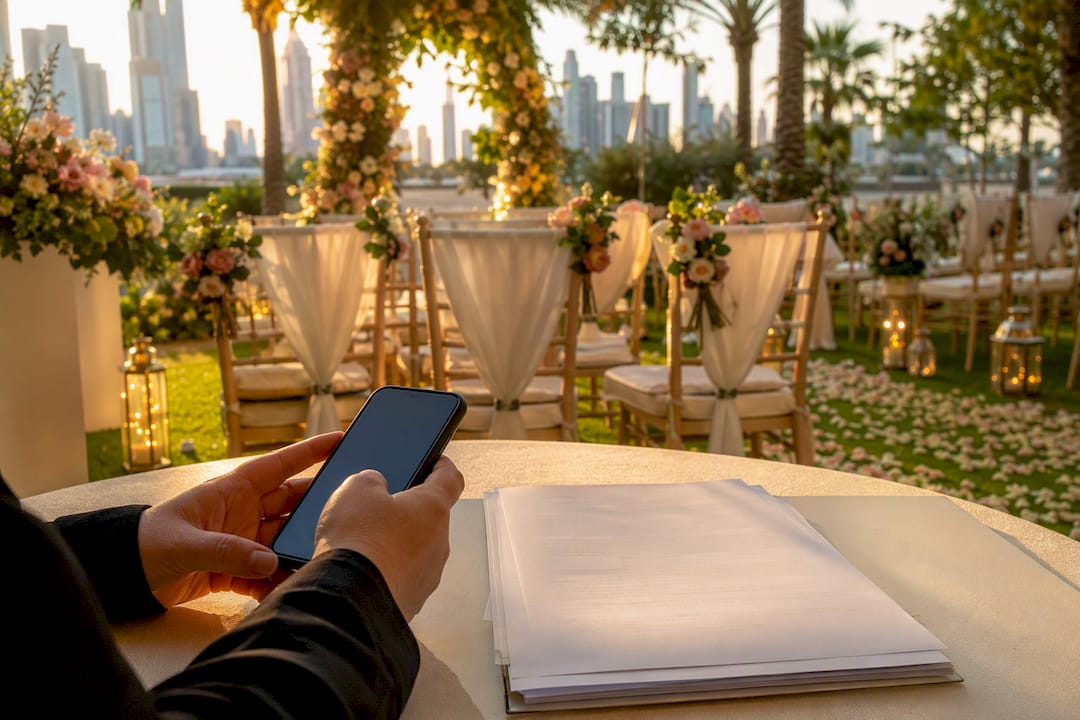
Private weddings at pre-licensed venues generally do not require the organizer to apply for a separate Department of Economy and Tourism (DET) e-Permit. The venue notifies DET on the client’s behalf when needed. Public, ticketed, or openly advertised outdoor ceremonies fall under a different rulebook entirely, requiring permits and layered approvals from multiple authorities. The distinction between “private” and “public” is the single most important thing to nail down before you book a photographer, hire a band, or send out a single invitation.
Expect several names to come up as you plan: DET’s e-Permit system (epermits.dtcm.gov.ae), Dubai Municipality for public areas and beaches, Dubai Civil Defence, SIRA for security, the Roads and Transport Authority (RTA), and the Dubai Film and TV Commission (DFTC) if anyone plans to photograph or film at a landmark location.
Run through this before anything else:
Is this a private wedding hosted at a licensed venue like a hotel or resort?
Are you selling tickets, promoting the event publicly, or hosting it in an open, unbooked space?
Will there be amplified sound, tents or staging, or fireworks?
Pro Tip: If your venue is a resort or hotel, ask upfront whether they’ll submit the NOC and handle entertainment permits for you. Most established properties in Dubai already do this as standard practice.
Key Takeaways
Whether you need a permit for your outdoor Dubai wedding depends entirely on one factor: is it a private event at a licensed venue, or a public, ticketed, or openly promoted one?
Table of Contents for outdoor permits
Which Permits and Authorities Matter for an Outdoor Wedding?
Six government bodies show up repeatedly once you start applying for outdoor event approvals, and each one owns a different piece of the puzzle.
DET (e-Permit) handles mainland event authorization and issues the E-Code needed for online ticket sales.
Dubai Municipality approves use of public areas and beaches, including temporary structures and site restoration plans.
Dubai Civil Defence signs off on tents, staging, generators, and general fire safety.
SIRA reviews security arrangements for larger or higher-risk gatherings.
RTA approves road closures and parking plans when guest traffic affects public roads.
DFTC governs commercial photography and filming at iconic or government-controlled public sites.
The e-Permit portal draws a clear line between private-event notification, which the venue usually files, and organizer-led applications for public or ticketed events. Business events can be applied for up to 12 months ahead, and a complete, clean application is often processed within a single business day.
Complete applications move fast through DET’s system. Incomplete ones, missing a venue NOC or an unclear event brief, are the most common reason approvals stall past that one-day window.
Pro Tip: If you’re shooting at an iconic backdrop like a beachfront promenade or a landmark, contact DFTC or the site-specific authority weeks ahead. Commercial photography often carries its own fee and its own approval track, separate from your wedding permit entirely.
Who Applies: Organizer, Venue, or You?
The rule of thumb is straightforward: private social events at pre-licensed venues typically have the venue notify DET on the client’s behalf, while public, ticketed, or commercial events require the organizer, holding a valid trade license, to apply directly through the e-Permit system.
Mainland and free-zone status matters more than most couples expect. A trade license does not double as an event permit. Free-zone event companies are limited to free-zone areas, so an organizer based in a free zone who wants to run a mainland ceremony usually needs a temporary mainland permit or branch registration. Before signing anyone, verify their exact licensed activity code covers events organizing.
Running a ticketed or public event without the organizer’s required permits risks a shutdown mid-event and fines that dwarf the permit fee you skipped. Confirm early who signs the NOC and who is actually paying for each approval.
Documents, NOCs, and Approvals You Will Need
Every authority wants proof of something specific, and having it ready before you apply is the difference between a same-day approval and a two-week back-and-forth.
Venue NOC stating approved capacity
Site plan or layout diagram
Trade license copy (if an organizer is applying, not the venue)
Passport or Emirates ID copies for organizers and performers
Public liability insurance certificate
Performer contracts and identification
Food provider licenses, if catering is involved
Equipment specifications for generators and PA systems
Waste management and site restoration plan
Different documents map to different desks. Civil Defence wants structural or tent drawings. Dubai Municipality wants food licenses and a restoration plan. DET wants the event brief alongside the venue NOC.
If you’re selling tickets, register for an E-Code through an approved online ticketing partner.
Confirm your ticketing platform is on DET’s approved list before advertising sales.
Budget for per-ticket levies before pricing tickets publicly.
Pro Tip: Build one shared folder with labeled PDFs, plus a contact spreadsheet listing a name and phone number for each authority. Complete applications get processed faster, and a messy submission is the single biggest cause of delay.
Beaches, Deserts, and Landmark Locations: What Changes?
Beach weddings carry their own rulebook. Dubai Municipality requires an NOC for beach occupation, applied for at least three weeks ahead, and it restricts generator use, sets noise limits, and mandates full cleanup and site restoration once the event ends. Public beach access generally has to stay open during your event, which limits how much of the shoreline you can fence off.
Desert and remote locations need separate access approvals, a waste management plan, and Civil Defence sign-off on emergency access and firefighting capability.
Iconic or government-managed public sites often require a DFTC permit for any commercial or editorial photography, separate from your wedding permit.
Some landmark locations ban commercial photography outright without prior written approval.
Shooting professional wedding photos or video at a public landmark without DFTC clearance can get equipment confiscated on the spot, and in some cases shut the entire event down. Confirm photography rules before you book a photographer for that location, not after.
What Do Permits and Approvals Actually Cost, and How Long Do They Take?
Budget for a range rather than a single number, since fees scale with event size and complexity. DET e-Permit fees typically run from roughly AED 1,500 to AED 4,000 or more depending on scale, while a temporary entertainment permit covering a larger stack of performers can run around AED 5,000.
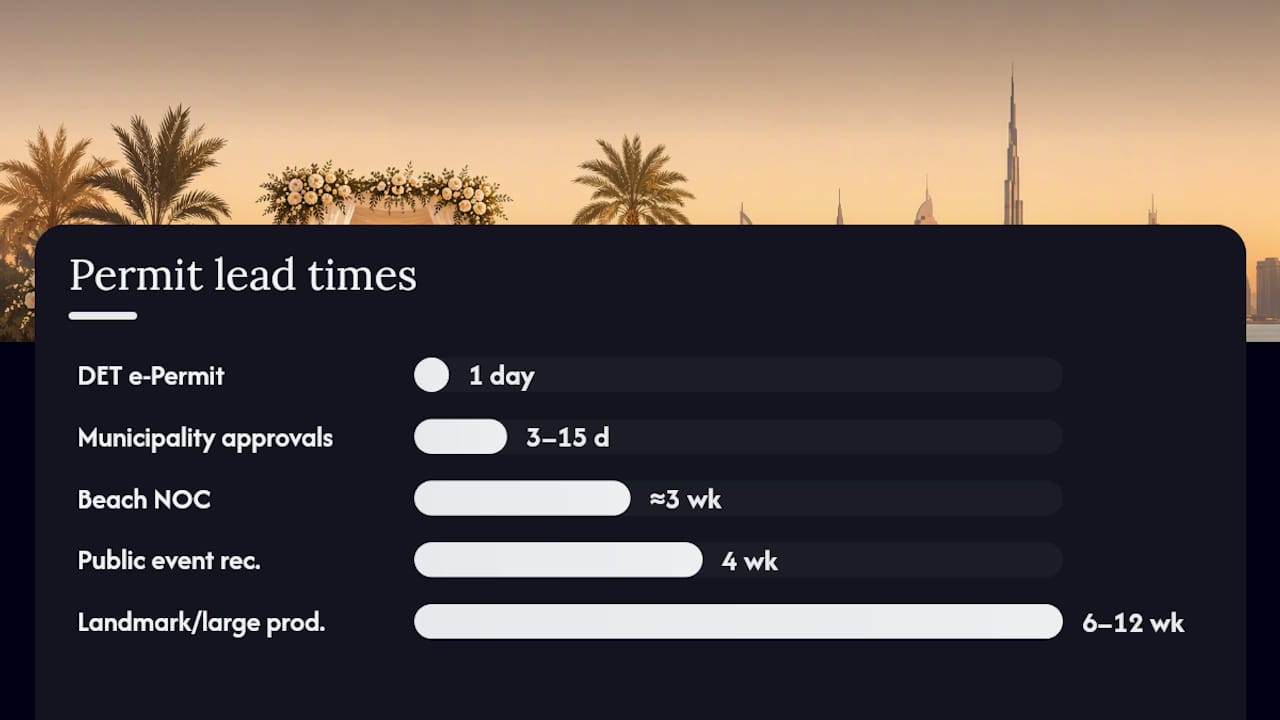
DET e-Permit: often processed within 1 business day for complete applications.
Municipality and public-area approvals: typically 3 to 15 working days depending on complexity.
Civil Defence, SIRA, and RTA approvals: usually need additional lead time beyond the standard window.
Treat these windows as minimums, not guarantees. Statistic callout: A beach NOC alone needs roughly three weeks of lead time before occupation, and Municipality approvals can stretch to 15 working days when documents come in incomplete.
Pro Tip: Submit at least four weeks ahead for any public or temporary-structure event. If you’re filming at a landmark or running a large production, push that to 6 to 12 weeks.
What’s the Realistic Timeline for Getting Everything Approved?
Work backward from the wedding date, and assign clear ownership at each stage so nothing falls through a gap between vendors.
12+ weeks out: Finalize the venue and confirm whether they handle permits directly. Reserve vendors and start NOC paperwork. If the location is public or iconic, open contact with DFTC or Municipality now.
8 to 6 weeks out: Submit primary permits, including the DET e-Permit if you’re the applying organizer. Request Civil Defence pre-approval for any tents or staging. File the Municipality public-area permit if your venue isn’t already licensed.
4 to 2 weeks out: Lock in SIRA security plans and RTA traffic arrangements, finalize insurance, and submit your E-Code plus pay ticket levies if applicable. Confirm generator and power NOCs.
Final 7 days: Have approved permits printed or saved offline, keep NOC copies on-site, confirm your restoration plan and cleanup crew, and schedule a final walk-through with the venue and any relevant authority.
Pro Tip: Put one person, a planner or venue contact, in charge of every authority follow-up and every electronic receipt. Splitting that responsibility across three people is how paperwork gets lost.
A Publisher’s Note on Permits and Peace of Mind
We’ve walked couples through DET e-Permits, Municipality beach approvals, Civil Defence sign-offs, SIRA coordination, and DFTC filming clearance often enough to know where applications usually stall: an incomplete NOC or a missing site plan, not the government’s response time. Catching that gap early, before submission rather than after a rejection, routinely saves a week or more on the calendar.

Pro Tip: Ask any planner you’re considering whether they personally act as your permit liaison, and how they bill for that work. Some quote it separately; others bury it in a package fee.
How Harris & Charms Handles Your Wedding Permits
Harris & Charms is the alternative to juggling six government portals yourself while you’re also supposed to be planning a wedding. We coordinate the DET e-Permit application, the venue NOC, Civil Defence and Municipality submissions, SIRA security sign-off, and DFTC filming clearance when your ceremony calls for it, so the paperwork moves in the background while you focus on the day itself.

Beyond permits, we handle event photography, yacht wedding packages, and the legal side of civil and Islamic marriage registration, including document attestation and translation. If your outdoor ceremony also needs to double as your legal wedding, our tailor-made civil marriage packages cover both the paperwork and the celebration under one plan. Couples exploring broader options can also review our complete marriage service packages for photography, venue coordination, and documentation bundled together.
Reach out for a permit assessment before you lock in a venue. It’s the fastest way to find out exactly which approvals your specific ceremony needs, and which ones you can skip entirely.
Official Sources and Further Reading
Dubai Municipality — for public-space and beach approval guidance, including temporary structure rules.
DCT Licensing Handbook — for context if you’re comparing procedures with Abu Dhabi weddings.
Recommended
Comments