
Prenuptial Agreement Attestation UAE: A Complete Guide

Updated: Sep 5

Yes, prenuptial agreements can be recognized in the UAE, provided they meet UAE formalities. For non-Muslim couples, the fastest and most reliable route runs through the Abu Dhabi Judicial Department (ADJD), which allows you to register a prenuptial agreement alongside a civil marriage application. Muslim couples face a different framework: agreements must sit within the boundaries of Federal Decree-Law No. 41 of 2022, the Personal Status Law, which sets mandatory rules on dowry, spousal rights, and grounds for separation that no private contract can override.
Prenuptial agreement attestation in the UAE hinges on a handful of actions you take before the wedding, not after a dispute starts. Draft the agreement bilingually, in English and Arabic, or arrange certified Arabic translation immediately after signing. Each party needs independent legal advice, documented in writing. Prepare full asset schedules rather than vague references to “all property.” Then notarize and attest the document, and register it with ADJD if you qualify for the civil marriage route.
Draft bilingually or get certified Arabic translation done immediately, not months later
Book independent legal consultations for both parties, and keep the confirmation letters
Compile a full asset and debt schedule before signing anything
Notarize the agreement and pursue ADJD registration where eligible
Pro Tip: ADJD charges a fee to notarize a prenuptial agreement submitted with a civil marriage application, in addition to a standard or express marriage registration fee.
Contact points that matter early: ADJD for civil marriage and prenup registration, the Ministry of Foreign Affairs for attestation of documents signed abroad, and UAE Pass for identity verification on government portals. Harrisandcharms handles this entire chain for couples who prefer not to manage translators, notaries, and appointment systems on their own.
Key Takeaways
A UAE prenuptial agreement gains real enforceability through bilingual drafting, full financial disclosure, independent legal advice, and formal notarization or ADJD registration completed well before the wedding date.
Point | Details |
Recognition depends on marriage track | Non-Muslim couples can use the Abu Dhabi civil route; Muslim couples remain bound by Federal Decree-Law No. 41 of 2022 |
Formalities drive enforceability | Bilingual text, full disclosure, independent advice, and notarization all strengthen a prenup’s standing in court |
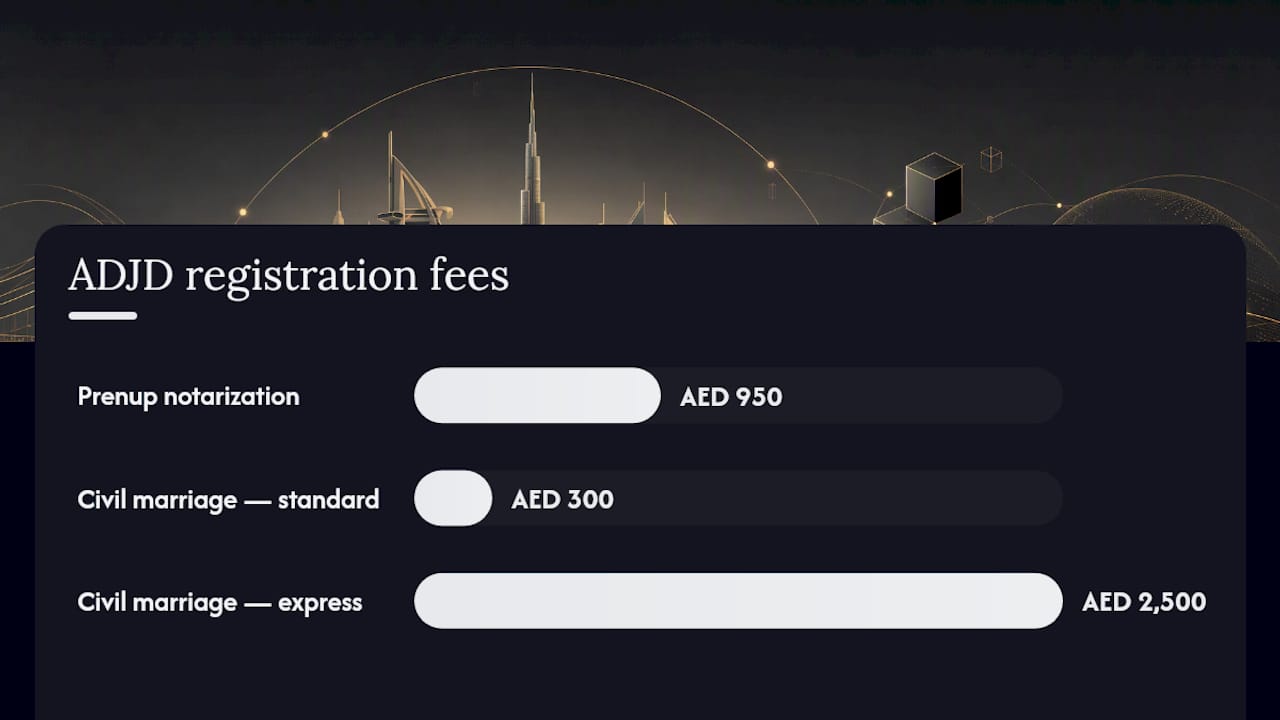
ADJD offers an integrated path | Registration costs AED 950 for prenup notarization plus AED 300 or AED 2,500 for civil marriage, standard or express |
Foreign documents need a full chain | Home-country notarization, embassy legalization, and UAE Ministry of Foreign Affairs attestation must all be completed |
Harrisandcharms manages the process | Harrisandcharms coordinates translation, notarization, ADJD liaison, and document attestation for couples who want it handled |
Table of Contents for prenuptial agreement attestation
Are Prenuptial Agreements Legally Recognized in the UAE?
Recognition depends almost entirely on which legal track your marriage falls under. The UAE runs two parallel systems: Sharia-based personal status law for Muslim couples, and a civil marriage option, centered in Abu Dhabi, for non-Muslim residents and visitors.
For Muslim couples, Federal Decree-Law No. 41 of 2022 governs marriage contracts, dowry terms, spousal obligations, and separation grounds. Articles within that decree, including provisions covering contract elements and spousal rights, give judges a statutory yardstick against which any private agreement gets measured. A prenup that tries to waive a wife’s right to maintenance outright, for instance, will run straight into a mandatory rule the court won’t let you contract around. The agreement isn’t void for existing. It’s just unenforceable on that specific point.
For non-Muslim couples, Abu Dhabi Law No. 14 of 2021 created a standalone civil marriage system with its own procedural rules, deliberately built to feel closer to a Western civil marriage regime. This is where ADJD’s registration path lives, and it’s the reason Abu Dhabi has become the default venue for expatriate couples across the UAE who want a prenup with real teeth, even if they live and marry in Dubai, Sharjah, or elsewhere.
What a UAE prenup can realistically cover:
Division of assets acquired before and during the marriage
Allocation of debts and financial liabilities between spouses
Ownership and management of business shares or company interests
Spousal support terms, within limits that don’t conflict with mandatory rights
Property acquired outside the UAE, including foreign real estate and investments
What it generally cannot override:
Mandatory Sharia inheritance shares for Muslim parties
Child custody, guardianship, and maintenance rights, which UAE courts treat as belonging to the child, not something parents can bargain away
Statutory spousal maintenance obligations under Sharia for Muslim marriages
Any clause that a judge deems contrary to UAE public policy
Citizens and residents also face different practical realities. Emirati Muslim citizens are bound tightly to Sharia procedure through the eZawaj electronic marriage service, which requires the standard elements of a marriage contract and mandatory medical screening. Expatriates marrying civilly in Abu Dhabi skip that medical screening requirement entirely, one of several administrative differences that make the civil route meaningfully lighter on paperwork.
What Formal Requirements Make a Prenup Valid?
Courts and registries in the UAE do not treat a handshake agreement or a casually typed document as a prenuptial agreement. They look for specific formal markers, and missing even one weakens your position if the marriage later ends in dispute.
A written instrument, signed by both parties, with full legal names and identifying details matching passport or Emirates ID records.
Identity verification for both signatories, typically through passport copies and Emirates ID where applicable.
Witnesses or notarization, depending on which emirate and which court will eventually see the document.
Certified Arabic translation, since Arabic remains the operative language in UAE courts and notarial offices regardless of what language the original was drafted in.
Proof of independent legal advice for each party, ideally a signed letter from separate lawyers confirming each spouse understood the terms before signing.
A full financial disclosure schedule, listing assets, debts, and business interests as of the signing date.
Appropriate timing, meaning execution with enough breathing room before the wedding date to avoid an argument that one party signed under pressure.
Beyond the paperwork itself, UAE courts weigh a set of evidentiary priorities when a prenup gets challenged. Voluntariness sits at the top: did both parties sign freely, with time to consider the terms, or was the agreement pushed through days before the ceremony? Translation quality matters almost as much. A sloppy or inconsistent Arabic version, one that doesn’t match the English text clause for clause, gives a challenging party an opening to argue the agreement never reflected a genuine meeting of minds.
Full disclosure is the other pillar. If one spouse later discovers assets that were deliberately hidden from the asset schedule, a judge has grounds to set aside the entire agreement, not just the affected clause. Practitioners who work regularly with UAE family courts consistently flag inadequate disclosure as one of the most common reasons agreements get challenged after the fact.
Pro Tip: Keep every proof document together in one file: signed independent-advice letters, the certified translator’s certificate, the notary’s attestation receipt, and dated asset schedules. If your marriage ever ends in dispute, that file is what your lawyer will reach for first.
Notarization and formal registration don’t guarantee a court will enforce every clause, but they materially strengthen your evidentiary position. A private side letter, signed with no witnesses and no notarial stamp, is far more vulnerable to a claim that it was never properly executed or that one party didn’t fully understand what they signed.
How Do You Notarize and Attest a Prenup for UAE Use?
The sequence changes slightly depending on whether you’re drafting fresh in the UAE or bringing in a document already signed elsewhere, but the underlying logic stays the same: every step exists to prove the document is genuine, both parties consented, and the Arabic version says exactly what the English version says.
Execute the agreement with both spouses present, signing in front of a notary or authorized witness.
Arrange certified Arabic translation if the original wasn’t drafted bilingually, using a translator authorized for legal work in the UAE.
Notarize the document, either at a UAE notary public office or, if signed abroad, at a notary in the home country first.
Legalize at the embassy or foreign ministry of the country where the document was originally signed, if it wasn’t executed in the UAE.
Attest through the UAE Ministry of Foreign Affairs, which confirms the document’s authenticity for use within the UAE legal system.
File or register with ADJD, where the civil marriage route applies, so the prenup becomes part of the official marriage record rather than a standalone private paper.
For documents originating outside the UAE, the Ministry of Foreign Affairs attestation step is not optional. Documents issued abroad must be officially attested and translated into Arabic by an authorized translator, then certified by the relevant UAE authority, whether that’s the Ministry of Justice, the Ministry of Foreign Affairs, or a UAE embassy in the country of origin.
Where UAE Pass and online submission fit in:
UAE Pass provides digital identity verification for several government portals, cutting down on in-person visits for routine steps.
ADJD’s civil marriage system accepts appointment booking and document submission online, reducing the need to physically queue at a service center.
Some notarial and attestation steps still require in-person attendance, particularly the actual execution and witnessing of the agreement itself.
Pro Tip: ADJD’s civil marriage service has become the practical default for expatriate couples across the UAE, not just Abu Dhabi residents, precisely because it lets you register the prenup and the marriage in a single integrated process instead of two disconnected filings.
A few practical notes worth flagging before you start. If one party can’t attend a step in person, a power of attorney can sometimes cover representative attendance, though notaries vary in how strictly they require the actual signatory to be present for execution. Keep certified copies of everything, not just the originals. Losing your only notarized copy of a prenup mid-dispute is the kind of avoidable disaster that turns a strong legal position into a weak one overnight.
How Do You Register a Prenup With ADJD in Abu Dhabi?
ADJD’s civil marriage system is open to non-Muslim residents and, in many cases, non-Muslim tourists, which makes it the go-to option for expatriate couples anywhere in the UAE, not only those living in Abu Dhabi. If either party is Muslim, this route generally isn’t available, and the marriage falls under Sharia procedure instead.

The process itself follows a fairly linear path. You register through UAE Pass for identity verification, then submit your application and supporting documents through the ADJD portal. Depending on your preference and schedule, you can book a standard court appointment or pay for the express service, which compresses the timeline considerably.
Step | What It Involves |
Identity verification | Register and verify identity through UAE Pass before submitting any application |
Document submission | Upload passports, proof of single status, and the prenuptial agreement via the ADJD portal |
Prenup notarization | ADJD notarizes the submitted agreement for AED 950 as part of the application |
Civil marriage fee | AED 300 for standard processing or AED 2,500 for express same-day service |
Appointment or express slot | Choose a scheduled court appointment or request express handling for faster turnaround |
The itemized documents ADJD typically asks for include valid passports for both parties, proof of single or divorced status, Emirates ID where either party is a resident, and the prenuptial agreement itself, drafted or translated into a form the court can process. If either party was previously married, expect to provide a divorce certificate or, where relevant, a death certificate for a former spouse.
Pro Tip: If your schedule is tight or you’re coordinating around flights and family travel, the express service is worth the extra cost. AED 2,500 against AED 300 sounds steep until you consider what it costs to rebook flights or delay a ceremony because a standard appointment slot fell through.
One detail that trips up couples unfamiliar with the system: the prenup notarization fee and the civil marriage fee are separate line items, not a bundled price. Budget for both, and confirm current figures directly with ADJD before your appointment, since government fee schedules do shift over time. Harrisandcharms coordinates this entire submission on behalf of clients who’d rather not navigate the portal, appointment system, and document formatting requirements solo, particularly useful if you’re managing an Abu Dhabi civil marriage from outside the country.
What Documents, Timelines, and Fees Should You Expect?
Planning a prenup attestation without a document checklist in hand is how couples end up making three trips to a notary’s office instead of one. Here’s the realistic list, gathered from what ADJD and UAE authorities actually require across the process.
Core documents to collect:
Valid passports for both parties, with enough validity remaining to cover the marriage date
Emirates ID for any party who is a UAE resident
Proof of single status, or a divorce or death certificate if either party was previously married
The prenuptial agreement itself, ideally drafted bilingually from the start
A certified Arabic translation, if the original document wasn’t drafted in both languages
Full asset and debt schedules, dated and signed alongside the main agreement
Notarization and attestation receipts, kept as proof the formal steps were completed
Timelines vary depending on how much of the document originates abroad. A prenup drafted and signed entirely within the UAE, with bilingual text prepared from day one, can often move through notarization and ADJD registration within a matter of days. Add certified translation as a separate step afterward, and you’re realistically looking at extra time for translator turnaround, plus scheduling around notary and court availability.
Foreign-issued documents take longer. Home-country notarization, embassy legalization, and UAE Ministry of Foreign Affairs attestation each add processing time, and courier delays between jurisdictions are common. Building in a buffer of several weeks before your intended marriage date is a reasonable planning assumption if any part of your prenup was executed outside the UAE.
Typical fees to budget for:
ADJD prenup notarization: AED 950
Civil marriage registration: AED 300 standard, or AED 2,500 for express service
Certified Arabic translation: varies by document length and translator, confirm current rates directly
Ministry of Foreign Affairs attestation: varies by document type and origin country
Pro Tip: Confirm every fee figure directly with ADJD or the Ministry of Foreign Affairs before booking anything. Government fee schedules get revised, and a number you read online six months ago may already be outdated.
For a full breakdown of what document legalization costs typically involve, this guide to document legalization for UAE marriages walks through the embassy and MOFA stages in more depth.
What Drafting Practices Actually Reduce Legal Risk?
Good drafting isn’t about clever legal language. It’s about removing every avoidable point of ambiguity before a judge ever has to interpret your intent from a poorly worded clause.
A practical drafting checklist:
Draft bilingually from the outset, rather than writing in English and translating later, since after-the-fact translation creates room for the two versions to drift apart in meaning.
Write operative clauses in plain, specific language. “Fair division of assets” invites dispute; “Party A retains sole ownership of the Dubai apartment purchased in 2023” does not.
Attach a separate, signed asset schedule rather than folding financial details into the body text, so updates don’t require rewriting the whole agreement.
Include clear signature blocks with space for witness or notary signatures, dated the same day as execution.
Document independent legal advice in writing, with each party’s lawyer confirming, separately, that their client understood the terms before signing.
Common clauses worth including, with a caution attached to each: a governing-law clause specifying UAE law applies; a dispute-resolution clause naming the court or arbitration body that would hear a challenge; clear language on business share ownership if either party runs a company; and spousal support terms that stay within the bounds UAE courts will actually enforce, rather than attempting to waive support obligations that mandatory law protects.
Bilingual drafting deserves particular attention because it should be treated as part of the original transaction, not an afterthought bolted on once you realize a court will need Arabic. Preparing a translation after the English version is already signed and finalized is exactly the kind of gap that gives a challenging spouse’s lawyer an opening: which version reflects the true agreement, if the two don’t say precisely the same thing?
Pro Tip: Have your Arabic and English versions reviewed clause by clause by the same translator who prepared the original, not two separate translators working independently. Small inconsistencies between versions are far easier to catch when one person is responsible for both.
Timing and process matter every bit as much as the words on the page. A beautifully drafted agreement signed the night before the wedding, with no independent advice and no notarization, is weaker in practice than a simpler agreement executed weeks in advance, properly witnessed, and formally registered.
How Strictly Do UAE Courts Enforce Prenuptial Agreements?
UAE courts don’t rubber-stamp prenuptial agreements. They scrutinize them, and the factors judges weigh most heavily are consistent across the cases practitioners describe: whether both parties signed voluntarily, whether disclosure was genuinely complete, whether the translation accurately mirrors the original intent, and whether any clause conflicts with public policy or children’s rights.
Grounds that commonly lead to a clause being set aside or limited:
Evidence of fraud or deliberately concealed assets at the time of signing
Undue influence, such as one party pressuring the other into signing shortly before the wedding
Incomplete or inaccurate financial disclosure
Terms that directly contradict mandatory Sharia provisions, for Muslim parties
Provisions attempting to predetermine child custody or maintenance outcomes
Even strong procedural safeguards, notarization, certified translation, formal registration, do not guarantee full enforcement. UAE courts focus on voluntariness, disclosure, and conformity with public policy above the mere existence of a signed and stamped document.
When a court does find a problem, the outcome usually isn’t total rejection of the agreement. Judges tend to work clause by clause: severing the offending provision while leaving the rest intact, or applying a mandatory statutory rule in place of a contract term that tried to override it. Full refusal to enforce anything is the least common outcome, reserved for cases where the entire agreement appears tainted by fraud or coercion.
This is precisely why the drafting checklist earlier in this guide matters so much in practice. A prenup built with full disclosure, independent advice, accurate bilingual text, and proper notarization gives a judge far less to work with when a spouse’s lawyer looks for a way to unwind it.
How Do You Make a Foreign Prenup Valid in the UAE?
Couples who signed a prenuptial agreement before moving to the UAE, or who married elsewhere and later relocated, face an extra layer of process. The document doesn’t automatically carry legal weight here just because it was valid where it was signed.
Notarize in the country of origin, confirming the signatures and execution date through that country’s own notarial system.
Legalize through the home country’s foreign affairs ministry or the relevant embassy, the step that formally certifies the document for international use.
Attest through the UAE Ministry of Foreign Affairs, which recognizes the document as authentic for use within the UAE.
Obtain certified Arabic translation, completed by a translator authorized to work on legal documents intended for UAE courts and authorities.
Once that chain is complete, the document theoretically carries legal recognition in the UAE. In practice, many lawyers recommend going a step further: drafting a UAE “mirror” or companion agreement that restates the original terms in a form built specifically for UAE enforcement, particularly when either party holds property or business interests physically located in the UAE.
The reasoning is straightforward. If a dispute ends up in a UAE court, a document built from scratch around UAE procedural requirements, with a UAE governing-law clause and Arabic as an equal original language, gives the judge far less room to question its validity than a foreign document run through the attestation chain after the fact.
It’s also worth coordinating your prenup with any will or estate plan you hold, in the UAE or elsewhere. A prenup that allocates assets one way while a will assumes a different distribution creates exactly the kind of contradiction that invites years of litigation. For couples navigating this from abroad, a marriage attestation guide for documents used abroad covers the embassy and MOFA sequence step by step, and MOJ-certified legal translators can handle the certified Arabic translation stage to the standard UAE courts expect.
What Services Does Harris & Charms Provide for Prenup Attestation?
Managing notarization, translation, embassy legalization, and ADJD filing across multiple government offices is a full-time task most couples don’t have room for during wedding planning. Harrisandcharms handles that entire chain directly.
Services relevant to prenup attestation and marriage registration:
Bilingual drafting support, coordinating with legal counsel on English and Arabic text that matches clause for clause
Certified translation coordination for documents that weren’t drafted bilingually from the start
Notary and ADJD liaison, including appointment booking and document formatting for portal submission
Document attestation assistance for agreements signed outside the UAE, covering the embassy and Ministry of Foreign Affairs stages
Venue and event coordination for couples combining civil marriage registration with a wedding celebration
Approach | What It Involves |
Fully DIY | You handle notary appointments, translation sourcing, MOFA attestation, and ADJD submission independently |
Managed with Harrisandcharms | Harrisandcharms coordinates translation, notarization, attestation, and ADJD filing on your behalf |
Pro Tip: Start the prenup attestation process at least four to six weeks before your intended marriage date if any document originates outside the UAE. That buffer absorbs courier delays and appointment scheduling without forcing a last-minute rush.
A prenup that’s properly drafted, translated, and registered before the wedding costs far less time and stress than one reconstructed under pressure during a dispute years later.
If you’d rather have someone else manage the notary, the translator, and the ADJD portal, Harrisandcharms’s marriage services start with a consultation, move into document collection, and end with a scheduled ADJD appointment or express registration slot.
Where Can You Confirm Current Rules and Fees?
Government fee schedules and procedural requirements shift, so confirm details directly with official sources before booking any appointment.
ADJD portal: for civil marriage applications, prenup notarization requests, and appointment booking
u.ae: for general UAE government guidance on marriage procedures and required documentation
UAE legislation portal: for the full text of Federal Decree-Law No. 41 of 2022 and Abu Dhabi Law No. 14 of 2021
Ministry of Foreign Affairs: for attestation requirements covering documents signed outside the UAE
Harrisandcharms marriage services: for managed support drafting, translating, notarizing, and registering your agreement
What This Guide Gets Right That Most Advice Misses
Most articles on this topic treat “prenups in the UAE” as one question with one answer. It isn’t. The real question is which legal track you’re on, and most of the generic advice floating around ignores that split entirely.
The conventional wisdom leans hard on the idea that notarization alone makes a prenup bulletproof. It doesn’t. Courts still look past the stamp to voluntariness, disclosure, and whether the Arabic text actually matches what both parties agreed to. A rushed, notarized document signed the week of the wedding is genuinely weaker than an unhurried one signed a month earlier with proper independent advice on file.
If you take one thing from this guide, prioritize timing over paperwork perfection. Start the drafting and disclosure process early, get the bilingual translation right the first time, and treat ADJD registration as the finishing step, not a substitute for doing the groundwork properly. Couples who try to compress this into the final week before their wedding are the ones most likely to end up with an agreement that looks solid on paper and falls apart under real scrutiny.
Get Managed Prenup Attestation Support From Harrisandcharms
Handling ADJD submissions, certified translation, and Ministry of Foreign Affairs attestation on your own means juggling three separate government processes while planning a wedding. Harrisandcharms is the alternative to piecing this together yourself: one point of contact who coordinates the notary, the translator, and the ADJD appointment so you’re not the one chasing status updates across three offices.

This matters most for couples managing documents from abroad or racing a tight wedding date. Harrisandcharms’s comprehensive marriage services cover bilingual drafting support, certified translation coordination, and direct liaison with ADJD for civil marriage and prenup registration, alongside venue and event coordination if you’re planning the celebration at the same time. Book a consultation now, bring your documents and your intended marriage date, and Harrisandcharms will map out which package and which registration route, standard or express, fits your timeline.
Recommended
Comments