
Single Status Certificate UAE: How to Get One and Get It Attested

Updated: Sep 5

A single status certificate (also called a certificate of no impediment or no-marriage certificate) proves you are legally free to marry, and in the UAE it is usually issued through the Abu Dhabi Judicial Department using digital signing via UAE PASS, or through your embassy or consulate if your nationality requires that route. Either way, the certificate is not fully usable for official purposes until it clears attestation by the UAE Ministry of Foreign Affairs (MOFA).
If you need one now, here is the fastest path:
Identify which of the three types applies to you (never married, divorced, or widowed).
Confirm your Emirates ID and UAE PASS account are active and current.
Apply through the Abu Dhabi Judicial Department portal, or contact your consulate if your nationality mandates home-country issuance.
Route the finished certificate through MOFA attestation before submitting it anywhere official.
Many nationalities, including Indian nationals cannot simply request this certificate from a UAE office. It has to originate from a court or authority back home, then travel through a counter-attestation chain before MOFA will touch it. Skipping that detail is the single most common reason applications stall for weeks.
Key Takeaways
Getting a single status certificate recognized in the UAE depends on matching the correct certificate type to your marital history and completing MOFA attestation before any official use.
Point | Details |
Identify your type first | Never married, divorced, or widowed each require different supporting documents and issuing routes. |
Check nationality rules early | Some nationalities, including Indian citizens, must obtain the certificate from a home-country authority first. |
Watch expiry windows | UAE-issued certificates last around 3 months; foreign-issued ones last up to 6 months. |
MOFA attestation is mandatory | No certificate is officially recognized in the UAE until MOFA has legalized it. |
Harrisandcharms handles the full chain | Document vetting, certified translation, UAE PASS coordination, and attestation tracking are managed as part of full-service marriage packages. |
Table of Contents for single status certificate
Which single status certificate type do you need?
Before you gather a single document, figure out which category fits your situation. The paperwork, timeline, and issuing authority all shift depending on the answer.
Never married: Usually needs only your Emirates ID (for residents) plus a personal declaration. This is the simplest and fastest of the three.
Divorced: Requires your final divorce decree, not just a filing notice. Courts and embassies will reject a certificate request if the divorce judgment isn’t marked final.
Widowed: Requires the death certificate of your former spouse, ideally attested if it was issued outside the UAE.
Nationality caveat: Some countries, India among them, require the certificate to be issued or affirmed by a home-country court or sub-divisional magistrate rather than a UAE authority, even if you live in Dubai or Abu Dhabi full-time.
Getting this classification wrong is the fastest way to waste a submission cycle, so confirm it before you start collecting paperwork.
When do you actually need this certificate?
You don’t need a single status certificate for most day-to-day UAE administrative tasks. It becomes necessary in a handful of specific scenarios, and knowing which one applies saves you from chasing paperwork you don’t need.
Registering a civil marriage in a UAE court or at your embassy.
Marrying abroad and needing UAE-recognized proof you were free to do so.
Sponsoring a spouse on a UAE residence visa, where immigration authorities want confirmation of marital status history.
Completing embassy marriage paperwork ahead of a wedding either inside the UAE or in a third country.
Timing matters here. Because UAE-issued certificates have a limited validity period and foreign-issued ones have a longer acceptance window, don’t request the certificate too early relative to your actual marriage or visa filing date, or you’ll be repeating the process.
What documents do you need, and how long are they valid?
Your documents pack depends on which certificate type you identified earlier, but a few requirements apply across the board.
Passport with at least six months of remaining validity.
UAE residence visa copy (if you’re a resident, not a visitor).
Emirates ID, active and matching your visa details exactly.
Divorce decree (final judgment only) if you were previously married and divorced.
Death certificate of a former spouse if you’re widowed, attested if issued abroad.
Passport-size photographs, per the issuing authority’s specifications.
Certified Arabic translation for any document not originally issued in Arabic.
Every non-Arabic document, including affidavits and foreign court decrees, needs a certified legal translation before UAE authorities will accept it. Skipping this step is one of the most frequent causes of rejected submissions.
Pro Tip: Request your certificate close to when you’ll actually use it. UAE-issued certificates typically expire around 3 months from issue, and foreign-issued ones around 6 months, so a certificate that sits in a drawer too long often forces you to restart the entire process, translations and all.

For a full breakdown of what’s needed for the marriage filing itself, refer to the complete checklist and legal guide for marriage paperwork in Ireland, which provides detailed insight into acceptable proof of marital status and paperwork processes abroad.
How do you apply for a single status certificate?
There are three realistic routes, and which one applies to you depends on your residency status and nationality.
UAE-issued route (Abu Dhabi Judicial Department): Prepare your documents, confirm your UAE PASS account is verified and active, submit your application digitally, and sign electronically. Digital signing through UAE PASS has largely replaced in-person signatures for this kind of judicial declaration, which cuts the process down to days in straightforward cases.
Embassy or consulate route (inside the UAE): If your nationality requires it, or if you simply prefer it, your embassy can issue a consular no-impediment letter. Requirements differ for residents versus visitors. The Consulate General of India, Dubai, for example, charges AED 198 for related marriage registration services and expects specific supporting documents depending on your visa status.
Home-country route (for visit-visa holders): If you’re only in the UAE on a visit visa, you may need to obtain a court or sub-divisional magistrate affidavit in your home country, then have it counter-attested by your home country’s foreign affairs ministry before it ever reaches UAE MOFA.
Automated rejections are common at the UAE PASS stage, almost always because of mismatched Emirates ID details or incorrect file formats. Double-check both before you submit.
How does MOFA attestation and legalization work?
MOFA is the finish line. No matter which route issued your certificate, it isn’t recognized by UAE courts, immigration, or government departments until MOFA has attested it.
If your certificate was issued inside the UAE, submission to MOFA is usually straightforward once the Abu Dhabi Judicial Department has signed off.
If it was issued abroad, the chain typically runs: home-country legalization, then UAE embassy attestation in your home country (if required), then MOFA attestation once you’re back in the UAE.
Some receiving authorities accept an apostille in place of full consular attestation, but this depends entirely on the destination country and the specific authority requesting the document, so confirm before assuming either path works.
Certified Arabic translation has to happen before or alongside this chain, not after, since MOFA and most courts won’t process an untranslated foreign document.
Pro Tip: Call the receiving authority, whether it’s a UAE court, an embassy, or an immigration office, before you start the attestation chain. Requirements for apostille versus consular attestation vary enough between countries that guessing wrong can cost you a full extra cycle.
Our detailed walkthrough on marriage attestation in the UAE breaks down the full legalization sequence step by step if you want more detail on timing and document flow.
What mistakes cause rejections, and how do you fix them fast?
Most rejections trace back to a small handful of avoidable errors.
Expired or mismatched Emirates ID: Confirm your ID details match your visa exactly before submitting anything digitally.
Wrong certificate type: Submitting a “never married” application when you’re actually divorced (or vice versa) gets flagged immediately.
Non-final divorce judgment: Courts and consulates want the final decree, not an interim ruling.
Missing attestation or translation: A certificate without MOFA sign-off, or a foreign document without certified Arabic translation, will bounce back at the receiving authority.
Pro Tip: If UAE PASS rejects your submission with no clear reason, check your file format and size first; this catches the majority of automated rejections before you need to contact support at all.
How Harris & Charms handles the paperwork for you
Chasing certificate types, translation certification, and MOFA queues while planning a wedding is a lot to carry alone. Harrisandcharms handles document vetting, certified translations, UAE PASS coordination, and full attestation tracking as part of its marriage registration support, drawing on a partner network built specifically for UAE civil and Islamic marriage documentation.
DIY makes sense if your case is simple: UAE resident, never married, straightforward Emirates ID application. Anything involving foreign issuance, a prior divorce or death certificate, or a tight visa timeline is where professional coordination saves real weeks, not just hassle.
Couples juggling attestation chains across two countries rarely realize how many steps depend on getting the sequence right the first time.
What the process actually rewards: sequencing, not speed
The conventional advice treats a single status certificate like a form to fill out. It isn’t; it’s a sequencing problem, and the UAE process punishes anyone who gets the order wrong more than it punishes anyone who moves slowly.
The biggest gap between what people expect and what actually happens: they assume UAE PASS and digital signing make the whole thing fast end to end. Digital signing does speed up the Abu Dhabi Judicial Department stage. It does nothing for the home-country leg that nationalities like Indian citizens have to complete first, and it does nothing for MOFA queues if your translation isn’t certified before you arrive there.
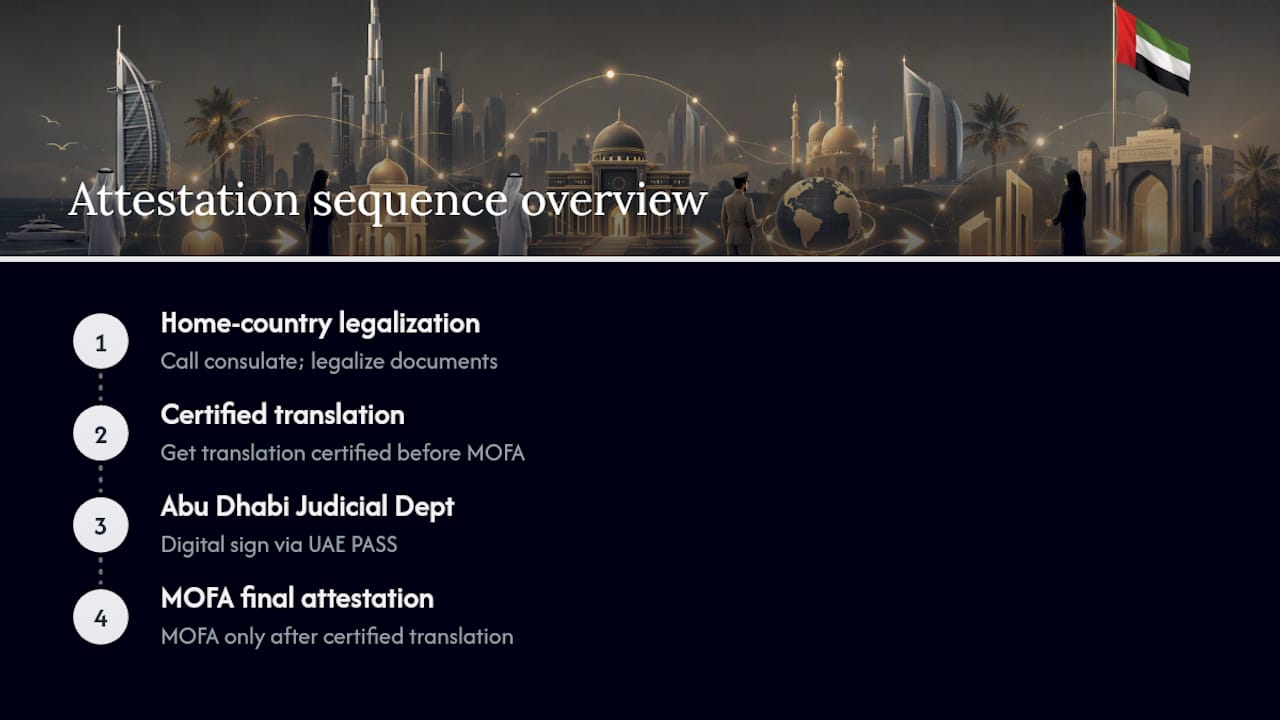
What actually matters is knowing your route before you touch a single form. Residents and visit-visa holders face genuinely different paths, and nationality changes the picture again. If there’s one thing worth prioritizing above all else, it’s calling your consulate first, before you assume the Abu Dhabi Judicial Department route even applies to you. That one phone call prevents more wasted weeks than any amount of careful form-filling afterward.
Let Harris & Charms Handle Your Marriage Paperwork
If you’d rather skip the back-and-forth between the Abu Dhabi Judicial Department, your consulate, and MOFA, Harrisandcharms manages the entire chain for you, from document vetting through certified translation to final attestation, as part of its full-service marriage registration packages.

Where a DIY applicant might lose weeks to a rejected UAE PASS submission or an unclear apostille requirement, Harrisandcharms coordinates document checks, translation, and attestation timing so nothing arrives at MOFA out of sequence. This matters most if you’re on a visit visa, previously divorced or widowed, or dealing with a nationality that requires home-country issuance, exactly the cases where a single misstep costs the most time.
Whether you’re planning a civil ceremony, an Islamic marriage, or need documentation support alongside full wedding planning, our comprehensive marriage services cover civil and Islamic packages with attestation assistance built in. Reach out to get a clear checklist for your specific certificate type and start your application the right way the first time.
Frequently Asked Questions
What is a single status certificate in the UAE used for? It proves you are legally free to marry, and UAE authorities, embassies, and courts typically require it for civil marriage registration, spouse sponsorship, or marrying abroad.
Who issues a single status certificate in the UAE? The Abu Dhabi Judicial Department handles UAE-issued certificates through digital signing via UAE PASS, while many nationalities need to go through their embassy or consulate instead.
Do I need MOFA attestation for a single status certificate? Yes, in most cases. MOFA is the final legalization authority in the UAE, and without its attestation, UAE government bodies and courts won’t recognize the certificate.
How long is a single status certificate valid in the UAE? Certificates issued inside the UAE are generally valid for about 3 months, while those issued outside the UAE are typically accepted for up to 6 months.
Can Indian nationals get a single status certificate directly in the UAE? Not usually. Indian nationals typically need a certificate issued by a competent court or sub-divisional magistrate in India, counter-attested by India’s Ministry of External Affairs, before UAE MOFA attestation.
What documents do I need for a single status certificate if I’m divorced? You need your final divorce decree, not an interim ruling, along with your Emirates ID, passport, and a certified Arabic translation if the decree was issued abroad.
Do visit-visa holders follow a different process than residents? Yes. Visit-visa holders often need to obtain the certificate through a home-country court or affidavit process rather than through the Abu Dhabi Judicial Department directly.
Why did my UAE PASS submission get rejected? Automated rejections usually come from mismatched Emirates ID details or incorrect file formats, so verify both before resubmitting.
Is an apostille the same as MOFA attestation? No. An apostille is sometimes accepted by receiving authorities in place of full consular attestation, but this depends on the specific country and authority, so confirm before assuming it applies.
How much does a single status certificate cost in the UAE? Costs vary by issuing authority and nationality; for example, related marriage registration services at the Consulate General of India, Dubai carry a fee of AED 198, while other routes have separate government and attestation fees.
Can Harrisandcharms help with the entire attestation process? Yes. Harrisandcharms coordinates document vetting, certified translation, UAE PASS assistance, and MOFA attestation tracking as part of its marriage registration support.
What happens if my certificate expires before I use it? You’ll need to reapply and, if applicable, restart translation and attestation, so time your application close to your actual marriage or visa filing date.
Do I need a certified translation for every document? Any document not originally issued in Arabic needs a certified Arabic translation before UAE authorities, including MOFA, will accept it.
Is a single status certificate different from a marital status certificate? They’re often used interchangeably, though “marital status certificate” can also refer to broader documentation confirming your current marriage or civil status history.
What’s the fastest route to get this certificate as a UAE resident? For residents who were never married, the Abu Dhabi Judicial Department’s digital route via UAE PASS is typically the fastest option available.
Should I contact my consulate before starting the application? Yes. Requirements vary significantly by nationality, and confirming your required route first prevents wasted time on the wrong process.
Can a widowed applicant use a foreign death certificate directly? Only after it has been properly attested; a foreign-issued death certificate generally needs legalization before UAE authorities will accept it as supporting evidence.
What’s the biggest reason applications get delayed? Sequencing errors, submitting to MOFA before completing home-country legalization, or skipping certified translation before attestation, cause most of the delays.
Does Harrisandcharms only handle documentation, or full wedding planning too? Harrisandcharms offers both: full-service civil and Islamic marriage planning alongside document vetting, attestation coordination, and legal translation support.
Recommended
Comments