
UAE Family Court Procedures: Your 2026 Legal Guide

Updated: Jul 24

UAE family court procedures follow a structured, multi-stage process governed by two distinct legal tracks: Sharia-based law under Federal Decree-Law No. 41 of 2024 for Muslim families, and civil personal status law under Federal Decree-Law No. 41 of 2022 for non-Muslims. A third layer, Abu Dhabi Civil Family Law No. 14 of 2021, applies specifically to non-Muslim foreigners residing in Abu Dhabi. Every case, regardless of which track applies, moves through the same basic sequence:
Filing: Submit a formal application with supporting documents to the relevant family court
Mediation: Attend mandatory Family Guidance Committee sessions before any hearing is scheduled
Court hearings: Present arguments before a judge at the Court of First Instance
Judgment and enforcement: Receive a binding court order, with appeal rights at the Court of Appeal and Court of Cassation
Post-judgment: Enforce orders covering alimony, custody, and asset division through court mechanisms
Timelines vary considerably. Some mutual-consent divorces can conclude quickly, while contested custody disputes may take significantly longer, especially when notification of the other party is delayed. Identifying which legal track governs your case is the single most important step you can take before filing anything.
How UAE family law actually works: the dual-track framework
The UAE does not apply one uniform family law to everyone. The system runs on two parallel tracks, and which one applies to you shapes everything from how you file to what evidence matters in court.
The two governing frameworks:
Federal Decree-Law No. 41 of 2024 governs personal status matters for Muslim residents and citizens, covering marriage, divorce, custody, inheritance, and maintenance under Sharia principles
Federal Decree-Law No. 41 of 2022 establishes a civil personal status law for non-Muslims, removing fault-based requirements and introducing no-fault divorce, equal custody rights, and civil inheritance rules
Abu Dhabi Civil Family Law No. 14 of 2021 predates the federal civil law and applies to non-Muslim expatriates in Abu Dhabi, offering similar civil protections at the emirate level
Non-Muslims and expatriates may also request that their home country’s law apply, provided it does not conflict with UAE public order or federal law
The practical difference between the two tracks is significant. Under the Sharia-based system, divorce types include talaq (husband’s unilateral pronouncement), khula (wife-initiated with financial concession), and judicial divorce. Under the civil track, a non-Muslim spouse can obtain a divorce through a unilateral declaration without proving fault or harm.
Feature | Muslim track (Federal Decree-Law No. 41 of 2024) | Non-Muslim track (Federal Decree-Law No. 41 of 2022) |
Divorce basis | Sharia principles; fault or grounds required for judicial divorce | No-fault; unilateral declaration sufficient |
Custody default | Mother typically retains physical custody for young children under Sharia law; joint legal custody applies, with fathers retaining guardianship | Under the civil track, both parents have joint and equal custody rights until the child reaches 18 years |
Inheritance | Sharia distribution rules | Civil distribution; testamentary freedom applies |
Home country law option | Generally not applicable | Available if not in conflict with UAE law |
Applicable courts | Personal Status Courts | Civil Personal Status Courts |
Pro Tip: If you are a non-Muslim expatriate, confirm at the outset whether your case falls under Federal Decree-Law No. 41 of 2022 or Abu Dhabi Civil Family Law No. 14 of 2021. The procedural steps differ slightly, and filing under the wrong framework can delay your case by months.
Understanding the civil vs. Islamic marriage distinction before you reach a family court is far easier than untangling it mid-proceeding.
What the UAE divorce process actually looks like, step by step
Divorce in the UAE is not a single procedure. The type of divorce you pursue, and the legal track you fall under, determines the documents you need, the hearings you attend, and how long the process takes.
Types of divorce recognized in UAE family courts
For Muslims:
Talaq (husband’s unilateral pronouncement): The husband pronounces divorce and registers it with the court. The court must be notified, and a reconciliation attempt is required before finalization.
Khula (wife-initiated): The wife requests divorce in exchange for returning the mahr (dowry) or another agreed financial concession. Court approval is required.
Judicial divorce (Faskh): Either spouse petitions the court on specific grounds, such as harm, non-maintenance, or prolonged absence. The court investigates and rules.
Mutual consent divorce: Both parties agree to dissolve the marriage and present a joint application. This is typically the fastest route.
For non-Muslims:
No-fault civil divorce: Under Federal Decree-Law No. 41 of 2022, a non-Muslim spouse can file a unilateral declaration of divorce without proving fault or harm. The court processes the declaration and issues a civil divorce certificate.
The filing and hearing process
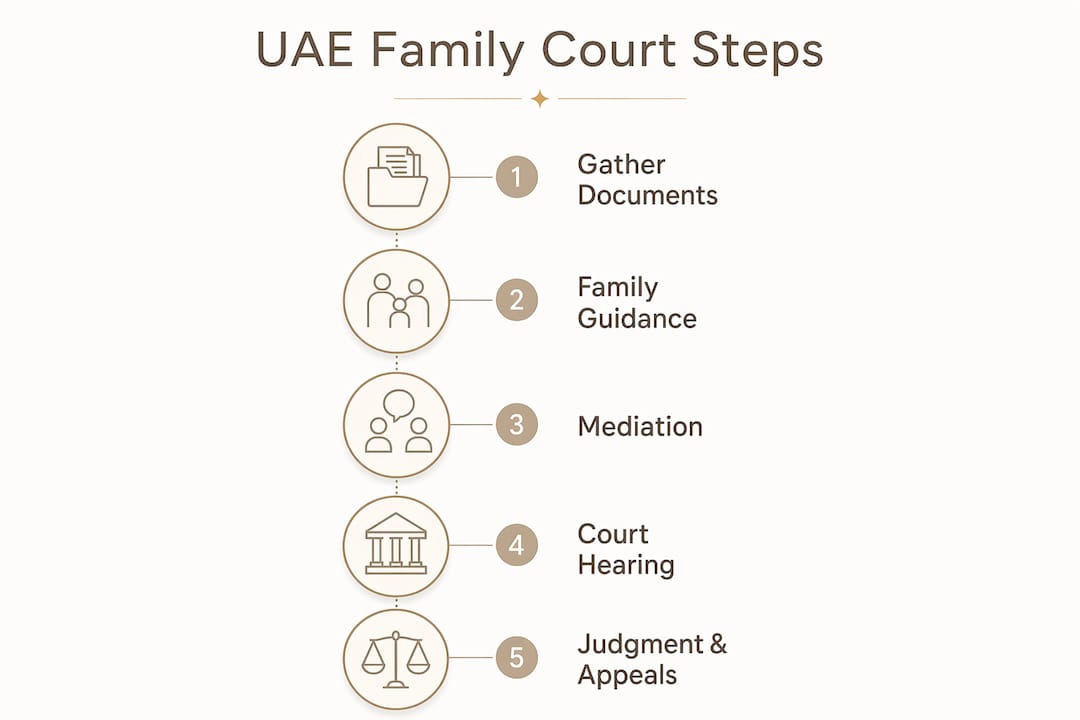
Step 1: Gather your documents. You will need your marriage certificate (attested and translated if issued abroad), Emirates IDs, passports, proof of residency, and any relevant financial or custody documents. For document attestation of foreign-issued certificates, use a recognized apostille service before filing.

Step 2: File at the Family Guidance Committee. Before any court hearing, both parties are referred to the Family Guidance Committee. These sessions encourage direct negotiation without lawyers present, aiming for an amicable resolution. The Abu Dhabi Judicial Department’s Family Booklet describes these meetings as a space for parties to discuss issues openly, often reaching quicker outcomes than full litigation.
Step 3: Attend mediation sessions. If the Committee cannot broker a settlement, it issues a referral to the court. This referral is mandatory before a judge will hear the case.
Step 4: Court hearings at the Court of First Instance. The judge schedules hearings, reviews evidence, and may propose an amicable settlement at least once during proceedings. Under Federal Decree-Law No. 41 of 2024, any settlement accepted by both parties and approved by the judge becomes a binding ruling, enforceable like a court writ.
Step 5: Judgment and post-divorce rights. The court issues its judgment covering divorce, maintenance (alimony), asset division, and custody. Spouses retain the right to appeal within the prescribed timeframe.
Legal rights post-divorce:
The wife is entitled to muta’a (post-divorce compensation) and iddah maintenance under the Muslim track
Under the civil track, maintenance is determined by the court based on financial circumstances rather than religious formula
Both tracks recognize the right to enforce financial orders through court execution mechanisms
The UAE divorce court process has been updated significantly since 2022, and the no-fault option for non-Muslims is one of the most consequential changes for expatriate families.
How UAE courts decide child custody
Child custody in the UAE is legally recognized as a joint and equal right for both parents until the child reaches 18 years. That framing, established under the updated federal laws, represents a meaningful shift from older arrangements where physical custody defaulted heavily to the mother for young children.
Key custody principles under UAE family law:
Both parents hold equal legal custody rights; physical residence arrangements are determined separately
From age 15, a child has the legal right to express a preference about which parent to live with, subject to court approval based on the child’s best interests
Courts may order psychological evaluations to assess the child’s wellbeing and the fitness of each parent
Guardianship (financial and legal decision-making authority) is typically retained by the father under the Muslim track, while physical care arrangements may favor the mother for younger children
Under the civil track, both parents share guardianship equally
Pro Tip: The most common mistake in custody cases is framing arguments around parental rights rather than the child’s needs. Courts consistently rule against parents who appear to be using custody as leverage. Every piece of evidence you present should connect directly to the child’s daily welfare, education, and emotional stability.
The difference between Muslim and non-Muslim custody procedures is worth spelling out. Under the Sharia-based track, physical custody of young children (hadhana) traditionally rests with the mother until boys reach a certain age and girls reach puberty, after which the father may seek custody. The civil track under Federal Decree-Law No. 41 of 2022 defaults to equal shared custody, with the court adjusting arrangements based on circumstances. Non-Muslim expatriates may also request that their home country’s custody law apply, provided it does not conflict with UAE law.

Visitation rights are enforceable through the court. A parent who denies court-ordered visitation can face legal consequences, including enforcement actions through the execution court.
How the UAE family court hierarchy works, and what appeals look like
UAE family courts operate across three levels, and understanding where your case sits determines both your procedural options and your realistic timeline.
Court level | Role | Typical timeframe |
Court of First Instance | Hears the original case; issues the primary judgment | Duration varies depending on case complexity |
Court of Appeal | Reviews errors of law or fact from the first instance ruling | Duration varies after filing the appeal |
Court of Cassation | Final review; addresses points of law only, not factual disputes | Duration varies; not all cases are accepted |
How the appeal process works:
A party dissatisfied with a Court of First Instance judgment files a notice of appeal within the statutory deadline, usually within a set period from the date of judgment
The Court of Appeal reviews the case record, may hear new arguments, and can uphold, modify, or reverse the original ruling
The Court of Cassation is not a third trial. It examines whether the lower courts correctly applied the law, not whether the factual findings were right
Family court judgments, once final, are enforceable through the execution court, which can freeze assets, garnish wages, or issue travel bans to compel compliance
Enforcement of custody and alimony orders:
Courts take enforcement seriously. A parent who fails to pay court-ordered child support, or who withholds a child in violation of a custody order, can face execution proceedings. The execution court has authority to compel payment directly from bank accounts or salary. Travel bans are a real enforcement tool in the UAE, particularly in cases where a parent attempts to relocate a child without court approval.
Amicable settlements reached during any stage, including at the appeals level, carry the same legal weight as a court judgment once the judge approves them. Federal Decree-Law No. 41 of 2024 explicitly requires judges to propose settlement at least once during proceedings, and an accepted settlement becomes a binding writ.
How to prepare for UAE family court procedures and avoid common mistakes
Good preparation shortens timelines and improves outcomes. The families who struggle most in UAE family court are usually those who arrive without complete documentation or who misunderstand which legal track governs their case.
Documents you need before filing
Original marriage certificate, attested and legally translated into Arabic if issued abroad
Emirates IDs and passports for both parties and any children
Proof of UAE residency (visa page, tenancy contract, or utility bills)
Birth certificates for children, attested and translated
Financial records if maintenance or asset division is in dispute (salary certificates, bank statements, property documents)
Any prior court orders or agreements relevant to the case
Notification of the other party can consume a large portion of the overall case duration, particularly when a respondent is uncontactable or abroad. Courts may resort to newspaper publication as a last resort for notification. Planning for this possibility early, by confirming the other party’s last known address and contact details, can prevent months of delay.
Preparing for mediation and hearings
Family Guidance Committee meetings are not a formality. They are a genuine opportunity to resolve disputes without the cost and time of full litigation. Parties attend without lawyers initially, which levels the dynamic and often produces faster agreements on straightforward issues like asset division or visitation schedules.
When the case does proceed to a hearing, your legal representative should be familiar with the specific court and judge’s procedural preferences. UAE family courts vary by emirate, and Abu Dhabi’s civil family court operates under slightly different procedural rules than Dubai’s personal status courts.
Pro Tip: If you are a non-Muslim expatriate, ask your lawyer at the first meeting whether applying your home country’s law would produce a better outcome for your specific situation. This option exists under UAE law, but courts will not raise it for you.
Working with legal representatives
Legal representation is not mandatory at the Family Guidance Committee stage, but it is strongly advisable once a case proceeds to court. Choose a lawyer with specific experience in UAE personal status law, not just general civil litigation. The procedural rules, evidentiary standards, and judicial culture in family courts are distinct from commercial courts.
For expatriates navigating the UAE family court system for the first time, understanding the court’s jurisdiction and which emirate’s courts have authority over your case is a prerequisite, not an afterthought.
Harrisandcharms supports families through marriage registration and legal documentation
Families dealing with UAE family court procedures often arrive at that point because the legal foundation of their marriage was never properly documented. Harrisandcharms offers a cleaner starting point.

For couples planning a civil marriage in Dubai, Harrisandcharms handles the full documentation process, from initial paperwork and legal translation to court filing and attestation. The team works across both civil and Islamic marriage frameworks, which means whether you are a non-Muslim expatriate or a Muslim couple, the procedural requirements are managed without you having to decode them yourself. Services extend to venue management, prenuptial photoshoots, and visa-related documentation through partner companies. For families who want their marriage registration done correctly from day one, reducing the risk of complications in any future legal proceedings, Harrisandcharms’s full marriage services are worth a direct conversation.
Key Takeaways
UAE family court procedures are governed by a dual-track legal framework, and identifying whether Sharia-based or civil personal status law applies to your case is the single most important step before filing.
Point | Details |
Dual legal tracks | Federal Decree-Law No. 41 of 2024 governs Muslims; No. 41 of 2022 governs non-Muslims in UAE family courts. |
Mandatory mediation | Every case must pass through the Family Guidance Committee before a judge will hear it. |
Joint custody default | UAE law recognizes child custody as a joint and equal right for both parents until the child reaches 18 years. |
Child’s voice at 15 | From age 15, children may legally express a residential preference, subject to court approval. |
Harrisandcharms | Harrisandcharms handles civil and Islamic marriage registration and documentation in the UAE, reducing legal risk from the start. |
Recommended
Comments