
Avoid AED 1,000 Deposit: Fast Routes for UAE Wedding Guest Visas

Updated: Sep 9

Check passport eligibility for visa-free entry or visa on arrival first. If that does not apply, book through an airline like Emirates or Etihad for a tourist visa, or have a UAE resident sponsor a visit visa through GDRFA or ICP. Start either process at least two to three weeks before travel, and budget for a possible refundable deposit and express fees if time is tight.
TL;DR:
Most international guests can qualify for visa on arrival, which requires no advance paperwork and can be obtained at the airport if eligible.
Guests without visa-free access should apply through airline-sponsored visas or have a UAE resident sponsor, with applications typically taking two to five days.
A refundable security deposit of AED 1,000 is the main cost difference between sponsor-backed visas and airline-sponsored visas, which do not require a deposit.
Starting visa preparations at least two to three weeks before travel prevents last-minute delays, especially during peak periods like December or Eid.
Avoid unlicensed agents and always verify application reference numbers to prevent fraud and ensure timely processing of guest visas.
Table of Contents
Which Wedding Guest Visa Types Actually Apply to You?
Most wedding guests fall into one of four visa categories, and picking the right one from the start saves both money and stress.
Visa on arrival is the fastest option, and it’s the first thing to check regardless of where the wedding is happening. Travelers from a long list of countries, including most of Western Europe, the US, and several Gulf and Asian nations, get a stamp at the airport with no advance paperwork. If your passport qualifies, skip everything else in this article and just pack.
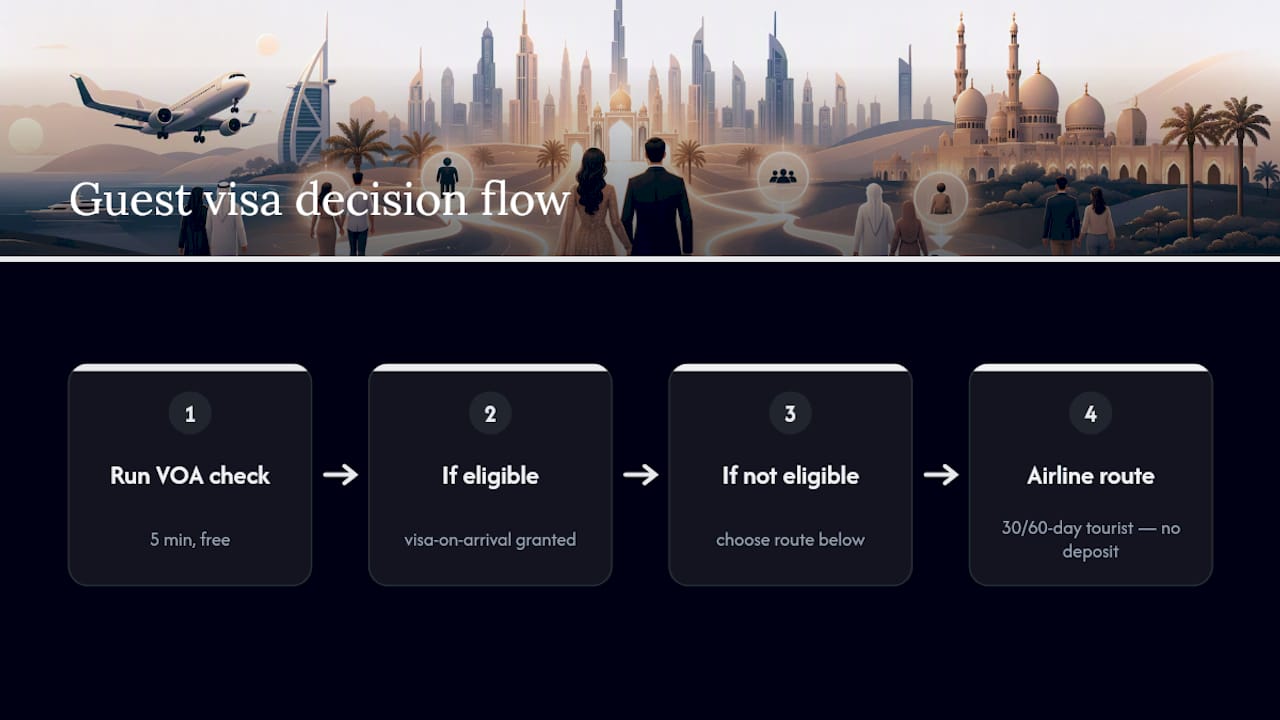
If you’re not eligible for visa-free or on-arrival entry, a tourist visa booked through the airline is usually next. Emirates, Etihad, and other carriers issue 30 or 60-day tourist visas tied to a confirmed ticket, and these do not require the refundable security deposit that sponsor-backed visas do.
A resident-sponsored visit visa, sometimes called a friend or relative visa, is the route when a UAE-based host wants to formally sponsor a guest. GDRFA issues these for 30, 60, or 90 days, but they require proof of relationship, sponsor documentation, and a refundable deposit.
Transit visas cover a narrower case: guests stopping over in the UAE for under 96 hours purely to attend the ceremony before flying onward.
Visa on arrival: free or low-cost, no documents beyond a valid passport, available at the airport
Airline tourist visa: 30 or 60-day options, no deposit, tied to a confirmed flight
Resident-sponsored visit visa: 30/60/90-day options, refundable deposit required, needs proof of relationship
Transit visa: 48 or 96-hour window, ideal for short stopover attendance only
How Do You Apply for a UAE Wedding Guest Visa?
The application path depends entirely on whether you have a UAE-based sponsor or you’re arranging things yourself from abroad.
If you’re booking through an airline or travel agency:
Book your flight with Emirates, Etihad, or another carrier offering visa sponsorship, then open the airline’s “Manage Booking” or dedicated visa portal.
Upload your passport scan, a passport-size photo, and your return ticket details.
Pay the visa fee online and wait for approval, typically three to five working days for standard processing.
If going through a hotel or travel agency instead, confirm the agency is licensed and listed with GDRFA before handing over any documents.
If a UAE resident is sponsoring you:
The sponsor logs into GDRFA or ICP and selects the visit visa (friend or relative) service.
They upload your passport copy, proof of the relationship (invitation, family record, or written justification), and their own Emirates ID, tenancy contract, and salary certificate.
They pay the visa fee plus the refundable security deposit and submit the application, which typically clears in two to five working days, or 24 to 48 hours with express processing.
Pro Tip: If the wedding falls during a peak window like December, January, or Eid, add three to five extra working days to whichever timeline you’re using. Processing queues back up fast during those stretches, and express fees jump accordingly.
What Documents and Fees Should You Budget For?
Every visa route needs a valid passport with at least six months remaining, a recent photo, and a return ticket. Beyond that, the paperwork splits by channel.
Guests applying through an airline need only their booking confirmation and passport details. Guests relying on a resident sponsor need more: proof of relationship to the sponsor, the sponsor’s Emirates ID, a valid tenancy contract, and a salary certificate showing they meet the income threshold GDRFA sets for that relationship category. Spouses and parents typically face different (usually lower) thresholds than friends being sponsored.
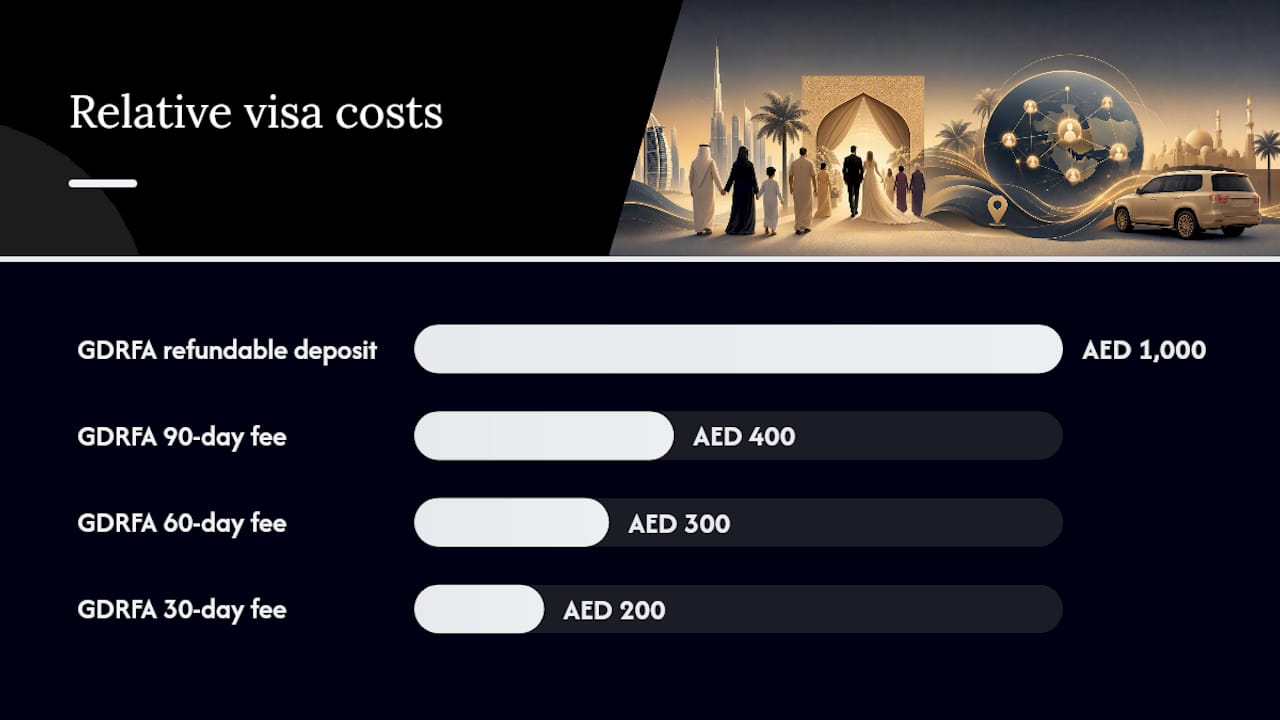
GDRFA’s published visit visa fees run AED 200 for 30 days, AED 300 for 60 days, and AED 400 for 90 days, on top of a refundable security deposit of AED 1,000, plus medical insurance and VAT. Airline-sponsored tourist visas skip the deposit entirely but carry their own visa service fee and mandatory insurance, which varies by carrier.
Visa route | Government fee | Deposit | Insurance/VAT |
Airline tourist visa (30 days) | Carrier-set fee | None | Required, added to fee |
GDRFA visit visa (30 days) | AED 200 | ~AED 1,000 (refundable) | Required, added separately |
GDRFA visit visa (60 days) | AED 300 | ~AED 1,000 (refundable) | Required, added separately |
GDRFA visit visa (90 days) | AED 400 | ~AED 1,000 (refundable) | Required, added separately |
The refundable deposit is the single biggest cost difference between the two main routes. A guest going through the airline pays less upfront and never sees a deposit; a guest going through a resident sponsor pays a lower base fee but has AED 1,000 tied up until they leave the country in compliance with their visa terms.
When Should Hosts and Guests Start the Visa Process?
Coordinating a wedding guest visa is a shared job between the guest, the sponsor (if there is one), and whichever airline or agency is involved. Missing the handoff between these parties is the most common reason applications stall.
As soon as the wedding date is set: guests check passport validity and visa-on-arrival eligibility for their nationality.
Two to three weeks before travel: guests without visa-free access start their application, either booking an airline-sponsored visa or sending documents to their UAE-based sponsor.
One week before travel: sponsors confirm GDRFA submission status and chase down any missing salary or tenancy documentation.
48 to 72 hours before departure: guests confirm their visa reference number, insurance certificate, and printed or digital copy of the approval.
Weddings scheduled around December, January, or Eid need extra buffer since processing queues run longer during those windows. Building in an extra week of slack costs nothing and prevents a last-minute scramble.
Common Mistakes That Delay or Derail Guest Visas
A surprising number of guest visa problems trace back to avoidable errors rather than actual eligibility issues.
Using an unlicensed “visa agent” found through social media instead of a GDRFA-listed agency or the official portal, which risks both fraud and a rejected application.
Waiting until the week of the wedding to start a sponsor application, forcing an expensive express fee or missing the ceremony entirely.
Assuming an invitation-reward program from a hotel or tourism initiative counts as visa approval. It does not. Those programs offer incentives to sponsors but never replace the actual GDRFA or ICP process.
Skipping the visa-on-arrival check altogether and paying for a sponsored visa that wasn’t necessary in the first place.
Pro Tip: Always ask for the official GDRFA or ICP application reference number once submitted. If an agency can’t produce one, that’s your signal to walk away and use a different, verified channel.
Can You Marry on a Tourist Visa, and How Is That Different for Guests?
Attending a wedding as a guest and getting married yourself are two entirely separate legal processes, and conflating them causes real confusion.
A guest attending a ceremony only needs a valid short-term entry permit, whether that’s visa-free entry, visa on arrival, or a sponsored visit visa. Someone planning to marry in the UAE, even while technically on a tourist visa, has to go through a distinct marriage-registration and attestation process that has nothing to do with the entry permit itself.
If you’re traveling to the UAE for someone else’s wedding but end up deciding to marry your own partner while there, the entry visa that got you through the airport does not carry any marriage authority. You’ll need to work through court application requirements, document attestation, and, depending on residency plans afterward, a possible shift toward a sponsored visa or marriage visa pathway. Anyone in that position should check marriage law for tourists in the UAE or speak directly with ICP, GDRFA, or Harris & Charms before assuming the guest visa covers it.
What Happens If You Need to Extend or You Overstay?
Extensions are possible on most visit and tourist visas, usually applied for online through GDRFA or the same airline/agency channel that issued the original visa, before the current validity expires. Extension fees are charged per additional period and stack on top of whatever the original visa cost.
Overstaying is where things get expensive fast. Fines accrue daily once a visa lapses, and for sponsor-backed visas, the refundable deposit gets forfeited if the guest overstays or breaks the visa’s terms. If you realize you’re going to run over, don’t wait: contact the sponsor or agency immediately and file for an extension before the expiration date, not after.
Do COVID-19 Rules Still Affect Wedding Guests Traveling to the UAE?
The strict COVID-era entry requirements that once complicated UAE wedding travel, mandatory PCR tests, quarantine periods, vaccination certificates checked at the border, have been rolled back. As of 2026, the UAE does not require COVID-19 testing or vaccination proof as a standard condition of entry for tourist or visit visa holders.
That said, health-related entry rules can shift with little notice if a new variant or outbreak triggers a temporary policy change, so it’s worth a quick check of the airline’s current travel advisory page or the UAE government portal a few days before departure rather than assuming the rules from your last trip still apply. Airlines like Emirates and Etihad typically post any active health documentation requirements directly on their visa and travel information pages, and that’s a faster, more current source than a general search.
For guests with any lingering health condition or recent illness, standard travel insurance that covers medical treatment abroad is worth carrying regardless of what the entry requirements technically demand. It’s not a visa condition, but it’s the kind of preparation that matters more than most people budget for when they’re focused only on the paperwork.
What Are the Entry and Exit Rules for Wedding Guest Visas?
Every UAE guest visa, whether visa-free, on-arrival, airline-sponsored, or GDRFA-issued, comes with a fixed validity window that governs both how long you can stay and, in some cases, how many times you can enter.
Single-entry visas mean exactly that: once you exit the UAE, that visa is spent, even if days remain on its stated validity. If your wedding trip includes a side excursion to a neighboring country and a plan to fly back in before heading home, confirm whether your specific visa allows multiple entries or if you’ll need a fresh application for the return leg.
Exit timing matters just as much as entry timing. Overstaying even by a single day triggers fines that increase the longer you wait, and for sponsor-backed visit visas, that same overstay is what puts the refundable security deposit at risk. Guests should always check the exact expiration date and time on their visa approval document, not just the day they think it ends, since some visas calculate validity from the date of entry stamp rather than the date of approval.
Airlines and immigration counters at UAE airports do check visa status on exit as well as entry, so a lapsed visa can mean delays or penalties even as you’re trying to leave the country, not just while you’re inside it.
Who Do You Contact If Something Goes Wrong With Your Visa?
Most visa questions and disputes route back to whichever authority issued the visa in the first place. For sponsor-backed visit visas, that’s GDRFA in Dubai or the equivalent immigration department in the emirate where the sponsor resides. For federally issued tourist visas and general inquiries, ICP and the u.ae government portal handle both applications and complaints.
If your visa was booked through an airline, Emirates and Etihad both maintain dedicated visa support lines separate from general customer service, and they’re usually the fastest way to resolve a processing delay or a rejected document tied to a flight booking. Travel agencies and hotels that sponsor visas are required to provide an official reference number precisely so disputes have a paper trail back to the issuing authority.
If a dispute involves suspected fraud (an agency that took payment but never filed an application, for instance), report it directly to GDRFA or ICP rather than trying to resolve it with the agency alone. Keep every receipt and reference number from the moment you start the process, since that documentation is what any authority will ask for first.
How Harris & Charms Supports Wedding Guest Visa Coordination
Sorting out guest visas while planning the actual wedding is a lot for any host to juggle alone, especially when guests are spread across different countries with different passport rules. Some wedding service providers work alongside couples on the wedding and marriage side of UAE events, and that includes helping hosts think through document checks, coordinating with partner visa agencies, and managing attestation paperwork tied to the marriage itself.
If you’re already working with Harrisandcharms on a civil or Islamic marriage package, guest visa questions rarely stand alone. They connect to the same document flow: passports, attestations, and sponsor paperwork you’re already assembling for the ceremony. Reach out through the contact page if you want a second set of eyes on your guest list logistics before invitations go out.
Get Help Coordinating Guest Visas and Your Wedding in One Place
Some service providers offer an alternative to piecing together visa agencies, wedding vendors, and attestation offices on your own, providing one point of contact who understands how all three pieces fit together for a UAE wedding.

That matters most for hosts flying in guests from multiple countries while also finalizing court applications, legal translation, or attestation for the marriage itself. Harrisandcharms coordinates with partner visa agencies on document checks and scheduling, so a guest’s paperwork doesn’t fall through the cracks while you’re focused on the ceremony. The same team handles the civil and Islamic marriage packages many of these guests are flying in to witness, including venue management, photography, and legal attestation, all under one roof.
If you’re planning a UAE wedding and want guest logistics handled alongside the marriage paperwork itself, reach out through the wedding services page to request a consultation and get a tailored breakdown of what your specific guest list and ceremony will need.
An Editorial Take on Guest Visas from Harris
The biggest misconception hosts carry into this process is that a sponsored visit visa is the default, safest option. It’s often the slowest and most expensive one. Every deposit, salary threshold, and tenancy document requirement exists because GDRFA is underwriting a relationship claim between two people, and that scrutiny takes time you may not have if you’re inviting guests six weeks before the ceremony.
The smarter move, and the one most hosts skip, is running the visa-on-arrival check before doing anything else. It costs nothing, takes five minutes per guest, and for a meaningful share of international travelers it eliminates the entire sponsorship question. Only after that comes back negative does the airline-versus-sponsor decision even matter.
There’s also a pattern worth naming directly: the guests most likely to run into trouble are not the ones sponsored by residents, they’re the ones who trust an unlicensed “visa fixer” found through a WhatsApp group or a Facebook wedding forum. GDRFA and ICP both flag this as a real fraud risk, and it’s avoidable with one simple habit: never hand over passport details or payment without a verifiable government reference number in return.
Hosts who treat guest visas as a logistics problem to solve two months out, rather than a paperwork favor to ask two weeks out, are the ones whose weddings run smoothly. The rest spend the week before the ceremony fielding panicked messages from guests stuck in processing limbo.
— Harris
Recommended
Comments