
Everything You Need to Get Married at the Courthouse

Updated: Sep 4

To get married at a courthouse, you need a valid marriage license, government-issued photo ID for both of you, proof that any prior marriage has legally ended, at least one adult witness, and payment for the license and ceremony fees. That covers the non-negotiables. Everything else, timing, waiting periods, specific supporting documents, depends on your state and county.
Here is your quick pre-visit checklist:
Valid marriage license (applied for together at the clerk’s office)
Government photo ID for both applicants (driver’s license, passport, or state ID)
Social Security numbers for both parties (or an affidavit if you don’t have one)
Certified divorce decree or death certificate if either of you was previously married
At least one adult witness (some jurisdictions require two)
Payment for the license fee and ceremony fee (cash or card, depending on the office)
Birth certificates, when the clerk’s office specifically requests them
Requirements vary by state and county. Before your visit, call or check your local clerk’s office website to confirm exactly what they need. Some offices let you start the application online, but both of you will still need to appear in person to finalize it.
Key Takeaways
Getting married at a courthouse requires a valid marriage license, government photo ID, proof of any prior marriage ending, at least one adult witness, and payment for fees.
Point | Details |
License is the first step | Both applicants must appear together at the clerk’s office to apply and sign. |
Documents vary by jurisdiction | Confirm your county’s exact list before visiting; missing one document means rescheduling. |
Witness rules differ | Most jurisdictions require one or two adult witnesses over 18; some require none. |
File promptly after the ceremony | Signed licenses must be returned to the clerk within 10–30 days, depending on the jurisdiction. |
Harrisandcharms assists UAE couples | Full support for court marriage paperwork, attestation, photography, and premium registration in the UAE. |
This article is general information, not a substitute for advice from a qualified lawyer. Consult a qualified legal professional about your own circumstances before acting on anything here.
Table of Contents to get married at the courthouse
What do you need to get a marriage license before the ceremony?
A courthouse wedding has three legal steps: get the license, have the ceremony, file the paperwork. The license step is where most couples run into trouble, usually because they show up without the right documents or don’t account for waiting periods.
The application process, step by step
Start online if your county allows it. Many clerk’s offices let you pre-fill the application. You’ll still need to appear together in person to sign and finalize.
Both applicants appear at the clerk’s office together. This is standard across virtually every U.S. jurisdiction.
Present valid government photo ID. A driver’s license, passport, or state-issued ID all work. The ID must be current and unexpired.
Provide your Social Security numbers. Some offices accept a signed affidavit if you don’t have a Social Security number.
Pay the license fee. Fees vary widely by county. Confirm accepted payment methods in advance.
Take the required oath and receive your license.
Documents commonly required for courthouse marriage
Valid, unexpired government photo ID (both applicants)
Social Security numbers or affidavit
Birth certificates (not always required, but some counties ask for them)
Certified divorce decree if either applicant was previously divorced
Death certificate if either applicant is a widow or widower
Certified English translations of any foreign-language documents
Any document not in English typically requires a certified translation, with the translator providing a signed statement attesting to its accuracy.
Timing: waiting periods and expiration windows
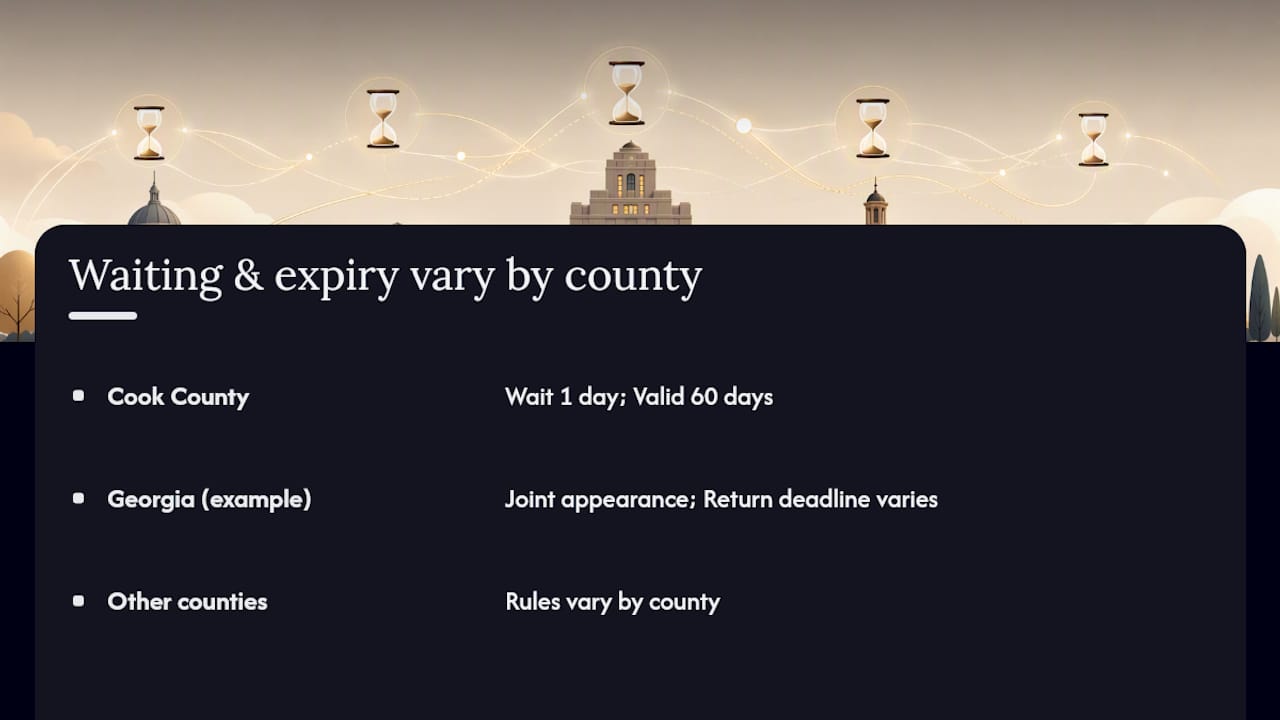
Some states impose a waiting period between license issuance and when the ceremony can legally take place. Cook County, Illinois, for example, issues licenses effective one day after issuance, valid for 60 days. Georgia requires both parties to appear at the county probate court together, show proof of age, and return the signed license within a specified period after the ceremony. Your county may differ on all of these points.
Pro Tip: Schedule your ceremony well within the license’s validity window. If you book too close to the expiration date and the ceremony is delayed for any reason, you’ll need to apply all over again.
For a broader look at civil wedding requirements, the document checklist overlaps significantly with courthouse-specific needs.
How to book the ceremony and what to expect on the day
Appointment vs. walk-in
Some courthouses perform ceremonies by appointment only. Others accept walk-ins during set hours. Call ahead or check the clerk’s website to find out which applies to your courthouse. Availability can be limited, especially on Fridays and around holidays.
Not every clerk’s office performs ceremonies. Some only issue licenses and expect you to arrange your own officiant, a judge, justice of the peace, or ordained minister, depending on what your state recognizes. Confirm this before you show up expecting a ceremony.
Witness rules
Most jurisdictions require at least one adult witness over 18. Some require two. In certain states, no witnesses are required at all. Clerk staff can sometimes serve as a witness if you don’t have anyone available, but don’t count on it. Bring your witness’s government-issued photo ID.
For couples marrying in the UAE, witness requirements follow a separate legal framework worth reviewing before your ceremony date.
What the ceremony actually looks like
Courthouse ceremonies are short, typically 10–20 minutes. The officiant reads a brief legal declaration, you exchange vows (sometimes just a simple “I do”), and both of you sign the license along with your witness(es) and the officiant. Bring your license, both IDs, your witness’s ID, and any payment receipts.
Guest policies vary. Some courthouses allow a small group in the ceremony room; others restrict it to the couple and witnesses only. Photography is usually permitted in the ceremony room, though hallways and courtrooms may have restrictions. If you want professional photos of the moment, confirm the courthouse’s policy first. A nationwide wedding photographer who knows courthouse logistics can make a real difference in what you capture.
Pro Tip: Double-check your license expiration date the morning of the ceremony. Bring your certified divorce decree if you were previously married, even if you showed it during the application. Some officiants ask to see it again.
What happens after the ceremony?
Filing the license and getting your certificate
Once the ceremony is done, the signed license needs to go back to the clerk’s office. In Cook County, that window is 10 days after the ceremony. Georgia gives you 30 days. Your county will have its own deadline. Missing it can complicate your legal record, so file promptly.
The clerk’s office then issues the official marriage certificate. This is the document you’ll use for everything that follows.
Step | Typical Timeline |
Return signed license to clerk | Within 10–30 days of ceremony (varies by jurisdiction) |
Clerk processes and records the marriage | A few days to a few weeks |
Certified copy available | 2–4 weeks after filing, in many jurisdictions |
Post-ceremony administrative tasks
Order certified copies at the time of filing. You’ll need multiple copies for name-change paperwork, banking, and travel documents. Ordering extras upfront is cheaper than requesting them later.
Update your Social Security record first. The Social Security Administration processes name changes before most other agencies will.
Update your driver’s license at your state DMV, using your certified marriage certificate.
Apply for a new passport if your name changed and you have international travel planned.
Notify your employer, bank, and insurance providers of the name change and update beneficiary designations.
The marriage certificate is what you present for most of these. An uncertified copy of the license won’t work.
Special cases: divorce, foreign nationals, and missing documents
Previously married applicants
Bring the final divorce decree or death certificate, certified by the issuing court. If you only have partial records, contact the court that issued the original decree and request a certified copy before your courthouse appointment.
Underage applicants
Some states still allow minors to marry with parental or judicial consent. The documentation typically includes a signed parental consent form and sometimes a court order. Rules here are changing fast, so confirm current state law directly.
Foreign nationals
Non-U.S. birth certificates, foreign passports, and foreign divorce or death documents usually require certified English translations. Some jurisdictions also require an apostille or legalization stamp. Contact your local clerk’s office before assuming your documents are sufficient.
Missing documents
If you arrive without a required document, most clerks will turn you away. Your options: reschedule, obtain a certified copy from the issuing authority, or ask whether an affidavit is accepted as a substitute. Some jurisdictions allow sworn affidavits for missing records; most don’t.
Pro Tip: If you’re traveling from abroad and have a tight schedule, contact the clerk’s office at least two weeks in advance. Explain your situation and ask exactly what they need. Some offices will hold an appointment slot and confirm your document list by email.
For couples navigating the court marriage procedure from outside the U.S., the steps above apply broadly, but local embassy requirements may add layers.
A note for couples in the UAE
If you’re marrying in the UAE, the process adds steps that don’t apply in the U.S.: document attestation, certified translations, and in some cases embassy legalization. The clerk’s office equivalent here is the relevant court authority, and requirements differ for civil versus Islamic marriages.
Harrisandcharms publishes detailed local guides covering UAE court marriage documents and the full registration process. For couples who want hands-on help with paperwork, attestation, or the full ceremony, Harrisandcharms handles all of it.
What the checklist-first approach gets right that most guides miss
Most courthouse wedding guides bury the checklist at the bottom, after three paragraphs of reassurance that a civil ceremony is “just as meaningful” as a big wedding. That framing misses what couples actually need: a fast, scannable answer to whether they’re ready to walk in today.
The real risk isn’t forgetting the license. It’s showing up with an expired license, a missing divorce decree, or a witness who forgot their ID. Those are the scenarios that send couples home and force them to rebook. The document step deserves more attention than the ceremony step, because the ceremony itself takes 15 minutes. Getting the paperwork right is what takes planning.
One thing worth knowing: the license expiration window is the most commonly overlooked detail. Couples apply, get busy, and then realize their license expires before they’ve booked the ceremony. Apply close to your intended ceremony date, not weeks in advance.
Harrisandcharms makes the paperwork the easy part
For couples in the UAE, the courthouse process comes with extra layers: attestation, certified translations, and court-specific filing requirements that vary by emirate and marriage type. Harrisandcharms handles all of it, from the initial document checklist through final registration, so you’re not piecing together requirements from multiple government websites.

Beyond the paperwork, Harrisandcharms offers venue management, event photography, yacht wedding packages, and premium registration support for civil and Islamic marriages. Whether you need a full ceremony or just help getting your documents in order, the team works around your timeline.
Ready to get started? Visit the Harrisandcharms marriage services page to book a consultation or ask about your specific situation.
Recommended
Comments