
Civil Marriage Ceremony Steps in the UAE: 2026 Guide


TL;DR:
A civil marriage in the UAE is a legally binding union performed by an authorized government official following strict procedural steps. Accurate document preparation, obtaining a valid marriage license, and timely filing of signed licenses are essential to ensure the marriage’s legal validity. The brief ceremony, lasting 10-15 minutes, must be conducted by recognized officials and followed by proper documentation to acquire the official marriage certificate.
A civil marriage ceremony is a legally binding union performed by an authorized government official, requiring specific documented steps from obtaining a marriage license to signing paperwork and filing the completed documents. In the UAE, the civil marriage ceremony steps follow a defined legal process that differs from religious ceremonies in both structure and authority. Getting each stage right is not optional. Civil marriage is a purely legal contract granting rights such as inheritance and property sharing, which means a missed step can invalidate the entire process. This guide walks you through every stage, from document preparation to receiving your official marriage certificate.
What are the essential documents and prerequisites for a civil marriage in the UAE?
Preparing your civil marriage documentation before anything else is the single most effective way to avoid delays. The UAE requires couples to gather a specific set of documents before any application or ceremony can proceed.
Required documents typically include:
Valid passports for both parties (with copies)
UAE residency visas or entry permits
Original birth certificates (attested and translated into Arabic if issued in another language)
Proof of single status, such as a certificate of no impediment or a divorce decree if previously married
Passport-sized photographs
Emirates ID cards for UAE residents
Beyond documents, the UAE enforces legal age and eligibility criteria. Both parties must meet the minimum age requirement, and neither can be currently married to another person. For expatriates, your home country’s embassy may need to issue a certificate confirming you are legally free to marry.
Witnesses are a non-negotiable part of the process. Witness requirements vary by jurisdiction, and in the UAE, you will typically need one or two adult witnesses who can be present at the ceremony and sign the legal documents. Understanding the UAE witness rules for civil ceremonies in advance prevents last-minute scrambling on the day.
Pro Tip: Attest and translate all foreign documents at least four weeks before your planned ceremony date. UAE government offices will not accept unattested documents, and translation services can take longer than expected.
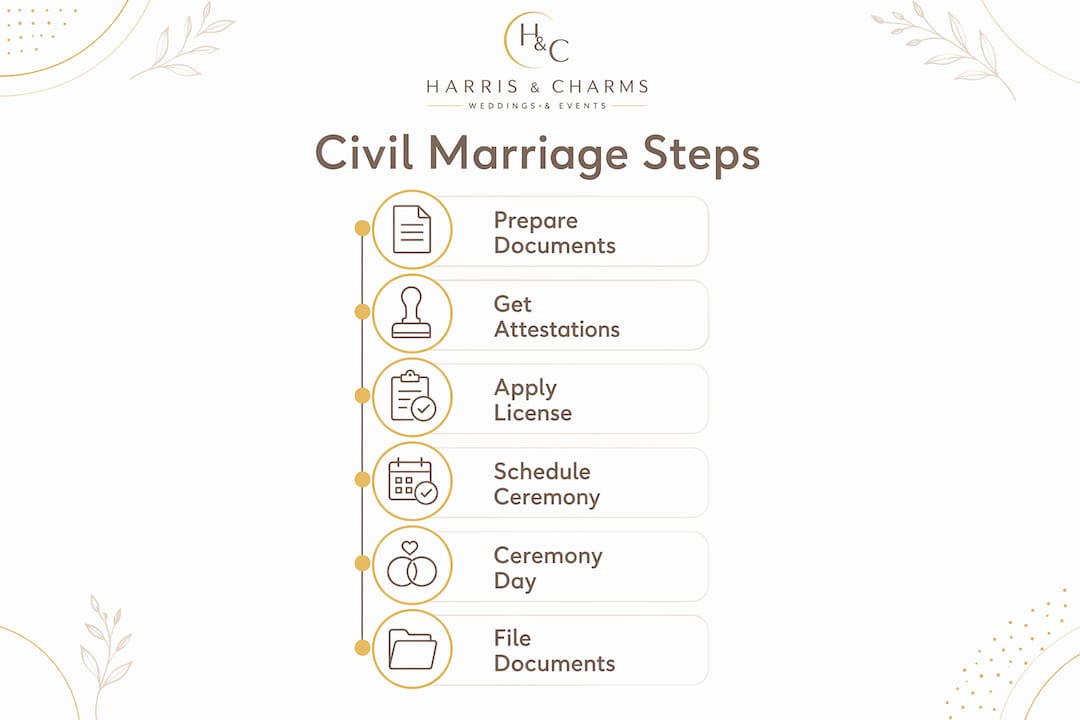
Once your documents are in order, you apply for a marriage license or its local equivalent through the relevant UAE authority. Marriage license fees in various jurisdictions range from $20 to $150, and licenses carry expiration periods of 30–90 days. That means you must schedule and complete your ceremony within that window or restart the application process.
What are the civil marriage ceremony steps in the UAE?
The civil ceremony can be performed at a government office, courthouse, or an alternate location if the officiant holds proper authorization. The setting does not affect legal validity. What matters is the sequence of actions and the authority of the person conducting them.
Here is the standard flow of the ceremony:
Arrival and identity verification. Both parties and their witnesses arrive at the designated venue. The officiant or registrar checks all documents and confirms identities before proceeding.
Welcome and opening statement. The officiant opens the ceremony with a brief formal statement explaining the legal nature of the union. This is not a religious declaration. It is a legal proceeding.
Declaration of intent. Each party is asked to confirm their willingness to marry. This is the legal core of the ceremony. Both parties must respond clearly and voluntarily.
Exchange of vows (optional). Civil ceremonies can be personalized with vows or kept brief and minimal, depending on couple preference and local rules. In the UAE, couples may include personal vows if the officiant permits it, but this does not change the legal requirements.
Pronouncement of marriage. The officiant formally declares the couple legally married. This moment is the legal turning point.
Signing the marriage license. Both parties, the officiant, and the required witnesses sign the marriage license. This document is the physical record of the ceremony and must be completed accurately.
Submission of documents. The signed license is handed to the appropriate authority, either immediately or within a specified number of days.
A civil ceremony typically lasts 10–15 minutes and includes a welcome, statement of intent, vows, pronouncement, and signatures. That brevity surprises many couples, but the legal weight of those minutes is substantial.
Pro Tip: Confirm your officiant’s legal authorization in the UAE before the ceremony date. A ceremony conducted by an unauthorized person is not legally valid, regardless of how formal it appears. Check the list of UAE marriage officiants to verify credentials.

Scheduling the ceremony requires contacting the relevant UAE authority or an authorized officiant directly. Wait times vary depending on the emirate and the time of year, so book your slot as soon as your documents are approved.
How and when are marriage documents filed to get the official certificate?
Filing the signed marriage license is the step that converts your ceremony from a legal event into a recorded marriage. Many couples treat the ceremony as the finish line. It is not.
The signed marriage license must be returned to the issuing office to trigger official marriage certificate issuance. In most cases, the officiant is responsible for submitting the signed license within a set number of days after the ceremony. You should confirm this responsibility explicitly before the ceremony.
Here is how the post-ceremony filing process works:
The officiant submits the signed license to the relevant UAE government authority
The authority processes the filing and issues an official marriage certificate
You request certified copies of the certificate for personal and legal use
Certified copies are used for name changes, insurance updates, visa applications, and immigration processes
The distinction between the license and the certificate matters enormously. The marriage license is permission to marry obtained before the ceremony. The certificate is legal proof issued after the signed license is filed. Couples frequently confuse these two documents, which causes delays when they need official proof of marriage for government or financial purposes.
Document | When issued | Purpose |
Marriage license | Before the ceremony | Permission to legally marry |
Signed marriage license | At the ceremony | Record of the ceremony taking place |
Marriage certificate | After filing | Official legal proof of marriage |
Certified copy | On request | Used for name change, visas, insurance |
Request at least two certified copies of your marriage certificate immediately after it is issued. Government offices, banks, and immigration authorities each typically require their own original copy.
What mistakes and legal pitfalls should you avoid?
Legal validity of a civil marriage depends on compliance with the jurisdiction’s procedural rules, not the grandeur of the ceremony. A beautifully organized event with an unauthorized officiant produces no legal marriage at all.
“Many couples underestimate how important strict adherence to local procedural steps is for ensuring legal validity of their marriage.” — David’s Bridal
The most common errors couples make in the UAE civil wedding process include:
Failing to secure the marriage license before the ceremony. No license means no legal ceremony. The UAE does not recognize ceremonies conducted without prior authorization.
Not verifying the officiant’s authority. An officiant must be legally recognized by UAE authorities. Checking the requirements for civil marriage UAE in advance tells you exactly which officials hold that authority.
Missing or unqualified witnesses. Witnesses must meet legal criteria, including age and presence at the ceremony. A witness who signs documents without attending the ceremony creates a legal problem.
Delaying the filing of signed documents. Filing the signed marriage license is often the most overlooked step but is critical to converting the marriage from permission status to legally recorded union. Delays in filing can complicate the certificate issuance timeline.
Pro Tip: Ask your officiant in writing who is responsible for filing the signed license and by what deadline. Do not assume this is handled automatically.
If any of these procedural requirements are not met, the marriage may not be legally recognized in the UAE or in your home country. That creates serious complications for visa applications, property rights, and inheritance claims.
Key Takeaways
A civil marriage in the UAE is legally valid only when every procedural step, from document preparation to post-ceremony filing, is completed correctly and in sequence.
Point | Details |
Documents first | Gather and attest all required documents at least four weeks before your ceremony date. |
License before ceremony | A valid marriage license must be obtained before any civil ceremony can legally proceed. |
Verify your officiant | Confirm the officiant holds UAE-recognized legal authority before booking the ceremony. |
File the signed license | Submit the signed marriage license promptly after the ceremony to trigger certificate issuance. |
Get certified copies | Request multiple certified copies of your marriage certificate for legal, financial, and immigration use. |
What I have learned from helping couples through this process
The paperwork is where most couples lose time, not the ceremony itself. I have seen couples arrive at the ceremony venue with documents that are correctly gathered but not attested, or attested but not translated. Either way, the ceremony cannot proceed. The UAE is strict about this, and rightly so. A legally recognized marriage protects both parties in ways that an informal or improperly filed ceremony simply cannot.
What surprises most couples is how short the actual ceremony is. Ten to fifteen minutes. After months of planning, that brevity can feel anticlimactic. My honest advice: do not let the simplicity of the ceremony fool you into treating the legal steps casually. The ceremony is brief because the legal weight is carried by the documents, not the words spoken in the room.
I also think couples underestimate the value of working with someone who knows the UAE system. The requirements for expatriates differ from those for UAE nationals, and the specific emirate you are marrying in can affect which authority you file with and how long the process takes. Getting that wrong costs weeks. Getting it right costs an afternoon.
If you are planning a civil ceremony and want to understand the full scope of what the process involves, the civil marriage definition guide on Harrisandcharms covers the legal framework in detail. Start there, then work through your document checklist.
— Harris
Let Harrisandcharms handle the complexity for you
Planning a civil wedding in the UAE involves more moving parts than most couples expect. Harrisandcharms offers tailor-made civil marriage packages that cover every stage of the process, from document preparation and attestation to officiant coordination and venue booking in Dubai.

The team at Harrisandcharms works directly with authorized officiants and government offices, so you do not have to navigate the paperwork alone. Whether you need full comprehensive marriage services across the UAE or targeted support for a specific step, the packages are built around your situation. Reach out to Harrisandcharms to start your inquiry and get a clear picture of exactly what your civil ceremony requires.
FAQ
What is a civil wedding in the UAE?
A civil wedding in the UAE is a legally recognized marriage performed by an authorized government official, without religious elements. It grants both parties full legal rights including inheritance and property sharing.
How long does a civil marriage ceremony take?
A civil ceremony typically lasts 10–15 minutes and includes identity verification, a declaration of intent, optional vows, pronouncement of marriage, and document signing.
What documents are required for civil marriage in the UAE?
Required documents generally include valid passports, UAE residency permits, birth certificates, proof of single status, and Emirates ID cards. All foreign documents must be attested and translated into Arabic.
What is the difference between a marriage license and a marriage certificate?
The marriage license is permission to marry, obtained before the ceremony. The marriage certificate is official legal proof of marriage, issued only after the signed license is filed with the relevant authority.
Can expatriates have a civil marriage ceremony in the UAE?
Yes, expatriates can legally marry through a civil ceremony in the UAE. They typically need a certificate of no impediment from their home country’s embassy in addition to standard UAE documentation requirements.
Recommended
Comments