
Civil Marriage Definition: What Every Couple Must Know


TL;DR:
Civil marriage is a legally recognized union recorded by the government, which requires proper documentation and official registration. It is distinct from religious marriage, as only state-authorized ceremonies hold legal validity, regardless of the ceremony’s religious nature. Recognition across borders depends on local laws and the place-of-celebration rule, making procedural compliance crucial for international couples.
Civil marriage is defined as a legally recognized union between two individuals, formally performed and recorded by a government authority, with no requirement for a religious ceremony. The Cambridge Dictionary describes it as a marriage recognized by law without a religious component. For couples marrying outside their home country, including the many expatriates navigating the UAE’s legal system, understanding the civil marriage definition is not optional. It determines whether your marriage carries legal weight for property rights, immigration status, inheritance, and more.
What is civil marriage and how is it legally defined?
Civil marriage is the state-recognized legal bond between two people, created through a process governed entirely by government law rather than religious doctrine. Wikipedia clarifies that civil marriage may be secular or performed by a religious body, provided that body is authorized by the state to conduct legally binding ceremonies. This distinction matters enormously. The ceremony style is irrelevant. What makes a marriage “civil” is that the state records it and grants it legal status.

The legal definition of civil marriage centers on three elements: a government-authorized officiant, formal registration with a state body, and compliance with local procedural requirements. A church wedding conducted by a priest who also holds state authorization qualifies as a civil marriage in many jurisdictions. A religious ceremony with no state recording does not, regardless of how elaborate or sincere it may be. This is the core of civil marriage meaning that most people misunderstand.
For expatriates and international couples, this distinction carries immediate practical weight. Your marriage certificate must be issued or recognized by a government body to unlock legal protections. Without that, you are legally single in the eyes of immigration authorities, tax offices, and courts.
How civil marriage requirements vary around the world
No two countries process civil marriages identically. The procedural requirements, timelines, and documentation demands differ significantly, and failing to meet local rules can invalidate a marriage entirely.
In New South Wales, Australia, civil ceremonies must be conducted by a Commonwealth registered civil celebrant. Couples must submit a Notice of Intended Marriage at least one month before the ceremony, and two adult witnesses must be present. Age restrictions apply, and the notice submission deadline is not flexible. Missing it means rescheduling.
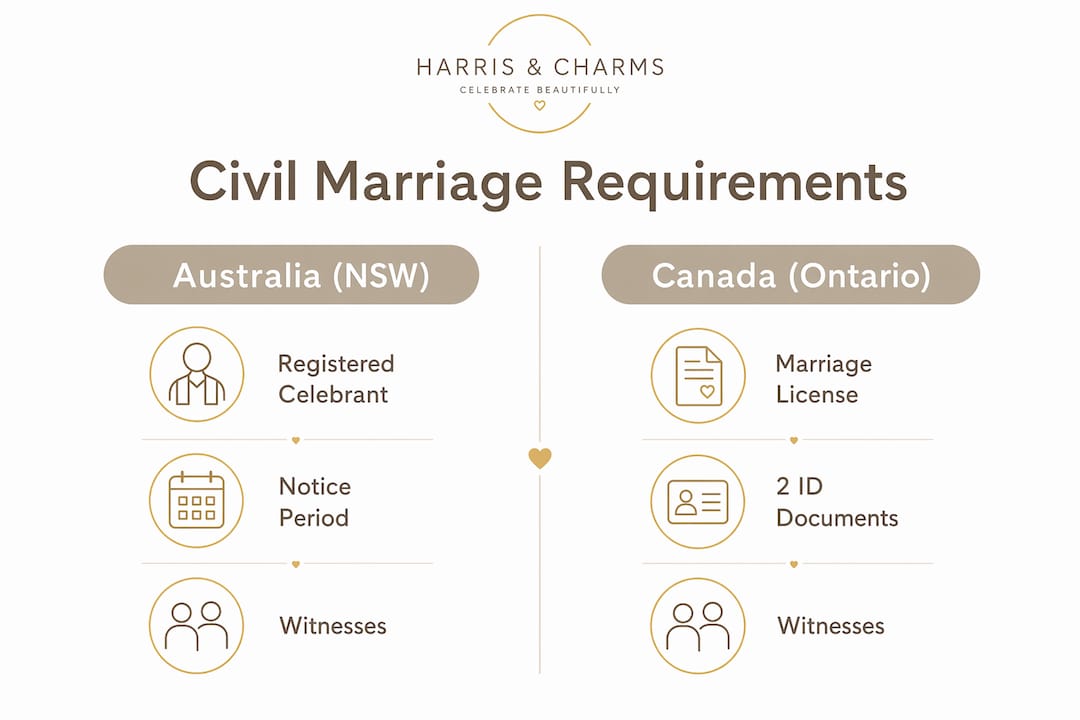
In Ontario, Canada, the marriage license requirement is the starting point. Applicants must present two government-issued photo IDs. No citizenship or residency restrictions apply, and there are no gender restrictions, but applicants under 18 require guardian consent. The license must be obtained before the ceremony takes place.
In Italy, civil marriage is performed by the mayor or a deputy mayor. The US Embassy in Italy notes that two adult witnesses with valid ID are required, an interpreter may be necessary if parties do not speak Italian, and fees vary by location and season. Some Italian municipalities charge significantly more for ceremonies held in historic venues.
Country | Key Requirement | Notice or License Period | Witnesses Required |
Australia (NSW) | Commonwealth registered celebrant | 1 month notice in advance | 2 adult witnesses |
Canada (Ontario) | Government-issued marriage license | License before ceremony | Varies by officiant |
Italy | Mayor or deputy mayor officiates | Publication of banns required | 2 adults with valid ID |
UAE | Authorized court or licensed body | Varies by emirate | 2 witnesses typically required |
Pro Tip: Before booking any venue or setting a date, contact the local civil registry office or its equivalent in your target jurisdiction. Requirements change, and a single missing document can delay your legal registration by weeks.
The procedural compliance required in jurisdictions like NSW shows that “civil” marriage is as much about paperwork and timing as it is about the ceremony itself. Getting the ceremony right but missing the notice deadline means the marriage has no legal standing.
Civil marriage vs religious marriage: what actually differs legally
Religious marriage is a union solemnized according to the rites of a faith tradition. Its legal effect depends entirely on whether the state recognizes the officiating body or requires separate civil registration. In countries like France and Germany, a civil ceremony at a registry office is legally mandatory. A church wedding alone carries no legal weight. In the United States and the United Kingdom, clergy can be licensed to perform legally binding ceremonies, so the religious and civil functions merge into one event.
Civil marriage guarantees legal status independently of any religious affiliation or belief. This is its defining advantage for couples of different faiths, no faith, or those marrying in a foreign country where their religion has no recognized legal standing. A couple married in a mosque, church, or temple in a country that does not recognize that institution’s authority to register marriages will find their union has no legal effect abroad.
The consequences are not abstract. A religious-only marriage with no state recording can mean a spouse has no inheritance rights, no spousal visa eligibility, and no legal standing in a divorce proceeding. USCIS, for example, does not recognize civil unions or domestic partnerships as marriages for immigration purposes, even when those arrangements are socially equivalent in the country of origin.
Marriage Type | Legal Recognition | Immigration Use | Inheritance Rights |
Civil marriage (state-recorded) | Guaranteed by law | Recognized by USCIS and most governments | Full spousal rights |
Religious marriage (state-authorized officiant) | Yes, if officiant is licensed | Recognized if valid under local law | Full spousal rights |
Religious-only (no state recording) | None in most jurisdictions | Not recognized for immigration | No automatic rights |
Civil union or domestic partnership | Varies by country | Often not recognized as marriage | Partial or no rights |
Pro Tip: If you married abroad in a religious ceremony, check whether your officiant was state-authorized in that country. If not, you may need to complete a separate civil registration to secure your legal rights.
How civil marriages are recognized across borders
Cross-border recognition of civil marriages follows a principle called the place-of-celebration rule. USCIS applies this rule to determine whether a marriage is valid for immigration purposes. If the marriage was valid under the laws of the country or state where it was performed, USCIS generally recognizes it. If it was not valid there, no amount of documentation or ceremony will make it valid for US immigration.
This rule has significant implications for international couples. A couple who married in a country where their union was not legally registered, or where the officiant lacked state authorization, may find their marriage unrecognized when they apply for a spousal visa or naturalization. The legal validity depends on local laws at the place of celebration, not on the couple’s intentions or the ceremony’s sincerity.
“Some relationship types, such as civil unions or domestic partnerships, are not recognized as marriages for immigration purposes, even if socially similar to marriage.” — USCIS Policy Manual
Common cross-border pitfalls include:
Marrying in a country that recognizes your union as a civil partnership but not a marriage, then applying for a spousal visa in a country that only recognizes marriages
Completing a religious ceremony abroad without confirming the officiant held state authorization
Failing to apostille or attest your marriage certificate for use in a foreign country
Assuming that a marriage valid in one emirate or state automatically transfers legal recognition to another jurisdiction
For expatriates in the UAE, these issues are especially relevant. The UAE has specific requirements for civil marriage in Dubai and other emirates, and documentation must meet both local and home-country standards for full legal effect.
Practical steps and documentation every couple needs
Getting a civil marriage legally right requires more than showing up on the day. The documentation process is where most couples encounter problems, particularly when marrying outside their home country.
Confirm jurisdiction requirements early. Contact the civil registry, court, or authorized body in the country or emirate where you plan to marry. Requirements for identification, residency, and prior marriage status vary widely.
Obtain a marriage license or equivalent. In Ontario, two government-issued IDs are required before a license is issued. In the UAE, requirements differ by emirate and nationality.
Submit required notices within the mandated timeframe. NSW requires a one-month advance notice. Missing this deadline means starting over.
Arrange qualified witnesses. Most jurisdictions require two adult witnesses with valid identification present at the ceremony.
Verify your officiant’s authorization. A civil marriage is only legally valid if the person conducting it holds state authorization. Confirm this in writing before your ceremony date.
Collect and attest your marriage certificate. Once issued, your certificate may need apostille or notarization for use in another country. This step is often overlooked until it becomes urgent for visa or residency applications.
Check home-country recognition requirements. Some countries require couples to register their foreign marriage with their home embassy or civil registry within a set period after the ceremony.
For couples navigating the UAE system, Harrisandcharms provides a detailed civil marriage checklist that covers each of these steps with jurisdiction-specific guidance. The UAE’s requirements for expatriates include specific documentation from home countries, and getting these right from the start prevents costly delays.
Key takeaways
Civil marriage is a state-recorded legal union that requires a government-authorized officiant, proper documentation, and procedural compliance, regardless of whether a religious ceremony takes place.
Point | Details |
Legal definition | Civil marriage is recognized by the state through official recording, not by ceremony style or religious content. |
Procedural compliance | Submitting notices, licenses, and documents on time is as legally critical as the ceremony itself. |
Civil vs religious | Religious-only marriages without state recording carry no automatic legal rights in most jurisdictions. |
Cross-border recognition | USCIS and most governments apply the place-of-celebration rule; validity depends on local law where married. |
Documentation matters | IDs, witness requirements, and authorized officiants are legal gatekeepers, not administrative formalities. |
Why most couples get the civil marriage process wrong
I have worked with hundreds of couples at Harrisandcharms, and the single most common mistake I see is treating the ceremony as the finish line. Couples spend months planning the event and hours on the dress, the venue, and the flowers. Then they discover, sometimes weeks after the ceremony, that their marriage has no legal standing because a notice was filed late, the officiant was not state-authorized, or a required document was missing.
The second mistake is assuming that “civil” means “secular.” Many couples from religious backgrounds avoid civil marriage because they believe it conflicts with their faith. In reality, a state-authorized religious officiant conducting a ceremony that is also registered with the government is performing a civil marriage. The two are not mutually exclusive. This misunderstanding causes unnecessary complications, especially for expatriates in the UAE who need both legal and religious recognition.
What I tell every couple is this: the paperwork is the marriage. The ceremony is the celebration. Both matter, but only one of them determines your legal rights. If you are marrying outside your home country, the stakes are even higher. Your immigration status, your right to your partner’s estate, and your ability to be recognized as a spouse in a medical emergency all depend on that certificate being valid.
— Harris
How Harrisandcharms makes civil marriage registration straightforward
Navigating civil marriage requirements across different legal systems is genuinely complex, especially for expatriates and international couples in the UAE.

Harrisandcharms offers comprehensive marriage services covering both civil and Islamic marriage packages, full documentation support, and legal attestation guidance. The team handles the procedural steps that couples most often get wrong: verifying officiant authorization, preparing jurisdiction-specific document packages, and coordinating attestation for cross-border recognition. Whether you are a UAE resident marrying for the first time or a foreign national registering a marriage for visa purposes, Harrisandcharms provides the expert guidance that turns a complex legal process into a manageable one. Reach out to start your consultation today.
FAQ
What is the legal definition of civil marriage?
Civil marriage is a legally recognized union performed and recorded by a government authority, as defined by the Cambridge Dictionary. It requires no religious ceremony and is valid solely on the basis of state recognition.
What are the basic civil marriage requirements?
Most jurisdictions require a marriage license or advance notice, a government-authorized officiant, two adult witnesses, and valid identification for both parties. Specific requirements vary by country and region.
How does civil marriage differ from religious marriage?
Civil marriage derives its legal validity from state recording and authorized officiants. Religious marriage is only legally valid if the officiating body holds state authorization; otherwise, it carries no automatic legal rights.
Are civil unions the same as civil marriages?
No. USCIS and many governments do not recognize civil unions or domestic partnerships as marriages for legal or immigration purposes, even when those arrangements are socially equivalent to marriage in their home jurisdiction.
Does a civil marriage performed abroad get recognized in other countries?
Recognition depends on the place-of-celebration rule. If the marriage was valid under local law where it was performed, most countries and USCIS will recognize it. Marriages not valid under local law at the place of celebration are generally not recognized abroad.
Recommended
Comments