
Court Marriage Process in UAE: 2026 Legal Guide

TL;DR:
Court marriage in the UAE is a legal registration process that follows either civil or Islamic law, depending on religion and nationality. It involves submitting attested documents, completing a medical exam, and signing a marriage contract before a court official, with the process varying for non-Muslims and Muslims. The chosen legal track affects long-term rights, including divorce, inheritance, and custody, making legal advice essential.
Court marriage is the legal process by which couples formally register their union through UAE courts, using either a civil or Islamic legal framework, without a mandatory religious ceremony. Understanding what is the process of court marriage matters because the UAE operates two distinct legal tracks: civil personal status law for non-Muslims and Sharia personal status law for Muslims. The wrong track means delays, rejected documents, or a certificate that lacks international standing. This guide covers eligibility, required documents, step-by-step court marriage procedure, and the key differences between civil and religious marriage in the UAE.
What is the process of court marriage in the UAE?
The court marriage process in the UAE is a formal legal registration conducted before a judge, notary, or authorized court official. Civil marriage is based on mutual consent and a signed contract, with no mandatory religious elements for non-Muslims. Muslim couples follow Sharia personal status law, which introduces additional requirements like a guardian and witnesses. Knowing which track applies to you is the first decision you make, and it shapes every step that follows.

The UAE introduced formal civil marriage options specifically to serve its large expat population. Abu Dhabi’s civil marriage framework, for example, allows couples to apply online via the Abu Dhabi Judicial Department’s portal. Dubai Courts handles marriages under its own legal pathway. Both systems are legally recognized and produce certificates valid for immigration, visa, and property purposes.
What documents and eligibility are required for court marriage?
Minimum age and identity requirements
Dubai Courts requires a minimum age of 18 lunar years for marriage and mandates in-person appearances by both the couple and male witnesses. That lunar year threshold is slightly younger than 18 calendar years, so verify your exact eligibility before booking your appointment. Both parties must present valid passports and, where applicable, UAE residence visas.
Proof of single status
Every applicant must prove they are legally free to marry. The documents required include passports, proof of single status, and divorce or death certificates where applicable. A previously married applicant who cannot produce a divorce decree will have their application rejected at the first review stage. Certificates issued abroad must be attested before submission.
Premarital medical examination
The UAE mandates a premarital medical screening certificate for all court marriage applicants. This exam checks for communicable diseases and genetic conditions. The certificate is issued by approved health centers and must be submitted as part of the application package. Skipping this step is the most common reason for delayed applications.
How eligibility differs by marriage type
The eligibility rules split clearly between civil and Islamic court marriages. The breakdown below covers the core differences:
Civil marriage (non-Muslims): No wali (guardian) required, no religious witnesses needed, mutual consent is sufficient
Islamic court marriage (Muslims): Muslim marriages require guardian consent and two male Muslim witnesses under Sharia marriage laws
Mixed-nationality couples: Must confirm which court has jurisdiction based on religion and nationality
Previously married applicants: Must submit attested divorce or death certificates regardless of marriage type
Pro Tip: Get all foreign documents attested by the issuing country’s foreign affairs ministry and then by the UAE Embassy before you arrive at the court. Missing attestation is the single biggest cause of rejected applications.
Step-by-step court marriage procedure in the UAE
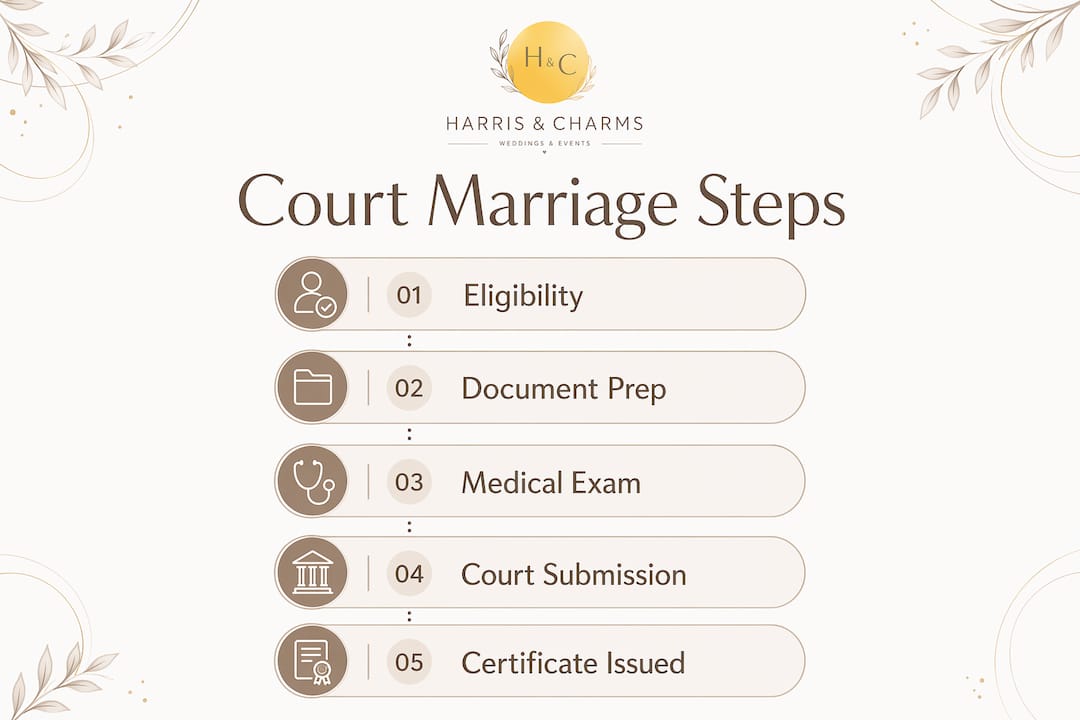
The court marriage procedure follows a clear sequence. Skipping or reordering steps causes rejections and rescheduling fees.
Confirm your legal track. Determine whether you fall under civil personal status law or Sharia personal status law based on your religion and nationality. For a detailed breakdown of Muslim court marriage steps, Harrisandcharms publishes a dedicated legal guide.
Gather and attest all documents. Collect passports, proof of single status, premarital medical certificates, and any divorce or death certificates. Attest foreign documents through the relevant embassy and UAE Ministry of Foreign Affairs (MOFA).
Submit the application. Couples applying for civil marriage must complete a formal application through the relevant court or government portal. In Abu Dhabi, this is done online via the Abu Dhabi Judicial Department. In Dubai, applications go through Dubai Courts.
Pay fees and schedule the ceremony. After document review, you pay the applicable court fees and book your marriage contract ceremony date. Fees vary by emirate and marriage type.
Attend the in-person ceremony. Both parties appear before the authorized court official. For civil marriages, the civil marriage contract in Abu Dhabi is signed before a notary without the need for a wali or witnesses. For Islamic court marriages, the wali and two male Muslim witnesses must be physically present.
Sign the marriage contract. Both parties sign the contract before the judge or notary. This is the legally binding moment of the marriage registration.
Receive the marriage certificate. The court issues the official marriage certificate after signing. Keep multiple certified copies.
Attest the certificate for international use. Marriage certificates issued by UAE courts can be attested by MOFA for international legal recognition and immigration use. This step is mandatory if you plan to use the certificate abroad or for UAE visa applications.
Pro Tip: Book your premarital medical exam at least two weeks before your planned court date. Results can take several days, and courts will not proceed without the certificate in hand.
How does court marriage differ from traditional religious marriage?
Legal frameworks side by side
Civil marriage is governed by secular laws offering equality between spouses and easier divorce processes. Sharia marriage follows Islamic personal status laws, which carry different rules for divorce, custody, and inheritance. Choosing between the two is not just a ceremony preference. It determines your legal rights for the entire duration of the marriage and any separation.
The comparison below captures the most consequential differences:
Factor | Civil Court Marriage | Islamic (Sharia) Court Marriage |
Legal framework | Civil personal status law | Sharia personal status law |
Religious ceremony required | No | Nikah ceremony typically included |
Guardian (wali) required | No | Yes, for Muslim brides |
Witnesses required | No (civil track) | Two male Muslim witnesses |
Divorce process | No-fault, unilateral request possible | Mediation-based, specific grounds needed |
Inheritance rules | Equal civil division | Sharia inheritance proportions apply |
Who typically uses it | Expats, non-Muslims, mixed-nationality couples | Muslim couples, UAE nationals |
Divorce and long-term legal outcomes
Civil marriage allows a no-fault divorce process under civil personal status law, which contrasts with Sharia divorce requirements that need mediation or specific grounds. That distinction matters enormously for expat couples who may relocate or separate across different legal jurisdictions. A civil marriage certificate is also easier to translate and recognize in Western court systems. For a full breakdown of how these frameworks compare in 2026, the civil vs. Islamic marriage guide from Harrisandcharms covers the legal implications in detail.
What are the main benefits of court marriage in the UAE?
Court marriage offers concrete legal and practical advantages, particularly for expats and mixed-nationality couples.
Legal clarity for expats: Civil court marriage produces a universally recognized legal document. It removes ambiguity about which country’s law governs the marriage.
Simplified divorce rights: The no-fault divorce option under civil personal status law gives both spouses equal standing in separation proceedings.
No religious prerequisites: Non-Muslim civil marriages are processed entirely through civil courts without guardian consent or religious witnesses, removing barriers for interfaith couples.
Flexibility for mixed-nationality couples: Civil court marriage accommodates couples from different countries and religions without requiring either party to adopt the other’s religious legal framework.
International attestation: MOFA attestation makes the certificate valid for visa applications, property transactions, and legal proceedings in most countries.
Choosing between civil and Sharia marriage is a significant decision because it affects long-term legal matters including divorce, property division, and child custody. Couples who skip legal advice before choosing their marriage track often discover the consequences only when separation or inheritance disputes arise.
Common pitfalls to avoid:
Submitting unattested foreign documents
Booking the court date before completing the premarital medical exam
Assuming the same process applies in Dubai and Abu Dhabi
Overlooking MOFA attestation for international use
Key takeaways
Court marriage in the UAE is a formal legal registration process that follows either civil personal status law or Sharia law, and the track you choose determines your rights on divorce, inheritance, and custody.
Point | Details |
Two legal tracks exist | Choose civil or Sharia court marriage based on religion and nationality before starting. |
Documents must be attested | Foreign certificates require embassy and MOFA attestation before court submission. |
Premarital exam is mandatory | Complete the medical screening at least two weeks before your scheduled court date. |
Civil marriage simplifies divorce | No-fault divorce is available under civil personal status law, unlike Sharia proceedings. |
MOFA attestation unlocks global use | Attest your marriage certificate through MOFA for visa, immigration, and international legal use. |
What i’ve learned after helping hundreds of couples register in the UAE
Most couples come to us thinking the court marriage process is a single, uniform procedure. It is not. The civil track and the Sharia track are genuinely different legal systems with different outcomes, and I have seen couples choose the wrong one simply because they did not know the distinction existed.
The documentation stage is where most applications stall. A divorce certificate from India or the Philippines, for example, needs attestation from the issuing country’s foreign ministry, then from the UAE Embassy in that country, and then from MOFA in the UAE. That chain takes time. Couples who start this process two weeks before their planned court date almost always miss it.
My honest observation after years in this space: mixed-nationality couples consistently underestimate how much the choice between civil and Sharia marriage affects their future. A British woman and a Lebanese man, for instance, may assume their marriage will follow familiar Western legal norms. If they register under Sharia law, inheritance and custody rules shift significantly. Legal advice before registration is not optional for these couples. It is the most important step they take.
The UAE has made the process more accessible in recent years, especially with online application portals in Abu Dhabi. But accessible does not mean simple. Preparation, accurate documents, and the right legal track from day one are what separate a smooth registration from a months-long ordeal.
— Harris
How Harrisandcharms makes your court marriage stress-free
Planning a court marriage in the UAE involves more moving parts than most couples expect. Harrisandcharms handles the full process so you do not have to figure it out alone.

From document preparation and premarital medical exam coordination to court scheduling and MOFA attestation, Harrisandcharms manages every step. The team supports both civil and Islamic marriage registrations across Dubai and Abu Dhabi, with tailored packages for expats, locals, and mixed-nationality couples. If you want a ceremony alongside your legal registration, Harrisandcharms also coordinates venue, photography, and makeup services through its partner network. Explore the civil marriage packages in Dubai or view the full range of marriage services in the UAE to find the right fit for your situation.
FAQ
What is the minimum age for court marriage in the UAE?
Dubai Courts requires a minimum age of 18 lunar years for both parties. Lunar years are slightly shorter than calendar years, so verify your exact age eligibility before applying.
Do non-muslims need a religious guardian for civil court marriage?
No. Non-Muslim civil marriages in the UAE require only mutual consent and a signed contract before a judge or notary. No wali or religious witnesses are required.
How long does the court marriage process take in the UAE?
The timeline varies by emirate and document readiness, but most couples complete the process in two to four weeks once all attested documents are in order. Delays almost always trace back to missing or unattested paperwork.
Can a UAE court marriage certificate be used abroad?
Yes. Marriage certificates issued by UAE courts can be attested by MOFA for international legal recognition, making them valid for immigration, visa, and legal proceedings in most countries.
What is the difference between civil and islamic court marriage in the UAE?
Civil court marriage follows secular personal status law with no religious requirements and allows no-fault divorce. Islamic court marriage follows Sharia law, requires a wali and male Muslim witnesses, and applies different rules for divorce, inheritance, and custody.
Recommended
Comments