
How Civil Marriage Works in the UAE: 2026 Guide


TL;DR:
Civil marriage is a legally recognized union that grants couples immediate rights from registration, independent of religious ceremonies.
In the UAE, the process involves applying for a license, completing a ceremony before an authorized official, and filing documents for registration, with the timeline depending on service type.
Civil marriage is a legally recognized union formalized by a government official, independent of any religious ceremony, that grants couples immediate legal rights and responsibilities from the moment of registration. For non-Muslims and expats living in the UAE, understanding how civil marriage works is the difference between a valid legal union and a ceremony with no standing in court. The Abu Dhabi Civil Family Court offers both Standard and Express service options, making the UAE one of the more accessible civil marriage jurisdictions in the region. This guide covers the full civil marriage process, from eligibility and documentation to ceremony structure and international recognition.
How does the civil marriage process work step-by-step?
Civil marriage follows three core stages: obtaining a marriage license, completing a ceremony before an authorized official, and filing the signed documents for official registration. Each stage has legal weight. Skipping or mishandling any one of them can render the marriage invalid.
Stage 1: Application and license
Couples begin by submitting a formal application to the relevant government authority. Valid government-issued ID is required at minimum. In the UAE, the Abu Dhabi Civil Family Court handles applications for non-Muslims. Internationally, fees vary widely. For example, a marriage license costs around $45 in Washington, D.C., and approximately $180 in Toronto.
Stage 2: The ceremony
An authorized government official conducts the ceremony. Both parties must appear in person, confirm their identities, and declare their intent to marry. Witnesses are typically required. The officiant’s legal authority is what makes the ceremony valid, not the venue or the vows exchanged.

Stage 3: Filing and registration
After the ceremony, the signed license must be submitted to the relevant authority for official registration. This is the step most couples underestimate. Official filing is what converts a ceremony into a legally recognized marriage. Without it, the marriage has no legal standing.
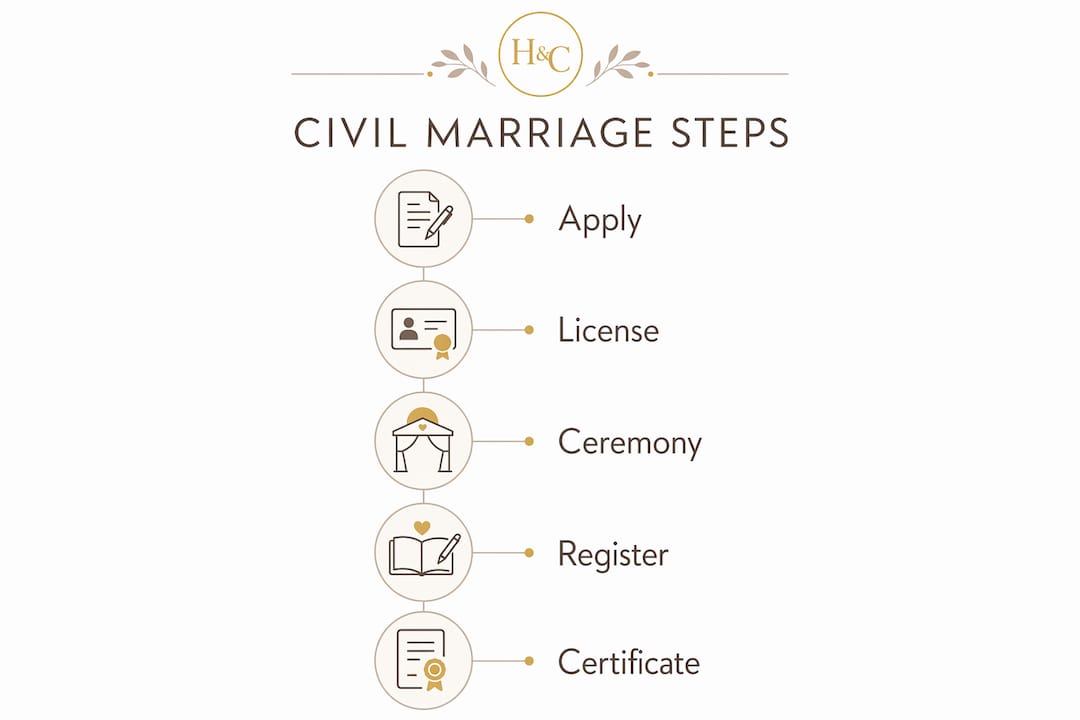
In the UAE, the civil marriage timeline depends on which service tier couples choose. Standard certificates are issued within 3 days. Express certificates are issued immediately after the ceremony.
Pro Tip: Book your ceremony appointment well in advance. UAE civil courts have specific scheduling windows, and popular dates fill quickly, especially around public holidays.
What are the legal requirements and eligibility criteria for civil marriage?
Civil marriage eligibility follows strict legal criteria. Meeting every requirement before applying prevents delays and rejections.
Core eligibility conditions
Age: Both parties must meet the minimum legal age in the jurisdiction. In the UAE, this is typically 18 years old.
Consent: Both parties must enter the marriage freely and voluntarily. Coercion invalidates the contract.
Marital status: Neither party can be legally married to another person at the time of application.
Kinship restrictions: Close blood relatives cannot marry under civil law in any UAE-recognized jurisdiction.
Mental capacity: Both parties must be legally capable of entering a contract.
Document requirements
The civil marriage requirements in the UAE typically include the following:
Document | Purpose |
Valid passport | Confirms identity and nationality |
UAE residence visa | Confirms legal residency status |
Birth certificate | Verifies age and parentage |
Death certificate (if widowed) | Confirms prior marriage has ended |
Divorce certificate (if divorced) | Confirms prior marriage has ended |
No-objection letter (where applicable) | Required by some nationalities |
UAE civil marriage is specifically designed for non-Muslims. Emirati nationals are not eligible for civil marriage under the Abu Dhabi Civil Family Court framework. Non-Emirati spouses must both meet residency and documentation requirements before the application is accepted.
Internationally, notice or posting periods add another layer. The Philippines requires a 10-day public notice before a marriage license becomes valid. Singapore requires a notice period of 21 to 180 days. Failing to complete these notice periods renders the application invalid in those jurisdictions.
Pro Tip: Gather certified translations of all non-English documents before your appointment. UAE courts require Arabic or English versions of every document submitted.
What happens during a civil marriage ceremony?
A civil marriage ceremony is brief, formal, and legally focused. Most courthouse ceremonies last between 10 and 30 minutes. The setting is legally secondary. What matters is the officiant’s authority and the proper filing of documents afterward.
The typical ceremony follows this structure:
The officiant confirms both parties’ identities using official documents.
Both parties declare their intent to marry in front of the officiant and witnesses.
Vows are exchanged. These can be standard legal vows or personalized versions, depending on the jurisdiction.
Witnesses sign the marriage license. Most jurisdictions require at least two adult witnesses.
The officiant signs and seals the license.
Venue options vary. Couples can marry at a courthouse, a civil registry office, or in some jurisdictions, a private location approved by the relevant authority. In the UAE, ceremonies take place within the Abu Dhabi Civil Family Court premises.
One distinction couples must understand: the marriage license vs. certificate difference. The license is the permission to marry. The certificate is the proof that the marriage occurred and was registered. Couples often leave the ceremony believing the signed license is their final document. It is not. The certificate is issued only after the signed license is officially filed and processed.
What are the legal implications, rights, and benefits of civil marriage?
Civil marriage is a legal contract that triggers immediate rights and protections for both spouses, regardless of how the ceremony looked or where it took place. These rights apply the moment registration is complete.
The core legal benefits include:
Tax status: Married couples can file jointly in most countries, often reducing their total tax liability.
Inheritance rights: A surviving spouse has automatic inheritance rights, even without a will, in most civil law jurisdictions.
Medical decision authority: Spouses can make medical decisions on each other’s behalf if one partner is incapacitated.
Property rights: Assets acquired during the marriage are typically treated as jointly owned, depending on the jurisdiction.
Government and employment benefits: Health insurance coverage, pension survivor benefits, and family leave entitlements often extend to legally married spouses.
Immigration eligibility: Civil marriage is a recognized basis for spousal visa applications in the UAE and most countries.
Civil marriage can also be voided or annulled under specific conditions. Age violations, consent failures, or undisclosed prior marriages can make a marriage voidable. Annulment deadlines typically fall within 4 years of the marriage date. After that window closes, the marriage remains legally valid even if grounds for annulment existed at the time.
How does civil marriage in the UAE compare with global practices?
The UAE’s civil marriage framework is one of the most structured in the Gulf region. It is specifically designed for non-Muslim residents and visitors, and it offers two clear service tiers.
Feature | UAE (Abu Dhabi Civil Family Court) | Philippines | Singapore |
Notice period required | Not applicable | 10 days | 21–180 days |
Certificate issuance | Immediate (Express) or 3 days (Standard) | After notice period | After notice period |
Eligibility | Non-Muslims only | All eligible citizens | All eligible citizens |
International attestation | UAE MOFA + home embassy | Not required domestically | Not required domestically |
The UAE Express service reduces the entire process to 2–3 days. That speed is a major advantage for expats who need legal documentation quickly for visa or residency purposes. However, a UAE civil marriage certificate does not automatically carry legal weight abroad. Couples who need international recognition must have the certificate attested by the UAE Ministry of Foreign Affairs and then by their home country’s embassy. Without attestation, the certificate may not be accepted in foreign courts or government offices.
For expats navigating this process, the civil marriage UAE expat guide covers the attestation steps in detail.
Key Takeaways
Civil marriage is a government-registered legal contract that grants couples immediate legal rights, and in the UAE, non-Muslims can complete the process in as little as 2–3 days through the Abu Dhabi Civil Family Court Express service.
Point | Details |
Three-stage process | Apply for a license, complete the ceremony, then file documents for official registration. |
UAE eligibility | Civil marriage in the UAE is available to non-Muslims only; Emirati nationals are not eligible. |
Certificate vs. license | The marriage certificate is issued after filing, not at the ceremony. Do not confuse the two. |
International validity | UAE certificates require attestation by UAE MOFA and your home embassy to be recognized abroad. |
Legal rights activate at registration | Tax benefits, inheritance, and medical authority all begin the moment registration is complete. |
What I’ve learned from watching couples get this wrong
Most couples focus almost entirely on the ceremony. They spend weeks choosing vows, outfits, and witnesses, then rush through the paperwork at the end. That is exactly backward. The ceremony is the easy part. The registration is what makes the marriage real.
I have seen couples leave the courthouse with a signed license and assume they are legally married. They are not. The signed license is a step in the process, not the finish line. The certificate comes after filing, and in some jurisdictions, that can take days. If you are traveling immediately after your ceremony, plan around that gap.
For expats in the UAE, the attestation requirement catches people off guard every time. A UAE civil marriage certificate is valid inside the UAE from the moment it is issued. But if you need that marriage recognized in your home country for visa applications, property transfers, or inheritance claims, you need the UAE Ministry of Foreign Affairs stamp and then your embassy’s authentication. Skipping either step means starting over.
The other thing I want couples to understand is the annulment window. If something was wrong at the time of marriage, such as a prior undisclosed marriage or a consent issue, the legal window to address it is typically 4 years. After that, the marriage stands regardless. That is not a technicality. It has real consequences for property, custody, and inheritance.
My honest advice: treat the paperwork with the same attention you give the ceremony. Both matter. Only one of them holds up in court.
— Harris
Civil marriage planning in the UAE, handled properly
Planning a civil marriage in the UAE involves more moving parts than most couples expect. Document preparation, court appointments, witness coordination, and post-ceremony attestation all need to happen in the right order.

Harrisandcharms specializes in civil marriage in Dubai and Abu Dhabi, offering tailored packages that cover the full process from document review to ceremony coordination and attestation support. Whether you need the Standard or Express service, or you are an expat navigating UAE civil marriage law for the first time, Harrisandcharms handles the details so you can focus on the day itself. Explore the full range of marriage services in the UAE to find the package that fits your situation.
FAQ
What is the difference between a marriage license and a marriage certificate?
A marriage license is the legal permission to marry, issued before the ceremony. A marriage certificate is the official proof of marriage, issued only after the signed license is filed and processed by the relevant authority.
Who is eligible for civil marriage in the UAE?
Civil marriage in the UAE through the Abu Dhabi Civil Family Court is available to non-Muslims only. Emirati nationals are not eligible under this framework.
How long does civil marriage take in the UAE?
The Express service issues a certificate immediately after the ceremony. The Standard service issues the certificate within 3 days of the ceremony.
Does a UAE civil marriage certificate work abroad?
Not automatically. Couples need attestation from the UAE Ministry of Foreign Affairs and authentication from their home country’s embassy for the certificate to be legally recognized in most foreign jurisdictions.
Can a civil marriage be annulled?
Yes. A civil marriage can be voided or annulled due to age violations, consent failures, or undisclosed prior marriages. Annulment deadlines typically fall within 4 years of the marriage date, after which the marriage remains legally valid.
Recommended
Comments