
Marriage Certificate for Tourists: Your 2026 Global Guide


TL;DR:
A marriage certificate for tourists confirms their marriage in a foreign country and aids recognition at home. Obtaining this certificate requires extensive documentation, legalization, and adherence to destination-specific procedures. Legal recognition abroad also depends on apostille certification, certified translations, and timely registration with local authorities.
A marriage certificate for tourists is a legal document issued to couples who marry in a foreign country, confirming their union and enabling recognition of that marriage in their home nation. Tourists can obtain this certificate by meeting the specific documentation and procedural requirements of the country where they marry. The UAE, California, and Vietnam each follow distinct processes, but all share a common foundation: valid identification, proof of single status, and compliance with local civil registration rules. Getting these details right before you travel saves weeks of delays and prevents costly legal complications after you return home.
What documents do tourists need for a marriage certificate abroad?
The document list for a tourist marriage license goes well beyond a valid passport. Most countries require a combination of identity documents, civil status records, and legalized translations before they issue any marriage certificate to foreign visitors.
The core documents tourists need include:
Valid passports for both partners, with at least six months of remaining validity
Birth certificates, often requiring apostille certification and a certified translation into the local language
Certificate of No Impediment (also called a Certificate of Single Status or Freedom to Marry), issued by your home country’s civil registry or embassy
Divorce decrees or death certificates if either partner was previously married, fully legalized and translated
Government-issued photo ID as a secondary form of identification
Many tourists incorrectly assume a valid passport is sufficient, but original civil documents like birth certificates and divorce decrees, legalized and translated, are often required. That gap between assumption and reality is where most tourist marriage applications stall.
Document validity periods add another layer of complexity. A Certificate of No Impediment issued in your home country may only be valid for three to six months. If you apply too early, it expires before your wedding date. If you apply too late, you cannot get it legalized and translated in time.

Pro Tip: Request your Certificate of No Impediment at least eight weeks before your intended wedding date. Legalization and translation alone can take two to four weeks, and some embassies require appointments booked weeks in advance.
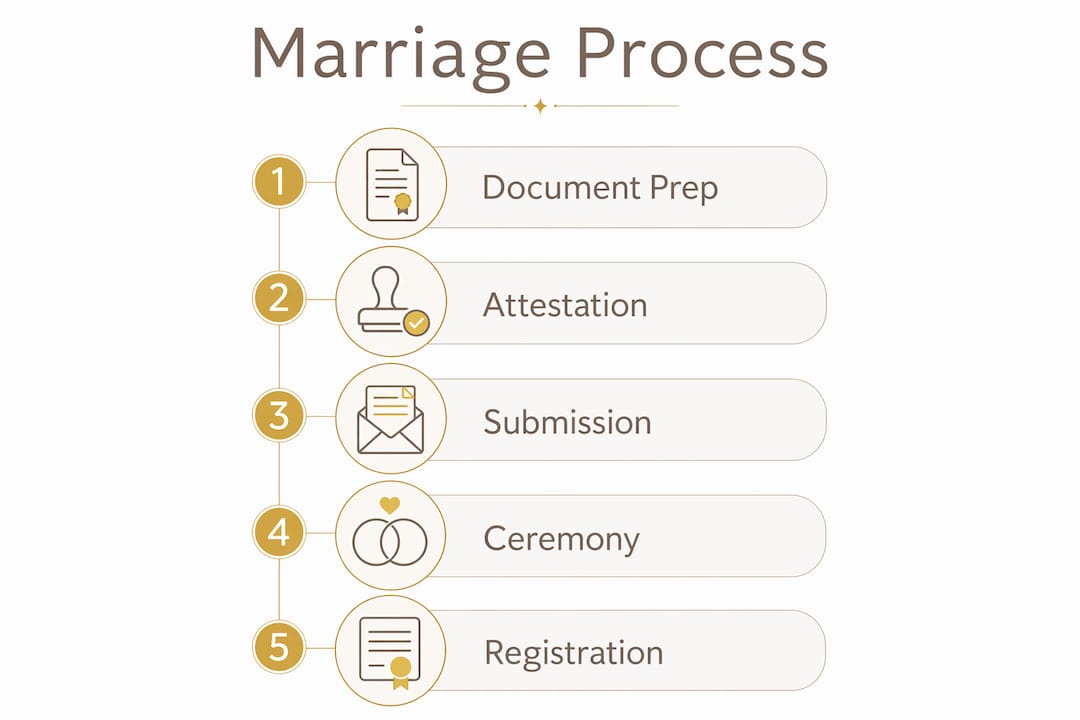
How does the marriage certificate process differ by destination?
The marriage process for foreigners varies significantly depending on where you marry. The UAE, California, and Vietnam represent three very different models, and understanding those differences helps you plan realistically.
UAE marriage requirements for tourists
The UAE requires foreign couples to present their passports, birth certificates, and proof of single status, all attested by the UAE Ministry of Foreign Affairs. Non-Muslim couples typically marry through a civil ceremony at a licensed venue or through a recognized church. Muslim couples follow Islamic marriage procedures, which require additional documentation including a guardian’s consent in some cases. The UAE court marriage documents list is specific and non-negotiable. Missing even one attested document means your application is rejected on the day.
California: the most accessible option for tourists
California allows international couples to marry on a tourist visa with no residency requirements. The license fee ranges from $35 to $100 USD depending on the county, and the license is valid for 90 days. California issues the marriage license in under an hour, with no blood tests or waiting periods required. That efficiency makes California one of the most popular destinations for couples who want a legally recognized marriage without bureaucratic delays.
Vietnam: the most document-intensive process
Vietnam requires foreigners marrying Vietnamese nationals to provide a certificate of marital status from their home country, fully legalized and translated. The process may also include a formal interview and, in some cases, a mental health certificate valid for six months. Industry analysts note that interviews for foreign-element marriages in Vietnam require professional interpreters to avoid delays. The Vietnamese Marriage Registration Certificate also serves as the basis for a foreign spouse’s residence permit application, which makes getting it right the first time critically important.
Destination | Residency required | Typical fee | Processing time | Key extra requirement |
UAE | No | Varies by ceremony type | Several days to weeks | Full document attestation by Ministry of Foreign Affairs |
California | No | $35–$100 USD | Under 1 hour | None beyond valid passports |
Vietnam | No | Varies | Several weeks | Mental health certificate, formal interview |
Toronto, Canada | No | $180 CAD | Same day | Two government-issued IDs, applied within 90 days of wedding |
Pro Tip: In the UAE, document attestation must follow a specific sequence: notarization in your home country, then authentication by your country’s foreign affairs ministry, then attestation by the UAE embassy, and finally by the UAE Ministry of Foreign Affairs. Skipping or reversing any step voids the entire process.
What legal challenges do tourists face with international marriage certificates?
Obtaining the certificate is only half the task. Getting your home country to recognize a foreign marriage certificate is a separate legal process with its own requirements.
The most common challenges tourists face include:
Apostille certification: Most countries that signed the 1961 Hague Convention require an apostille stamp on foreign marriage certificates before they recognize them. Without it, the document has no legal standing abroad.
Certified translations: Apostille and certified translations are generally required for foreign marriage certificates to be recognized abroad and locally registered. A standard translation is not enough. It must be sworn or notarized.
Local registration deadlines: Some countries require you to register your foreign marriage at home within a specific window. In Brazil, for example, marriages conducted abroad must be registered at the consulate or civil registry within a defined timeframe, with apostille and sworn translation attached.
Document authenticity delays: Civil registries in many countries run authenticity checks that can take weeks, especially if your documents come from countries with less standardized civil registration systems.
Language barriers: A marriage certificate issued in Arabic, Vietnamese, or Portuguese needs a certified translation before any foreign authority will process it.
Legal experts also recommend executing prenuptial agreements in international marriages to clearly define property regimes and avoid disputes. When two people from different countries marry, their assets may fall under two different legal systems simultaneously. A prenuptial agreement, drafted with legal advice in both jurisdictions, prevents that ambiguity from becoming a costly dispute.
Understanding how marriage abroad is legally recognized in your home country is as important as completing the ceremony itself.
Practical tips for managing your marriage certificate process smoothly
Most tourist couples underestimate how much time the documentation process takes. Document preparation is the critical bottleneck in the international marriage certificate process, often taking three to six weeks. Planning around that reality is the single most effective thing you can do.
Start at least three months before your wedding date. Request your Certificate of No Impediment, birth certificates, and any divorce decrees immediately. Factor in legalization, translation, and apostille time for each document.
Confirm requirements directly with the local civil registry or embassy. Requirements change. What applied last year may not apply in 2026. Call or email the specific office where you plan to register, not just a general government website.
Use certified translators approved by the destination country. Many countries maintain lists of approved translators. Using an unapproved translator means your documents will be rejected, even if the translation itself is accurate.
Bring originals and at least three certified copies of every document. Many jurisdictions require original documents in person at registry offices, even if digital copies were submitted previously. Copies protect you if originals are held for processing.
Work with a licensed wedding service provider in your destination country. Local providers know which documents each specific office requires, which translation agencies are approved, and how to handle unexpected rejections. That local knowledge saves weeks.
Pro Tip: If your wedding involves interview footage or a videographer, that documentation can also serve as supporting evidence of a genuine marriage in jurisdictions that scrutinize foreign-element unions. Wedding film interviews, as explained in this guide on how interview footage strengthens your wedding record, add a layer of authenticity that civil authorities recognize.
Key Takeaways
A marriage certificate for tourists requires jurisdiction-specific documents, apostille certification, and local registration to achieve full legal recognition in your home country.
Point | Details |
Document preparation is the bottleneck | Start at least three months early to allow time for legalization, translation, and apostille processing. |
Passports alone are not enough | Most countries require birth certificates, proof of single status, and certified translations beyond a valid passport. |
Destination rules vary widely | California processes licenses in under an hour; the UAE requires full Ministry of Foreign Affairs attestation; Vietnam may require a formal interview. |
Apostille is mandatory for recognition | Foreign marriage certificates need an apostille stamp and sworn translation before most home countries will legally recognize them. |
Local registration has deadlines | Some countries require you to register a foreign marriage at home within a set timeframe, or the marriage has no domestic legal standing. |
What I’ve learned from helping tourists marry in the UAE
Most couples I work with arrive thinking the hardest part is choosing a venue. The hardest part is always the paperwork, and specifically the gap between what they think they need and what the civil registry actually requires.
The most common mistake I see is couples who bring notarized copies when the registry requires original documents. That single error can push a wedding date back by weeks. The UAE Ministry of Foreign Affairs attestation sequence is also something most tourists have never encountered before. They assume their home country’s apostille is the final step. It is not. The UAE requires its own attestation layer on top of that.
Tourist visa limitations create another misunderstanding. A tourist visa does not restrict your right to marry in the UAE, but it does restrict how long you can stay while waiting for documents to clear. If your visa expires before your marriage registration is complete, you face a gap that requires either a visa extension or a border run, neither of which is ideal in the middle of a wedding process.
My honest advice: verify every document requirement directly with the issuing authority at least 12 weeks before your planned date. Do not rely on blog posts, including this one, as your final source of truth. Requirements shift, offices change their procedures, and the cost of being wrong is a delayed wedding. Work with someone who has done this process recently and knows the current requirements from direct experience.
— Harris
How Harrisandcharms helps tourists get married in the UAE
Harrisandcharms handles the full marriage documentation process for tourists in the UAE, from document attestation to civil and Islamic ceremony coordination.

The UAE marriage services offered by Harrisandcharms cover civil and Islamic marriage packages, Ministry of Foreign Affairs attestation support, certified translation coordination, and venue management. Couples also get access to Harrisandcharms’ network of sister companies for visa assistance and legal attestation, which matters when your tourist visa timeline is tight. The team has direct experience with the UAE’s specific document requirements for foreign nationals, so nothing gets missed. If you are planning to marry in the UAE as a tourist, the marriage law overview for tourists on the Harrisandcharms website is the right place to start.
FAQ
What is a marriage certificate for tourists?
A marriage certificate for tourists is a legal document issued by a foreign country’s civil authority confirming that a marriage took place there. It serves as official proof of marital status and is required for recognition of the marriage in the couple’s home country.
Can tourists legally marry in the UAE?
Yes, tourists can legally marry in the UAE. Non-Muslim foreign couples typically marry through a civil ceremony at a licensed venue, while Muslim couples follow Islamic marriage procedures, both requiring full document attestation by the UAE Ministry of Foreign Affairs.
Do I need an apostille on my foreign marriage certificate?
Most countries that are signatories to the 1961 Hague Convention require an apostille on foreign marriage certificates before they will recognize them domestically. A certified translation is also required alongside the apostille.
How long does it take to get a marriage certificate abroad?
Processing times range from under one hour in California to several weeks in the UAE and Vietnam. Document preparation, including legalization and apostille processing, typically takes three to six weeks before the ceremony even begins.
Do I need to register my foreign marriage when I return home?
Most countries require you to register a foreign marriage with your local civil registry after returning home. Some jurisdictions set strict deadlines for this registration, and failure to register can leave your marriage without domestic legal recognition.
Recommended
Comments