
What Does Islam Say About Marriage: A Complete Guide


TL;DR:
Islam regards marriage as a divine sign aimed at fostering tranquility, affection, and mercy between spouses within a formal nikah contract that requires mutual consent, a guardian, witnesses, and a mahr. It emphasizes that marriage addresses spiritual and social needs, with Quran 30:21 highlighting its role as a sign of God’s creation, not merely a social custom. Legally, in the U.S., a religious nikah alone does not confer civil marriage rights, which require a state-issued license and registration.
Islam’s answer to marriage is found in a single verse: Quran 30:21 describes it as a divine sign, created so that spouses may find sakinah (tranquility), mawadda (affection), and rahma (mercy) in one another. That is the theological core. Legally, Islamic marriage is a formal contract called nikah, and it carries specific conditions that scholars across all major schools treat as non-negotiable.
“And of His signs is that He created for you from yourselves mates that you may find tranquility in them; and He placed between you affection and mercy. Indeed in that are signs for a people who give thought.” — Quran 30:21
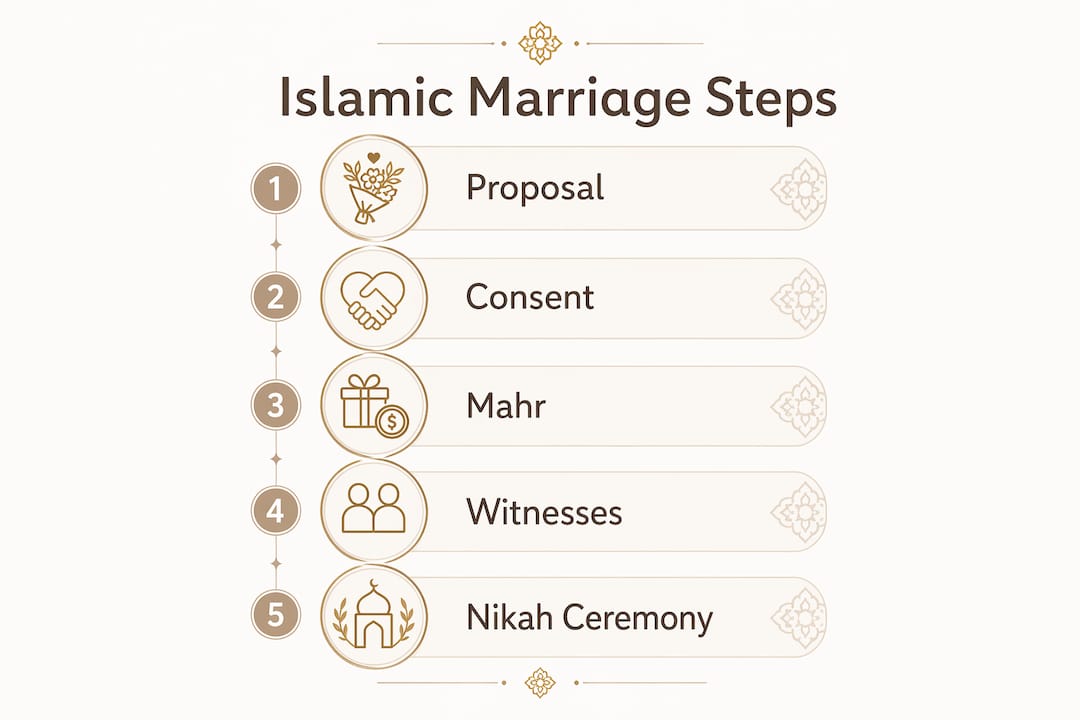
Marriage in Islam is not merely recommended. Depending on personal circumstances, classical scholars classify it as obligatory for those who fear falling into sin. For many people, it is highly recommended, and the Prophet described it as “half the religion.” Before diving into the details, here are the five legal elements every valid nikah requires:
Nikah (contract): a formal offer and acceptance between the parties
Consent: free, explicit agreement from both bride and groom
Wali: a guardian who represents the bride in most schools
Witnesses: at least two adult Muslim witnesses (requirements vary by school)
Mahr: a gift of value given exclusively to the bride
Table of Contents
What does Islam say about marriage in the Quran and Hadith?
The Quran does not treat marriage as a social convention. It frames it as a sign of God — the same category as the creation of the heavens and the earth. Quran 30:21 is the most-cited verse on the subject, and its three terms carry distinct weight in Islamic jurisprudence.
Sakinah means the psychological stillness a person finds in their spouse, not just emotional comfort but a reduction of existential restlessness. Mawadda is active affection, the kind that motivates care and generosity. Rahma is mercy, the disposition that sustains a marriage when affection fluctuates. Together, they describe a marriage that functions as a spiritual and psychological anchor.
“The Prophet said: ‘When a man marries, he has completed half of his religion, so let him fear Allah regarding the remaining half.’” — Hadith, reported by al-Bayhaqi
Scholars treat this hadith as more than a metaphor. It signals that marriage addresses a structural dimension of religious life: the management of desire, the formation of a household, and the continuity of lineage. Ignoring it is not spiritually neutral.
Other verses carry specific legal weight. Quran 4:3 permits polygyny under strict conditions of justice. Quran 2:228 establishes that wives and husbands hold mutual rights, though with differentiated roles. Quran 4:19 prohibits inheriting women against their will and commands treating them with kindness. These verses are not isolated; classical jurists read them together to construct a coherent family law.
One distinction matters here: the Quran and authenticated hadith are primary sources. What scholars derive from them, the rules in fiqh manuals, are juristic interpretation. The two are not the same. A ruling in the Hanafi school may differ from one in the Maliki school not because the scripture differs, but because the interpretive methodology does. Readers should keep that gap in mind throughout this guide.
What makes a nikah valid under Islamic law?
Nikah is a legal contract (ʿaqd), not a sacrament. That distinction matters practically: it means the marriage can be dissolved, its terms can be negotiated, and its validity depends on meeting specific legal conditions rather than on a religious official’s blessing.
The conditions mainstream scholars agree on:
Mutual consent: both parties must agree freely. A marriage contracted under coercion is void in most schools.
Wali (guardian): the bride’s guardian, typically her father or another male relative, represents her in the contract. The Hanafi school allows a mature woman to contract her own marriage without a wali; the Shafi’i and Maliki schools require one.
Witnesses: the Sunni majority requires at least two adult Muslim witnesses. Twelver Shia jurisprudence does not require witnesses for validity, though they are recommended.
Offer and acceptance (ijab wa qubul): explicit verbal exchange between the parties (or their representatives) in a single sitting.
Mahr: a mandatory gift from the groom to the bride. The amount is negotiable; its existence is not.
Understanding the mahr
The mahr belongs exclusively to the bride. She may spend it, save it, or gift it back, but no one can compel her to do so. It can be paid immediately (muʿajjal) or deferred (muʾajjal), with the deferred portion typically due on divorce or the husband’s death. If the contract omits a specific mahr, classical courts historically determine a judicially set sum based on what women of comparable status received. The mahr functions as financial protection: it gives the wife an independent asset from the moment the marriage begins.

Temporary marriage and ʿurfi contracts
Not all marriage forms carry the same legal standing. Mut’ah (temporary marriage) is accepted in Twelver Shia jurisprudence but rejected by Sunni schools, which treat it as prohibited. ʿUrfi marriages are informal, unregistered contracts practiced in some Arab contexts; they are legally precarious and offer the wife minimal protection. Neither form substitutes for a properly documented permanent nikah in most jurisdictions.
Pro Tip: If you are unsure whether your nikah meets the conditions of your particular school of thought, consult a qualified scholar from that tradition before the ceremony, not after. Conditions differ enough between schools that a marriage valid in one may be disputed in another.
What rights and responsibilities do spouses have in Islam?
Quran 2:228 states that wives have rights equivalent to their obligations, “in accordance with what is reasonable.” That phrase, bil-ma’ruf, appears repeatedly in Islamic family law and functions as a standard of recognized fairness rather than a fixed list.
Mutual rights both spouses hold:
Fidelity and sexual exclusivity within the marriage
Dignity and respect; neither spouse may demean or harm the other
Consultation on household decisions
Emotional companionship and affection
The husband’s specific duties center on nafaqa (financial maintenance): food, clothing, and housing appropriate to his means. This obligation exists regardless of the wife’s own wealth. He also owes her kindness, sexual availability within lawful bounds, and fair treatment if he has more than one wife.
The wife’s specific duties include managing the household, maintaining fidelity, and not admitting anyone into the home the husband objects to. Classical scholars also describe her right to refuse sexual intercourse during menstruation, postpartum bleeding, and during the daylight hours of Ramadan fasting.
Sexual rights in Islamic marriage are mutual but bounded. Both spouses have a right to intimacy, and neither may unilaterally withhold it without cause. The prohibitions are specific: intercourse during menstruation (Quran 2:222), during postpartum bleeding, and during fasting hours. These are not cultural preferences; they are textual rulings.
Pro Tip: Fiqh schools differ on details like the extent of nafaqa, what counts as adequate housing, and the wife’s right to work outside the home. When spouses disagree on these duties, a local scholar or an Islamic family mediator is a better first stop than a general internet search.
How does a nikah ceremony work, and does it count in the U.S.?
A typical nikah ceremony follows a clear sequence, though cultural additions vary widely by region.
Standard nikah steps:
Confirm the wali’s presence and role
Agree on the mahr amount and payment terms
The officiant (imam or qadi) opens with recitation of Quranic verses and the khutbat al-nikah
The wali makes the formal offer (ijab) on behalf of the bride
The groom gives explicit acceptance (qubul)
Two witnesses attest to the exchange
The mahr is declared and recorded
Recitation of Surah Al-Fatiha (common in many traditions)
Signing of the marriage contract document
The ceremony can take fifteen minutes. The cultural celebration around it, the walima (wedding feast), is a separate sunnah act.
Does a nikah satisfy U.S. civil marriage requirements?
No, not automatically. A religious nikah and a U.S. civil marriage are legally distinct. In most U.S. states, a marriage is legally recognized only when a civil license is obtained from the county clerk’s office, the ceremony is performed by an authorized officiant, and the signed license is returned to the county within the required window (typically 30–60 days, varying by state). Some states do recognize religious ceremonies performed by an imam as legally valid, provided the officiant is registered and the license is in hand. Others do not.
A nikah performed without a civil license gives the couple no legal standing in U.S. family courts. That means no inheritance rights, no spousal benefits, and no civil divorce process if the marriage ends. A religious ceremony alone is also insufficient for immigration and visa purposes.
Element | Islamic Nikah | U.S. Civil Marriage |
Legal authority | Islamic jurisprudence / school of thought | State law (county clerk) |
Required officiant | Imam, qadi, or authorized Muslim scholar | State-licensed officiant |
Documentation | Nikah contract (written or witnessed) | Civil marriage license |
Legal rights granted | Religious/community recognition | Federal and state legal rights |
Recognized for immigration | Not independently | Yes, with civil license |
Documents commonly needed for civil registration in the U.S.:
Government-issued photo ID (passport or driver’s license)
Proof of single status (divorce decree or death certificate if previously married)
Social Security number (where required by the state)
Application fee (varies by county)
Witnesses (requirements vary by state)
What does Islam say about polygyny, and how do scholars debate it today?
Quran 4:3 permits a Muslim man to marry up to four wives, but the permission is conditional: “if you fear that you will not be just, then marry only one.” The verse does not encourage polygyny; it limits a pre-existing practice and attaches a condition that classical scholars treat as extremely demanding.
“But if you fear that you will not be just, then [marry only] one.” — Quran 4:3
The standard of justice required is not merely financial. It includes equal time, emotional availability, and equitable treatment across households. Quran 4:129 then states that a man will never be able to be fully just between wives even if he tries, which many contemporary scholars read as a strong implicit discouragement.
Common misconceptions vs. juristic positions:
Misconception: Polygyny is freely permitted with no conditions. Juristic position: It requires demonstrated capacity for justice; most scholars say the default should be monogamy.
Misconception: The first wife has no say. Juristic position: Many scholars recommend, and some require, informing the first wife; some marriage contracts include a clause granting the wife the right to divorce if the husband takes another wife.
Misconception: Polygyny is widely practiced in Muslim communities. Reality: It is legally prohibited in many Muslim-majority countries and socially uncommon in most Western Muslim communities.
For U.S. residents: polygynous marriages are not legally recognized under any U.S. state law. A man who contracts a second religious nikah while civilly married is committing bigamy under civil law. The second wife would have no civil legal standing.
How does divorce work in Islam, and what happens after?
Islamic law provides multiple divorce pathways, each with distinct procedures and consequences.
The main divorce mechanisms
Talaq (husband-initiated): The husband pronounces divorce, ideally once, during a period when the wife is not menstruating and intercourse has not occurred. The pronouncement initiates the iddah waiting period.
Khula (wife-initiated): The wife requests dissolution and typically returns the mahr. The husband must agree, or the matter goes to a judge.
Judicial divorce (faskh): A qadi or Islamic court dissolves the marriage on grounds such as harm, abandonment, or failure to provide maintenance. This route is available to wives when the husband refuses talaq or khula.
The iddah waiting period
After talaq, the wife observes iddah: three menstrual cycles for a woman who menstruates, three months for a post-menopausal woman, and the full term of pregnancy if she is pregnant. The purposes are to confirm whether she is pregnant and to allow a reconciliation window. During iddah, the husband owes her maintenance and housing.
“Divorced women shall wait for three menstrual periods, and it is not lawful for them to conceal what Allah has created in their wombs.” — Quran 2:228
Mahr after divorce
If the husband initiates divorce before consummation, the wife receives half the agreed mahr. After consummation, she keeps the full mahr regardless of who initiates the divorce. In a khula, she typically returns the mahr as the price of release, though scholars differ on whether she must return all of it.
Custody basics
Classical fiqh generally awards young children’s physical custody to the mother (hadana) until a set age (around seven for boys, puberty for girls in many schools), after which the father may take custody. The child’s welfare is the overriding principle, and contemporary Muslim scholars increasingly emphasize flexible arrangements that serve the child rather than rigid age cutoffs.
For U.S. residents: an Islamic divorce has no civil legal effect. You must also obtain a civil divorce through your state’s family court to dissolve the legal marriage. Custody, asset division, and support are governed by state law, not Islamic jurisprudence. Document all agreements in writing and consult a U.S. family law attorney for the civil side. For couples navigating both processes, Harrisandcharms’s Islamic marriage contract guide explains how written nikah terms can support civil proceedings.
This article provides general religious and informational guidance, not legal advice. Consult a qualified U.S. family law attorney and a trusted Islamic scholar for guidance specific to your situation.
Is marriage mandatory in Islam, and when should you marry?
The short answer: for most people, marriage is mustahabb (highly recommended). For some, it becomes wajib (obligatory). The distinction turns on personal circumstances, not a universal rule.
Classical scholars identify the following factors:
Obligatory when a person has strong sexual desire they cannot control through fasting or other means, and they have the financial capacity to marry. Remaining unmarried in this state risks falling into zina (fornication), which is prohibited.
Recommended for those who have moderate desire, can afford marriage, and would benefit spiritually and emotionally from it.
Permissible but not required for those who are indifferent to marriage and face no risk of sin.
Discouraged or prohibited in rare cases where a person would be unable to fulfill the rights of a spouse due to illness, poverty, or other incapacity.
The Prophet’s guidance on spouse selection is direct: choose by faith and character first. Hadith literature across both Sunni and Shia traditions records the instruction to prioritize religious commitment and moral integrity over wealth, beauty, or social status. A spouse chosen for character tends to build a marriage that lasts; one chosen for status alone tends to create a household built on conditions.
Practical guidance for timing:
Assess your financial capacity to provide nafaqa honestly before committing
Seek a spouse whose religious practice and values align with yours
Consult a trusted scholar if you are unsure whether your circumstances make marriage obligatory for you
Do not delay marriage indefinitely out of perfectionism; the Prophet encouraged young Muslims to marry when they were able
How do contemporary scholars interpret Islamic marriage today?
Classical fiqh was developed in specific historical contexts. Contemporary scholars, including those at Dar Al-Ifta, increasingly frame Islamic marriage through maqasid al-sharia, the higher objectives of Islamic law: preservation of religion, life, intellect, lineage, and property. Marriage serves at least three of those five objectives directly.
Dar Al-Ifta’s position frames marriage as an act of worship when approached with taqwa (God-consciousness). That framing shifts the focus from contractual compliance to spiritual intentionality. A couple who treats their marriage as a religious project, not just a legal arrangement, tends to approach conflict, rights, and duties differently.
Contemporary Quranic studies also note that Islamic marriage legislation is designed to create psychological stability and social welfare, a finding that aligns with broader social science research on the benefits of stable family structures. The two frameworks, religious and social-scientific, reach similar conclusions from different starting points.
Lens | Classical Fiqh | Contemporary Scholarship |
Primary focus | Contract validity and legal conditions | Maqasid, consent, gender justice |
Polygyny | Permitted with conditions | Strongly qualified; many scholars discourage |
Wife’s agency | Wali required in most schools | Increasing emphasis on direct consent |
Divorce access | Talaq primary; khula available | Greater emphasis on equal access to dissolution |
Spiritual framing | Sunnah and religious duty | Act of worship; psychological and social benefit |
Key modern interpretive trends:
Stronger emphasis on explicit, informed consent from both parties
Growing scholarly support for marriage contracts that include protective clauses for wives
Recognition that cultural practices (forced marriages, denial of mahr) are not Islamic requirements
U.S.-based Muslim scholars increasingly address how to navigate dual religious and civil systems
For U.S. couples navigating both systems, the practical tension is real. An Islamic marriage that is not civilly registered leaves the wife without legal recourse in divorce, inheritance, or medical decision-making. A UK spouse visa interview process, for example, requires documented civil marriage, not just a nikah certificate, illustrating how civil registration affects rights far beyond the wedding day. The same principle applies in the U.S.
Key takeaways
Islamic marriage is a formal contract grounded in Quran 30:21 whose three purposes, sakinah, mawadda, and rahma, define both its spiritual goal and its legal structure, with nikah validity requiring consent, wali, witnesses, and mahr across all major schools.
Point | Details |
Scriptural foundation | Quran 30:21 names sakinah, mawadda, and rahma as the three core purposes of marriage. |
Nikah essentials | Valid nikah requires mutual consent, a wali, two witnesses, offer and acceptance, and an agreed mahr. |
Mahr is the wife’s alone | The mahr belongs exclusively to the bride and cannot be taken from her by family or spouse. |
U.S. civil registration | A religious nikah does not create legal marriage in the U.S.; a civil license is required for legal rights. |
When marriage is obligatory | Classical scholars classify marriage as wajib for those who fear committing sin without it and can afford it. |
Why the spiritual framing of nikah matters more than most guides admit
Most guides on Islamic marriage focus on the legal checklist: wali, witnesses, mahr, contract. Those elements matter, and this guide covers all of them. But the checklist framing misses what Quran 30:21 actually says. The verse does not describe marriage as a duty or a legal mechanism. It describes it as a sign of God, placed in the same category as the alternation of night and day and the diversity of human languages.
That framing changes how you approach the whole institution. A couple who treats their nikah as a spiritual project, not a compliance exercise, handles conflict differently. They are more likely to seek reconciliation before divorce, more likely to negotiate mahr fairly, and more likely to honor the mutual rights the Quran describes. Dar Al-Ifta’s emphasis on taqwa as the foundation of marriage is not pious decoration; it is a practical instruction about what makes marriages survive.
The other thing most guides understate is the gap between Islamic jurisprudence and cultural practice. Forced marriages, denial of mahr, refusal to grant khula, and exclusion of the wife from the nikah process are not Islamic requirements. They are cultural distortions that have been mistaken for religious ones. The Quran’s standard is bil-ma’ruf, what is recognized as fair and good. That standard is demanding in both directions.
For couples in the U.S., the practical takeaway is straightforward: get the civil license, document the mahr in writing, and treat the nikah contract as a living document that protects both parties. Harrisandcharms offers comprehensive marriage services for couples navigating both civil and Islamic processes, including documentation support and legal attestation.
Useful sources for further study
The sources below are organized by what they are best suited for.
For scriptural and theological grounding:
The Quran directly: Surah 30 (Al-Rum), verse 21; Surah 4 (An-Nisa), verses 3 and 19–21; Surah 2 (Al-Baqarah), verses 221–232 cover the core marriage and divorce rulings.
Tafsir Ibn Kathir and Tafsir Al-Tabari for classical exegesis of the marriage verses.
For juristic detail by school:
Reliance of the Traveller (ʿUmdat al-Salik) by Ahmad ibn Naqib al-Misri: the standard Shafi’i manual, available in English translation.
Al-Fiqh ʿala al-Madhahib al-Arbaʿa by Abd al-Rahman al-Jaziri: covers all four Sunni schools comparatively.
Al-Islam.org’s A Code of Practice for Muslims in the West for Shia jurisprudence on marriage in Western contexts.
For contemporary scholarly positions:
Dar Al-Ifta Al-Misriyyah (daralifta.gov.eg): authoritative fatwas on marriage, divorce, and mahr in modern contexts.
IslamQA.info: accessible scholarly answers on when marriage is obligatory, mahr rules, and divorce procedures.
For practical U.S. civil registration steps:
Your state’s official county clerk or probate court website for marriage license requirements (these vary by state).
Harrisandcharms’s nikah process guide for step-by-step documentation guidance.
Harrisandcharms’s U.S.-focused nikah guide for readers reconciling Islamic and civil marriage requirements.
Recommended
Comments