
Islamic Marriage for Expats in the UAE: 2026 Guide


TL;DR:
Expats in the UAE must complete a Sharia-compliant Nikah with proper documentation, attestation, and court registration for legal recognition. The process involves preparing documents, understanding religious requirements, and coordinating steps across various authorities to ensure validity abroad and domestically. Proper planning, respectful engagement with officials, and professional support help an expat couple avoid delays and legal issues.
Islamic marriage for expats in the UAE is a legally and culturally defined process that requires specific documentation, Sharia compliance, and official registration to be valid under UAE law. The process is known formally as Nikah, and completing it correctly means satisfying both religious requirements and the UAE’s civil registration system. Expats face a dual challenge: meeting UAE regulations while also securing recognition from their home country. This guide walks you through every stage, from document preparation to Sharia court registration, so you can plan with confidence and avoid the delays that catch most couples off guard.
What documents do expats need for an islamic marriage in the UAE? islamic marriage for expats guide

The Islamic marriage for expats guide starts with documentation, because missing even one paper can delay your entire process by weeks. The UAE requires a specific set of documents from both parties before any marriage can proceed.
Core documents required for both parties:
Valid passport (original plus copies)
UAE residence visa
Birth certificate (attested and translated into Arabic)
Certificate of no impediment or single status letter from your home country embassy
Divorce decree or death certificate if previously married (attested and translated)
Recent passport-sized photographs
Attestation is non-negotiable. Every foreign document must be authenticated by your home country’s foreign affairs ministry, then attested by the UAE Ministry of Foreign Affairs. The U.S. State Department confirms that documents like divorce certificates require both translation and authentication before they are accepted abroad. That means a divorce certificate issued in Texas must be notarized, authenticated by the U.S. Department of State, and then attested by the UAE embassy before it is usable here.
Pro Tip: Request your single status letter from your home country embassy at least six weeks before your planned marriage date. Processing times vary widely by nationality, and delays here are the single most common reason couples miss their scheduled Nikah appointment.
Premarital health screening is also part of the process. The UAE’s Emirati Genome Programme screens for over 840 hereditary disorders across 570 genes. Among the first 1,000 couples tested, 70 shared potentially harmful recessive variants. That figure represents 8% of couples carrying risks they were previously unaware of. While the screening program currently focuses on Emirati nationals, expats should confirm with their emirate’s health authority whether any screening is required for their specific situation.
Document | Who Needs It | Attestation Required |
Passport copy | Both parties | No |
Birth certificate | Both parties | Yes |
Single status letter | Both parties | Yes |
Divorce/death certificate | Previously married only | Yes |
Residence visa copy | Both parties | No |
How does the nikah ceremony work for expats?
The Nikah is the Islamic marriage contract, and it carries specific religious requirements that every expat couple must understand before the ceremony day. Under Sharia law, a valid Nikah requires mutual consent from both parties, the presence of a Wali (the bride’s guardian), a public declaration, and at least two adult Muslim witnesses.
The four pillars of a valid Nikah:
Consent (Ijab and Qabul): The offer and acceptance must be spoken clearly by both parties.
Wali: The bride’s male guardian, typically her father or brother, must be present. If no male guardian is available, a judge can act as Wali.
Mahr: A mandatory gift from the groom to the bride, agreed upon before the ceremony. It can be money, property, or any agreed item of value.
Witnesses: Two adult Muslim males, or one male and two females, must witness the contract.
For non-Muslim expats marrying a Muslim partner, the rules shift. A Muslim man may marry a Christian or Jewish woman under Sharia. A Muslim woman, however, may only marry a Muslim man under UAE law. This is one of the most misunderstood points in any Islamic wedding guide for expats, and getting it wrong means your marriage will not be registered.
Expats often ask whether they can combine a Nikah with a civil ceremony. The answer is yes, but they are treated as two separate legal events. A Nikah conducted by a cleric is a religious ceremony. For legal validity in the UAE, it must be registered separately at the Sharia court. Skipping that registration step means the marriage exists religiously but not legally.
Pro Tip: If the bride has no male guardian available in the UAE, contact the Sharia court in advance. A judge can be appointed as Wali, but this requires a formal application and takes additional time to arrange.
What are the step-by-step registration procedures?
Registering your Islamic marriage at the Sharia court is what converts a religious ceremony into a legally recognized marriage under UAE law. The process differs slightly by emirate, but the core steps are consistent across Dubai, Abu Dhabi, and Sharjah.
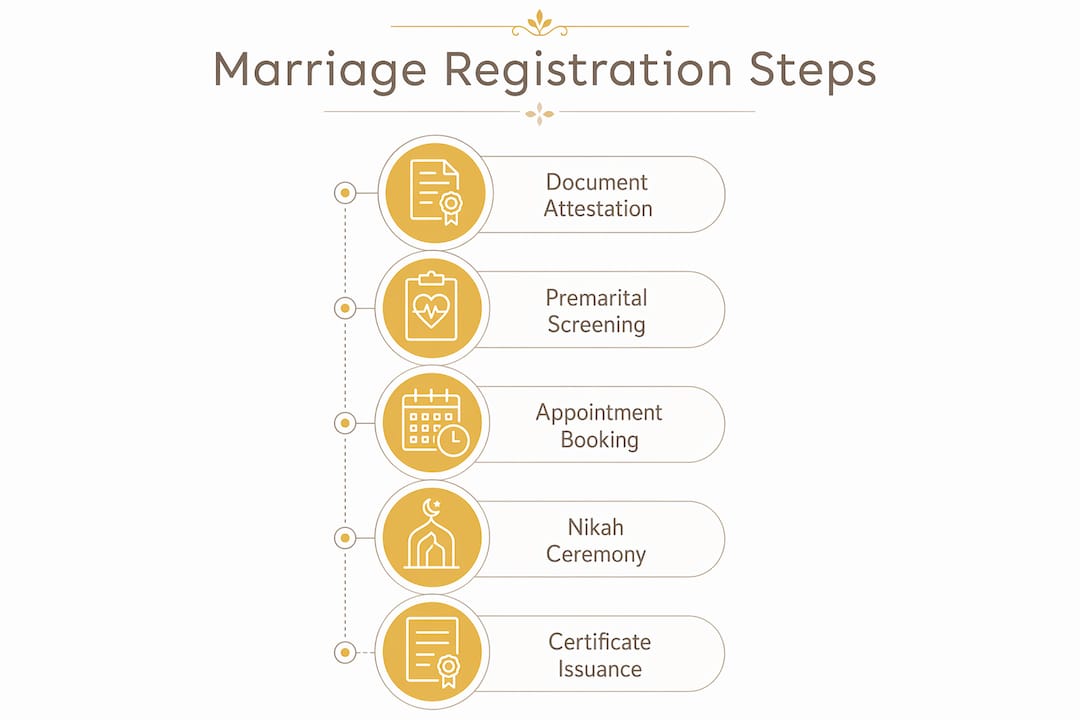
Gather and attest all documents as outlined in the documentation section above.
Book an appointment at the Sharia court in your emirate. Dubai couples use the Dubai Courts online portal. Abu Dhabi couples use the Abu Dhabi Judicial Department platform.
Submit documents at the court, including passports, visas, birth certificates, single status letters, and any divorce or death certificates.
Pay the registration fee. Fees vary by emirate but typically range from AED 100–300 for the basic registration.
Attend the Nikah session at the court, where a licensed cleric officiates the ceremony with witnesses present.
Receive your marriage certificate (Aqd Zawaj), issued in Arabic by the court.
Attest the marriage certificate through the UAE Ministry of Foreign Affairs if you need it recognized abroad.
Step | Location | Estimated Time |
Document attestation | Home country + UAE MOFA | 3–8 weeks |
Court appointment booking | Sharia court portal | 1–2 weeks |
Nikah and registration | Sharia court | 1 day |
Marriage certificate issuance | Sharia court | Same day or 3–5 days |
Certificate attestation for abroad | UAE MOFA | 3–7 business days |
The U.S. State Department notes that home country recognition of a foreign marriage depends entirely on that country’s own laws. Getting your UAE marriage certificate attested and then translated by a certified translator is the standard path for recognition in the U.S., UK, and most European countries.
Pro Tip: Request a certified English translation of your Arabic marriage certificate directly from the Sharia court or a UAE-licensed translation office. Many home country agencies will not accept a private translation.
What challenges do expats face and how can they avoid them?
Common issues during Islamic marriage registration include document delays, translation errors, and misunderstanding the difference between religious and civil recognition. Knowing these pitfalls in advance saves you weeks of back-and-forth.
The most frequent stumbling blocks:
Incomplete attestation chains: A document attested only by your home country’s notary is not enough. It needs the full chain: notary, foreign affairs ministry, UAE embassy, and UAE MOFA.
Expired single status letters: Many embassies issue these letters with a validity of three to six months. If yours expires before your court date, you start over.
Language barriers at the court: Sharia court proceedings are conducted in Arabic. Bring a licensed interpreter if you are not fluent, or work with a service provider who handles this for you.
Mismatched names across documents: Your name must appear identically on every document. A middle name on your passport but not your birth certificate will cause a rejection.
Expats must anticipate the dual challenge of complying with UAE regulations and ensuring their marriage is recognized in their home country, planning accordingly. Source: U.S. State Department
Choosing a reliable officiant matters more than most couples realize. Not every cleric in the UAE is licensed to conduct a Nikah that the Sharia court will register. Confirm that your officiant holds a valid license from the relevant emirate’s Islamic affairs authority before you book.
Pro Tip: Start your document collection at least three months before your target marriage date. Build in buffer time for embassy delays, courier issues, and attestation queues. Couples who start six weeks out almost always hit problems.
For expats weighing their options, the key Islamic marriage requirements page on Harrisandcharms covers the full eligibility checklist in detail, including nationality-specific variations that are easy to miss.
Key takeaways
A valid Islamic marriage for expats in the UAE requires Sharia-compliant ceremony elements, fully attested documents, and Sharia court registration to achieve legal recognition both in the UAE and abroad.
Point | Details |
Documentation is the foundation | Attest every foreign document through the full chain before your court appointment. |
Nikah has four legal pillars | Consent, Wali, Mahr, and witnesses are all required for a valid Islamic marriage contract. |
Registration is separate from ceremony | A religious Nikah must be registered at the Sharia court to carry legal weight in the UAE. |
Home country recognition needs extra steps | Attest and translate your UAE marriage certificate to secure recognition abroad. |
Start three months early | Document delays are the top reason expat marriages are postponed. |
What i’ve learned after years of helping expats marry in the UAE
The biggest misconception I see from expat couples is that the Nikah ceremony is the finish line. It is not. The ceremony is the beginning of the legal process, not the end. Couples arrive at the Sharia court having had a beautiful religious ceremony, only to discover their documents are incomplete or their single status letter expired two weeks ago. That moment is avoidable entirely with proper planning.
The second thing I have noticed is that expats underestimate how much the UAE’s system rewards preparation. Government offices here are efficient when you arrive with the right paperwork. The delays people complain about are almost always self-inflicted. Bring originals and copies of everything. Bring more than you think you need.
I also want to address the cultural side directly. Respecting the Wali requirement is not a bureaucratic formality. It is a meaningful part of the marriage contract in Islam, and approaching it with genuine respect rather than as an obstacle to manage makes a real difference in how smoothly the process goes. Judges who serve as Wali are experienced and professional, but they respond well to couples who come prepared and respectful.
My practical advice: use the Muslim marriage rules guide as your checklist, then layer in professional support for the attestation and court coordination. The couples who have the smoothest experience are the ones who treat this as a legal project with a clear timeline, not a wedding detail to sort out later.
— Harris
How Harrisandcharms makes your islamic marriage in the UAE simpler
Planning an Islamic marriage as an expat involves more moving parts than most couples expect. Harrisandcharms exists to handle exactly those moving parts, from document attestation and translation coordination to Sharia court appointment management and ceremony arrangement.
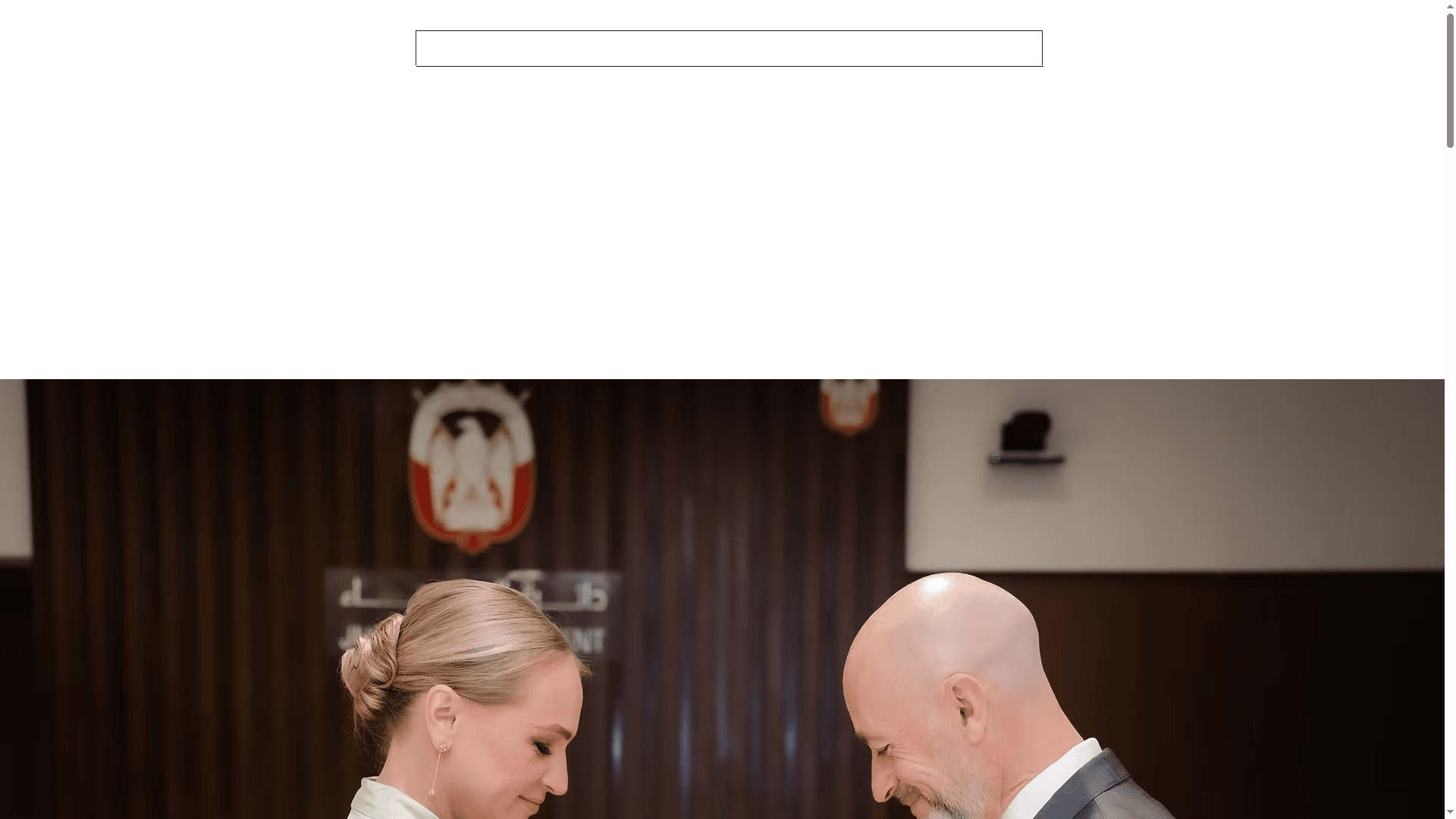
The team at Harrisandcharms has worked with expat couples from dozens of nationalities, which means they know the nationality-specific document quirks that trip people up. Whether you need a fully managed Islamic marriage package or targeted help with one stage of the process, their marriage service packages are built around what expats actually need. For couples who also want a civil ceremony, the civil wedding packages in Dubai cover both tracks under one roof. Reach out directly to start planning with a team that has done this before.
FAQ
What is the minimum age for islamic marriage in the UAE?
The UAE sets the minimum marriage age at 18 for both parties. A court may grant exceptions for younger individuals, but judicial approval is required.
Can a non-muslim expat have an islamic marriage in the UAE?
A non-Muslim man cannot marry a Muslim woman under UAE Sharia law. A non-Muslim woman (Christian or Jewish) may marry a Muslim man, provided all documentation and Sharia requirements are met.
How long does islamic marriage registration take for expats?
The court registration itself takes one day, but document attestation and appointment booking typically add three to eight weeks to the total timeline.
Does a UAE islamic marriage certificate work in other countries?
Recognition depends on your home country’s laws. Attesting your UAE marriage certificate through the UAE Ministry of Foreign Affairs and obtaining a certified translation is the standard path for international recognition.
Do expats need a premarital health screening to marry in the UAE?
The UAE’s genomic screening program currently focuses on Emirati nationals. Expats should confirm with their emirate’s health authority whether any screening applies to their specific case before scheduling their court appointment.
Recommended
Comments