
Marriage consent in UAE weddings: Essential 2026 guide


Planning a wedding in the UAE can feel overwhelming, especially when legal requirements seem unclear. Many couples, particularly expats, misunderstand what marriage consent truly means under UAE law. Some assume a simple signature suffices, while others worry about guardian approval or age restrictions. The reality is more nuanced. Consent is the cornerstone of both civil and Islamic marriages in the UAE, and getting it right ensures your union is legally valid. This guide clarifies exactly what marriage consent legal rules require for different marriage types in 2026, helping you navigate the process with confidence.
Table of Contents
Key takeaways
Point | Details |
Free and voluntary agreement | Marriage consent in the UAE requires explicit, voluntary agreement from both parties without coercion or duress. |
Different rules apply | Islamic marriages follow Sharia principles with Ijab and Qabul, while civil marriages use federal or Abu Dhabi regulations. |
Age and guardian matters | Legal age varies by marriage type, and Islamic weddings often require guardian consent for the bride. |
Witnesses validate consent | Both marriage types require witnesses to confirm the voluntary nature of consent. |
Consent remains essential | Mutual agreement cannot be overridden by external pressure and remains vital throughout the marriage process. |
Understanding marriage consent under UAE law
Marriage consent is the foundation of every valid marriage contract in the UAE. Under UAE law, consent means both parties freely and explicitly agree to marry without any coercion, duress, or improper conditions. This principle applies equally to Islamic marriages governed by Sharia and civil marriages regulated by federal statutes.
In the UAE, civil marriage consent requires explicit and voluntary agreement from both parties, free from coercion or duress, and must be given before a judicial authority or authorized registrar. For Islamic marriages, consent manifests through the traditional Ijab and Qabul, the offer and acceptance exchange that formalizes the union under Sharia principles. Without genuine mutual consent, no marriage contract holds legal validity.
The law protects individuals from forced marriages by requiring consent to be given freely. Courts rigorously examine whether consent was truly voluntary. A Fujairah court case illustrated this principle when a groom sued his fiancée over luxury wedding demands. The court dismissed his lawsuit, emphasizing that consent must be mutual and cannot be coerced through financial pressure or unreasonable conditions.
Several elements define valid consent in UAE marriages:
Both parties must possess full legal capacity and mental soundness
Agreement must be given voluntarily without external pressure or threats
Consent cannot include conditions that contradict Islamic principles or public policy
The agreement must be witnessed and documented according to legal requirements
Pro Tip: Always ensure your consent is documented properly before authorized officials. Verbal agreements alone may not satisfy legal requirements for marriage validity in the UAE.
“Marriage consent is not merely a formality but a fundamental right protecting individuals from unwanted unions. UAE law upholds this principle across all marriage types, ensuring personal autonomy in one of life’s most significant decisions.”
Understanding these foundational consent principles helps you approach your wedding with clarity about your legal rights and obligations.
Marriage consent requirements for Islamic weddings in the UAE
Islamic marriages in the UAE follow Sharia law, which establishes specific consent requirements rooted in religious tradition. The core of Islamic marriage consent lies in the Ijab and Qabul, the formal offer and acceptance exchanged between the bride and groom or their representatives. This ritual ensures both parties explicitly agree to the union.
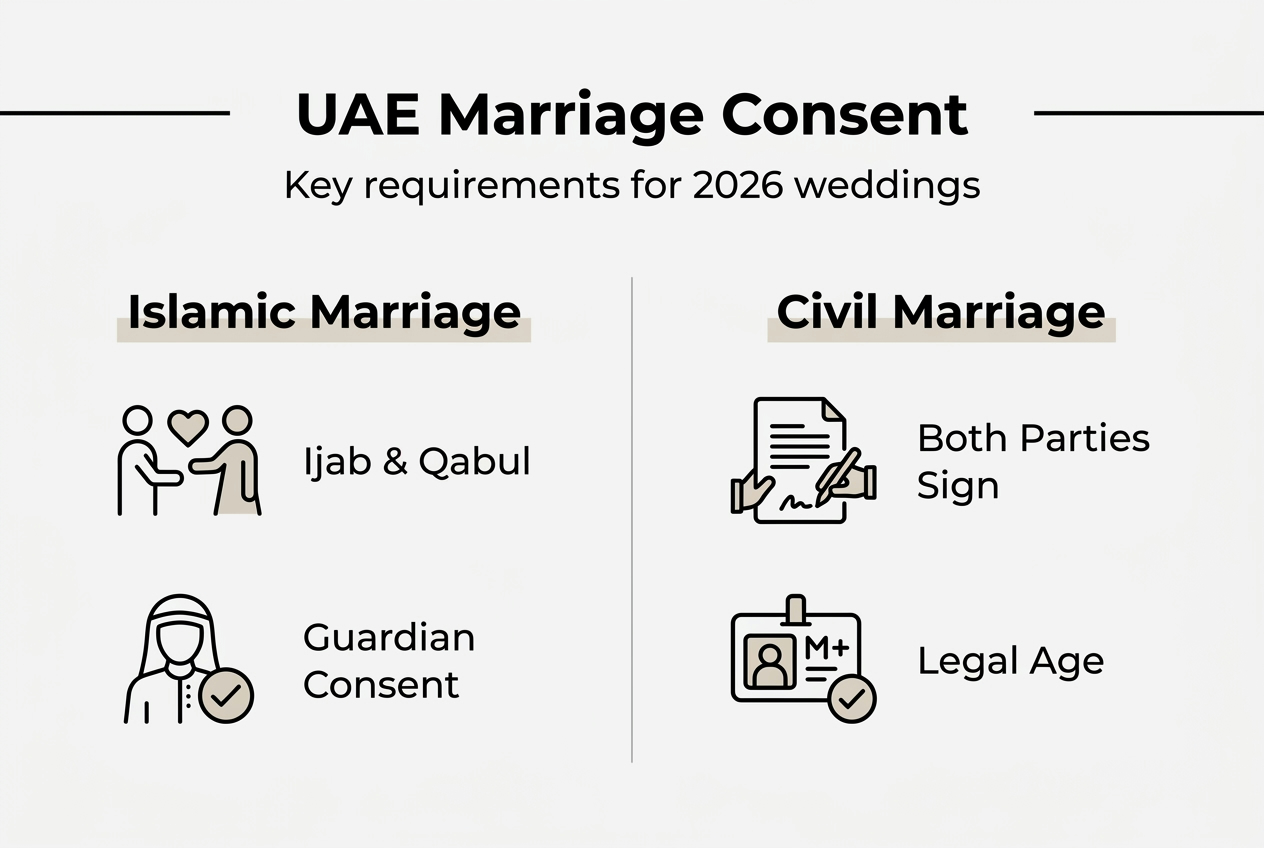
Sharia-based UAE marriage contract requirements include Ijab and Qabul, guardian consent, dowry and witness rules. The Ijab is the proposal, typically made by the bride’s guardian or the bride herself. The Qabul is the acceptance, usually spoken by the groom. Both must be stated clearly and unambiguously in the presence of witnesses.
Guardian consent adds another layer to Islamic marriage requirements. In most cases, the bride’s wali, usually her father or closest male relative, must consent to the marriage. This requirement stems from Islamic jurisprudence aimed at protecting the bride’s interests. However, if the guardian unreasonably withholds consent, the bride can seek judicial intervention to proceed with the marriage.

The dowry, or mahr, represents another essential element. The groom must offer a dowry to the bride, and she must accept it as part of the marriage contract. The amount is negotiated and agreed upon by both parties, symbolizing the groom’s commitment and the bride’s financial security.
Witness requirements complete the consent framework for Islamic weddings:
At least two male Muslim witnesses or one male and two female Muslim witnesses must be present
Witnesses must hear the Ijab and Qabul clearly
Witnesses confirm the voluntary nature of consent
Their presence validates the marriage contract under Sharia law
Pro Tip: Confirm guardian consent requirements early in your planning. Some Islamic schools of thought have different rules, and ensuring compliance prevents contract validity issues later.
Here’s a comparison of key consent elements between Islamic and civil marriages:
Element | Islamic Marriage | Civil Marriage |
Consent expression | Ijab and Qabul ritual | Signed declaration before authority |
Guardian involvement | Usually required for bride | Not required |
Dowry requirement | Mandatory (mahr) | Optional |
Witness count | Minimum two males or one male and two females | Varies by jurisdiction |
Religious authority | Islamic judge or authorized imam | Civil court judge or registrar |
Understanding these Islamic marriage requirements UAE ensures your wedding ceremony meets both religious and legal standards.
Consent in civil marriages for non-Muslims and expats
Civil marriages offer non-Muslim couples and expats an alternative pathway to legal marriage in the UAE. The consent requirements differ significantly from Islamic marriages, focusing on secular legal principles rather than religious traditions. Two main civil marriage frameworks exist: the federal pathway and the Abu Dhabi pathway.
Under the federal civil marriage system, consent must be given by individuals at least 21 years old, with full legal capacity, and free from prohibited degrees of kinship. Both parties must appear before a judicial authority to declare their voluntary agreement. The process emphasizes individual autonomy without requiring guardian approval.
In Abu Dhabi, civil marriage requires consent from both parties, with a minimum age of 18, and at least one party must be a non-citizen. This lower age threshold and residency flexibility make Abu Dhabi’s system particularly attractive to younger expat couples.
The civil marriage consent process follows these sequential steps:
Submit application to the competent court with required documents including passports, birth certificates, and proof of legal capacity
Attend pre-marriage counseling session if required by the jurisdiction
Appear jointly before the judge or authorized registrar for the consent declaration
Make explicit verbal confirmation of voluntary agreement to marry
Sign the marriage contract in the presence of witnesses and the officiating authority
Receive the official marriage certificate for legal registration
Pro Tip: Verify jurisdiction-specific consent rules before starting your application. Federal and Abu Dhabi requirements differ in age limits and documentation, and using the wrong pathway can invalidate your marriage contract.
Here’s how federal and Abu Dhabi civil marriage consent requirements compare:
Requirement | Federal Pathway | Abu Dhabi Pathway |
Minimum age | 21 years | 18 years |
Residency requirement | Both parties can be UAE residents | At least one must be non-citizen |
Guardian consent | Not required | Not required |
Witness requirement | Two witnesses | Two witnesses |
Authority | Federal court judge | Abu Dhabi family court |
Understanding these civil marriage requirements UAE and legal age for marriage UAE helps you choose the right pathway and prepare proper documentation.
Civil marriages also offer flexibility in applying foreign law to certain aspects of the marriage, provided it doesn’t conflict with UAE public order. This means couples can incorporate elements from their home country’s legal system while still obtaining UAE legal recognition.
Legal nuances and practical advice for couples on marriage consent
Beyond basic consent requirements, several legal complexities deserve your attention when planning a UAE wedding. Understanding these nuances prevents disputes and ensures your marriage starts on solid legal footing.
Prenuptial agreements present different challenges depending on your marriage type. Western-style prenuptial agreements have limited legal effect under Sharia-based personal status rules, but civil courts may apply foreign law chosen by spouses if it does not conflict with UAE public order. This means civil marriage couples have more flexibility in crafting prenuptial terms, while Islamic marriage couples must ensure their agreements align with Sharia principles.
The application of foreign law adds another layer of complexity. Non-Muslim couples can request that their home country’s laws govern financial aspects of their marriage, such as property division or inheritance. However, UAE courts retain the right to reject foreign law provisions that contradict fundamental public policy or Islamic principles.
Mutual consent extends beyond the initial agreement. Even after signing a marriage contract, both parties must continue to consent throughout the marriage process. A real-life example demonstrates this principle: when a bride withdrew her consent after her fiancé failed to meet agreed conditions, the court upheld her right to refuse, dismissing the groom’s lawsuit. This case reinforces that consent is ongoing, not a one-time formality.
Common pitfalls couples face regarding consent include:
Assuming verbal agreements suffice without proper documentation
Failing to verify guardian consent requirements for Islamic marriages
Not understanding age requirements for their chosen marriage pathway
Overlooking witness requirements or using unqualified witnesses
Including conditions in the marriage contract that contradict Sharia or public policy
Rushing the process without ensuring all parties genuinely consent
Pro Tip: Seek legal guidance early in your wedding planning. A qualified family law attorney can clarify consent terms specific to your situation, help draft compliant prenuptial agreements, and prevent costly disputes down the road.
Forced marriage protections deserve special mention. UAE law strictly prohibits forced marriages, and courts actively protect individuals from coerced unions. If you face pressure from family or others to marry against your will, you have legal recourse. Courts can invalidate marriages where consent was obtained through threats, violence, or undue influence.
The marriage consent nuances UAE legal framework also addresses capacity issues. Mental soundness and legal competence are prerequisites for valid consent. If either party lacks the mental capacity to understand the marriage commitment, the contract is void. This protection ensures vulnerable individuals are not exploited through invalid marriages.
Conflicts between religious and civil law occasionally arise. When they do, UAE courts generally prioritize Sharia principles for Muslim parties while allowing non-Muslims greater autonomy under civil frameworks. Understanding which legal system governs your marriage helps you navigate these potential conflicts.
Document everything. Keep copies of all consent-related paperwork, including guardian approvals, witness statements, and official marriage certificates. Proper documentation protects your rights and simplifies future legal processes, from visa applications to inheritance matters.
Why Harris & Charms makes your UAE wedding seamless
Navigating marriage consent requirements can feel overwhelming, especially when you’re balancing cultural expectations, legal formalities, and wedding dreams. That’s where expert guidance transforms stress into celebration.

Harris & Charms specializes in making UAE weddings effortless for couples like you. Whether you’re planning an Islamic ceremony with traditional consent rituals or a civil marriage under federal or Abu Dhabi law, we handle the complex documentation, coordinate with authorities, and ensure every consent requirement is properly met. Our team understands the nuances of guardian approvals, witness requirements, and jurisdiction-specific rules, so you don’t have to become a legal expert overnight. We’ve helped countless couples navigate these exact challenges, turning potential obstacles into smooth processes. From initial consultation to final certificate, we’re with you every step, ensuring your marriage is legally sound and beautifully celebrated. Let us handle the paperwork while you focus on your love story.
What common questions do couples have about marriage consent in the UAE?
What if one party withdraws consent after signing the marriage contract?
If either party withdraws consent after signing but before the marriage is finalized, UAE courts generally uphold the right to refuse. Marriage requires ongoing mutual consent, not just initial agreement. Courts have dismissed lawsuits from parties trying to force marriage completion when consent was withdrawn, emphasizing that consent must be maintained throughout the entire process until the marriage is legally registered.
Can a non-Muslim marry a Muslim in the UAE and what are the consent rules then?
Under UAE law, a Muslim woman generally cannot marry a non-Muslim man, while a Muslim man can marry a Christian or Jewish woman. When such marriages are permitted, they typically follow Islamic marriage requirements, including the consent framework of Ijab and Qabul, guardian involvement, and Sharia compliance. The non-Muslim party may need to provide documentation of their faith and agree to certain conditions regarding children’s religious upbringing.
What legal age must be met for valid consent in Islamic vs civil marriages?
Islamic marriages in the UAE generally require both parties to have reached puberty, though courts often set practical minimums around 18 for women and 21 for men. Civil marriages have clearer thresholds: the federal pathway requires both parties to be at least 21, while the Abu Dhabi pathway sets the minimum at 18. Understanding these UAE marriage consent rules helps ensure your marriage meets legal age requirements.
How is forced marriage consent treated under UAE law?
UAE law strictly prohibits forced marriages and provides robust protections for individuals facing coercion. Courts can invalidate any marriage where consent was obtained through threats, violence, or undue pressure. If you’re experiencing pressure to marry against your will, you can seek court protection, and judges will examine the circumstances carefully to ensure consent was truly voluntary before allowing any marriage to proceed.
Are prenuptial agreements recognized to address consent disputes?
Prenuptial agreements are recognized in the UAE, but their enforceability depends on your marriage type. Civil marriages offer more flexibility for Western-style prenuptial terms, provided they don’t violate UAE public order. Islamic marriages must ensure prenuptial conditions align with Sharia principles. Courts may apply foreign law chosen by non-Muslim spouses for financial matters, but Islamic marriage prenuptial terms cannot contradict fundamental Sharia rules regarding consent, rights, and obligations.
Recommended
Comments