
Marriage in GA: Legal Steps, Venues & 2026 Guide


TL;DR:
Marriage in Georgia requires a valid license from a probate court before the ceremony can occur, with specific age and residency rules. Couples can benefit from premarital education to lower license fees, and choosing the right venue type significantly impacts planning and logistics. Proper preparation, starting with legal documentation, ensures a smoother wedding experience in the diverse Georgia wedding landscape.
Marriage in Georgia is defined as a legally recognized union that requires a valid marriage license issued by a Georgia probate court before any ceremony can take place. Couples planning their wedding in the Peach State face a clear set of legal requirements covering age, residency, fees, and documentation. Beyond the paperwork, Georgia offers one of the most diverse wedding venue selections in the American South, from historic Atlanta mansions to North Georgia mountain farms. This guide covers every step you need, from the marriage license requirements GA couples must meet to the cultural traditions that make a Georgia wedding unforgettable.
What are the legal requirements for marriage in GA?
A Georgia marriage license is the legal document that authorizes your ceremony. Without it, no officiant can legally marry you, and no marriage certificate will follow. The license is issued by the probate court in the county where you apply, and the rules for where you apply depend on where you live.
Residency rules determine which county’s probate court you visit. If either applicant is a Georgia resident, you can apply at any county probate court in the state. If neither of you lives in Georgia, you must apply in the county where your ceremony will take place. This rule catches many destination wedding couples off guard, so confirm your county before booking your venue.
Fees are straightforward but vary slightly by county:
Standard license fee: approximately $66–$68
Reduced fee: approximately $16–$26 when you present a premarital education certificate
Payment: cash is often accepted, but bills larger than $20 are frequently refused at probate court windows
Credit cards are accepted at many counties, though a convenience fee may apply
Documents you will need at the probate court include government-issued photo ID and proof of age such as a birth certificate, passport, or driver’s license. Both applicants must appear in person. Georgia imposes no waiting period after the license is issued, so your ceremony can happen the same day if you choose.
Appointment vs. walk-in access differs by county. Some counties require an online application before your in-person visit, while others accept walk-ins. Check your specific county’s probate court website before you go.
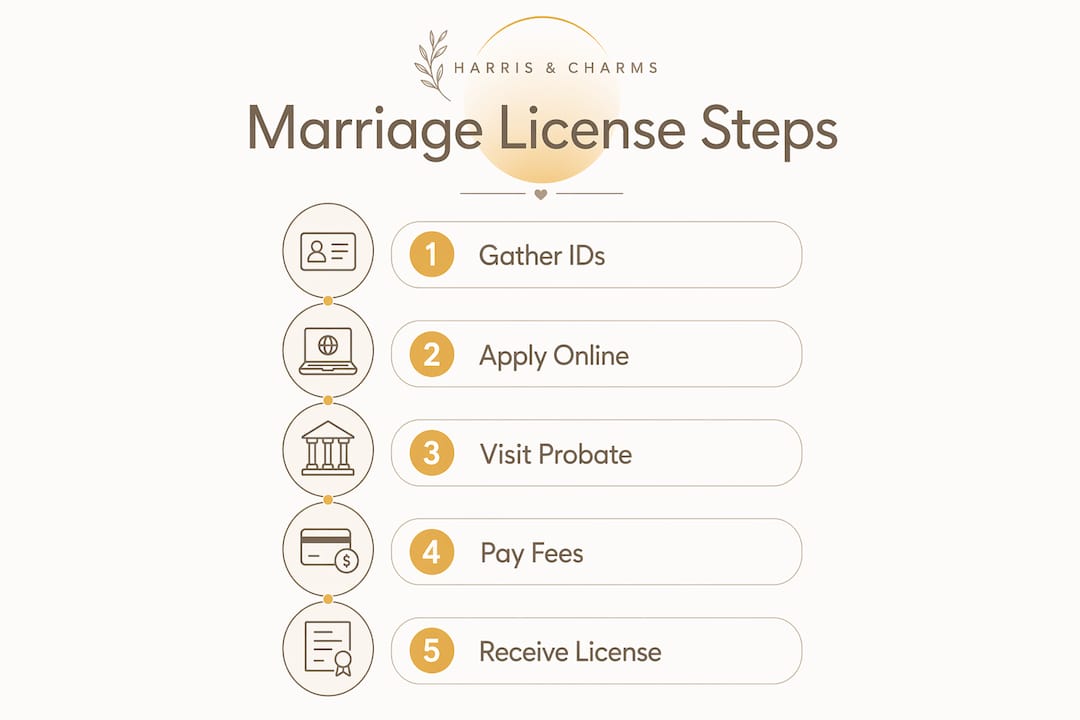
Pro Tip: Bring small bills and a debit card to the probate court. Many Georgia counties cap cash payments at $20 bills, and credit card convenience fees can add $3–$5 to your total.
One critical distinction every couple must understand: the marriage license and the marriage certificate are not the same document. The license authorizes the ceremony, while the certified marriage certificate is a separate document you must request after the ceremony. You will need the certificate for legal name changes, updating Social Security records, and other official purposes.
How do age laws and premarital education affect your wedding?
Georgia’s legal marriage age is 18. That is the standard, and it applies to the vast majority of couples. The state does allow one narrow exception for 17-year-olds, but the conditions are strict.
A 17-year-old may marry in Georgia only when all three of the following conditions are met:
The minor must have been legally emancipated for at least 15 days before applying for the license.
The age difference between the two applicants must be no more than four years.
Both applicants must complete a state-approved premarital education program before the license is issued.
No marriage is permitted for anyone under 17 in Georgia, with no exceptions. Family court reviews are part of the emancipation process, adding a legal safeguard against coercion or duress. These protections exist specifically to prevent forced marriages involving minors.
Premarital education is worth considering even if you are both well over 18. The course covers communication, conflict resolution, and financial planning as a couple. Completing it cuts your license fee from roughly $66 down to as low as $16, a saving of $40–$50. Beyond the financial benefit, research consistently shows that couples who complete structured premarital programs report stronger communication in the first years of marriage.
Pro Tip: Search for Georgia-approved premarital education providers through your county’s probate court website. Many programs are now offered online and can be completed in a single weekend.
What are the best wedding venue types in georgia?

Georgia offers diverse wedding venue styles that range from grand historic estates in Atlanta to intimate rustic farms in the Blue Ridge Mountains. That variety is one of the strongest reasons couples choose Georgia for destination weddings. Selecting the right venue type shapes everything from your guest experience to your vendor logistics.
Here is a breakdown of the most popular venue categories:
Historic Atlanta mansions and estates: Formal settings with built-in elegance, ideal for black-tie receptions and large guest lists
North Georgia mountain farms: Rustic, photogenic, and increasingly popular for fall weddings when foliage peaks
Countryside vineyard estates: Offer a relaxed atmosphere with on-site catering options
Lakeside and riverside venues: Strong for summer and spring ceremonies with natural backdrops
Urban event spaces in Savannah or Athens: Walkable locations with built-in accommodation options for out-of-town guests
Venue Type Comparison
Venue Type | Best Season | Typical Guest Capacity | Key Advantage |
Historic Atlanta mansion | Year-round | 100–300 | Formal elegance, city access |
North Georgia mountain farm | Fall, spring | 50–150 | Scenic views, rustic charm |
Vineyard estate | Spring, summer | 75–200 | On-site catering, relaxed feel |
Lakeside venue | Summer | 50–200 | Natural backdrop, outdoor ceremony |
Urban Savannah space | Year-round | 75–250 | Walkable, hotel proximity |
Choosing an all-inclusive venue in North Georgia is the single most effective way to reduce planning stress in remote areas. All-inclusive packages typically bundle catering, tables, chairs, lighting, and sometimes a day-of coordinator into one contract. That means fewer vendors to manage and fewer chances for a scheduling conflict on your wedding day.
Seasonal planning matters more in Georgia than many couples expect. North Georgia mountain venues can be cold in November and December, so climate control or tent heating becomes a real budget line. Fall foliage typically peaks in mid-October in the Blue Ridge area, making that window the most competitive and most expensive time to book.
What practical steps make GA wedding planning easier?
The difference between a smooth Georgia wedding and a stressful one almost always comes down to preparation on the legal and logistical sides. Start with the probate court, not the venue.
Verify your county’s specific process first. Probate court procedures vary across Georgia’s 159 counties. Some counties post their full application checklist online. Others require a phone call to confirm current requirements. Do this before you book anything else, because your venue county may have different rules than your home county.
Order your certified marriage certificate immediately after the ceremony. This is the step most couples delay and then regret. The marriage certificate is separate from the license and must be requested through the probate court. Processing times vary, and you will need it quickly if you plan to change your name or update financial accounts.
Common pitfalls couples miss during GA wedding planning:
Confusing the license with the certificate and assuming the officiant handles everything
Forgetting to check whether the chosen county requires an online pre-application
Arriving at the probate court with only large bills or a single payment method
Booking a remote North Georgia venue without confirming vendor availability in that area
Skipping premarital education and paying the higher license fee unnecessarily
Pro Tip: Request at least three certified copies of your marriage certificate when you order. Name change processes at the Social Security Administration, DMV, and your bank each require a separate certified copy.
Vendor logistics in rural Georgia require extra planning. A farm venue 90 minutes from Atlanta may not have reliable cell service, which affects your caterer’s coordination, your photographer’s timeline, and your guests’ navigation. Build buffer time into every vendor arrival window and share printed directions with all vendors in advance.
Key takeaways
Legal marriage in Georgia requires a probate court license, specific age and residency compliance, and a separate certified certificate request after the ceremony to establish full legal proof of marriage.
Point | Details |
License is mandatory | Apply at a Georgia probate court before your ceremony; no license means no legal marriage. |
Residency determines county | Georgia residents apply anywhere in the state; non-residents apply in the ceremony county. |
Fee savings are real | Complete a premarital education course to reduce your license fee by up to $50. |
Certificate is separate | Request certified marriage certificate copies immediately after the ceremony for legal name changes. |
Venue type drives logistics | All-inclusive venues in North Georgia reduce vendor coordination stress in remote areas. |
What i’ve learned from watching couples plan georgia weddings
Most couples I speak with focus almost entirely on the venue before they have touched a single legal requirement. That order of operations creates real problems. I have seen couples fall in love with a North Georgia farm venue, book it, and then discover that the county’s probate court requires an online pre-application they were not aware of. That kind of surprise two weeks before a wedding is avoidable.
My strongest recommendation is to treat the probate court visit as your first wedding task, not your last. Confirm the county’s specific process, gather your documents, and get the license handled early. Georgia’s no-waiting-period rule is a genuine advantage. Use it by applying a few days before your ceremony rather than scrambling the morning of.
On venues: the all-inclusive model is underrated. Couples often think they are paying a premium for convenience, but when you add up the individual vendor contracts, the coordination time, and the risk of a single vendor cancellation affecting everything else, the all-inclusive package frequently costs less in total. And it almost always costs less in stress.
Premarital education is the most overlooked item in Georgia wedding planning. The fee reduction is nice. The skills are better. Couples who go through a structured program before their wedding tend to handle the stress of the day itself more calmly, because they have already practiced communicating under pressure.
Georgia’s wedding landscape is genuinely one of the most varied in the South. You can have a formal black-tie reception in Atlanta or a barefoot ceremony on a mountain farm two hours away. That range is a gift. Use it intentionally, not just aesthetically.
— Harris
How Harrisandcharms supports couples through every step
Planning a wedding involves more moving parts than most couples anticipate, from legal documentation to vendor coordination to post-ceremony paperwork. Harrisandcharms specializes in making that process manageable. Whether you need guidance on civil wedding documentation or full-service event planning support, the team brings hands-on experience to every stage of your wedding journey.

Harrisandcharms offers tailored packages that cover legal compliance, ceremony coordination, and documentation processing so you can focus on the experience rather than the paperwork. For couples who want professional support from license application through certified certificate ordering, explore the full range of wedding and marriage services available through Harrisandcharms. The goal is simple: fewer surprises, more celebration.
FAQ
What documents do i need for a georgia marriage license?
Both applicants must present a government-issued photo ID and proof of age such as a birth certificate or passport. Both parties must appear in person at the probate court.
How long is a georgia marriage license valid?
A Georgia marriage license does not expire once issued. There is no waiting period, so your ceremony can take place on the same day you receive the license.
What is the difference between a marriage license and a marriage certificate in georgia?
The license authorizes the ceremony, while the certified marriage certificate is a separate document issued after the ceremony that serves as legal proof of marriage for name changes and official records.
Can non-georgia residents get married in georgia?
Yes. Non-residents can legally marry in Georgia, but they must apply for their license in the county where the ceremony will take place rather than any county of their choosing.
Does completing premarital education lower the marriage license fee in georgia?
Completing a state-approved premarital education course reduces the license fee to approximately $16–$26, compared to the standard fee of $66–$68 without the certificate.
Recommended
Comments