
Muslim marriage in the UAE: legal steps and wedding guide

TL;DR:
Planning a Muslim marriage in the UAE requires official registration through Sharia courts to ensure legal recognition and rights. The process involves eligibility verification, obtaining a premarital medical certificate, conducting the Nikah ceremony, and registering the marriage with proper attestation for international validity. Proactive preparation and professional support significantly reduce delays and streamline the journey to a legally recognized union.
Planning a Muslim marriage in the UAE involves far more than booking a venue and choosing flowers. Many couples are genuinely surprised to discover that Muslim marriages are governed by Sharia-based personal status rules, and that legal registration through the correct channels is what makes a marriage officially recognized. Without this, even the most beautiful ceremony carries no legal weight. This guide walks you through every stage, from understanding the Sharia legal structure to securing your final attested certificate, specifically for couples navigating this process in the UAE.
Table of Contents
Understanding Sharia marriage and legal structures in the UAE
Essential requirements and eligibility for a Muslim marriage
Post-marriage certification, legalities, and using your marriage certificate
The realities of planning a Muslim marriage in the UAE: Lessons no one tells you
Comprehensive wedding services and legal support for Muslim marriages in the UAE
Key Takeaways
Point | Details |
Legal workflow is critical | Sharia marriage in the UAE requires careful attention to legal eligibility, approved documentation, and registration steps. |
Interfaith marriages have barriers | Interfaith marriages often face strict requirements, and Muslim women can only marry non-Muslim men if conversion is proven and certified. |
Premarital certificates cause delays | Premarital medical certificates from approved UAE facilities are the most common hurdle for timely registration. |
Post-marriage attestation needed | Official marriage certificates must often be attested and translated for legal use abroad or for residency purposes. |
Expert help streamlines the process | Relying on dedicated marriage service teams can reduce legal risk and ensure all ceremony and documentation needs are met. |
Understanding Sharia marriage and legal structures in the UAE
The UAE operates a dual legal system for marriage. Civil marriages exist for non-Muslims, but for Muslims, whether Emirati citizens or expatriates, the process falls entirely under Sharia law. This is not optional. Muslim marriages in the UAE must be registered through approved Sharia channels to carry any legal standing, including rights related to inheritance, spousal visa sponsorship, and child custody.
This matters for expatriate Muslim couples just as much as it does for Emirati nationals. A marriage conducted in a private setting or through a religious ceremony alone, without formal Sharia court registration, will not be recognized by UAE government authorities. That means no family book entry, no visa sponsorship rights, and no official record of the union.
Here is a quick comparison of how Muslim marriages differ from civil marriages in the UAE:
Feature | Muslim marriage (Sharia) | Civil marriage |
Governing law | Sharia personal status law | Civil Marriage Law (Non-Muslims) |
Applicable to | All Muslims in UAE | Non-Muslims only |
Solemnized by | Licensed Sharia officiants | Court-appointed civil registrar |
Registration authority | Sharia courts or licensed bodies | Abu Dhabi Court / Dubai Courts |
Witnesses required | Yes (two male Muslim witnesses) | Yes (two adult witnesses) |
Marriage contract | Islamic Nikah contract | Civil contract |
The core workflow for any Muslim marriage in the UAE involves three broad stages. First, confirming eligibility and preparing documentation. Second, completing the ceremony and Nikah contract through a licensed Sharia channel. Third, registering the marriage and obtaining the official certificate.
“Sharia law forms the legal basis for every Muslim marriage in the UAE. Registration through the appropriate Sharia channels is not a formality. It is the mechanism that converts a religious event into a legally recognized union.”
For couples seeking detailed guidance on navigating the Sharia legal structure, reviewing Muslim marriage rules UAE before starting any paperwork is strongly recommended. You can also explore the full Sharia court marriage guide to understand procedural specifics before your first appointment.
Essential requirements and eligibility for a Muslim marriage
Now that the legal framework is clear, it is important to understand the specific eligibility rules and contract requirements couples must meet before the ceremony can proceed.
At the heart of every Islamic marriage contract are two elements: ijab (the offer) and qabul (the acceptance). These must be spoken clearly and in the presence of witnesses. According to established Sharia marriage contract principles, both parties must also have legal capacity, meaning they are of sound mind, of legal age, and not already in a marriage that would prevent them from contracting another. Additional conditions written into the contract are permitted, but they must not violate Sharia principles.
Here is a summary of the standard eligibility requirements:
Both parties must be of legal marriage age as recognized under UAE law
The groom must be Muslim; for the bride, there are specific interfaith rules (see below)
Two adult Muslim male witnesses must be present at the contract signing
The bride’s wali (guardian) is typically required to be present or to provide documented consent
Proof of single or divorced status must be submitted for both parties
Valid government-issued identification (Emirates ID or passport) is required for both parties
Interfaith marriages are a particularly sensitive area under UAE Sharia law. A Muslim man may marry a Christian or Jewish woman under certain conditions. However, a Muslim woman cannot marry a non-Muslim man unless he provides certified documentation of his conversion to Islam, as interfaith marriage under UAE Sharia law makes it impossible to proceed without specific conversion documentation when the Muslim spouse is female. This rule is not flexible within the Sharia framework.
The conversion documentation itself must come from a recognized Islamic authority in the UAE, not simply a letter from a mosque abroad. Many couples in interfaith situations underestimate how formal this requirement is and approach the Sharia court without the right paperwork, which leads to immediate rejection of their application.
Here is a simplified eligibility comparison for interfaith scenarios:
Scenario | Eligible under UAE Sharia? | Key requirement |
Muslim man + Muslim woman | Yes | Standard Nikah requirements |
Muslim man + Christian or Jewish woman | Conditional | Depends on jurisdiction and documentation |
Muslim woman + non-Muslim man | Not eligible by default | Man must provide certified conversion proof |
Muslim woman + converted man | Yes (with documentation) | Certified conversion certificate required |
Pro Tip: If you are in an interfaith situation, consult a Sharia legal advisor before booking any ceremony date. Getting clarity on your specific scenario early can save weeks of delay and considerable frustration. Review the UAE Muslim marriage rules resource for interfaith-specific guidance before your first meeting.
Step-by-step Sharia marriage process: What to expect
Once eligibility and requirements are understood, couples should follow a clear sequence of steps to ensure legal recognition and minimize bureaucratic delays. Skipping even one step or submitting an incomplete document can send the entire process back to square one.
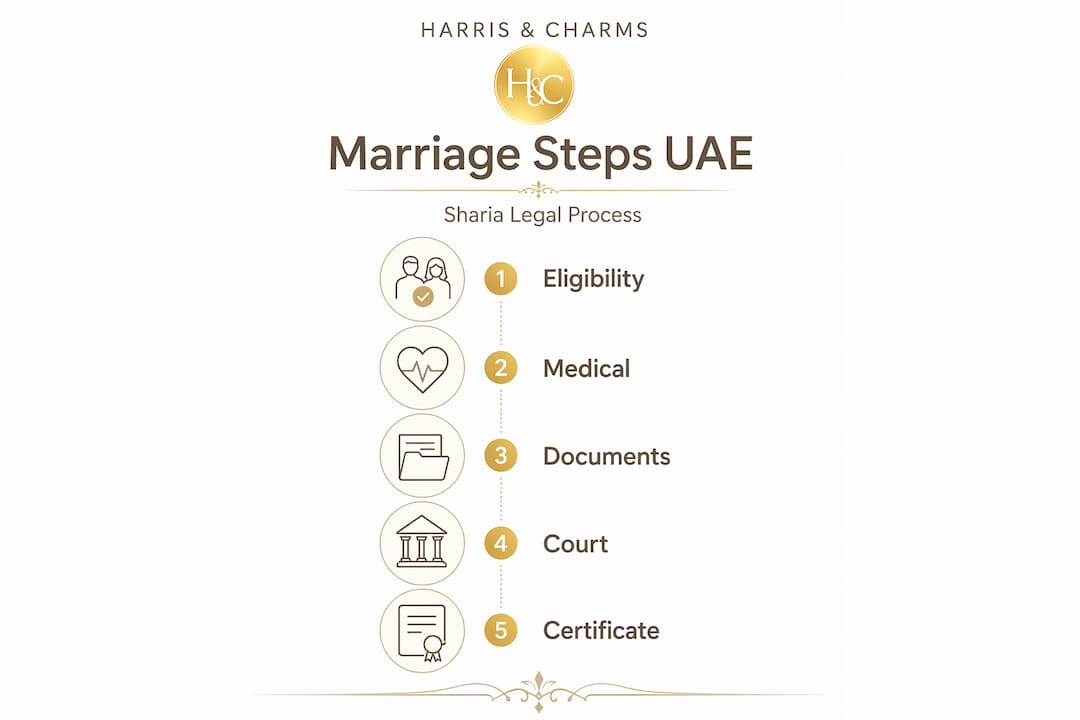
Confirm eligibility and gather documents. Start by collecting valid passports or Emirates IDs, proof of marital status (original divorce certificate or death certificate of a previous spouse if applicable), and letters of no objection from employers or embassies if required.
Complete premarital medical screening. This is one of the most frequently overlooked requirements and also the most common source of delays. Both parties must complete a premarital medical certificate from a UAE government-approved health center. Private clinics that are not on the approved list will not have their results accepted.
Schedule and attend the Nikah ceremony. The ceremony must be conducted by a licensed Sharia officiant. Both parties, the wali (for the bride), and two Muslim male witnesses must be present. The Nikah contract is signed at this stage.
Submit documentation for Sharia court registration. Following the ceremony, all signed documents are submitted to the relevant Sharia court or authorized registration body. This typically involves presenting the original Nikah contract, medical certificates, and identity documents.
Receive the official marriage certificate. Once reviewed and approved, the marriage certificate is issued. This is your official, legally recognized document. Processing time varies but typically takes a few business days after submission.
According to documented experience with marriage registration in the UAE, obtaining valid medical documentation from an approved facility is consistently the biggest operational hurdle for couples, often because they attend a non-approved clinic or miss a required test.
“The premarital certificate is not just a health formality. It is a legal prerequisite, and the facility you use must be on the government-approved list. Using an unapproved clinic is one of the most avoidable delays in the entire process.”
For a fully detailed breakdown of each registration step, the Islamic marriage registration steps guide covers every checkpoint you will encounter. You can also find a broader overview of the complete Islamic marriage process and a practical legal marriage step-by-step guide to cross-reference your progress.
Pro Tip: Book your premarital medical appointment at least two to three weeks before your intended marriage date. Some approved health centers have waiting times, and results must be available before the Sharia court will accept your registration application.

Post-marriage certification, legalities, and using your marriage certificate
After successfully registering your marriage, here is what you need to know about official documentation and international usage.
Your UAE marriage certificate is a powerful legal document inside the country, but using it internationally for visa applications, residency processes, or family reunification purposes almost always requires additional steps. Specifically, it typically needs to be attested and sometimes translated.
Attestation is the process of having your document officially verified by a chain of government authorities, starting at the UAE Ministry of Foreign Affairs and International Cooperation (MOFA) and then continuing through the relevant embassy or consulate of the destination country. The process for attesting a marriage certificate in Dubai follows a specific sequence, and skipping any step means the document will be rejected abroad.
Here is what the standard post-marriage documentation process looks like:
Obtain the original certified marriage certificate from the Sharia court
Have the certificate notarized if required by the destination country
Submit for MOFA attestation in the UAE
Present the attested document to the relevant embassy or consulate for their own authentication stamp
In some cases, have a certified translation prepared by a UAE-licensed legal translator
This process is especially relevant for couples where one spouse is sponsoring the other for a UAE residency visa. Immigration authorities require an attested marriage certificate, not just the original. Understanding legal validity abroad for your certificate is critical before you begin any visa or relocation process.
According to official UAE marriage and divorce statistics covering 2022 to 2024, thousands of marriages are registered annually in Dubai alone, which means Sharia courts and attestation offices process significant volumes. Understanding the process and having your documentation in order helps you move through more efficiently.
Pro Tip: Request multiple certified original copies of your marriage certificate from the Sharia court at the time of issuance. Different countries often require original copies, not photocopies, for their embassy attestation process. Getting extras upfront saves weeks of effort later. The UAE marriage attestation guide and the full marriage certificate process overview are both essential reading before you begin this stage.
The realities of planning a Muslim marriage in the UAE: Lessons no one tells you
Most couples come to us after spending weeks going in circles because they assumed the process would be intuitive. It is not. And the honest truth is that most guides, including official government pages, tell you what is required but not how the reality of executing those steps actually feels.
Here is what we see repeatedly. Couples underestimate the timeline. They assume they can book a ceremony date first and sort paperwork later. This works in reverse. Your premarital medical certificate, your apostille or NOC from your home country, your witness arrangements, all of that must be in place before the date is confirmed. Booking the ceremony first is the number one reason couples end up postponing.
Mixed-nationality and interfaith couples face an additional layer of scrutiny. Authorities are thorough. Document formatting matters. Translation quality matters. A document that was accepted by an embassy in London may not satisfy the Sharia court’s requirements in Dubai without additional certification. This is not bureaucratic pettiness. It is how the system protects legal rights, yours included.
The other thing nobody says clearly enough: the emotional cost of delays is real. When paperwork hits a wall, it does not just delay the wedding. It delays visa applications, housing arrangements, and sometimes employment situations for the relocating spouse. We have seen couples separated for months because the attestation chain was broken at one link.
The good news is that almost all of these delays are preventable with the right support. Proactively gathering government-approved paperwork, understanding exactly what each authority requires, and working with experienced professionals for the Islamic registration guidance phase removes most of the risk. Outsourcing attestation and legal coordination to specialists, especially for international documents, is not a luxury. For most couples, it is the difference between a smooth process and months of frustrating back-and-forth.
Comprehensive wedding services and legal support for Muslim marriages in the UAE
Planning a Muslim marriage in the UAE is manageable when you have the right team behind you. At Harris & Charms, we have guided hundreds of couples through exactly what this article describes, from initial eligibility checks and premarital screening logistics through to Sharia court registration and post-marriage attestation.
Our approach is built around removing the bureaucratic burden so you can focus on the celebration itself. Whether you need Dubai Muslim marriage packages that cover ceremony coordination and legal filing, or you are looking for broader UAE marriage services including venue management, photoshoots, and document processing, we handle the complexity on your behalf. The Harris N Charms wedding team works with specialist partners for visa processing and international attestation so that no step in your journey is left unmanaged. Reach out today to begin your personalized consultation.
Frequently asked questions
What documents are required for a Muslim marriage in the UAE?
You typically need Emirates IDs or passports, premarital medical certificates from an approved facility, and proof of marital status for both parties. Interfaith cases and non-resident couples require additional documentation as governed by Sharia-based personal status rules.
Can a Muslim woman marry a non-Muslim man in the UAE?
Not by default under Sharia law. As interfaith marriage rules in the UAE make clear, the non-Muslim man must provide certified documentation of his conversion to Islam issued by a recognized UAE Islamic authority before the marriage can proceed.
What is the biggest cause of delay for registering a Muslim marriage in the UAE?
The most consistent cause of delay is the premarital medical certificate, specifically when couples attend a clinic not on the government-approved list. Marriage registration delays in UAE are overwhelmingly tied to documentation issues rather than the ceremony itself.
Can you use a UAE Muslim marriage certificate abroad for visas or family purposes?
Yes, but it must first be attested through the correct chain including MOFA and the relevant embassy, and sometimes translated by a licensed UAE legal translator. The Sharia registration requirements are the foundation, but international use requires additional verification steps.
Recommended
Comments