
Nikah Day in the UAE: Your Complete Planning Guide


TL;DR:
A valid nikah is the Islamic marriage contract that makes two people husband and wife upon signing.
Couples must fulfill religious requirements like offer, acceptance, mahr, witnesses, and a wali, along with UAE legal registration.
Nikah day is the Islamic marriage contract ceremony that makes two people husband and wife the moment the contract is signed. The nikah, which is the recognized term for this religious union, is not a prelude to marriage. It is the marriage. Everything else, including the walima feast and the reception party, comes after. Couples planning their nikah day in the UAE face a dual requirement: satisfying Islamic law and meeting UAE civil registration standards. This guide covers both, from the religious essentials to the practical steps that make your ceremony legally recognized.
What are the religious and legal requirements for a valid nikah day?
A valid nikah rests on four non-negotiable elements: offer and acceptance (ijab and qabul), agreed mahr, qualified witnesses, and in most schools of thought, a wali (guardian). Miss any one of these, and the contract is not valid under Islamic law.
The offer and acceptance must happen in a single sitting, with both parties giving clear, uncoerced consent. The groom states his acceptance; the bride or her wali states the offer. The exchange must be explicit and witnessed.
Mahr is a mandatory gift from the groom to the bride. It is not symbolic. Mahr must be agreed upon and recorded before the contract moment to guarantee the marriage’s religious validity and legal recognition in the UAE. Couples often choose a combination of prompt mahr (paid immediately) and deferred mahr (paid later), but both amounts must be specified in writing.
Witness requirements vary by school of thought. The Maliki, Shafi’i, and Hanbali schools require both a wali and two male witnesses. The Hanafi school requires two witnesses but does not mandate a wali for an adult woman. Knowing your school of thought before the ceremony prevents last-minute confusion.
UAE legal registration adds a separate layer. The Islamic marriage process in the UAE requires couples to submit documents including passports, residency visas, and in some cases a certificate of no impediment from the home country. The ceremony must be conducted or registered through an authorized court or licensed officiant.
Gather valid passports and Emirates ID cards for both parties
Obtain a no-objection letter or certificate of no impediment if required by your nationality
Confirm your wali’s documentation if he is traveling from abroad
Register the nikah contract with the UAE’s relevant authority after the ceremony
Keep a certified copy of the signed contract for visa and residency applications
Pro Tip: Start your paperwork at least eight weeks before your planned nikah date. UAE government offices have processing timelines that do not bend for ceremony schedules.
What is the typical ceremony flow on nikah day?
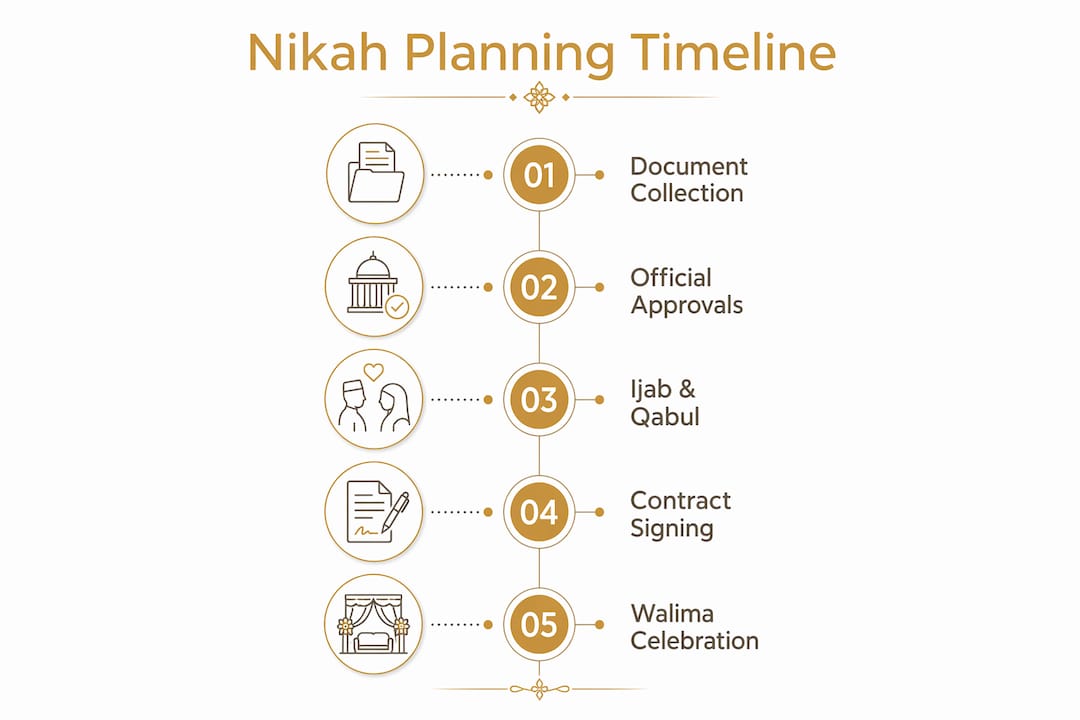
The nikah ceremony sequence follows a clear order that most scholars agree on, regardless of cultural background. The ceremony can be completed in under an hour when properly prepared.
Qur’an recitation. The ceremony opens with selected verses, commonly from Surah Al-Baqarah and Surah An-Nisa, which address marriage, rights, and responsibilities.
Khutba (sermon). The officiant delivers a brief sermon on the purpose of Islamic marriage, the rights of spouses, and the couple’s responsibilities to each other and to God.
Mahr confirmation. The agreed mahr is stated aloud and confirmed by both parties in front of witnesses. This step is not optional.
Ijab and qabul. The offer and acceptance are exchanged. This is the moment the marriage is established. The room goes quiet. It matters.
Witness confirmation. The witnesses formally confirm they heard and understood the exchange.
Contract signing. Both parties, the wali, and the witnesses sign the nikah contract document.
Du’a (supplication). The officiant leads a closing prayer for the couple’s happiness, health, and a blessed life together.
The nikah ceremony can be held anywhere from a mosque office to a private home. Location does not affect validity. What matters is that the required people are present and the required words are spoken.
Pro Tip: Ask your officiant to walk through the ijab and qabul wording with both parties the day before. Nerves are real, and a rehearsal prevents stumbling through the most important sentence of the ceremony.

How do couples in the UAE celebrate nikah day and walima?
The nikah contract and the walima feast are two separate events with different religious standings. Nikah is the contract; walima is the celebratory feast held afterward as a sunnah practice. Confusing the two leads couples to over-invest in the party and under-prepare for the contract.
Walima should be held within seven days after the nikah. Its size and format are flexible. Some couples hold an intimate dinner the same evening. Others plan a larger reception the following weekend. Both are acceptable.
Feature | Nikah ceremony | Walima celebration |
Religious status | Obligatory contract | Strongly recommended sunnah |
Timing | Scheduled by couple and officiant | Within seven days of nikah |
Minimum attendees | Wali and two witnesses | Open to family and friends |
Location flexibility | Mosque, home, court, hotel | Banquet hall, hotel, yacht, garden |
Dress code significance | Modest and appropriate | Formal or cultural attire |
UAE couples typically separate the nikah and walima by at least one day. This gives the couple time to recover, change venues, and welcome a wider guest list to the celebration. Hotels in Dubai and Abu Dhabi frequently offer dedicated Islamic wedding packages that cover both events.
Non-Muslim guests are welcome at the walima; some families also invite them to witness the nikah with prior arrangement
Traditional Emirati customs include serving dates and Arabic coffee immediately after the nikah signing
Many couples in the UAE incorporate henna nights (laylat al-henna) the evening before the nikah
Photography and videography are common at both events, though some families prefer women-only photography during the nikah
What practical planning steps should couples follow for a smooth nikah?
Nikah planning in the UAE works best when you treat the legal registration and the ceremony as two parallel tracks that must both finish on time. Letting one fall behind delays the other.
Start legal paperwork first. Contact the relevant UAE authority or a licensed marriage service at least eight weeks out. Check the legal steps and requirements for your specific nationalities, since expat couples often need additional documents from their home countries.
Select and confirm your officiant. A licensed Islamic marriage officiant (ma’dhun) must conduct or witness the ceremony for it to be legally recognized in the UAE. Book early, especially around Ramadan and Eid periods when demand spikes.
Schedule around prayer times. Fridays hold special significance in Islamic tradition and are a popular choice for nikah ceremonies. Avoid scheduling the contract exchange during the five daily prayer times to respect the congregation and your guests.
Document the mahr in writing. Both the prompt and deferred amounts must appear in the signed contract. A verbal agreement is not sufficient for UAE legal purposes.
Confirm witness eligibility. Witnesses must be adult Muslim males in most schools of thought. Confirm their availability and their own documentation if they are expats.
Book venues for both events separately. The nikah venue needs privacy and quiet. The walima venue needs capacity and catering. These are different requirements.
Planning milestone | Recommended timeline |
Begin legal document collection | 8–10 weeks before nikah |
Book officiant and witnesses | 6–8 weeks before nikah |
Confirm mahr amount in writing | 4–6 weeks before nikah |
Submit registration paperwork | 3–4 weeks before nikah |
Finalize walima venue and catering | 4–6 weeks before walima |
Confirm all attendees and logistics | 1–2 weeks before nikah |
Pro Tip: Hire a professional coordinator who specializes in Islamic marriages in the UAE. They know which documents each emirate requires and can flag problems before they become delays.
Key Takeaways
A valid nikah requires correct execution of the contract elements first. Celebration comes after.
Point | Details |
Contract is the marriage | The nikah signing is the marriage itself; walima and receptions are celebrations held afterward. |
Four essentials for validity | Ijab and qabul, agreed mahr, witnesses, and a wali (depending on school) are all required. |
Mahr must be documented | Record both prompt and deferred mahr amounts in writing before the contract is signed. |
UAE requires dual compliance | Couples must satisfy both Islamic law and UAE civil registration requirements for full legal recognition. |
Start paperwork early | Begin document collection at least eight weeks before the ceremony to avoid delays. |
What I’ve learned from planning nikah days in the UAE
The single biggest mistake I see couples make is treating the nikah like a formality before the real event. They spend months on the walima venue and two weeks on the contract paperwork. Then they discover a missing document or an unqualified witness the week before the ceremony.
The contract is the marriage. The party is the party. When you internalize that distinction, your planning priorities shift immediately. The officiant, the mahr documentation, and the witness eligibility move to the top of the list. The centerpieces move to the bottom.
I also see couples underestimate how much the UAE’s legal layer adds to the timeline. Expat couples in particular often need documents attested from two or three countries. That process takes time. The planning effort should prioritize correct execution of the contract elements above everything else.
The good news is that a valid, beautiful nikah does not require a large budget or a grand venue. I have seen deeply moving ceremonies in a simple office with four people present. Simplicity is not a compromise. For many couples, it is the point.
— Harris
How Harrisandcharms supports your nikah day in the UAE
Planning a nikah in the UAE involves more moving parts than most couples expect. Harrisandcharms handles both the legal documentation and the event coordination so you can focus on the ceremony itself.

Harrisandcharms offers tailored civil and Islamic marriage packages in Dubai that cover document processing, officiant coordination, venue management, and legal registration compliance. Whether you are an Emirati couple or an expat navigating a cross-border marriage, the team manages the paperwork timeline and flags requirements specific to your nationalities. For couples who want full-service support, the comprehensive marriage services include photoshoots, walima planning, and attestation assistance through partner companies.
FAQ
What is the difference between nikah and walima?
Nikah is the Islamic marriage contract that legally and religiously unites the couple. Walima is the celebratory feast held afterward as a sunnah practice, typically within seven days of the nikah.
Is a wali required for a valid nikah?
It depends on the school of thought. The Maliki, Shafi’i, and Hanbali schools require a wali; the Hanafi school requires witnesses but not a wali for an adult woman. Confirm the requirement with your officiant based on your school.
Does the nikah need to be registered in the UAE to be legally valid?
Yes. The religious contract alone is not sufficient for UAE civil purposes. Couples must complete legal registration through the appropriate UAE authority to have the marriage recognized for residency, visa, and legal matters.
Can the nikah ceremony be held outside a mosque?
Yes. The nikah can be held in a home, hotel, court, or any private space. Location does not affect the contract’s validity as long as the required participants are present.
How far in advance should couples start planning their nikah in the UAE?
Start at least eight weeks before the ceremony date. Expat couples who need documents attested from abroad should allow ten to twelve weeks to account for international processing times.
Recommended
Comments