
Online Nikah in the UAE: Your 2026 Legal Guide


TL;DR:
Online nikah in the UAE involves a remote Islamic marriage ceremony combined with official registration. Couples must comply with both Sharia and civil requirements, including certified officiants, witnesses, and proper documentation. Proper attestation and registration are essential for legal recognition and rights within the UAE.
Online nikah is the practice of conducting an Islamic marriage ceremony remotely through live video platforms, combining Sharia-compliant religious rites with legally binding formalities recognized by UAE authorities. For couples separated by distance, or those who want a faster path to a valid Islamic union, the digital nikah process offers a real and structured option. The UAE’s official eZawaj system and strict Sharia requirements mean this is not a casual workaround. It is a formal process with defined steps, required documents, and legal consequences that every couple must understand before proceeding.
What legal and religious requirements must couples meet for an online nikah?
A valid online nikah in the UAE requires meeting both Islamic law and UAE civil requirements simultaneously. Neither set of rules is optional, and skipping either one creates a marriage that is either religiously void or legally unenforceable.
Under Sharia law, four elements are non-negotiable:
Consent (Ijab and Qabul): Both the bride and groom must give clear, verbal consent during the live ceremony.
Wali (guardian): The bride’s male guardian must be present and give his approval. Remote presence via video is accepted in many jurisdictions, but his participation is mandatory.
Two witnesses: Two adult Muslim male witnesses must observe the ceremony in real time. They cannot review a recording after the fact.
Mahr (dower): A agreed-upon gift from the groom to the bride must be declared and accepted during the ceremony.
On the civil side, UAE couples must use the eZawaj platform, which is the UAE Ministry of Justice’s fully digital system for legal marriage processing compliant with Sharia law. This system is distinct from private online nikah services. A ceremony conducted through a private platform alone does not produce a state-recognized marriage in the UAE.
Required documents typically include valid passports or Emirates IDs for both parties, a no-objection letter if applicable, and proof of the wali’s identity. Non-Muslim converts may need additional documentation confirming their faith.

Pro Tip: Verify that your chosen Imam or Qazi holds credentials recognized by UAE religious authorities before booking. An uncertified officiant can invalidate the entire ceremony.
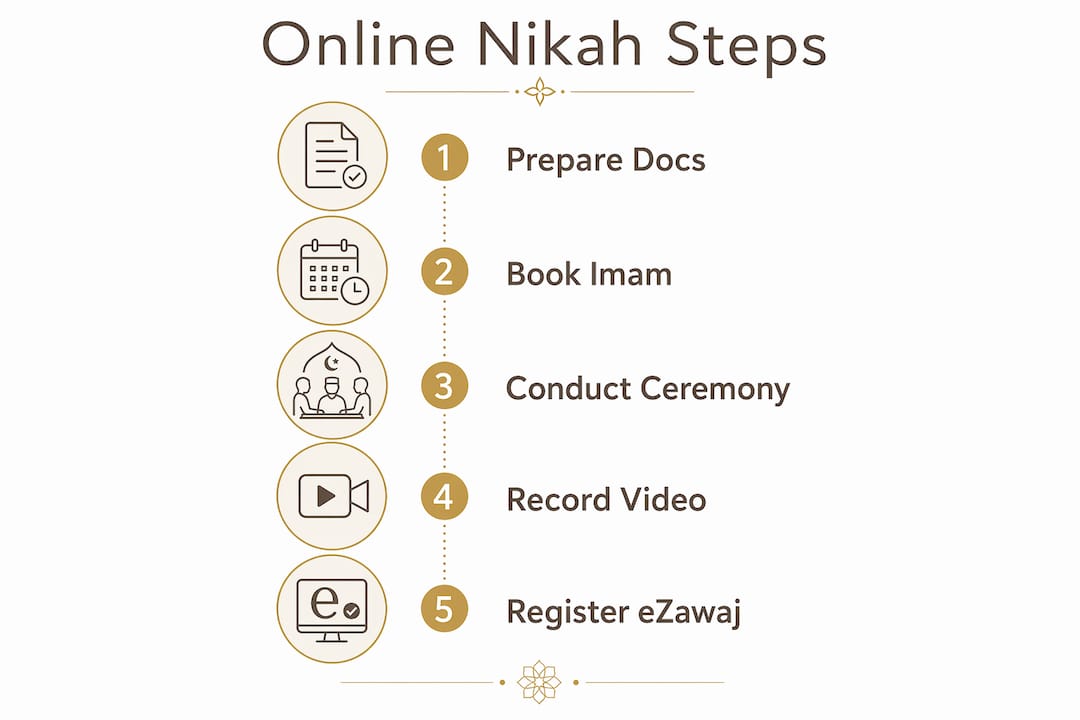
How to conduct the online nikah ceremony step by step
The actual ceremony follows a structured sequence. Rushing any step creates gaps that can cause problems during registration.
Book a certified officiant. Select an Imam or Qazi whose credentials are recognized by the relevant religious authority. Confirm they have experience conducting remote ceremonies and can issue valid documentation afterward.
Schedule and verify identities. All parties, the bride, groom, wali, and two witnesses, must join the video call. Identity verification happens at the start of the session. Each person presents their ID or passport on camera.
Conduct the ceremony. The Imam leads the session. The groom makes the offer (Ijab), and the bride accepts (Qabul). The mahr amount is declared and agreed upon. Both parties must respond clearly and without coercion.
Sign documents electronically. After the verbal ceremony, electronic documents are signed by all parties. The session is typically recorded as an additional evidentiary record.
Receive the religious certificate. The Imam issues a nikah certificate immediately or within a short processing window. This document is your primary proof of the religious ceremony.
Prepare for registration. Gather all signed documents, the certificate, and identity records. These go directly into the UAE registration process or international authentication chain, depending on where the ceremony was conducted.
The technical side matters more than most couples expect. A dropped connection during the Ijab and Qabul exchange can create a dispute about whether consent was properly given. Test your internet connection, use a wired connection if possible, and have a backup device ready.
Pro Tip: Record the session with all parties’ consent and store the file securely. UAE family courts have accepted video recordings as supporting evidence in marriage validity disputes.
How to register and legalize your online nikah with UAE authorities
The religious ceremony and the legal registration are two separate events. Completing the ceremony without registering it leaves you without inheritance rights, custody protections, or the ability to sponsor a spouse’s visa.
The UAE Ministry of Justice’s eZawaj system is the primary mechanism for legal marriages in the UAE, and it is fully digital as of 2026. Couples submit their documents through the platform, and the system processes the official government marriage certificate. The table below outlines the key registration stages.
Stage | Action required | Outcome |
Pre-registration | Submit IDs, nikah certificate, and wali consent | Application approved for processing |
eZawaj submission | Upload all documents to Ministry of Justice portal | Government marriage certificate issued |
Certificate collection | Download or collect official certificate | Legally recognized marriage record |
Attestation (if needed) | MOFA attestation for international use | Certificate valid for foreign authorities |
The difference between religious and civil registration is significant. A nikah certificate from an Imam proves the religious ceremony happened. The eZawaj-issued government certificate is what UAE immigration, courts, and employers recognize. You need both documents for full legal standing.
Post-ceremony documentation affects visa sponsorship, inheritance claims, and child custody rulings. Couples who skip registration often discover the gap only when they need legal protection, which is the worst possible time to find out.
Pro Tip: Start the eZawaj registration within 30 days of the ceremony. Delays can require additional declarations or re-verification of witnesses, adding weeks to the process.
How do international online nikah certificates get recognized in the UAE?
Couples who conducted their nikah abroad, particularly in Pakistan, face an additional authentication chain before their marriage is recognized in the UAE.
In Pakistan, a legally valid online nikah requires solemnization by an authorized Nikah Khawan, with proper witnesses, followed by registration with the local Union Council and upload to the NADRA Computerized Marriage Registration Certificate (CMRC) system. The NADRA CRMS integrates digital marriage registrations nationwide, which means overseas Pakistanis can complete the process remotely with full legal enforceability. Without that state registration, the marriage lacks legal protection for inheritance, child custody, and travel rights.
For UAE recognition, a Pakistani online nikah certificate must pass through a specific authentication chain:
MOFA attestation in Pakistan (Ministry of Foreign Affairs)
UAE Embassy legalization in Islamabad or Karachi
UAE MOFA counter-attestation after arrival in the UAE
Missing any authentication step renders the certificate invalid for residence or visa purposes in the UAE. This is not a technicality. UAE immigration and family courts apply this requirement strictly.
The contrast between UAE and Pakistani processes is worth noting. UAE couples using eZawaj complete registration within a single government system. Pakistani couples conducting a remote nikah must navigate two countries’ bureaucracies before their marriage carries full legal weight in the UAE. The 2026 expat document guide from Harrisandcharms covers the attestation workflow in detail for couples managing cross-border documentation.
Many advertised online nikah services are only partially virtual. Fully virtual issuance and ceremonies without any in-person step remain rare globally, and the ease of conducting a remote ceremony does not exempt couples from strict evidentiary and attestation requirements for legal federal recognition in the UAE and abroad.
Key Takeaways
A valid online nikah in the UAE requires both a Sharia-compliant ceremony with a certified Imam and official registration through the UAE Ministry of Justice’s eZawaj system to carry full legal weight.
Point | Details |
Religious requirements | Wali, two witnesses, mahr, and clear verbal consent are all mandatory for a valid nikah. |
eZawaj registration | The UAE Ministry of Justice platform is the only route to a state-recognized marriage certificate. |
International authentication | Foreign nikah certificates need MOFA attestation and UAE Embassy legalization before UAE courts accept them. |
NADRA for Pakistani couples | Pakistan-based online nikahs must be registered with the Union Council and NADRA CRMS to be legally enforceable. |
Post-ceremony urgency | Register within 30 days of the ceremony to avoid delays in visa, custody, and inheritance processes. |
What I’ve learned from helping couples navigate online nikah in the UAE
The single biggest mistake I see couples make is treating the nikah ceremony as the finish line. The ceremony is the beginning of a legal process, not the end of one. Couples who complete a beautiful, emotionally meaningful virtual ceremony and then wait months to register it often find themselves in a difficult position when they need to apply for a spouse visa or update official records.
The second misconception I encounter regularly is the belief that any Imam with a video call setup can conduct a legally recognized online nikah in the UAE. The officiant’s credentials matter enormously. An Imam who is not recognized by UAE religious authorities produces a certificate that private parties may accept but government systems will not.
I also want to be direct about something the marketing around online nikah services rarely mentions: the process is not as simple as booking a video call. The documentation requirements, the witness protocols, and the registration steps require attention and follow-through. Couples who approach it casually tend to create problems that take months to fix.
What gives me confidence in recommending the digital nikah process is that, when done correctly, it is genuinely valid and genuinely convenient. The eZawaj system is well-designed. The authentication chains for international certificates are clear, if demanding. Technology in 2026 makes remote identity verification reliable enough that courts accept it. The process works. It just requires you to take every step seriously.
My practical advice: work with a service that handles both the ceremony coordination and the post-ceremony documentation. Separating those two functions between different providers creates gaps in accountability that couples pay for later.
— Harris
How Harrisandcharms supports your marriage documentation in the UAE
Harrisandcharms works with UAE couples at every stage of the marriage process, from ceremony coordination to legal documentation and attestation. Whether you need support with an Islamic marriage package or the civil registration steps that follow your online ceremony, the team handles the paperwork so you can focus on the milestone itself.
Harrisandcharms offers civil wedding packages in Dubai designed to cover both the ceremonial and legal sides of marriage in one place. For couples who need a broader range of support, the full marriage services page covers Islamic and civil packages, document processing, and attestation coordination. Every package is built around UAE legal requirements, so nothing falls through the cracks after your ceremony is complete.
FAQ
What is an online nikah?
An online nikah is an Islamic marriage ceremony conducted remotely via live video, with all required parties present digitally. It is valid under Sharia law when conducted with a certified Imam, a wali, two witnesses, and clear verbal consent.
Is online nikah legally recognized in the UAE?
A remote nikah ceremony alone is not sufficient for UAE legal recognition. Couples must register their marriage through the UAE Ministry of Justice’s eZawaj platform to receive an official government marriage certificate.
What documents are needed for an online nikah in the UAE?
Required documents typically include valid passports or Emirates IDs for both parties, the wali’s identification, and the nikah certificate issued by the officiating Imam. Additional documents may apply depending on nationality.
Can overseas Pakistanis conduct a legally valid online nikah?
Yes. Overseas Pakistanis can solemnize a legally enforceable online nikah remotely through an authorized Nikah Khawan, with registration completed via the Union Council and NADRA CRMS system.
How do I get my foreign nikah certificate recognized in the UAE?
Foreign nikah certificates require MOFA attestation in the country of origin, UAE Embassy legalization, and UAE MOFA counter-attestation. Skipping any step makes the certificate unacceptable to UAE immigration and family courts.
Recommended
Comments