
UAE Divorce Court: Your 2026 Legal Process Guide


TL;DR:
UAE divorce courts operate on two tracks: Sharia for Muslims and civil for non-Muslims, with different procedures and timelines. Civil cases tend to be faster and have joint custody as the default, while Sharia cases require mandatory reconciliation and slower processes. Expats can choose to apply their home country’s laws if they provide proper documentation early in the process.
UAE divorce court is the judicial system where marriage dissolutions are adjudicated under either Sharia or civil law, depending on the parties’ religion and legal preferences. The UAE operates a dual-track divorce system governed by two separate federal laws: Federal Decree-Law No. 41 of 2024 for Muslims and Federal Decree-Law No. 41 of 2022 for non-Muslims. Understanding which track applies to your situation determines your timeline, your rights, and your costs before you file a single document.
What are the key steps in the UAE divorce court process?
The divorce process in UAE courts follows a defined sequence, but the exact steps differ based on which legal track applies to you. Both paths begin with case registration, then move through hearings, and conclude with a court-issued divorce judgment.
For Muslim couples, the process runs through these stages:
Register the case at the Family Guidance Section attached to the relevant court. Both parties submit identification, the marriage certificate, and a statement of grounds.
Attend the Family Guidance Committee. This committee attempts reconciliation over a mandatory 60-day period. Any settlement reached here is legally binding once signed, so arrive with clear goals.
Proceed to the family court if reconciliation fails. The judge reviews evidence, hears both parties, and may schedule multiple hearings for contested matters.
Receive the divorce judgment. The court issues a formal decree covering divorce, custody, and financial arrangements.
For non-Muslim couples, the path is shorter. Civil courts, including the Abu Dhabi Civil Family Court, allow direct filing without the Family Guidance Committee stage. Civil courts may issue judgment at the first hearing without mediation delays. That is a significant time advantage.
Typical timelines reflect this difference. Uncontested civil cases resolve in 1–3 months. Contested cases, whether under civil or Sharia tracks, can run 6–12 months or longer. The contested timeline extends when asset disputes, custody disagreements, or missing documentation slow proceedings.

Pro Tip: Prepare a complete file before your first court appearance. Missing documents are the single most common reason for hearing postponements, and each delay adds weeks to your timeline.
How do Sharia-based and civil divorce tracks differ?
The two divorce tracks in the UAE share the same end goal but operate under fundamentally different rules. Knowing the differences helps you choose the right court and set realistic expectations.
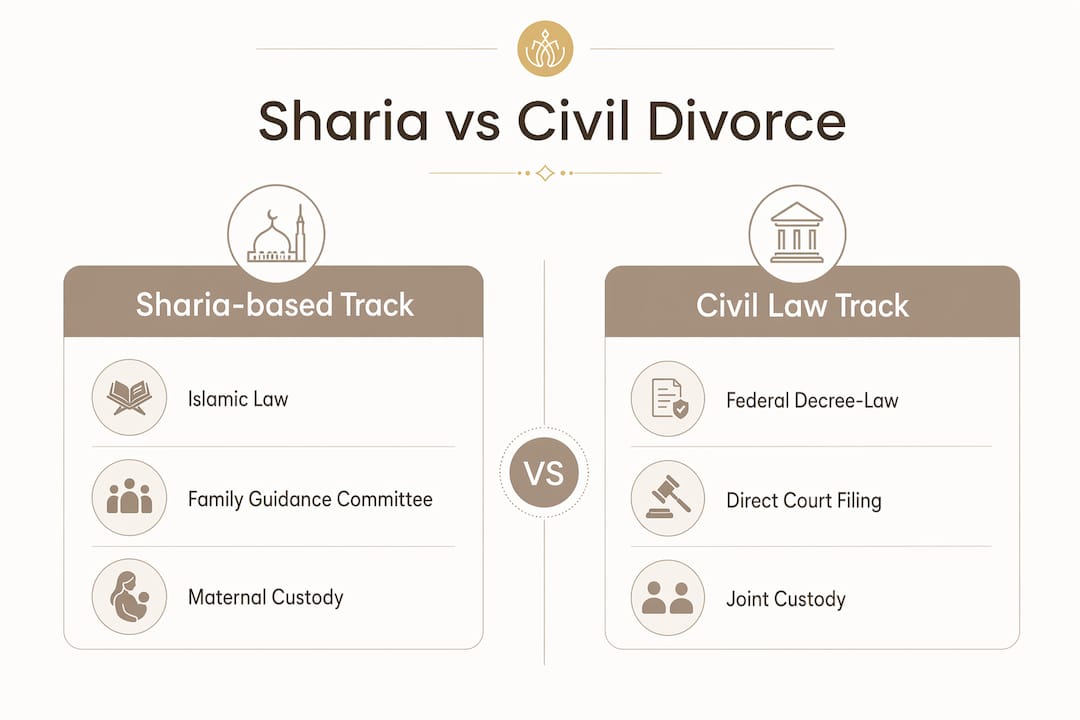
Factor | Sharia-based track | Civil law track |
Governing law | Federal Decree-Law No. 41 of 2024 | Federal Decree-Law No. 41 of 2022 |
Reconciliation requirement | Mandatory 60-day Family Guidance Committee | |
Court language | Arabic | English and Arabic (bilingual) |
Custody default | Mother preference until age 11 (historically) | |
Fault requirement | Grounds required in most cases | No-fault divorce available |
Typical speed | Slower due to mediation stages | Faster, possible at first hearing |
The Abu Dhabi Civil Family Court is the flagship venue for non-Muslim cases. It operates with specialized secular judges and bilingual proceedings, which removes a major barrier for expats who do not speak Arabic. The court applies the civil personal status law directly, without routing cases through religious frameworks.
Custody outcomes represent the sharpest difference between the two tracks. Under the civil regime, joint custody is now the default for non-Muslims, replacing the prior Sharia preference where mothers retained custody until a child reached age 11. This reform requires both parents to submit detailed parenting plans. Courts use those plans to structure post-divorce arrangements, so vague or incomplete plans invite future disputes.
One factor that surprises many expats: you may be able to apply your home country’s divorce laws in UAE courts. Expats can elect their home country’s laws when filing if they provide proof of nationality and domicile. That choice can significantly alter custody outcomes and asset division, so it requires early legal advice, not a last-minute decision. For a deeper look at how court selection affects your case, the guide on choosing a UAE marriage court covers the strategic considerations for expats in detail.
What does divorce cost at a UAE family court?
Cost is one of the first questions people ask, and the range is wide enough to require careful financial planning. Court filing fees alone run AED 1,500–5,000 depending on the emirate and case type. Legal fees add substantially more.
For uncontested civil divorces, legal fees range AED 8,000–18,000. That figure covers straightforward cases where both parties agree on all terms. Contested divorces are a different category entirely. Complex contested cases can exceed AED 150,000 when asset disputes, business valuations, or international custody battles are involved.
Hourly billing is common among senior family law specialists. Rates for experienced lawyers run AED 1,500–3,500 per hour at 2026 market rates. That means a single contested hearing with preparation can cost AED 10,000 or more in legal fees alone.
Key cost drivers include:
Number of hearings. Each additional hearing adds lawyer time and court fees.
Asset complexity. Real estate, business interests, and offshore accounts require expert valuations.
Custody disputes. Child welfare reports and guardian ad litem appointments add cost.
Fixed-price vs. hourly billing. Fixed packages offer cost certainty for simple cases; hourly billing suits complex matters where scope is unpredictable.
Pro Tip: Ask your lawyer for a written cost estimate broken into stages before signing a retainer. Contested divorce costs escalate quickly, and knowing the financial exposure early helps you decide whether negotiated settlement is more practical than full litigation.
Contested cases also require upfront retainers. Lawyers handling complex divorce matters typically request substantial retainers before filing, reflecting the time commitment involved. Budget conservatively and treat the lower estimates as best-case figures, not guarantees.
What rights do spouses and children have during UAE divorce proceedings?
UAE divorce law provides specific protections for spouses and children, and those rights apply from the moment proceedings begin, not just after a final judgment.
Financial rights for wives include:
Moral compensation (Nafket Motaa). A wife divorced against her will can claim moral compensation covering up to one year of expenses. This is a recognized right under UAE family law, not a discretionary award.
Retention of personal belongings. Divorced wives retain ownership of all personal property brought into or acquired during the marriage.
Housing during Iddah. The husband is legally required to provide housing for the wife during the Iddah period (the post-divorce waiting period under Islamic law). Courts enforce this obligation.
Rights related to children include:
Joint custody as the default under civil law for non-Muslim families.
Court-enforced child support, with amounts set based on the father’s income and the child’s documented needs.
Travel restrictions on children during proceedings. Courts routinely issue travel bans to prevent one parent from relocating a child before custody is resolved.
Pro Tip: Document all shared assets and your financial contributions to the household before filing. Courts rely heavily on documented evidence, and gaps in your records weaken your position on both alimony and property claims.
Non-Muslim couples benefit from the civil law’s clearer framework on joint custody. The shift away from age-based maternal preference means fathers have stronger standing than under the prior system. That said, courts still evaluate the best interests of the child as the primary standard. A well-drafted parenting plan, covering school decisions, medical authority, and holiday schedules, carries significant weight in the judge’s final order. For context on how civil personal status law shapes these rights, the overview of non-Muslim marriage law in the UAE provides useful background.
Key takeaways
The UAE divorce court system operates on two distinct legal tracks, and choosing the right one early determines your timeline, costs, and outcomes.
Point | Details |
Dual-track system | Muslims follow Sharia-based courts; non-Muslims use the civil law track under Federal Decree-Law No. 41 of 2022. |
Timeline varies widely | Uncontested civil cases resolve in 1–3 months; contested cases can run 6–12 months or longer. |
Costs scale with complexity | Uncontested legal fees start at AED 8,000; contested cases can exceed AED 150,000. |
Joint custody is now the default | Civil law replaced maternal preference with joint custody for non-Muslims, requiring detailed parenting plans. |
Home country law is an option | Expats can apply their home country’s divorce laws in UAE courts with proper documentation and early legal advice. |
What I’ve learned from watching people navigate UAE divorce courts
Most people walk into the UAE divorce court process thinking the hardest part is the emotional side. The emotional side is hard. But the cases that go badly wrong almost always fail on preparation, not feelings.
The single most common mistake I see is choosing the wrong court track. A non-Muslim couple who defaults to a Sharia-based court because they married under Islamic rites can face a longer, more procedurally complex process than they needed. The civil law track exists precisely to give non-Muslims a faster, more predictable path. Knowing the differences between civil and Islamic marriage frameworks before you file changes the entire outcome.
The Family Guidance Committee stage catches Muslim couples off guard more than any other step. People arrive at that session without clear goals, get pressured into agreements they later regret, and then discover those agreements are legally binding. Preparation for that session is not optional. It is the most consequential meeting in the entire process.
For expats, the home country law option is genuinely underused. Many people do not know it exists until they are already deep into proceedings. By then, the strategic window has closed. Early legal counsel, ideally before filing, is the only way to evaluate whether applying your home country’s laws serves your interests better than UAE law.
The financial reality also surprises people. Contested divorces are expensive. Not “uncomfortable” expensive. Genuinely disruptive to long-term financial plans. If settlement is possible, it is almost always cheaper and faster than full litigation. Courts in the UAE are efficient, but efficiency does not eliminate cost when both parties are fighting over assets and custody.
— Harris
How Harrisandcharms supports your family legal journey in the UAE
Harrisandcharms specializes in civil marriage services across the UAE, with deep knowledge of the legal frameworks that govern both marriage and family law proceedings.

Whether you are starting fresh after a divorce or planning a civil marriage with full legal clarity from day one, Harrisandcharms offers tailor-made civil marriage packages designed for residents and expats alike. The team understands UAE personal status law, documentation requirements, and the court processes that affect your legal standing as a couple. Getting the legal foundation right at the start protects you at every stage that follows. Reach out to Harrisandcharms directly to discuss your situation and find the right path forward.
FAQ
What is the UAE divorce court system?
The UAE divorce court system operates on two tracks: Sharia-based courts for Muslims under Federal Decree-Law No. 41 of 2024, and civil courts for non-Muslims under Federal Decree-Law No. 41 of 2022. Each track has distinct procedures, timelines, and custody rules.
How long does the divorce process in UAE take?
Uncontested civil divorces typically resolve in 1–3 months. Contested cases, whether civil or Sharia-based, can take 6–12 months or longer depending on asset disputes and custody complexity.
How do I file for divorce in UAE as an expat?
Non-Muslim expats file directly with the civil family court, such as the Abu Dhabi Civil Family Court, without going through the Family Guidance Committee. One party must have domicile or work presence in the UAE to establish jurisdiction.
What does divorce cost in UAE courts?
Legal fees for uncontested civil divorces range AED 8,000–18,000. Contested cases can exceed AED 150,000. Court filing fees add AED 1,500–5,000 on top of legal costs.
Can I use my home country’s divorce laws in the UAE?
Yes. Expats can elect their home country’s laws when filing in UAE courts by providing proof of nationality and domicile. This choice affects custody arrangements and asset division, so it requires early legal advice before filing.
Recommended
Comments