
Wedding Preparing in the UAE: Your 2026 Complete Guide


TL;DR:
Wedding planning in the UAE involves organizing legal, logistical, and cultural steps compliant with local laws and traditions.
Preparing legal documents early and booking venues 12 to 18 months in advance are essential for smooth wedding execution.
Wedding preparing in the UAE is the process of organizing all legal, logistical, and cultural steps needed to hold either a civil or Islamic ceremony that complies with local laws and traditions. The UAE’s legal framework now supports both religious and civil marriage options, making it one of the most accessible destinations for expat and interfaith couples in the region. Getting the documentation right from the start separates a smooth ceremony from a stressful one. Prenuptial agreements, for example, require mirror agreements combining foreign documents with UAE-compliant instruments for legal validity. Harrisandcharms has guided hundreds of couples through exactly this process.
What legal documents are required for civil and Islamic weddings in the UAE?
The documents you need depend on whether you are pursuing a civil or Islamic marriage, and your nationality adds another layer to that requirement. Getting this step wrong delays everything else, so treat documentation as the foundation of your entire plan.
Civil marriage requirements
Non-Muslim civil marriage in the UAE is contract-based and legally valid across all emirates without religious authority involvement. That makes it the preferred path for interfaith and expat couples. The civil marriage certificate is legally binding throughout the UAE regardless of the emirate where it is issued.
Standard documents required for civil marriage include:
Valid passports for both parties
UAE residency visas or entry permits
Birth certificates (attested and translated into Arabic)
Certificate of no impediment or single status certificate from your home country
Divorce decree or death certificate if either party was previously married
Two witnesses with valid identification
Islamic marriage requirements
Islamic marriage, known as a Nikah, requires religious authority approval and follows Sharia law. The groom must provide a Mahr (dowry), and the bride’s wali (male guardian) must be present or formally represented. Witnesses are mandatory, typically two adult Muslim males. The Muslim wedding process also requires registration with the relevant emirate’s Islamic affairs authority after the ceremony.
Document | Civil Marriage | Islamic Marriage |
Valid passport | Required | Required |
Single status certificate | Required | Required |
Religious authority approval | Not required | Required |
Wali (guardian) presence | Not required | Required |
Mahr agreement | Not required | Required |
Attested birth certificate | Required | Required |
Requirements vary by emirate and nationality. Couples from certain countries must also have their home country’s embassy authenticate documents before UAE authorities will accept them.
How should couples plan their wedding timeline in the UAE?
The timeline you need depends entirely on the size and style of your wedding. Large traditional weddings with 100 or more guests typically require 12–18 months to plan comfortably. Micro weddings under 50 guests can come together in 3–6 months. That gap matters because venue availability, vendor bookings, and legal processing times all compound quickly.

12-month planning overview
Phase | Timeframe | Key tasks |
Foundation | 12–18 months out | Set budget, choose ceremony type, begin legal document collection |
Booking | 9–12 months out | Book venue, photographer, caterer, and officiant |
Planning | 6–9 months out | Finalize guest list, send invitations, arrange accommodations |
Confirmation | 3–6 months out | Confirm all vendors, complete legal filings, dress fittings |
Final prep | 1 month out | Final payments, logistics review, share day-of timeline |
Popular UAE venues book 12–18 months in advance, especially during cooler months from october through april. That is peak wedding season in the UAE, and photographers fill their calendars just as fast. Book both before you finalize any other detail.
Legal paperwork should be the first task you complete, not the last. Document attestation, translation, and embassy authentication can each take weeks. Starting this process 12 months out gives you buffer time if any authority requests additional paperwork.
Pro Tip: Build a shared digital folder with your partner containing scanned copies of every document. UAE authorities frequently request originals and copies simultaneously, and having everything organized digitally saves hours of searching.
The final month of preparation is best reserved for confirmations, logistics, and payments. New creative decisions in the last four weeks create unnecessary pressure and risk vendor miscommunication.
What practical steps help UAE couples avoid common wedding day pitfalls?
The week before your wedding is not the time for decisions. It is the time for confirmation. Every vendor, every timeline, and every document should already be locked in. Your job in the final week is to verify, not create.
Follow this sequence in the final seven days:
Confirm arrival times and locations with every vendor in writing.
Share a minute-by-minute day-of timeline with your coordinator, photographer, caterer, and officiant.
Pack an emergency kit: safety pins, stain remover, pain reliever, phone chargers, and a printed copy of all vendor contacts.
Confirm the officiant has the marriage license and knows exactly what documents to sign and when.
Assign a trusted person to handle vendor check-ins on the day so you are not managing logistics during your ceremony.
Rest for at least two full nights before the wedding. Physical fatigue amplifies emotional stress.
Delegating vendor check-ins and sharing detailed timelines are the two most effective ways to prevent ceremony day chaos. Couples who try to manage everything themselves on the day consistently report missing key moments.
Document mix-ups are the most common legal pitfall. The officiant must have the correct, signed marriage license before the ceremony begins. Confirm this the day before, not the morning of.
Pro Tip: Print three copies of your day-of timeline: one for your coordinator, one for your partner, and one for yourself. Phones die. Paper does not.
Emotional and physical readiness on the wedding day comes from rest, delegation, and letting go of minor imperfections. The couples who enjoy their day most are the ones who decided in advance that small hiccups would not derail them.
How do Islamic and civil weddings differ in the UAE?
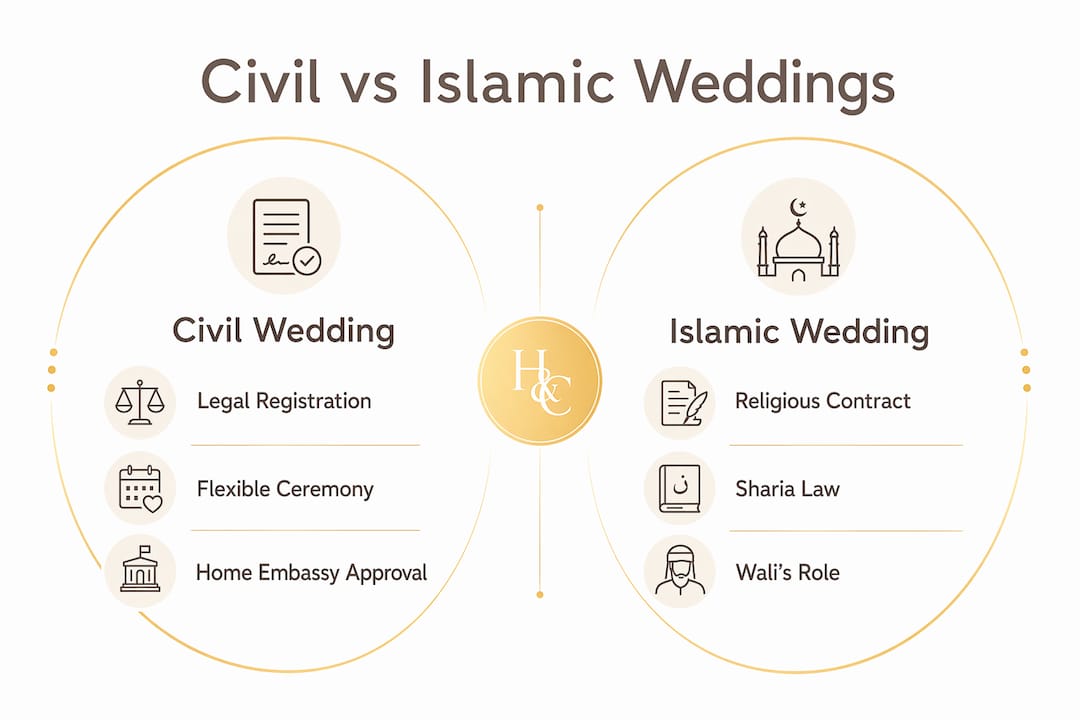
The core difference is this: an Islamic wedding is a religious contract governed by Sharia law, while a civil wedding is a legal contract governed by UAE civil personal status law. Both are legally recognized, but they carry different rights and obligations.
Key distinctions for couples to understand
Islamic marriage:
Requires a wali (guardian) for the bride
Mahr is a mandatory financial gift from groom to bride
Divorce is governed by Sharia law, which applies different standards to husbands and wives
Religious authority must officiate and register the marriage
Cultural ceremonies (Henna night, Walima reception) are traditional but not legally required
Civil marriage:
No religious authority involvement
Both spouses have equal legal standing
Civil personal status law governs divorce, offering no-fault options and equal treatment of spouses
Valid across all emirates without re-registration
Preferred by non-Muslim expats and interfaith couples
The differences between civil and Islamic marriage go beyond ceremony style. They affect property rights, divorce proceedings, and child custody outcomes. Couples should understand these implications before choosing their path, not after.
Choosing civil marriage does not mean abandoning cultural traditions. Many couples hold a civil registration for legal purposes and a separate cultural or religious celebration for family and community. The UAE legal system accommodates both.
Key Takeaways
Successful wedding preparation in the UAE requires completing legal documentation first, booking venues and vendors 12–18 months in advance, and delegating day-of logistics to a trusted coordinator.
Point | Details |
Legal documents come first | Begin document collection and attestation at least 12 months before your wedding date. |
Civil vs. Islamic path matters | Each marriage type carries different legal rights, divorce rules, and documentation requirements. |
Venue and vendor timing | Popular UAE venues and photographers book 12–18 months out, especially during peak season. |
Final month is for confirmation | Use the last four weeks for payments and logistics, not new decisions or creative changes. |
Delegate on the day | Assign a coordinator to manage vendors so you can focus on the ceremony itself. |
What I have learned from planning UAE weddings
The single biggest mistake I see couples make is treating legal paperwork as an afterthought. They spend months choosing flowers and menus, then scramble in the final weeks to get documents attested and translated. That scramble is avoidable and completely unnecessary.
The UAE’s civil marriage system is genuinely one of the most forward-thinking legal frameworks in the region for expat couples. The 2019 and subsequent legal reforms removed enormous barriers for non-Muslim and interfaith couples. But the system still requires precision. A missing attestation or an incorrectly translated document can delay your registration by weeks.
My honest advice: treat your marriage registration like a project with a hard deadline, because it is. Assign one person to own the documentation process. That person tracks every document, every submission, and every follow-up. If you are working with a service like Harrisandcharms, that responsibility transfers to a team that does this every day.
The other thing I tell every couple: the day itself goes faster than you expect. Every couple I have worked with says the same thing afterward. The preparation, the stress, the months of planning, and then it is over in hours. The couples who enjoy it most are the ones who let go of control on the day and trusted the people they hired. Delegation is not weakness. It is the smartest thing you can do.
— Harris
How Harrisandcharms supports your wedding preparation in the UAE
Planning a wedding in the UAE involves more moving parts than most couples anticipate, especially when legal documentation is involved.

Harrisandcharms provides end-to-end support for both civil and Islamic marriages, covering document processing, legal attestation, venue coordination, and event photography. The team specializes in helping expat couples and foreign nationals navigate UAE marriage requirements without the confusion of doing it alone. Whether you are registering a civil marriage, planning a Nikah, or looking for premium marriage registration services, Harrisandcharms handles the details so you can focus on the day itself. Reach out through the website to start your inquiry and get a clear picture of exactly what your specific situation requires.
FAQ
What documents do expats need for civil marriage in the UAE?
Expats need valid passports, UAE residency visas, attested birth certificates, a certificate of no impediment from their home country, and any divorce or death certificates if previously married. All foreign documents typically require embassy authentication and Arabic translation before submission.
How long does wedding preparation take in the UAE?
Large weddings with 100 or more guests require 12–18 months of preparation. Micro weddings under 50 guests can be organized in 3–6 months, provided legal documents are started immediately.
Can non-Muslims legally marry in the UAE?
Yes. The UAE introduced a non-Muslim civil marriage system that is legally binding across all emirates without requiring religious authority involvement. This makes it a practical option for interfaith and expat couples.
What is the role of a wali in an Islamic wedding in the UAE?
A wali is the bride’s male guardian, typically her father or a close male relative, who must be present or formally represented during the Nikah ceremony. His presence is a legal requirement under Islamic marriage law in the UAE.
Do civil and Islamic marriages have different divorce rules in the UAE?
Yes. Civil marriages are governed by UAE civil personal status law, which includes no-fault divorce and equal treatment of both spouses. Islamic marriages follow Sharia law, which applies different standards and procedures for husbands and wives in divorce proceedings.
Recommended
Comments