
Documents Needed for Marriage Registration in the UAE


TL;DR:
Getting married in the UAE requires completing specific documentation based on your chosen route and nationality, including valid passports and attested foreign documents. Proper preparation involves starting attestation early, organizing translated and certified papers, and understanding route-specific requirements like medical certificates and wali presence for Sharia marriages. Employing professional assistance, such as wedding package providers, can streamline the process and prevent costly delays.
Getting married in the UAE is exciting, but the paperwork side of things trips up more couples than you’d expect. If you’ve been searching for what are the documents needed for marriage registration here, you’ve likely already discovered that the answer is not one single list. It depends on your chosen route (civil in Abu Dhabi or Dubai, or Sharia), your nationality, and your current residency status. Foreign nationals face an extra layer of complexity with attestation and certified Arabic translations. This guide breaks it all down so you walk into your appointment with the right paperwork, the first time.
Table of Contents
Key takeaways
Point | Details |
Route determines document list | Abu Dhabi civil, Dubai civil, and Sharia marriages each require a different set of documents. |
Passports are universal | A valid passport is required across all three marriage routes without exception. |
Attestation is mandatory for foreign docs | Foreign-issued documents must pass a full attestation chain before UAE authorities will accept them. |
Medical certificate timing matters | The pre-marital health fitness certificate is valid for approximately three months, so timing is critical. |
Originals required at appointment | Even when you apply online, you must bring original documents on the day of your in-person appointment. |
What are the documents needed for marriage registration in the UAE
The foundational documents for marriage registration form the base of every application, regardless of which route you take. Getting these right first saves you from scrambling later.
Every couple must present valid passports for both parties. This applies across all three registration routes: Abu Dhabi civil, Dubai civil, and Sharia. Your passport must be valid, not just technically unexpired by a day or two. Aim for at least six months of validity.
For residents and UAE nationals, the Emirates ID is also required depending on the specific route. If you hold UAE residency, bring your Emirates ID regardless of whether the route technically requires it. Having it ready prevents unnecessary back-and-forth with registration officials.
Foreign nationals visiting the UAE for the purpose of getting married must provide proof of legal entry, meaning a valid visa or entry stamp. This is separate from residency proof and specifically establishes your right to be in the country at the time of registration.
Here is a clear breakdown of what to bring for marriage registration as your identity document set:
Passports of both partners (originals plus clear photocopies)
Emirates ID for UAE residents and citizens (original and copy)
Valid entry visa or residency visa for non-resident foreign nationals
Recent passport-size photographs of both partners (typically two to four photos each, white background)
Pro Tip: Make at least three sets of photocopies of every document before your appointment. UAE registration offices regularly request multiple copy sets, and having them ready saves time and frustration.
Marital status proof and attestation requirements
This is where most couples run into problems. Proving your current marital status is not just a formality. It is a legal requirement, and the paperwork involved varies depending on your situation and your chosen marriage route.
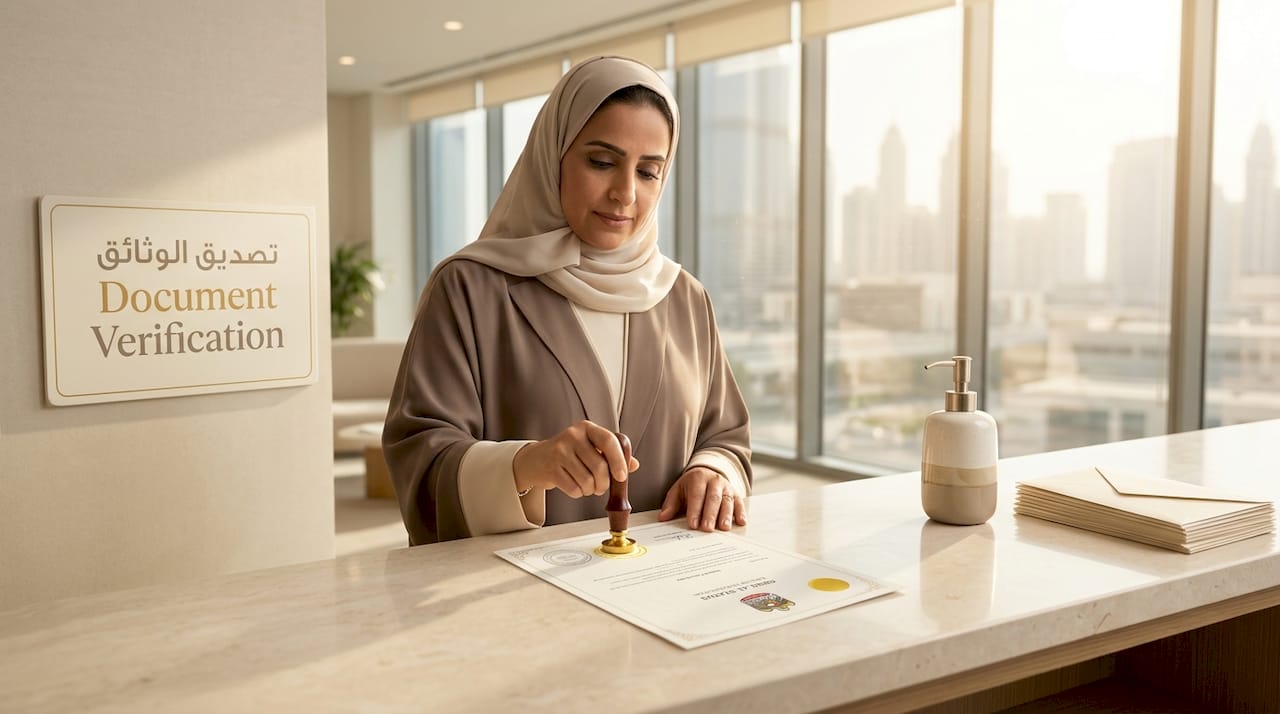
For Dubai civil marriages and Sharia marriages, a single-status certificate is required to confirm you are legally free to marry. Interestingly, Abu Dhabi civil marriages do not require this document. If you are going the Dubai civil or Sharia route, this certificate must be current and properly authenticated before submission.
If you have been married before, the necessary paperwork for marriage shifts. You will need either a divorce decree (if divorced) or a death certificate (if widowed). These documents must be official, not photocopies you made at home, and they must be authenticated through the full attestation chain if they were issued outside the UAE.
The attestation process for foreign-issued documents follows a specific chain that many couples underestimate. Here is the required sequence:
Notarization or authentication in the country where the document was issued
Foreign Ministry attestation in the country of origin (also known as apostille in some countries)
UAE Embassy attestation in the country of origin
MOFAIC attestation once you arrive in the UAE (Ministry of Foreign Affairs and International Cooperation)
After completing the attestation chain, every foreign-language document must be accompanied by a certified Arabic translation. Standard translations by non-certified translators will be rejected. You need a UAE-licensed legal translator or a translation office approved by the UAE Ministry of Justice.
Attestation fees via MOFAIC run AED 150 per document with a typical turnaround of three business days. Budget both the cost and the time into your preparation schedule.
Pro Tip: Start the attestation process at least six to eight weeks before your intended registration date. Courier delays, public holidays in your home country, and MOFAIC processing times can stack up quickly.
Common pitfalls causing application failures include submitting expired single-status certificates, incomplete attestation steps, and missing certified Arabic translations. These are the top three reasons applications get rejected and couples have to restart.
Special documents for Sharia marriages
Sharia marriages require a few additional layers of documentation and attendance requirements that civil marriages do not. If you are a Muslim couple registering through the Sharia route, these apply directly to you.
The required documents and attendees include:
Pre-marital medical fitness certificate for both partners (mandatory, not optional)
Muslim bride’s guardian (wali) must be present in person, or a legal power of attorney is required if the wali is abroad
Two Muslim male witnesses with valid identification documents
Passports and Emirates IDs of both witnesses
The pre-marital medical fitness certificate deserves special attention. For Sharia marriages it is mandatory, and for civil marriages it is strongly recommended. The certificate is valid for approximately three months, so if you get tested too early and the registration is delayed, you may need to test again.
Document | Civil Marriage | Sharia Marriage |
Passport (both partners) | Required | Required |
Emirates ID | Required for residents | Required for residents |
Single-status certificate | Required (Dubai) | Required |
Pre-marital medical certificate | Recommended | Mandatory |
Wali (guardian) presence | Not required | Required |
Two Muslim witnesses | Not required | Required |
If the wali lives outside the UAE, the bride’s family must arrange a notarized and fully attested power of attorney authorizing a representative in the UAE to act in that role. This is one of the more time-consuming parts of a Sharia marriage application and should be arranged weeks in advance.
Practical steps for gathering and attesting your documents
Knowing what documents you need is half the work. Knowing when and how to gather them prevents last-minute chaos. Timing your document collection strategically makes the difference between a smooth process and a frustrating cycle of re-submissions.
Start with the medical fitness certificate last. Because the certificate’s validity window affects the timing of everything else, schedule the health screening close to your registration date. Three months sounds like plenty of time until attestation delays push your registration back.
Follow this preparation sequence:
Six to eight weeks out: Begin attestation of foreign documents. Request your single-status certificate from your home country’s relevant authority and start the attestation chain immediately.
Four weeks out: Submit documents for MOFAIC attestation in the UAE and arrange certified Arabic translations simultaneously.
Two to three weeks out: Confirm all documents are attested and translated. Book your medical fitness screening at a DHA-approved facility.
One week out: Assemble your full document packet with originals and multiple copies. Double-check expiry dates on every document.
For couples applying online through Dubai’s digital registration system, online applications still require original documents at your in-person appointment. Do not assume that uploading digital copies means you are done. The appointment day requires every original to be physically present for verification. This catches many couples off guard.
Pro Tip: Use a physical folder with labeled sections for each document type (passports, marital status, medical, photos, translations). When the registration officer asks for a specific document, you should be able to hand it over in under ten seconds.
For couples putting together their marriage certificate documents and legal documents for a wedding, a final checklist review the night before your appointment is worth every minute. Compare your documents against the step-by-step registration guide for your specific route to catch anything missing.
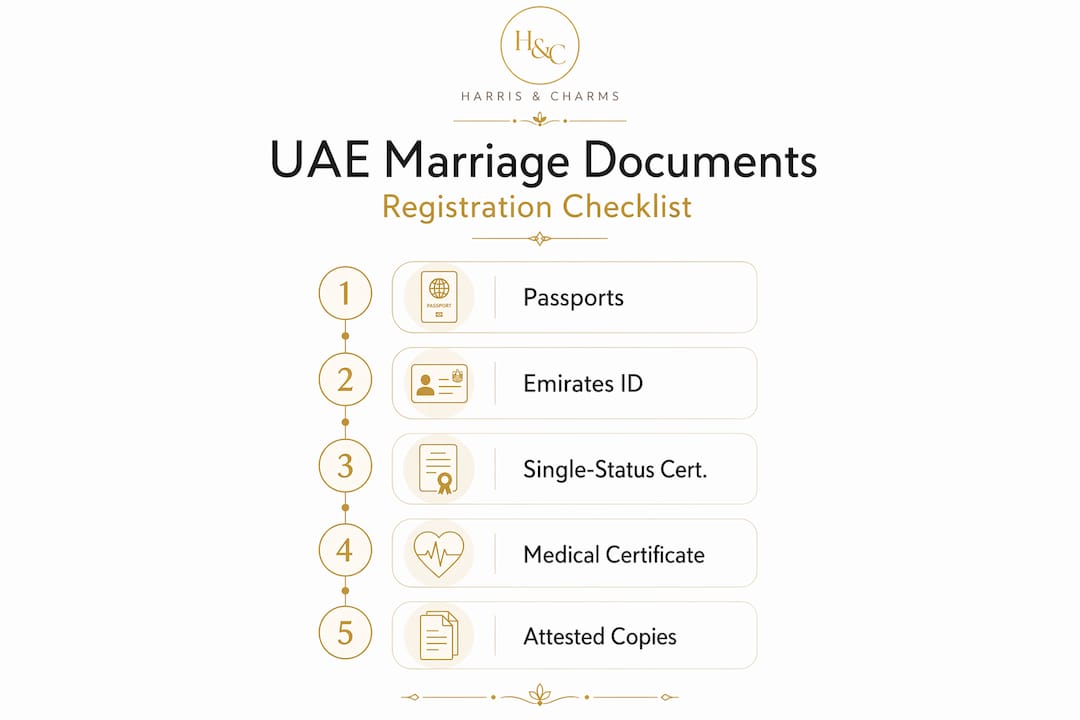
Documents also need to be organized by applicant. Keep both partners’ documents clearly separated and labeled to avoid confusion at the registration desk. Officers process high volumes of applications daily, and presenting a clean, organized packet works in your favor.
What I’ve learned from guiding couples through this process
I’ve helped dozens of couples work through the UAE marriage registration process, and the pattern I see most often is this: couples spend months planning every detail of the ceremony and then leave the paperwork until three weeks before the date. That timeline rarely works, especially for foreign nationals.
The single biggest mistake I’ve witnessed is treating the attestation chain as a one-step process. People think they get their document notarized and they’re done. They’re not. Each step in the chain adds days, sometimes weeks, and each country has its own processing speed. Some of the home-country foreign ministry offices I’ve dealt with through clients take up to ten business days alone.
What I’ve also found is that choosing your marriage route early is more important than most couples realize. The documents for a Dubai civil marriage differ from what’s required for a Sharia marriage, and making that decision late forces you to scramble for certificates you didn’t know you needed. Understanding the route-specific requirements at the start of your planning process saves real time.
For foreign nationals especially, getting a certified Arabic translator involved early pays off. Poorly translated documents submitted without official certification are a guaranteed rejection. I’ve seen couples lose weeks because of a translation that looked fine to them but was not done by a UAE-licensed translator.
My honest advice: treat the document process like a project with a timeline and checkpoints. Know your route. Know your documents. Start early. And if the process feels too complex, bring in help from people who do this every day.
— Harris
How Harrisandcharms simplifies your marriage registration
Pulling together every document, tracking the attestation chain, booking medical tests, and coordinating with Dubai Courts is a real workload. Most couples have jobs, families, and an actual wedding to plan on top of it.
Harrisandcharms offers tailored civil marriage packages specifically designed to take the document burden off your plate. The team manages document preparation, coordinates certified Arabic translations, handles MOFAIC attestation submissions, and schedules your appointment with the relevant UAE authorities. For couples who want their registration handled professionally without the back-and-forth, the civil wedding Dubai service covers everything from initial consultation through to your official marriage certificate. Whether you are a UAE resident or a foreign national navigating attestation for the first time, Harrisandcharms brings the experience and local knowledge to get it right.
FAQ
What documents are needed for all UAE marriage routes?
A valid passport for both partners is required across all UAE marriage registration routes. Residents also need their Emirates ID, and foreign nationals must provide proof of legal entry into the UAE.
Is a single-status certificate required for all UAE marriages?
No. A single-status certificate is required for Dubai civil and Sharia marriages but is not required for Abu Dhabi civil marriages. Check your specific route before preparing this document.
For court marriage, what age is required in the UAE?
Both parties must be at least 18 years old to register a civil marriage in the UAE. Marriages involving individuals under 18 require court approval and are subject to additional legal conditions.
How long does the attestation process take?
MOFAIC attestation in the UAE typically takes three business days and costs AED 150 per document. The full attestation chain, including steps in your home country, can take six to eight weeks depending on your nationality.
Do I need original documents if I already submitted online?
Yes. Even when you apply through Dubai’s online registration system, you must present all original documents at your in-person verification appointment for the application to be finalized.
Recommended
Comments