
How to Get Married in GA: 2026 Legal Guide

Updated: Jul 27

TL;DR:
If you're wondering how to get married in GA, the process begins by obtaining a marriage license from the local probate court, which both partners must apply for in person. The license is valid immediately and has no expiration date. Marriage officiants are limited to judges, magistrates, and certain ministers. After the ceremony, the officiant must return the signed license within 30 days to ensure the marriage is legally recorded and that certified marriage certificates are available.
Getting married in Georgia requires a valid marriage license from your local probate court, compliance with state eligibility rules, and proper filing after the ceremony. The process is governed by the Official Code of Georgia Annotated (O.C.G.A.), which sets clear standards for age, identification, authorized officiants, and post-ceremony filing. Georgia offers no waiting period and no license expiration, making it one of the more flexible states for couples planning their wedding. This guide walks you through every legal step so your marriage is valid and recognized from day one.
How to get married in GA: legal requirements and eligibility
Getting legally married in Georgia starts with meeting the state’s eligibility criteria. Georgia law sets the minimum marriage age at 18, with a narrow exception for 17-year-olds who are legally emancipated, have completed premarital education, and meet specific age-gap conditions. No one under 17 may marry under any circumstances. This stricter standard reflects the state’s intent to protect minors from early marriage.

Beyond age, both parties must be mentally competent and not currently married to anyone else. Georgia does not recognize bigamous marriages, and any prior marriage must be legally dissolved before a new license is issued. You do not need to be a Georgia resident to apply. Out-of-state and international couples can apply at any Georgia probate court.
You will need to bring valid, government-issued photo identification to prove your identity and age. Acceptable documents typically include a passport, driver’s license, or state-issued ID. Some counties may also request a certified copy of a birth certificate, so check your specific probate court’s requirements before you go.
Both applicants must be at least 18 years old (or 17 with emancipation and additional conditions)
Neither party can be currently married
Both must be mentally competent at the time of application
Valid government-issued photo ID is required for each applicant
No Georgia residency requirement applies
Pro Tip: If you were previously married, bring your divorce decree or death certificate of a former spouse. Probate courts routinely ask for this documentation, and missing it will delay your application.
How do you apply for a marriage license in Georgia?
The GA marriage application process begins at your county’s probate court. Both partners must appear in person with valid identification. You cannot send a representative or apply by mail. Some counties allow you to start the process online to speed up your in-person visit, but the final step always requires both of you to be physically present.
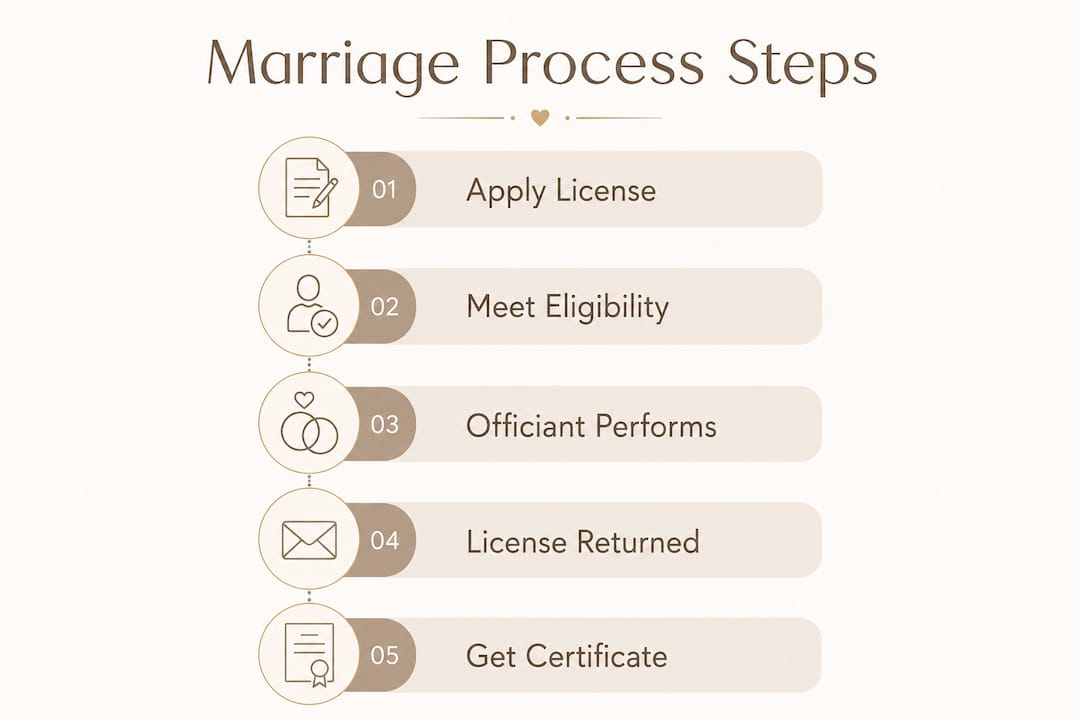
Here is the standard step-by-step process:
Check your county’s probate court website. Procedures vary by county. Some require scheduled appointments; others accept walk-ins. County-specific procedures differ widely, so confirming this detail in advance saves you a wasted trip.
Complete any available pre-application online. Several counties offer an online form that pre-populates your application, cutting down your time at the courthouse.
Appear in person together. Both applicants must show valid photo ID and sign the application in front of a probate court clerk.
Pay the license fee. The base fee in Forsyth County is $56. Couples who present a premarital education certificate pay only $16, a reduction of more than 70%.
Receive your license. Georgia has no waiting period. Your license is valid the same day it is issued.
Detail | Georgia Rule |
Waiting period | None; license is valid immediately |
License expiration | No expiration date |
Base fee (Forsyth County) | $56 |
Reduced fee with premarital education | $16 |
In-person appearance | Required for both applicants |
Georgia’s no-expiration policy on marriage licenses is genuinely unusual. Most states impose a 30 to 90-day window. In Georgia, you can hold the license indefinitely and marry when you are ready.
Pro Tip: Complete a state-approved premarital education course before your probate court visit. The fee savings are significant, and many couples report the course itself reduces pre-wedding stress.
Who can legally officiate your Georgia wedding?
Georgia law under O.C.G.A. § 19-3-30 defines exactly who may perform a legally valid marriage ceremony. Authorized officiants include judges, magistrates, ministers of any religious denomination, city recorders, and certain other public officials. A friend or family member cannot simply declare themselves an officiant without meeting these legal criteria.
The officiant carries a specific legal obligation after the ceremony. They must sign the marriage license and return it to the issuing probate court within 30 days of the ceremony date. That 30-day clock starts on the day you marry, not the day the license was issued. If the officiant fails to return the signed license, the marriage may not be legally recorded, which creates real problems for tax filings, name changes, and inheritance rights.
Georgia does not require witness signatures on the marriage license. Only the couple and the officiant sign the document to create a valid legal record. This surprises many couples who expect a witness requirement, as most states include one.
Judges and magistrates at any level
Ordained or licensed ministers of any religious denomination
City recorders and certain municipal officials
Notaries public are generally not authorized to perform marriages in Georgia
Pro Tip: Ask your officiant directly: “Are you authorized under O.C.G.A. § 19-3-30?” Then request written confirmation of their credentials. This one step protects your marriage’s legal standing.
Legal analysts stress that verifying officiant credentials before the ceremony is the single most important step couples overlook. An invalid officiant can trigger challenges to your marriage’s legal status, affecting everything from joint tax returns to spousal inheritance.
What happens after the ceremony?
The ceremony is not the finish line. The legal marriage only takes full effect once the probate court accepts the signed and returned license. The 30-day return deadline begins on your ceremony date, not your license issue date. Missing this window creates a gap in your legal record that requires court intervention to fix.
Once the probate court processes the returned license, you can request certified copies of your marriage certificate. You will need these copies for name changes, updating Social Security records, passport applications, and joint financial accounts. Most counties charge a small fee per certified copy, typically in the range of $10 per copy, though fees vary.
Common ceremony venues in Georgia include:
Courthouse ceremonies: Quick, affordable, and handled directly by probate court staff in many counties
Religious venues: Churches, mosques, temples, and synagogues, with an authorized minister officiating
Private venues: Estates, gardens, barns, and event spaces across Georgia’s diverse regions
Outdoor locations: State parks, lakesides, and mountain settings, particularly popular in North Georgia
Post-Ceremony Step | Timeline |
Officiant signs and returns license | Within 30 days of ceremony |
Probate court records the marriage | Typically within a few business days of receipt |
Certified copies available | Upon request after recording |
Name change process begins | After receiving certified copies |
Keep a personal copy of every document you submit and receive. Probate courts process high volumes of paperwork, and having your own records means you can resolve any discrepancy quickly.
What mistakes should you avoid when getting married in Georgia?
The most common mistake couples make is arriving at the probate court without both partners present. Both applicants must appear together with valid ID. Sending one person ahead to “get the paperwork started” does not work. The clerk cannot issue the license until both parties are physically there.
The second most common mistake is assuming all Georgia counties operate the same way. Probate court procedures vary significantly across the state’s 159 counties. Some require appointments booked days or weeks in advance. Others accept walk-ins during limited hours. Calling ahead or checking the court’s website takes five minutes and prevents a wasted day.
“The couples who have the smoothest Georgia marriage process are the ones who treat the legal steps with the same care they give the ceremony itself. Confirm your officiant’s credentials, schedule your probate court visit early, and keep every document in a dedicated folder. The paperwork is simple when you plan for it.”
Additional mistakes to avoid:
Skipping premarital education and paying the higher license fee when the reduced rate is easily accessible
Choosing an officiant without confirming their authorization under O.C.G.A. § 19-3-30
Forgetting to follow up with your officiant about returning the signed license within 30 days
Waiting until peak wedding season (may through october) to schedule your probate court visit
Losing your certified marriage certificate copies before completing name change paperwork
Pro Tip: Set a calendar reminder for 20 days after your ceremony to confirm your officiant has returned the signed license. This gives you a 10-day buffer to resolve any issue before the legal deadline.
For a deeper look at the 2026 eligibility rules and venue options, Harrisandcharms has published a detailed breakdown covering the full legal framework.
Key Takeaways
Getting legally married in Georgia requires a probate court license, an authorized officiant under O.C.G.A. § 19-3-30, and a signed license returned to the court within 30 days of the ceremony.
Point | Details |
License from probate court | Both partners must appear in person with valid ID; no waiting period applies. |
Age and eligibility | Minimum age is 18; a narrow emancipation exception exists for 17-year-olds only. |
Fee reduction available | Completing premarital education cuts the license fee by more than 70% in many counties. |
Authorized officiant required | Only judges, magistrates, ministers, and certain officials may legally perform the ceremony. |
30-day return deadline | The officiant must sign and return the license within 30 days of the ceremony date. |
What I’ve learned from watching couples navigate Georgia’s marriage process
Most couples underestimate how much the legal side of a Georgia wedding matters until something goes wrong. I’ve seen couples arrive at the probate court with only one partner present, or with an expired out-of-state ID, and the whole day unravels. The fix is always the same: prepare the paperwork as seriously as you plan the flowers.
The officiant credential issue is the one that keeps me up at night. Georgia’s courts do tend to uphold a marriage if the license was properly returned, even when questions arise about the officiant later. But “tends to uphold” is not the same as “guaranteed.” Why take that risk on one of the most important legal documents of your life? Spend ten minutes confirming your officiant’s standing before the ceremony.
The premarital education discount is genuinely underused. A $40 savings sounds small, but the courses themselves are worth far more than the fee reduction. Couples who complete them report going into the marriage with clearer communication habits and fewer surprises about finances and expectations. Georgia built that incentive into the law for a reason.
Georgia’s no-expiration license policy is one of the most couple-friendly rules in the country. You can take your time planning the ceremony without worrying about the license lapsing. Use that flexibility wisely. Get the license early, confirm your officiant, and give yourself breathing room before the big day.
For couples who also have international ties, particularly those managing civil and Islamic marriage paths across jurisdictions, the documentation requirements add another layer. Getting the Georgia side right first makes everything else easier.
— Harris
Harrisandcharms wedding services for your Georgia celebration
Planning a wedding involves far more than paperwork. Harrisandcharms offers full-service wedding support, from legal documentation and ceremony coordination to venue management and event photography, for couples who want every detail handled with care.

Whether you are planning a courthouse ceremony, a private estate wedding, or a destination celebration with international documentation needs, Harrisandcharms brings the same attention to detail to every couple. The team specializes in civil and Islamic marriage packages that cover legal compliance, ceremony planning, and post-wedding documentation support. Couples managing cross-border paperwork, including those with UAE connections, benefit from Harrisandcharms’ experience with attestation and registration across jurisdictions. Reach out directly to discuss your specific needs and get a clear picture of what full-service wedding support looks like.
FAQ
What documents do I need for a Georgia marriage license?
You need valid government-issued photo ID, such as a passport or driver’s license, and proof of any prior marriage dissolution if applicable. Some counties also request a certified birth certificate, so verify your local probate court’s requirements before your visit.
Is there a waiting period for a marriage license in Georgia?
Georgia has no mandatory waiting period. Your license is valid immediately upon issuance, and it carries no expiration date.
Can someone from out of state get married in Georgia?
Yes. Georgia has no residency requirement for marriage licenses. Out-of-state and international couples can apply at any Georgia county probate court.
How do I get a certified copy of my marriage certificate in Georgia?
After your officiant returns the signed license to the probate court and it is recorded, you can request certified copies directly from that court. Fees vary by county but are typically around $10 per copy.
What happens if my officiant does not return the signed license in time?
If the signed license is not returned within 30 days of the ceremony, your marriage may not be legally recorded. Contact your probate court immediately if this deadline is at risk, as court intervention may be required to resolve the gap in your legal record.
Recommended
Comments