
Marriage Vows in UAE: Real Examples for Every Couple


TL;DR:
UAE wedding vows must adhere to legal requirements, such as Ijab and Qabul for Muslims and mutual consent for civil ceremonies. Couples can personalize their vows by incorporating cultural, religious, or bilingual elements within the legal framework. Combining meaningful personal vows with understanding of legal structures ensures a heartfelt and compliant ceremony.
Your wedding vows are the most personal words you will ever speak in public, and finding examples of marriage vows in UAE ceremonies can feel harder than it should. The UAE brings together civil law, Islamic tradition, and dozens of cultural backgrounds under one legal framework, which means the “right” vows look different for every couple. This article gives you real, usable examples across Islamic, civil, and multicultural traditions, along with the legal context you need to make them count.
Table of Contents
Key takeaways
Point | Details |
Islamic vows follow legal structure | Ijab and Qabul are legally required; personalization happens around these, not instead of them. |
Civil vows offer creative freedom | Non-Muslim couples in the UAE can write expressive, heartfelt vows within a contract-based legal format. |
Multicultural elements are welcome | Traditions like the Hindu Saptapadi enrich UAE ceremonies and can be layered with legal vows. |
Bilingual vows reflect UAE reality | Incorporating Arabic alongside English or another language honors both legal and cultural contexts. |
Legal compliance and meaning coexist | Understanding the legal framework actually deepens vow meaning rather than limiting personal expression. |
Examples of marriage vows in UAE: What you need to know first
Before you fall in love with a particular phrasing, it helps to understand what the law actually requires. UAE marriage ceremonies are not one-size-fits-all, and the legal weight of your vows depends entirely on which type of ceremony you are having.
For Muslim couples, UAE marriage law structures the ceremony around two foundational components. The Ijab and Qabul form the legal core: the offer from the bride’s guardian and the acceptance by the groom, spoken clearly before two qualified witnesses. Without these, the marriage contract has no legal standing. Updated personal status laws effective since 2024 also govern mahr (the mandatory gift), guardian consent, and witness qualifications.
For non-Muslim expatriates, civil marriages in the UAE do not require religious ceremony or a guardian’s approval. The Abu Dhabi civil marriage framework operates on a contract model, and the certificate is valid throughout the UAE. Vows in this context are promises embedded in a legal contract rather than religious ritual.
Here is what shapes vow language across both traditions:
Consent must be explicit. In Islamic ceremonies, the words used must clearly convey offer and acceptance. In civil ceremonies, mutual agreement must be unmistakable.
Witnesses are legally required. Two qualified witnesses must be present for Islamic marriages. Civil ceremonies have their own witnessing requirements.
Mahr is specific to Islamic marriages. It is a financial gift from the groom to the bride and is part of the contract, not just ceremony.
Language of the vow matters. Vows said in Arabic carry specific legal phrasing conventions; bilingual ceremonies often include a certified translation.
Pro Tip: Draft your personal vow additions separately from the legal contract language. Share both with your officiant before the ceremony so they can confirm nothing conflicts with the legal requirements.
1. Traditional Islamic Ijab and Qabul examples
The Ijab and Qabul are the heartbeat of an Islamic marriage contract. They are not decorative. They are the marriage itself, spoken aloud before witnesses.
A standard Ijab (offer by the bride’s representative or wali) sounds like this:
“I give you my daughter [name] in marriage according to the laws of Allah, with a mahr of [amount].”
The Qabul (acceptance by the groom) follows:
“I accept the marriage of [name], daughter of [father’s name], in accordance with the laws of Allah and His Messenger, with a mahr of [amount].”
These phrases can be rendered in Arabic, English, or both depending on your officiant and the registry. The key is that they must be clear, unambiguous, and spoken in the present tense.
Beyond the contract language, Islamic blessings are often added by the imam, family members, or guests. The most recognized is:
“Barakallahu lakuma wa baraka alaykuma wa jama’a baynakuma fi khayr” meaning “May Allah bless you both, bless your union, and bring you together in goodness.”
Other commonly used UAE marriage blessings include:
“Bil-rafa’ wal-banin” — wishing the couple prosperity and children, widely used in Emirati and Gulf Arab weddings
“Taqabbalallahu minkuma” — “May Allah accept from you both,” often said after the nikah
“Rabbana hab lana min azwajina wa dhurriyyatina qurrata a’yun” — a Quranic dua asking Allah to grant comfort through spouses and children
A simple spoken blessing: “May your home be filled with love, patience, and gratitude to Allah”
To personalize while maintaining religious appropriateness, couples sometimes ask the imam to add a brief personal supplication referencing the couple by name, or they include a reading from Surah Ar-Rum (30:21), which speaks to the divine origin of love between spouses.
2. Civil marriage vow examples for UAE weddings
Non-Muslim couples and expatriates choosing a civil ceremony have considerably more creative latitude. The civil marriage requirements in the UAE call for clear expression of consent and commitment, but they do not prescribe specific words. That freedom is genuinely exciting.
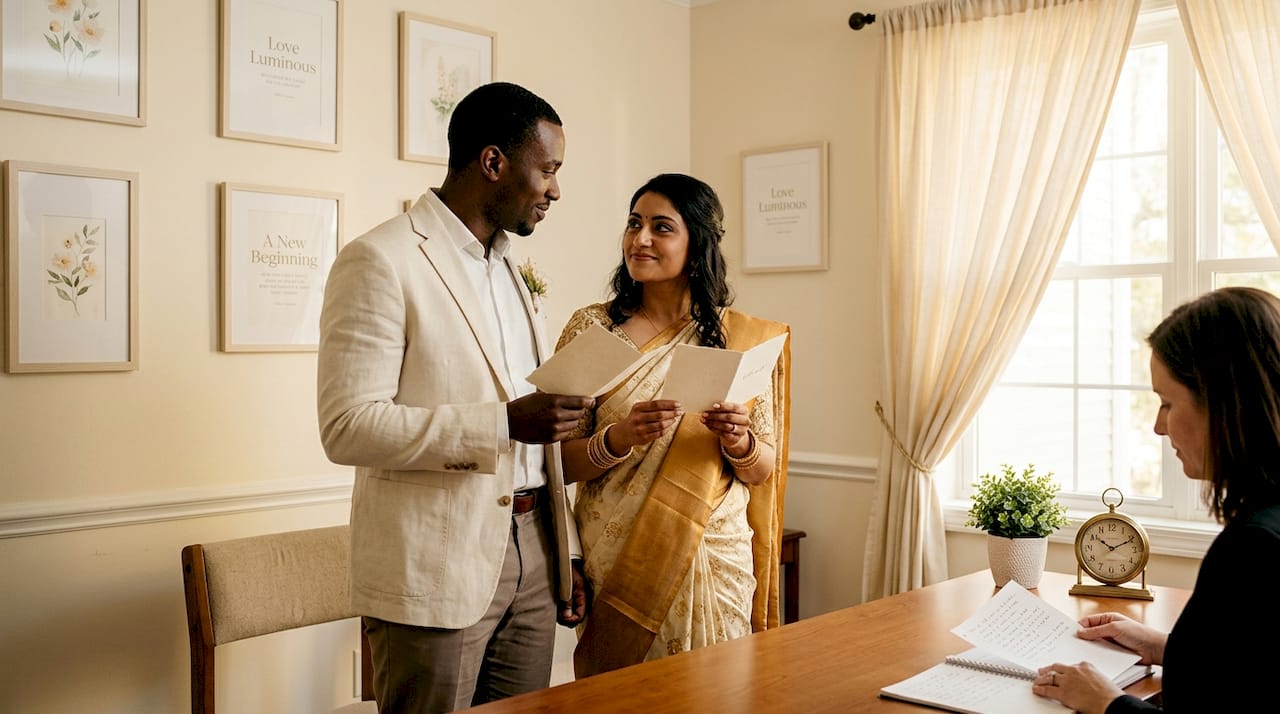
Here are civil vow examples ranging from traditional to personalized:
Traditional civil vow:“I, [name], take you, [name], to be my lawfully wedded [husband/wife]. I promise to love and respect you, to be honest with you, and to stand by you through every season of life.”
Short and sincere:“I choose you today and every day. I will love you with patience, protect you with honesty, and walk beside you wherever life leads.”
More personal, multicultural-friendly version:“I promise to be your partner in every sense of the word. I will celebrate your joys as my own, carry your burdens beside you, and honor the person you are and the person you are becoming.”
Common promises found in UAE civil vows include:
A promise of mutual love and support through difficulty and joy
A commitment to honesty and open communication
A pledge of fidelity and partnership
A promise to respect each other’s culture, faith, and family
A forward-looking line about building a shared life
Pro Tip: If you are writing vows for a multicultural ceremony in the UAE, include one line that specifically acknowledges your different backgrounds. It does not need to be long. Something as simple as “I honor where you come from as part of who you are” lands with extraordinary warmth in the room.
3. Multicultural vow traditions and how UAE couples use them
The UAE’s population is one of the most diverse on the planet, and wedding ceremonies reflect that reality. Many couples weave in vow traditions from their heritage alongside or following the legal ceremony.
The Hindu Saptapadi is among the most structurally rich examples. These are seven vows spoken while walking seven steps around a sacred fire, each step carrying a specific promise. A simplified English version used in UAE ceremonies might look like:
We will nourish and sustain one another.
We will grow in strength together.
We will work together for prosperity.
We will share joy and sorrow equally.
We will care for our family and community.
We will be loyal and devoted to one another.
We will remain true friends for life.
These seven commitments speak to practical and emotional life together, not just romantic feeling, which many couples find more honest and lasting.
Here is how vow themes compare across the three main traditions practiced in UAE weddings:
Tradition | Core vow themes | Typical phrases used |
Islamic (Nikah) | Divine covenant, mahr, consent, guardianship | “I accept in marriage…”, blessings invoking Allah |
Civil (UAE law) | Mutual consent, partnership, love, honesty | “I take you…”, “I promise to…” |
Hindu Saptapadi | Seven life duties, friendship, sustenance | Each step framed as a shared vow |
Christian | Lifelong fidelity, love in all circumstances | “To have and to hold…”, “Till death do us part” |
Multicultural fusion | Personalized blend of the above | Couple-written lines drawing from all traditions |
UAE couples increasingly use fusion ceremonies where the legal requirement (civil or Islamic) is completed first, and then a symbolic ceremony from their cultural tradition follows.
4. How to personalize your UAE wedding vows
Writing your own vows is one of the most meaningful things you can do for your ceremony. It is also the part most couples leave to the last minute. Here is a practical sequence to get it right.
Identify your ceremony type first. Know whether you are having a nikah, a civil ceremony, or both. Your personal vows layer on top of the legal structure, not instead of it.
List three specific things you love about your partner. Vows that name actual qualities or moments are ten times more moving than vows that speak in generalities.
Choose a tone together. Funny and warm works for some couples. Quiet and sincere works for others. Mismatched tones in back-to-back vows can feel awkward, so align beforehand.
Write a first draft and read it aloud. What sounds good on paper can be hard to say through tears. Practice matters.
Keep it between 60 and 120 seconds. That is roughly 150 to 300 words. Short enough to feel intentional, long enough to feel complete.
Personalized bilingual vows are especially resonant in UAE ceremonies. A couple where one partner is Emirati and the other is from the Philippines, for example, might write vows that include Arabic lines followed by English, with the same sentiment expressed in both languages.
Pro Tip: Share your personal vows with your officiant at least one week before the ceremony. They need to know what is coming so they can structure the ceremony flow correctly, and they may catch wording that unintentionally echoes the legal contract language.
My honest take on writing vows in the UAE
I have been present at hundreds of ceremonies in the UAE, from intimate nikah gatherings in private apartments in Sharjah to civil ceremonies at the Abu Dhabi court followed by sunset receptions on the water. The couples who seem most at peace during their vows are not the ones who memorized the perfect speech. They are the ones who understood what the words were actually doing.
In my experience, the legal structure of UAE vows is not a limitation. It is a container. The Ijab and Qabul do not restrict your feelings. They formalize them in a way that your culture and your country recognize. When you understand that the legal words do something real, the personal words you add around them feel more meaningful too, not less.
What I have seen go wrong, repeatedly, is couples treating the two as separate. The legal part is the “paperwork” and the personal part is the “real” ceremony. That split makes the legal words feel hollow and the personal words feel unconnected to anything lasting. The best ceremonies treat them as one continuous act.
Write vows that are true to who you both are. If your relationship is built on humor, let that show. If it is built on quiet loyalty, say that plainly. The UAE’s multicultural reality actually gives you more permission to be yourselves than almost anywhere else.
— Harris
Plan your UAE wedding vows with expert support
Writing meaningful vows is personal. Getting the legal process right takes a different kind of help. At Harrisandcharms, we support couples through both civil and Islamic marriage ceremonies in Dubai and across the UAE, from documentation and court coordination to ceremony planning and vow guidance.
Whether you are planning a civil wedding in Dubai or working through the steps of an Islamic nikah, our team walks with you through every stage. We handle the paperwork, coordinate with the relevant authorities, and make space for your ceremony to feel like yours. Explore our civil marriage packages or reach out directly to tell us about your plans. Every couple we work with has a different story, and we are genuinely interested in yours.
FAQ
What are the legal requirements for Islamic marriage vows in the UAE?
Islamic marriage vows in the UAE must include the Ijab and Qabul, spoken before two qualified witnesses with clear consent and agreed mahr. Personal additions are welcome but cannot replace these legal components.
Can non-Muslim couples write their own vows for a UAE civil ceremony?
Yes. Civil marriage vows in the UAE operate within a contract framework that allows personal expression, as long as mutual consent is clearly stated. Couples can write their own words or follow a standard civil format.
What is the most common Islamic blessing used at UAE weddings?
The most widely used blessing is “Barakallahu lakuma wa baraka alaykuma wa jama’a baynakuma fi khayr,” which means “May Allah bless you both, bless your union, and bring you together in goodness.”
Can couples include multicultural or non-religious vow elements in UAE ceremonies?
Yes. Many UAE couples complete the legal ceremony first and then hold a separate cultural or symbolic ceremony that reflects their heritage, such as Hindu Saptapadi vows or Christian exchange of vows.
How long should personalized wedding vows be?
Most officiants recommend keeping personal vows between 150 and 300 words, roughly 60 to 120 seconds when spoken aloud. This length feels intentional and complete without losing the room’s attention.
Recommended
Comments