
What You Need to Get Married at a Courthouse

Updated: Sep 4
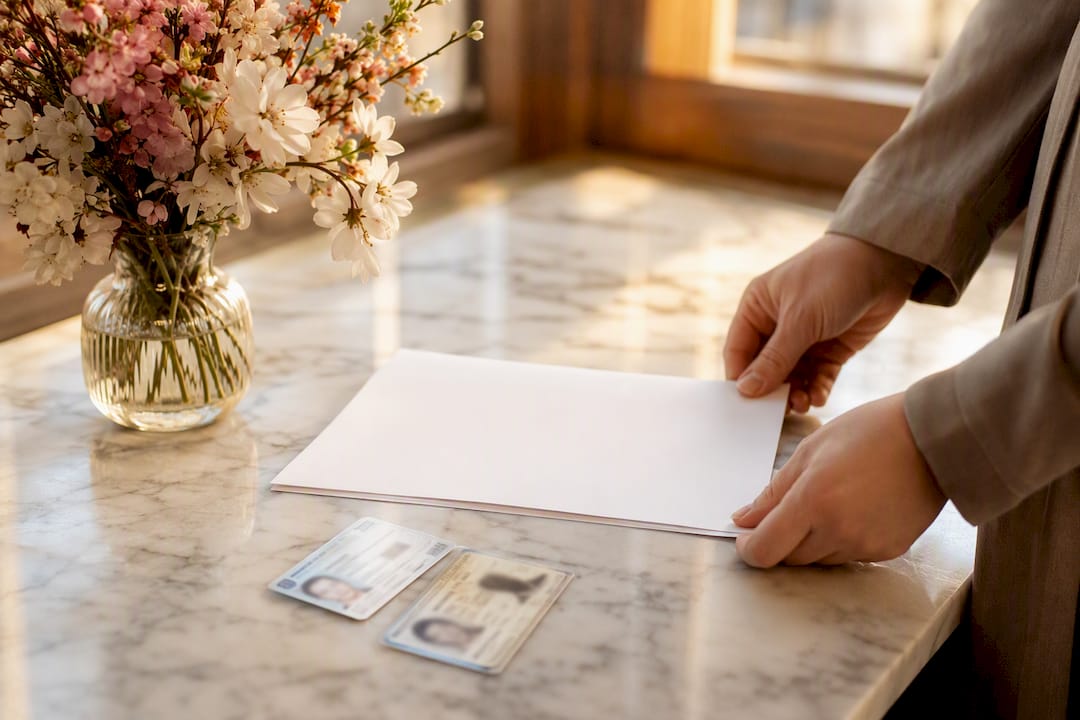
To get married at a courthouse, you need a valid marriage license, government-issued photo ID for both partners, proof that any prior marriage legally ended, required witnesses if your state calls for them, and payment for the ceremony fee. That’s the entire list. The one move to make right now: contact your county clerk or registrar to confirm their marriage license requirements and book your appointment before you show up.
Valid marriage license (apply first, ceremony second)
Government photo ID for both partners
Certified divorce decree or death certificate, if applicable
One or two adult witnesses, depending on your state
Cash or card for the ceremony fee, depending on the county
Confirmed appointment time with the courthouse
Key Takeaways
Getting married at a courthouse requires a valid marriage license, government photo ID for both partners, proof of any prior marriage’s legal end, required witnesses, and fee payment, in that order.
Point | Details |
Apply for the license first | Visit your county clerk or registrar before anything else, since the license must exist before a ceremony can happen. |
Confirm your waiting period | Some states require 24 to 72 hours between application and ceremony, so time your paperwork against your actual wedding date. |
Bring proof if previously married | A certified divorce decree or death certificate is mandatory; clerks won’t accept photocopies. |
Order multiple certified copies | Social Security, the DMV, and banks each require their own certified copy of the marriage certificate for a name change. |
Get help with UAE documentation | Harris & Charms handles translation, attestation, and premium registration support for couples navigating UAE requirements alongside U.S. courthouse steps. |
Table of Contents on how to get married at courthouse
Complete Documents Checklist to Bring to the Courthouse
A wasted trip to the courthouse almost always comes down to one missing paper. Here are the full documents needed for courthouse marriage, broken into what applies to nearly everyone and what applies only in specific situations.
Core documents for every couple:
Valid government-issued photo ID for both partners (driver’s license, passport, or state ID card)
Proof of age if you look younger than your ID suggests, though your ID itself typically covers this
Social Security number for each applicant, or a signed affidavit if you don’t have one
The marriage license itself on ceremony day, printed and unexpired
Documents required only if they apply to your situation:
Certified copy of a final divorce decree if either partner was previously married
Certified death certificate if a prior spouse has passed away
Valid ID for each witness, if your courthouse requires witnesses to sign
About half of U.S. states require one or two adult witnesses on the marriage license, and where that rule exists, witnesses generally need to be at least 18. If you don’t have anyone lined up, some courthouses will let staff or another couple in the building act as a courtesy witness, but that’s not something to count on. Call ahead and ask specifically.
Optional but worth packing: rings, printed vows (many courthouses allow a short personal reading), a small bouquet, and a phone or camera for photos, since most courthouses don’t provide anyone to shoot the moment for you.
Pro Tip: Before you leave the house, compare the spelling of both names on your IDs against what’s typed on the marriage license application. A middle name dropped or a hyphenated last name typed wrong is the single most common reason couples get sent home to reapply.
How and When to Apply for a Courthouse Wedding
Getting married at a courthouse follows a fixed sequence, and skipping ahead usually backfires. Here’s the order that actually works.
Apply for the marriage license first. Go to your county clerk’s office or marriage bureau. Many counties let you fill out the application online ahead of time, but you’ll still need to appear in person at least once so a clerk can verify both applicants’ identity and witness the signatures. Bring both partners’ legal names, dates of birth, current addresses, and Social Security numbers, since the form usually asks for all of it.
Check your waiting period and license validity. Some states issue the license the same day; others impose a waiting period, commonly somewhere between 24 and 72 hours, between application and when the license becomes valid for a ceremony. Every license also expires if unused, so timing your application against your actual wedding date matters more than most couples expect.
Reserve your ceremony slot. Courthouses typically run civil ceremonies by appointment rather than open walk-in hours, and slots fill up fast around Fridays and holidays. Call the clerk’s office or check their website directly rather than assuming you can walk in same-day.
Show up prepared on the day. Arrive 15 to 30 minutes early for check-in. After the ceremony, the officiant, whether a judge, magistrate, or court clerk, is responsible for returning your signed license to the clerk’s office for recording. Some jurisdictions require that filing within a few days, so if weeks pass and you haven’t received confirmation, follow up yourself.
Once your marriage is on file, order several certified copies of the marriage certificate. You’ll need them separately for a Social Security name change, the DMV, and your bank, and processing times for those copies vary depending on the county.
Fees, Timing, and Appointment Logistics
Courthouse marriage costs stay modest compared to almost any other wedding option, but the numbers and rules shift by jurisdiction. Kane County, Illinois, for example, charges a flat $10 cash-only fee for its ceremony and books couples into scheduled time slots rather than open walk-ins, with certified copies of the marriage record taking up to two weeks to process. Anne Arundel County, Maryland, runs differently again: a 48-hour waiting period after applying, a license valid for six months, and civil ceremonies booked by appointment with a guest limit.
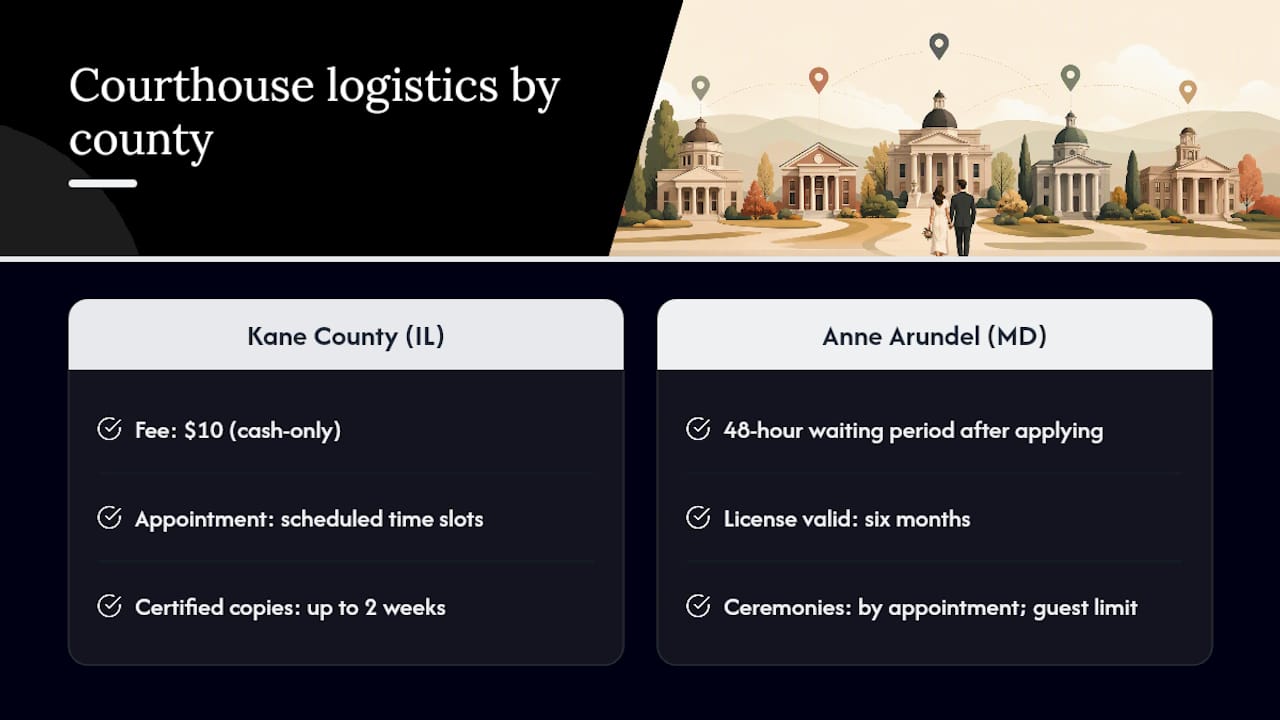
That gap between two counties is the whole point. Don’t assume your local rules match a guide written for somewhere else. Call the clerk’s office, confirm the fee amount and accepted payment method (some offices are cash-only for the ceremony itself), and get their current appointment system before you commit to a date.
Special Situations: Foreign Nationals, Prior Marriages, and Minors
Foreign nationals and non-U.S. citizens: a valid passport typically works as your photo ID for the license application. Getting married at a courthouse does not automatically change anyone’s immigration status, so if visa questions are part of your situation, that’s a conversation for an immigration attorney, not the county clerk.
Previously married partners: no clerk will issue a license without proof the prior marriage legally ended. That means a certified final divorce decree or a certified death certificate, not a photocopy and not a court printout you made yourself.
Minors: most states set 18 as the age to marry without parental consent, with a handful of state-specific exceptions below that. Check your state’s exact rule rather than assuming.

Name changes after the wedding: order multiple certified copies of your marriage certificate once it’s recorded. Social Security, the DMV, and your bank each want their own certified copy, not a shared one passed between offices.
Pro Tip: If either partner has foreign documents, verify translation and legalization requirements weeks before your court date, not the week of. Clerks reject uncertified translations on the spot, and there’s rarely a same-day fix.
Translations, Legalization, and Attestation for Foreign Documents
Foreign birth certificates and foreign divorce decrees are the two documents most likely to trip up an otherwise straightforward application. Clerks generally won’t accept them in their original language or without proper legalization, so budget time for this step separately from everything else on your courthouse marriage checklist.
The typical path looks like this:
Get a certified translation of the foreign document into English.
Have the translation notarized.
Complete embassy legalization or an apostille, depending on the issuing country.
For couples handling UAE-issued documents alongside a U.S. courthouse process, the attestation steps for UAE marriage documents work through this exact sequence in more detail.
Bring to the courthouse once documents are translated:
The original foreign document
The certified English translation
Proof of notarization or apostille/legalization
Your standard photo ID and marriage license application
Start this process early. Ask the clerk directly which of your documents need translation or attestation. Assuming your paperwork is fine because it worked in another country is a common, costly mistake.
What Happens During a Courthouse Ceremony
The ceremony itself moves fast. You’ll check in, a judge, magistrate, or authorized court official will lead a brief civil script, you’ll exchange vows if the courthouse permits a personal reading, then both partners sign the license along with any required witnesses.
A civil courthouse ceremony is legally binding and typically runs about 10 to 15 minutes from start to finish. The officiant then carries the responsibility of returning your signed license to the clerk for recording, a step you can’t complete yourselves.
What to bring on the day:
Your marriage license, printed and current
Photo ID for both partners
Witnesses, if your state requires them
Payment for any remaining fee
Courthouses run security screening like any government building, so skip large bags and metal accessories where possible. Dress code is loose but “respectful” is the unwritten rule: no swimwear, no costumes, business casual or better works fine.
COVID-19 and Health-Related Rules at the Courthouse
Courthouse marriage policies tightened considerably during the height of the pandemic, and while most offices have returned to standard operations, a few practical carryovers are worth knowing before you plan a court date.
Guest limits are the most common lingering rule. Several courthouses that expanded ceremony capacity pre-2020 never fully reversed the cap they introduced afterward, so a five or six-guest limit in a small ceremony room isn’t unusual even now. Call ahead if you’re planning to bring family, since some offices still enforce a hard number rather than a flexible one.
Appointment-only scheduling is another holdover that stuck. Many courthouses that shifted from walk-in ceremonies to booked appointments during COVID never went back to open walk-in hours, largely because the appointment system reduced crowding in shared waiting areas. If you’re picturing a spontaneous same-day courthouse wedding, check first: that option is far less common than it used to be.
Mask and health screening requirements have mostly lapsed at the federal and most state levels, but individual county buildings retain the authority to reinstate them during local health advisories. If you or a guest has symptoms of a contagious illness, it’s worth calling the clerk’s office in advance rather than assuming policy at your specific courthouse. A quick call also confirms whether current health guidance affects capacity limits, mask rules, or documentation on the day you’ve booked.
The Checklist Matters More Than the Ceremony
Most guidance on courthouse weddings spends its energy describing the ceremony itself, the vows, the ten minutes in front of a judge, when the ceremony is genuinely the easy part. The paperwork sequence is where couples lose time and money: a missed waiting period, a witness nobody arranged, a foreign divorce decree nobody thought to translate.
The conventional advice to “just show up with ID” undersells how much local variation exists. A $10 cash-only fee in one county and a 48-hour waiting period with a six-month license window in another aren’t edge cases. They’re the norm, which means the single highest-leverage thing you can do is call your specific clerk’s office before you assume anything.
If you’re marrying across borders, whether that’s a foreign partner, foreign documents, or plans to register the marriage somewhere else afterward, treat translation and attestation as a project with its own timeline, not an afterthought squeezed in the week before. Couples who start that process early rarely run into surprises. Couples who don’t, often do.
How Harris & Charms Handles the Paperwork Side for You
Harris & Charms exists for the part of this process nobody enjoys: chasing document requirements, booking appointments, and getting foreign paperwork translated and attested correctly the first time. If you’re marrying in the UAE or need documents recognized there, that’s exactly where the courthouse checklist above gets complicated fast, and where our team steps in directly.

Our civil marriage packages cover document preparation, appointment coordination, and legal translation and attestation support, so you’re not the one figuring out embassy legalization at 9 p.m. the night before your appointment. We also offer premium registration assistance for Golden visa holders navigating UAE-specific requirements, plus event photography and yacht wedding add-ons if you want the day itself to feel like more than a courthouse formality. Explore our civil marriage packages in Dubai to see what’s included, or check our full range of marriage and wedding services for the add-ons that fit your situation. Reach out today to book a consultation and get your documents moving.
Official and Practical Sources to Check
Your county clerk or marriage bureau’s official website for exact fees, waiting periods, and appointment systems
Local courthouse procedure pages for ceremony scheduling and guest policies
Confirm every detail with your local clerk directly. Rules on waiting periods, fees, and appointments vary by county and change without much notice.
Frequently Asked Questions
What do I need to bring to get married at a courthouse? You need your marriage license, valid photo ID for both partners, required witnesses if your state calls for them, and payment for any remaining ceremony fee. Bring certified proof of a prior marriage’s end if that applies to you.
How much does a courthouse wedding cost? Fees vary widely by county. Some charge as little as $10 in cash for the ceremony itself, separate from the marriage license fee, which also differs by jurisdiction. Check your specific county clerk’s fee schedule before you go.
Do I need an appointment for a courthouse wedding in a major city? Most courthouses in larger cities require appointments rather than accepting walk-ins, and slots around Fridays and holidays fill quickly. Book as early as your marriage license validity window allows.
Can foreign nationals get married at a U.S. courthouse? Yes. A valid passport typically works as photo ID for the application. Keep in mind that getting married doesn’t automatically change immigration status, so speak with an immigration attorney separately if that’s relevant to your situation.
Do all courthouses require witnesses? Not all of them. Roughly half of U.S. states require one or two adult witnesses on the license, generally 18 or older. Where required, call ahead if you don’t have anyone lined up, since some courthouses offer a courtesy witness.
How long does it take to get a marriage license? Some counties issue it the same day; others impose a waiting period before it’s valid, commonly between 24 and 72 hours. Every license also has an expiration date, so apply with your actual ceremony date in mind.
Recommended
Comments