
What Do You Need for a Civil Wedding: 2026 Guide


TL;DR:
Many couples mistakenly see civil weddings as simple and quick; however, the process involves detailed paperwork, witness arrangements, and timing considerations. Proper preparation—including early application for marriage licenses, matching identification, and understanding local requirements—ensures a smooth ceremony and legal registration. Personalizing the ceremony within legal bounds enhances the experience, and seeking professional assistance can simplify complex bureaucratic steps.
Most couples assume a civil wedding is the simple option. Just show up, say yes, sign something, and you’re done. The reality is that figuring out what do you need for a civil wedding involves more moving parts than most people expect, from specific documents for civil wedding ceremonies to witness arrangements and post-ceremony filings. Get any one of these wrong and you could delay your marriage date by weeks. This guide breaks down every requirement clearly, so you walk into your ceremony prepared and confident.
Table of Contents
Key takeaways
Point | Details |
Marriage license comes first | Apply early because licenses have validity windows and some jurisdictions have mandatory waiting periods. |
IDs must match exactly | Every document you bring must show consistent legal names and dates of birth or your application can be rejected. |
Witnesses are legally required | Most jurisdictions require two witnesses present at the ceremony; confirm this before the day. |
Previous marriages need proof | A Certificate of Divorce or equivalent official document is required if either party was previously married. |
Post-ceremony filing seals it legally | Your officiant must file paperwork after the ceremony for the marriage to be legally registered. |
What you need for a civil wedding: legal documents
Before you book a venue or pick an outfit, the paperwork has to be right. Civil marriage paperwork is the foundation of the entire process, and it is also where most couples run into problems.
The marriage license is your starting point. You apply for it through your local government office, county clerk, or civil registry, depending on where you live. One detail that catches couples off guard: licenses have expiration dates. Sacramento County, for example, issues licenses valid for 90 days. If your ceremony falls outside that window, you have to start the application all over again. Check your jurisdiction’s validity period before you schedule anything.
Photo identification is non-negotiable. Most jurisdictions require a government-issued photo ID, such as a passport, national ID card, or driver’s license. What matters just as much as having the ID is making sure the details match. Two valid government IDs are required per person in some jurisdictions, and photocopies or electronic copies are routinely rejected. Your ID must show your legal name exactly as it appears on your marriage license application.
If either of you has been married before, you will need more than just your ID. Proof of divorce or dissolution is mandatory, and the acceptable documents are strictly defined. Toronto’s civil registry, for instance, accepts a Certificate of Divorce or a Final Decree but will not accept a Decree Nisi or a Divorce Judgment. Getting the wrong version means rejection. Order certified copies from the court that handled your divorce well in advance.
Here is a working checklist of documents you will typically need:
Valid government-issued photo ID for both parties (original, not copies)
Completed marriage license application form
Proof of dissolution of any previous marriages (certified Certificate of Divorce or equivalent)
Birth certificates (required in some jurisdictions, especially for age verification)
Parental consent documentation if either party is a minor (varies by location)
Any applicable fees, often paid by check or cash
Pro Tip: Request certified copies of your divorce decree or birth certificate at least four weeks before your planned ceremony date. Processing times for certified documents can run longer than expected, especially internationally.
Age requirements are another area that varies. Most places set the minimum at 18 without parental consent, but some jurisdictions allow marriage at 16 or 17 with a parent or guardian’s written approval. Confirm this with your local office before you apply.
For couples planning a UAE ceremony, the civil marriage requirements in the UAE follow a distinct process that differs from many Western jurisdictions, so checking region-specific guidance is worth the time.
How to plan a civil wedding step by step
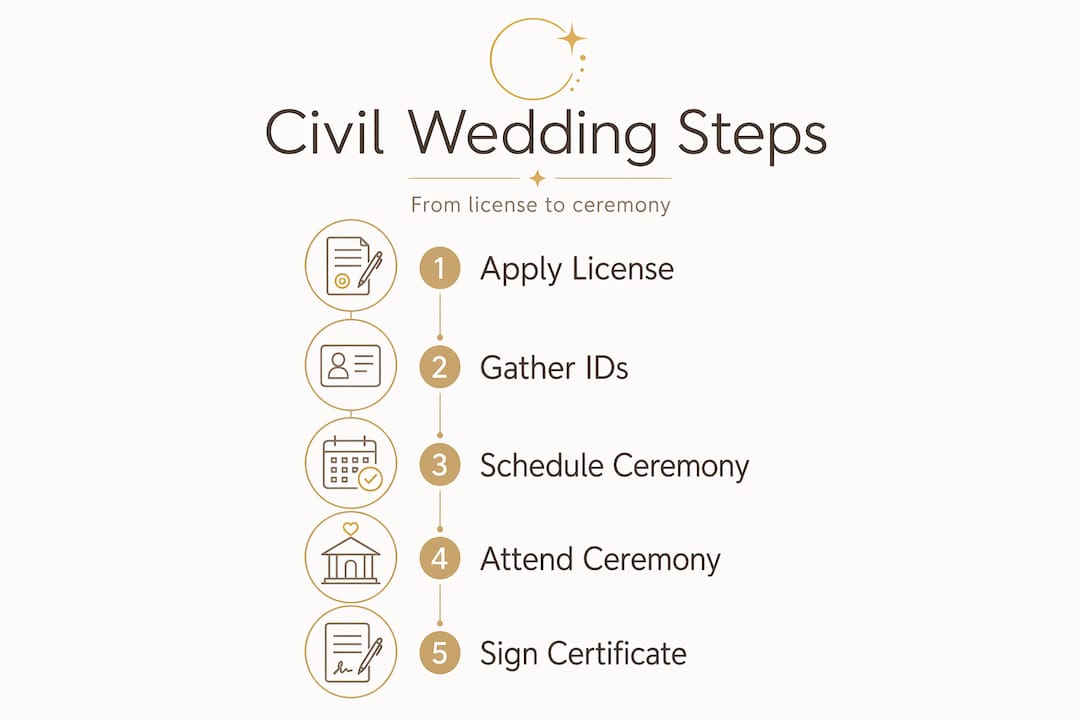
Once your documents are in order, the procedural side of civil wedding preparation tips comes down to sequencing things correctly. Getting the order wrong is one of the most common mistakes couples make.
Confirm local requirements before anything else. Contact your local civil registry, county clerk’s office, or municipal office directly. Rules around waiting periods, acceptable IDs, and fees differ widely by location. Local civil wedding rules vary significantly even within the same country, so never assume what applied to a friend in another city applies to you.
Submit your marriage license application. Many jurisdictions now allow online applications or at least online scheduling for in-person submission. Both parties typically need to appear in person when the license is issued, even if the form was submitted digitally. Factor in any mandatory waiting period between application and issuance.
Schedule your ceremony with an authorized officiant. Not just anyone can perform a legally binding civil ceremony. You need a licensed civil officiant, a judge, a justice of the peace, or another person legally authorized in your jurisdiction. Book this appointment after you have your license in hand or know your issuance date.
Arrange your witnesses. Most jurisdictions require two adult witnesses present at the signing. They do not need to be related to you, but they must be present in person. If you do not have two people available, some offices will provide one. Sacramento County charges $27 to supply a witness if you need one. Check whether this option exists where you are getting married.
Pay the applicable fees. Civil wedding fees vary from under $50 to over $150 depending on location. Some jurisdictions offer discounts. Nashville, for example, reduces the license fee by $60 with a premarital counseling certificate, which is worth knowing if counseling is already part of your plan.
Collect your signed marriage license after the ceremony. Hold onto the officiant’s copy and confirm the timeline for receiving your certified marriage certificate.
Pro Tip: Apply for your marriage license at least three to four weeks before your intended ceremony date. This buffer covers any document corrections, waiting periods, or application processing delays without forcing you to push your ceremony.
The civil marriage checklist for expats offers additional guidance on steps that apply specifically when one or both partners are not nationals of the country where they are marrying.
What to expect on the day of your civil ceremony
Civil ceremonies are short. A typical civil ceremony lasts under 10 minutes and includes a brief introduction by the officiant, an exchange of declarations or vows, the legal pronouncement, and the signing of documents. That brevity surprises many couples who picture something more elaborate. The simplicity is the point.
Here is what to bring to your civil wedding ceremony on the day:
Your original signed marriage license (not a copy)
Valid photo ID for both parties
Rings, if you plan to exchange them
Names and contact details of your two witnesses
Payment for any day-of fees if applicable
The officiant’s role is more administrative than ceremonial, though a skilled civil officiant can still make the moment feel meaningful. They confirm identity, guide both parties through the legal declarations, and oversee the document signing. Your witnesses sign the license directly after you and your partner do. Their role is to confirm the ceremony took place in their presence.
Here is a quick breakdown of how the document flow works after the ceremony:
Stage | What happens | Who is responsible |
Ceremony signing | Marriage license signed by couple, witnesses, and officiant | All parties present |
Officiant filing | Officiant submits signed license to the civil registry | Officiant |
Registry processing | Marriage is officially recorded and indexed | Civil registry office |
Certificate issuance | Certified marriage certificate issued to the couple | Registry/couple request |

The post-ceremony registration process is one step many couples forget to track. In the Philippines, for instance, the solemnizing officer must transmit documents within 15 days to the Local Civil Registrar. Missing this deadline can cause complications when you need your certified certificate for visa applications, name changes, or legal filings.
Navigating different rules and special cases
Civil weddings do not follow one universal rulebook. This is where couples doing a destination wedding or marrying in a country different from where they live run into the most friction.
The biggest variable is how widely local civil marriage rules can differ. Some jurisdictions impose a waiting period of three days between license issuance and the ceremony. Others allow same-day ceremonies. Some require a notice period to be posted publicly for a set number of days before the marriage can proceed. None of this is standardized.
Scenario | What to prepare | Key consideration |
Previously married | Certified Certificate of Divorce or Dissolution | Decree Nisi alone is often not accepted |
Expat or foreign national | Apostilled documents from home country | Translation may be required |
Destination civil wedding | Local license and potentially home-country documents | Check bilateral recognition rules |
Minor applicant | Parental or guardian consent form | Jurisdiction sets minimum age |
For expats marrying in the UAE, the requirements layer in additional document attestation, residency considerations, and sometimes a No Objection Certificate. The civil wedding process in the Philippines is similarly detailed, with specific local registry steps that differ from what Filipino nationals abroad might expect.
Some jurisdictions also offer confidential marriage licenses for couples who want their marriage to remain private and not appear in public records. This is a legitimate legal option in certain U.S. states, for example. If privacy matters to you, ask your local office whether this is available.
Pro Tip: If you are an expat or marrying across borders, contact both the local civil registry where the ceremony will take place AND your home country’s embassy or consulate. Both sides of that equation affect whether your marriage will be legally recognized where you live.
My honest take on civil wedding preparation
I have worked with hundreds of couples through the documentation and ceremony process, and the same pattern comes up again and again. People wait too long to start the paperwork. They assume a civil wedding is a shortcut and treat preparation as an afterthought.
The couples who have the smoothest experiences all do one thing: they front-load the work. They confirm local requirements early, order certified documents before they think they need them, and have a clear plan for their witnesses weeks in advance. The ones who hit delays almost always hit them at the document stage, not because the requirements are complicated but because they underestimated the lead time.
What I find underappreciated is just how much room there is to personalize a civil ceremony within the legal framework. The legal declarations are fixed, but everything around them, the location, the music, the guest count, what you wear to a civil wedding, is entirely your call. I have seen couples turn a five-minute registry ceremony into a genuinely moving moment just by being intentional about the setting and who they chose to have present.
My recommendation: start your witnesses in UAE marriage planning and document preparation at least six weeks out if you are in the UAE. Four weeks is workable in simpler jurisdictions. And please, always request a certified copy of your marriage certificate the same week the ceremony happens. Waiting until you need it for a visa or name change is when people discover the registry’s processing backlog.
— Harris
Let Harrisandcharms handle the details for you
Planning a civil wedding should feel exciting, not like a bureaucratic obstacle course. Harrisandcharms works with couples every day to take the complexity out of civil marriage documentation, officiant coordination, and ceremony arrangements, particularly in Dubai and across the UAE.

Whether you are an expat couple starting from scratch or a local pair who needs support with the legal paperwork, the civil marriage packages in Dubai from Harrisandcharms cover the full process. From document verification to ceremony day coordination, every step is handled with care. If you are ready to make your civil wedding in Dubai simple and stress-free, explore the civil wedding services in Dubai that Harrisandcharms offers and reach out today.
FAQ
What documents do you need for a civil wedding?
You typically need a completed marriage license application, valid government-issued photo IDs for both parties, and proof of divorce if either party was previously married. Requirements vary by jurisdiction, so confirm with your local registry office before applying.
How long is a civil wedding ceremony?
A civil ceremony typically lasts under 10 minutes and includes declarations, an officiant’s pronouncement, and signing of legal documents. The brevity is by design, as the focus is on fulfilling legal requirements.
How many witnesses do you need at a civil wedding?
Most jurisdictions require two adult witnesses to be physically present at the ceremony and to sign the marriage license. Some offices, like Sacramento County, can provide a witness for a small fee if you do not have one available.
How early should you apply for a marriage license?
Apply at least three to four weeks before your ceremony to allow for processing time, any required waiting periods, and potential corrections to your application. Marriage licenses also have validity windows, typically around 90 days, so do not apply too far in advance either.
Can you personalize a civil wedding ceremony?
Yes. While the legal declarations are fixed by law, everything outside of those core requirements is flexible. You can choose your location, invite guests, exchange rings, and select attire freely. What you wear to a civil wedding is entirely a personal choice.
Recommended
Comments