
How to Register a Marriage: Steps for UAE and India Couples
- haris haneef
- Aug 17
- 13 min read

Updated: 3 days ago
The process for registering a marriage comes down to one thing: filing the right paperwork with the right authority and getting your certificate issued. In the UAE, that means an appointment through the Ministry of Justice or, for Abu Dhabi non-Muslim civil marriages, the Abu Dhabi Judicial Department (ADJD). In India, it usually runs through your local Sub-Registrar or, for interfaith and interstate couples, a Marriage Officer under the Special Marriage Act. Your single next move: confirm which route applies to you, then book the appointment or file the notice today, because both systems run on fixed timelines you cannot rush.
Here is the shape of the process, stripped down:
Pick your legal route (civil marriage, religious registration, or the Special Marriage Act).
Confirm eligibility: age, marital status, residency.
Gather identity documents, proof of single status, and any required affidavits.
File your notice or application, often through UAE PASS or a state e-portal.
Attend in person with witnesses for signing and solemnization.
Collect your certificate, then attest and translate it if you plan to use it abroad.
If you’re short on time, the fastest first step is checking whether your emirate or Indian state accepts an online notice through platforms like UAE PASS or a state civil registration portal. That single click tells you what to prepare next.
Key Takeaways
Registering a marriage requires confirming eligibility, filing with the correct authority, meeting any statutory notice period, and attesting the certificate for cross-border use when needed.
Point | Details |
Confirm your legal route first | Choose between civil marriage, religious registration, or the Special Marriage Act before booking anything. |
The 30-day notice cannot be shortened | India’s Special Marriage Act requires a fixed 30-day public notice period with no exceptions. |
Document mismatches cause the most delays | Mismatched names across passports and certificates routinely trigger correction affidavits and lost weeks. |
Attestation is mandatory for cross-border use | Certificates used abroad typically need MOFA attestation and embassy legalization, not just translation. |
Harrisandcharms handles the full chain | The team coordinates ADJD appointments, embassy NOCs, MOFA attestation, and certified translation as one process. |
Table of Contents
What Is the Process for Registering a Marriage?
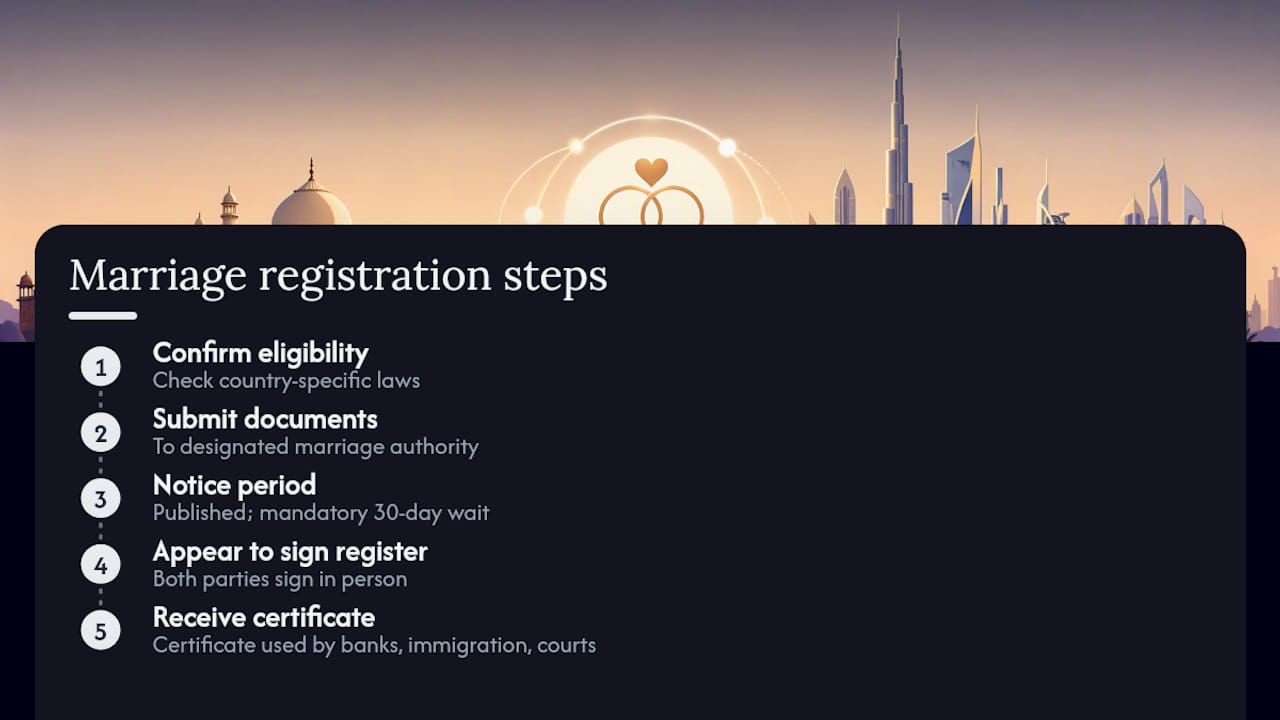
The process for registering a marriage is a sequence of legal steps: confirming eligibility, submitting documents to a designated marriage authority, waiting out any required notice period, appearing in person to sign the register, and receiving an official certificate. That certificate is what banks, immigration offices, and courts will actually ask to see, not your wedding invitation or photos.
In the UAE, non-Muslim civil marriages in Abu Dhabi run under Abu Dhabi Law No. 14 of 2021, administered by ADJD, while Dubai’s civil marriage service has its own eligibility and processing rules through the government’s official platform. Islamic marriages follow a separate contract process through the Ministry of Justice, which offers a dedicated “Request for Marriage Contract” service, often requiring UAE PASS authentication.
In India, the law you use depends on your circumstances. The Hindu Marriage Act, the Special Marriage Act, and separate Christian and Parsi statutes each set their own procedure. Interfaith and interstate couples typically use the Special Marriage Act, 1954, which requires filing a written notice with the Marriage Officer in the district where one party has lived for at least 30 days. That notice sits published for 30 days before the marriage can be solemnized, a waiting period nobody can shortcut.
Who Is Eligible to Register a Marriage?
Eligibility hinges on three things almost everywhere: age, marital status, and jurisdiction. Get any one of these wrong and your application stalls before it starts.
Both parties must be legally single, meaning unmarried, divorced with a final decree, or widowed with a death certificate on hand.
Minimum age requirements vary by law and location. Some UAE civil marriage services set a floor of 21 for both spouses, while Indian marriage acts generally require 21 for men and 18 for women, though this differs slightly by statute.
Dubai’s civil marriage service requires that the couple be non-Muslim and that at least one party maintain UAE residency, according to the government’s own eligibility criteria.
In India, choosing between the Hindu Marriage Act, the Special Marriage Act, or a community-specific law depends on the couple’s religion, whether they belong to different faiths, and whether they married in different states.
Foreign nationals marrying in India often need an embassy-issued No Objection Certificate before the Marriage Officer will even accept their notice.
UAE residents filing digitally frequently need UAE PASS to authenticate their identity for online services.
Pro Tip: Before booking anything, call or check online exactly which office has jurisdiction over you, based on residency in the UAE or district residence in India. Filing with the wrong office is the single most common reason couples get bounced back to square one.
What Documents Do You Need for Marriage Registration?
Bring too little paperwork and you’ll be making a second trip. Bring the wrong format, uncertified translations, or mismatched names across documents, and you might make a third.
Core documents overlap heavily between the UAE and India: valid passports or national ID, proof of address, passport-sized photographs, and, where applicable, proof that a religious or civil ceremony took place. Beyond that baseline, each jurisdiction has its own additions.
In India, filing under the Special Marriage Act means submitting proof of residence in the district for at least 30 days, sworn affidavits confirming marital status and age, and, for religious ceremonies registered separately, a priest’s certificate. Foreign nationals need that embassy No Objection Certificate mentioned earlier, since a Marriage Officer will commonly refuse to proceed without it.

In the UAE, Emirates ID and passport copies are standard, and many services now run through UAE PASS for identity verification rather than in-person document handovers. Emirate-specific civil marriage services, like Dubai’s, may ask for proof of residency and confirmation that neither party is Muslim, since Islamic marriage contracts follow a separate Ministry of Justice process entirely.
Document Type | Typical Issuer | Attestation or Translation Needed? |
Passport / national ID | Government passport office | Translation if not in English or Arabic |
Proof of single status (affidavit) | Notary or embassy | Often needs attestation |
Divorce or death certificate | Court or civil registry | Usually needs attestation for cross-border use |
Embassy No Objection Certificate | Home country embassy | Attestation almost always required |
Marriage certificate (post-issuance) | Sub-Registrar / ADJD / MOJ | Translation and MOFA attestation for use abroad |
A common pitfall worth flagging: a passport that spells your name one way and a birth certificate that spells it another. Registrars notice, and it can delay a file for weeks while you sort out a correction affidavit. Our guide on documents required to register marriage in the UAE breaks down the checklist emirate by emirate.
Pro Tip: Photocopy everything twice before your appointment. Registrars in both countries routinely keep one set and hand your originals back only after verification, so a spare copy saves you a return visit if anything needs re-checking.
What Are the Steps to Register a Marriage?
The steps for registering a marriage follow a similar backbone whether you’re filing in Mumbai or Abu Dhabi, though the timing and forms differ.
Confirm your legal route. Decide whether you’re filing under a religious act, a civil marriage service, or the Special Marriage Act, based on your eligibility.
Gather and organize documents. Match every ID, affidavit, and certificate to the checklist your chosen authority publishes.
Submit your notice or application. In India under the Special Marriage Act, this notice goes to the Marriage Officer in your district. In the UAE, many services now accept applications online through UAE PASS.
Wait out any statutory notice period. India’s Special Marriage Act mandates a 30-day public notice window before solemnization, and it cannot be waived.
Attend the appointment in person. Both spouses and, in most cases, three witnesses need to appear for the signing.
Sign the register and receive your certificate. This is the moment your marriage becomes legally recorded, not the ceremony itself.
Move to attestation or translation if needed, particularly if you plan to use the certificate outside the country that issued it.
A marriage is considered officially registered the moment your details are entered into the government’s marriage register and a certificate is issued, not when vows are exchanged. That distinction trips people up constantly: a religious or cultural ceremony without registration carries no legal weight in court, immigration, or inheritance matters.
Bring original IDs plus photocopies.
Confirm witness availability in advance; last-minute witness scrambles are a leading cause of rescheduled appointments.
Ask the registrar directly how the certificate will be delivered, since some offices issue same-day while others mail it.
For a UAE-specific walkthrough with appointment tips, see our step-by-step guide to registering your marriage in the UAE.
Which Authority Handles Marriage Registration?
Filing with the wrong office wastes time you don’t get back. Here’s how to identify the right one.
Sub-Registrar (India): Handles registration under the Hindu Marriage Act and similar community-specific statutes, typically based on the district where the marriage took place or where one party resides.
Marriage Officer under the Special Marriage Act (India): A distinct role from the Sub-Registrar, this officer accepts the 30-day notice for interfaith and interstate marriages.
Abu Dhabi Judicial Department (ADJD): Administers civil marriage for non-Muslims in Abu Dhabi under Abu Dhabi Law No. 14 of 2021 and its later regulations.
Dubai government civil marriage service: A separate portal and process for Dubai residents, with its own eligibility rules around residency and religion.
Ministry of Justice (UAE): Runs the marriage contract request service used primarily for Islamic marriages, often requiring UAE PASS authentication.
Embassies and consulates: Relevant for NRIs and foreign nationals who need document certification or, in some cases, consular registration of a marriage performed abroad.
Territorial jurisdiction matters more than people expect. In India, filing depends on where you or your spouse have resided, not simply where the wedding happened. In the UAE, eligibility for a given emirate’s civil marriage service often hinges on residency status tied to that emirate specifically. Digital gateways like UAE PASS and various Indian state e-portals now let couples start this process online, though most still require an in-person visit for signing and verification. Our overview of marriage registration steps for UAE expats covers how that online-to-in-person handoff typically works.
How Long Does Marriage Registration Take, and What Does It Cost?
Timelines vary sharply depending on which law and which office you’re dealing with, so treat these as general expectations rather than guarantees.
Some UAE civil marriage services can issue documentation quickly, occasionally within the same visit, once eligibility is confirmed and UAE PASS verification clears.
India’s Special Marriage Act imposes a fixed 30-day notice period that applies regardless of how quickly you submit your paperwork.
Several Indian state registries, including Delhi’s, report certificate issuance within roughly 14 days once the application and documents are accepted.
Sub-Registrar offices in states like Puducherry list modest registration fees alongside their document requirements, though exact amounts vary by state.
The one number that cannot be negotiated: the Special Marriage Act’s 30-day public notice period is a hard statutory floor. No amount of urgency, expediting fees, or influence shortens it, because the notice exists specifically to give the public a window to raise objections before the marriage is solemnized.
Government fees in India tend to be nominal, often a modest sum for basic registration, though state-by-state variance is real enough that you should check your specific Sub-Registrar’s published fee schedule rather than assume. UAE service fees depend heavily on the emirate and whether you’re using a Ministry of Justice service or an emirate-specific civil marriage portal, so confirm current pricing directly with the issuing authority before budgeting. Most official portals accept card payments online, with cash or card options typically available for in-office visits.
How Do You Attest and Translate a Marriage Certificate for Use Abroad?
If your certificate needs to work in another country, whether for a visa application, a name change, or immigration paperwork, attestation is not optional.
The typical flow: your certificate gets issued locally, then attested by the relevant local authority, then legalized by the Ministry of Foreign Affairs (MOFA) in the UAE, and finally legalized again by the embassy of the destination country if required. MOFA’s attestation service exists specifically for this cross-border chain, and skipping a link in it usually means the destination country’s authorities reject the document outright.
Step 1: Obtain the original certificate from ADJD, the Ministry of Justice, or your Indian Sub-Registrar.
Step 2: Get local attestation where the issuing authority requires it before forwarding to MOFA.
Step 3: Submit for MOFA attestation if the document will be used outside the UAE.
Step 4: Arrange legalization at the destination country’s embassy, if that country requires it.
Step 5: Commission a certified translation if the destination country doesn’t accept the original language.
Indian certificates headed for use in the UAE, or vice versa, often need an embassy-issued No Objection Certificate or consular legalization layered on top of standard attestation. Skipping this step is one of the most common reasons couples get stuck reapplying for visas or residency paperwork months later.
Pro Tip: Instead of running to three separate offices for attestation, translation, and legalization, look for a single document clearing service that bundles all three. It typically saves multiple trips and cuts weeks off the timeline.

What Special Cases Complicate Marriage Registration?
Some situations add extra steps nobody warns you about until you hit them.
Interfaith couples in India generally need to use the Special Marriage Act rather than a religion-specific statute, which brings the 30-day notice requirement into play.
Foreign nationals marrying in India almost always need an embassy-issued No Objection Certificate; without it, registration under the Special Marriage Act is commonly blocked outright.
Previously married applicants must produce a final divorce decree or a death certificate for a deceased former spouse before a Marriage Officer will proceed.
Golden Visa holders in the UAE face documentation specifics tied to their visa category, so it’s worth confirming with the relevant authority whether your residency status changes which service or emirate applies to you.
Name mismatches across passports, IDs, and prior certificates routinely trigger requests for correction affidavits, adding days or weeks to the process.
Objections filed during the Special Marriage Act’s 30-day notice window are taken seriously by Marriage Officers, and a valid objection can pause the entire process while it’s investigated. Couples rarely expect this, since most assume the notice period is a formality rather than an active public window.
If your registered details turn out to be wrong, most authorities allow a correction request, though you’ll need supporting evidence such as an affidavit or corrected ID to back the change. For couples juggling cross-border paperwork, an embassy NOC, and translation needs simultaneously, hiring a local service to coordinate the pieces often prevents the kind of delay that turns a two-week process into a two-month one.
How Harrisandcharms Supports Your Marriage Registration
Handling registration paperwork across two legal systems is exactly the kind of task that benefits from someone who does it daily. Harrisandcharms manages document preparation, embassy coordination for No Objection Certificates, UAE attestation through MOFA channels, appointment booking with ADJD and local registries, certified translation, and full civil marriage packages for couples who want the entire process handled from start to finish.
Document preparation and pre-appointment checklist review, so nothing gets rejected at the counter.
Embassy coordination for foreign nationals needing an NOC before filing under the Special Marriage Act.
UAE attestation and MOFA legalization services for certificates headed abroad.
Appointment scheduling with ADJD or local Sub-Registrar offices.
Certified translation and copy services for cross-border use.
Bundled event services, including event photography, yacht wedding packages, and makeup services, for couples who want registration and celebration handled by one provider.
Couples who’ve worked with Harrisandcharms on cross-border cases, particularly Indian nationals registering marriages while resident in the UAE, consistently point to the coordination between embassy requirements and UAE attestation as the part they were most relieved to hand off. For a closer look at that specific path, see how to register marriage in the UAE for Indian couples.
Why We Built Our Registration Process Around the Hard Cases
Most couples don’t come to us with a simple, single-jurisdiction marriage. They come to us because one partner holds an Indian passport, the other holds a Golden Visa, and neither of them wants to spend three weekends figuring out which embassy needs to stamp what before the Marriage Officer will even look at their file.
That’s the case we built our process around, not the easy one. The paperwork chain for a cross-border couple, embassy NOC, Special Marriage Act notice, UAE attestation, MOFA legalization, is unforgiving of small mistakes, and a single mismatched name or missing attestation stamp can cost weeks. Our approach treats each document as part of one continuous chain rather than a series of separate errands, because that’s genuinely how the authorities on both ends will treat it once it reaches them.
If you want help moving through that chain accurately and on schedule, reach out through our booking and contact page.
Skip the Runaround With Full-Service Marriage Registration
There’s a real cost to handling cross-border registration yourself: repeat trips to the same office because a document wasn’t attested correctly, weeks lost waiting on an embassy NOC you didn’t know you needed, or a rejected translation that sends you back to square one. Harrisandcharms is the alternative to piecing this together on your own. We coordinate ADJD appointments, MOFA attestation, embassy NOCs, and certified translation as one connected process, not five separate errands.

Our civil marriage packages in Dubai bundle document preparation, appointment booking, and attestation into a single service, and our comprehensive marriage services page covers both civil and Islamic routes alongside event planning if you’re combining registration with a celebration. Reach out today to get a quote on the package that matches your situation, whether that’s a straightforward civil registration or a complex cross-border case involving an embassy NOC and MOFA legalization.
Where to Verify Official Marriage Registration Rules
Rules and fees shift by state and emirate, so confirm details directly with the issuing authority before your appointment.
Ministry of Justice (UAE) services directory for marriage contract requests and UAE PASS requirements.
Abu Dhabi Judicial Department (ADJD) for civil marriage law and appointment procedures in Abu Dhabi.
Dubai’s official government platform for civil marriage eligibility and booking.
Ministry of Foreign Affairs (MOFA) UAE for attestation and legalization services.
Your relevant Indian state’s registration or revenue department portal, such as Delhi’s Department of Revenue, for document lists and fee schedules.
Confirm current fees and required documents with the issuing authority directly, since both change periodically by state and emirate.
Frequently Asked Questions
Is marriage registration compulsory? Yes, in most jurisdictions relevant to UAE and India-connected couples, registration is what makes a marriage legally recognized for immigration, inheritance, and court purposes. A religious or cultural ceremony alone typically carries no legal standing without registration.
Can you complete marriage registration entirely online? Partially. Many UAE services accept applications through UAE PASS, and several Indian states let you file notice online, but nearly all routes still require an in-person appearance for signing and witness verification.
What’s the difference between a registered marriage and a traditional ceremony? A traditional or religious ceremony reflects cultural and family commitments, while a registered marriage creates a legal record entered into a government register with an official certificate. Only the registered version holds up in court, immigration, or property matters.
How long does the Special Marriage Act process take from start to finish? Expect at least 30 days from filing notice to solemnization, since the notice period is fixed by law, plus additional time for gathering documents and, if applicable, an embassy NOC beforehand.
Do Golden Visa holders in the UAE follow a different marriage registration process? The core process is similar, but Golden Visa holders should confirm with the relevant authority whether their residency category affects which emirate’s service or documentation applies to them.
This article is general information, not a substitute for advice from a qualified lawyer. Consult a qualified legal professional about your own circumstances before acting on anything here.
Recommended
Comments